Planning a journey to see the August 2, 2027 total solar eclipse in Egypt raises unusual questions. This is not a normal summer holiday and it is not simply a one-hour astronomy event. Travelers must combine the exact geometry of the Moon’s shadow with international flights, desert transport, August heat, permits, safe solar viewing, accommodation, insurance, and a viewing site that is genuinely inside the path of totality.
This 2027 Egypt eclipse tour FAQ answers 50 of the questions travelers ask most often. It covers the eclipse itself, the best Egyptian viewing regions, the Western Desert and Bahariya route, current package options, camp conditions, booking, visas, costs, families, seniors, photography, weather, and safety.
The short version is simple: the eclipse occurs on Monday, August 2, 2027; Cairo and Alexandria see only a partial eclipse; a traveler who wants totality must reach a verified site inside the central path before eclipse day; and no operator can guarantee clear weather.
For a complete introduction before using this FAQ, read the 2027 Total Solar Eclipse in Egypt guide. To compare the current commercial options directly, use the 2027 Egypt eclipse package page.
Quick Facts
| Question | Short answer |
|---|---|
| When is the eclipse? | Monday, August 2, 2027. |
| Is it total everywhere in Egypt? | No. Only locations inside the path of totality see totality. |
| Does Cairo see totality? | No. Cairo sees a deep partial eclipse. |
| What is the global maximum duration? | Approximately 6 minutes 23.2 seconds. |
| Is the White Desert automatically inside totality? | No. The tourism region is broad; the exact viewing coordinate must be verified. |
| Should you arrive on eclipse morning? | No. Reach the viewing region at least one day earlier. |
| Are regular sunglasses safe? | No. Use appropriate solar viewers during every partial phase. |
| Can weather be guaranteed? | No. Desert climatology may be favorable, but clouds and dust remain possible. |
| When should you book? | After verifying the operator and terms, without unnecessary delay. |
| How do you check availability? | Use the live package pages or the written availability request. |
Questions About the 2027 Eclipse
1. When is the total solar eclipse in Egypt?
The eclipse occurs on Monday, August 2, 2027. The partial phase begins before totality and continues after it, so the viewing program lasts much longer than the few minutes when the Sun is completely covered.
Exact contact times depend on the observer’s coordinates. Do not copy a Luxor time and assume it applies everywhere in Egypt. Use the 2027 eclipse times by Egyptian city for representative schedules, then rely on the final operator briefing for the actual field.
2. What is a total solar eclipse?
A total solar eclipse occurs when the Moon passes between Earth and the Sun and appears large enough to cover the Sun’s bright visible face. Observers inside the Moon’s umbral shadow experience totality: the sky darkens, bright planets or stars may become visible, and the solar corona appears around the black lunar silhouette.
People outside the umbra see a partial eclipse. Even 99 percent coverage is not equivalent to totality. The physical transition occurs only inside the central path. Read How Does a Total Solar Eclipse Happen? for the simple science.
3. How long will totality last in Egypt?
NASA calculates a global greatest duration of approximately 6 minutes 23.2 seconds for this eclipse. That maximum applies at a particular point, not to the whole country.
Representative sites near Luxor receive roughly 6 minutes 22 seconds, while representative coordinates near Bahariya receive approximately 6 minutes 17 seconds. Local duration changes with position, and the final field must be calculated independently. Once a site already offers more than six minutes, field control, weather prospects, heat management, and access may matter more than gaining a few extra seconds.
4. Is this the longest solar eclipse in 87 years?
That wording is misleading. The August 2, 2027 event is the longest total solar eclipse since July 22, 2009, when maximum totality lasted about 6 minutes 39 seconds. NASA’s long-range catalog indicates that no later total eclipse exceeds the 2027 maximum until 2114.
A responsible description is: the longest total solar eclipse since 2009, with no longer one expected until 2114. See Why the 2027 Eclipse Is So Rare for the astronomical comparison.
5. Is the eclipse total everywhere in Egypt?
No. Totality is visible only inside the central path shown between the northern and southern limits on NASA’s map. Other parts of Egypt see a partial eclipse.
This distinction is the most important planning fact. A hotel advertisement, city name, or tour title does not prove totality. Ask for a viewing coordinate or a clearly defined region and verify it against a reliable path map. The full Egypt path-of-totality guide explains the geography.
6. Will Cairo see totality?
No. Cairo experiences a major partial eclipse but remains outside the path of totality. It is an excellent international gateway and a practical pickup point, not the place to remain on eclipse day if totality is your goal.
A traveler based in Cairo must join a planned journey to a verified site in advance. Do not attempt a same-morning dash to an unfamiliar desert coordinate. Read Cairo and Alexandria on eclipse day for the precise distinction.
7. Will Alexandria see totality?
No. Alexandria also sees a partial eclipse. The city’s Mediterranean location can make it appealing for a holiday, but it is not inside the totality path.
If you want to combine Alexandria with the eclipse, visit before or after a separately confirmed totality itinerary. Do not market or purchase an Alexandria viewing event as a total eclipse experience.
8. Is Luxor a good viewing destination?
Yes. Luxor is one of the world’s most prominent 2027 eclipse destinations because it lies close to the centerline, offers about 6 minutes 22 seconds at representative coordinates, has an airport and extensive hotels, and combines the event with major archaeological sites.
Its disadvantages may include exceptional demand, busy roads, high August temperatures, and the need for explicit permission at protected sites. A famous temple should never be assumed to be an available public viewing field. The complete Luxor eclipse guide explains both strengths and limits.
9. Is Aswan inside the path of totality?
The answer depends on the exact location. “Aswan” can mean the city, a governorate, or a broad tourism region. Some areas of southern Egypt are inside the path, but a city name alone is not sufficient for planning.
Use coordinates and local circumstances rather than general destination labels. The dedicated guide Is Aswan Inside the 2027 Eclipse Path? separates Aswan city from the wider governorate and nearby options.
10. Is Siwa Oasis a good eclipse location?
Siwa is inside totality and offers a remote oasis setting, open horizons, and roughly five and a half minutes of totality at representative locations. It may suit travelers who value a distinctive oasis journey more than maximum duration.
The main trade-offs are the long road journey, smaller accommodation base, limited medical resources, and the need for careful transport planning. See the Siwa Oasis eclipse guide before comparing it with Luxor or Bahariya.
11. Can I see totality from Hurghada?
Hurghada is generally treated as outside the totality path and should not be sold as a total-eclipse viewing destination without a separate verified field. It can be a useful Red Sea holiday base before or after the event.
Marsa Alam and other Red Sea locations require coordinate-specific analysis. The Hurghada and Marsa Alam eclipse guide explains where the Red Sea options differ.
12. What is the best place in Egypt to watch the eclipse?
There is no single best location for every traveler.
- Luxor is strongest for near-maximum duration, hotels, airport access, and ancient-Egypt tourism.
- Bahariya and a managed Western Desert field can be stronger for a controlled, lower-density, totality-first experience from Cairo.
- Siwa suits travelers seeking a remote oasis journey.
- Selected southern or Red Sea locations may fit a broader itinerary when coordinates and logistics are verified.
Use the full comparison of Egypt’s eclipse locations rather than choosing by duration alone.
Questions About the Western Desert and White Desert
13. Is the White Desert inside the path of totality?
The phrase “White Desert” covers a broad tourism area, and it is inaccurate to treat every chalk formation or every Farafra-area campsite as automatically inside totality. Some northern Western Desert locations near Bahariya lie inside the path, while locations farther south can differ.
The correct question is: What are the final camp and viewing-field coordinates? The eclipse must be calculated for that coordinate. Read Can You See Totality from the White Desert? for the geographical nuance.
14. Why choose the Western Desert instead of Luxor?
The Western Desert can offer open horizons, lower urban density, a controlled private field, locally managed transport, and an immersive desert experience. Luxor offers slightly longer totality, established hotels, an airport, and extraordinary monuments.
The choice is not “good versus bad.” It is controlled desert logistics versus a major city-based tourism ecosystem. The article Western Desert vs Nile Valley makes the comparison without pretending a five-second timing difference decides everything.
15. What is Bahariya Oasis?
Bahariya is an oasis region in Egypt’s Western Desert and a traditional gateway for Black Desert and White Desert journeys. The towns of Bawiti and Qasr provide local services, guides, vehicles, agriculture, springs, and accommodation before travelers continue into desert landscapes.
For the eclipse, Bahariya’s value comes from experienced local desert operations and access to northern Western Desert sites that can be verified inside totality. Learn more in the Bahariya Oasis eclipse guide.
16. How long is the journey from Cairo to Bahariya?
The road journey commonly takes about four to five hours under normal operating conditions, but traffic, stops, checkpoints, group organization, and road conditions can change the schedule.
Guests then transfer to desert-ready 4x4 vehicles for off-road sections. That is why flying into Cairo on the morning of a desert departure is a poor plan. The Cairo to Bahariya journey guide covers pickup, vehicle changes, stops, and realistic timing.
17. Do I need a permit and official guide for the White Desert?
Travel rules and permit requirements can change, but current UK government travel guidance states that tourists entering Bahariya Oasis, Farafra, the White Desert, and Black Desert must arrange permits in advance and use an official guide.
This is one reason not to treat the event as a self-drive picnic. Confirm that the local operator manages current permits, approved routes, checkpoints, and guide requirements. Recheck your own government’s travel advice immediately before departure.
18. Is the White Desert safe in August?
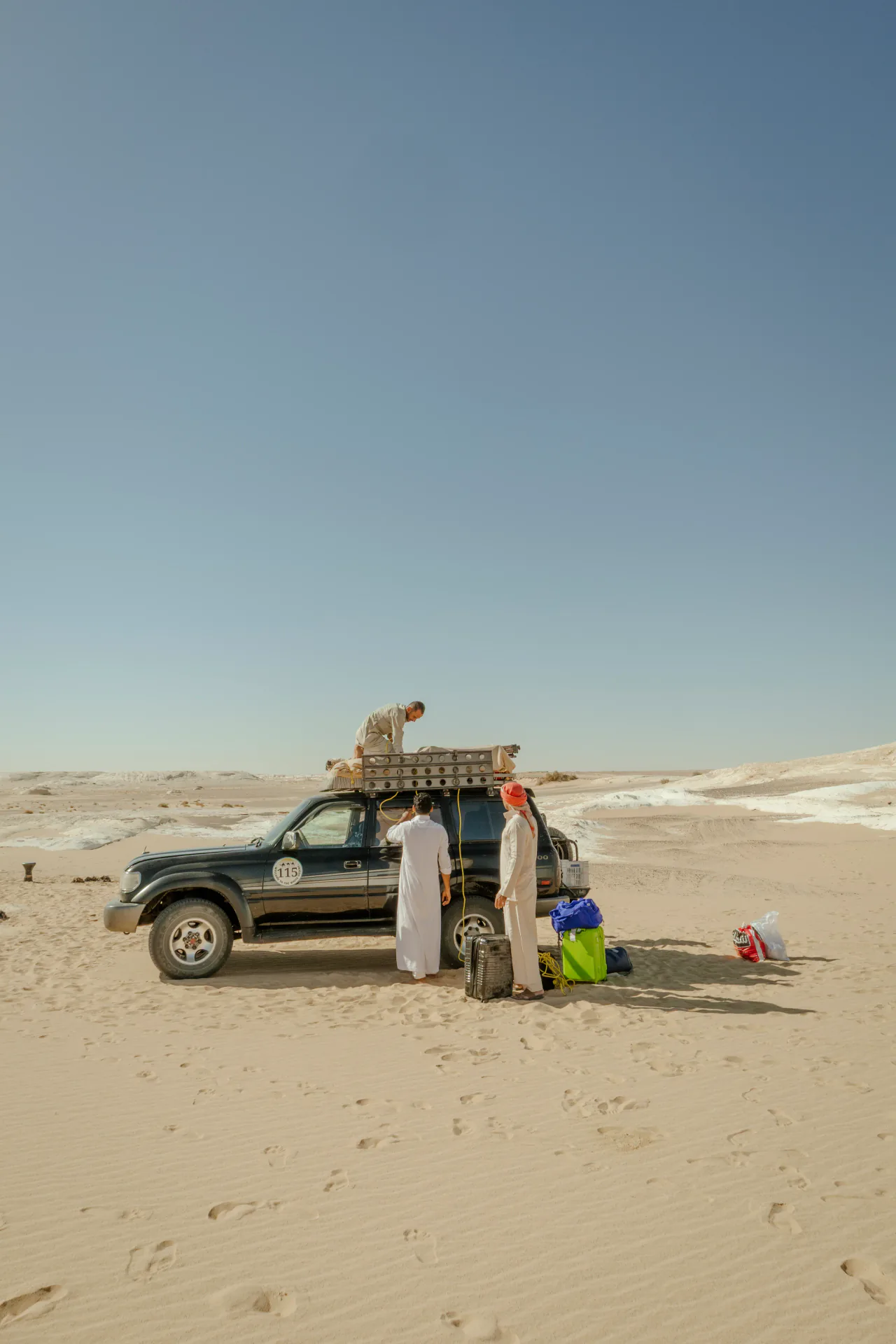
It can be visited responsibly with a qualified operation, permits, appropriate vehicles, reliable water, cooling and shade, communications, medical planning, and an emergency route. August heat makes casual or improvised travel inappropriate.
Safety is not created by the destination name. It comes from the operating plan. Read Is the White Desert Safe in August? and ask what happens if a vehicle fails, a guest becomes ill, or wind and dust affect the field.
19. Will the viewing area be crowded?
No one can responsibly guarantee that an entire region will be empty. Public roads, towns, and famous sites may attract visitors. A managed private or permitted field with a published capacity offers more control than an open public location.
The Solar Eclipse Tours event camp currently publishes a maximum capacity of 40 guests. Live availability can change, so confirm current space before booking. That is a controlled event size, not a prediction for the whole Western Desert.
20. Is a regular desert safari enough for eclipse day?
Not necessarily. A normal safari is designed around sightseeing, camp hospitality, and flexible timing. Eclipse day adds an immovable astronomical schedule, a verified totality coordinate, long midday exposure, solar filters, tripod management, crowd control, communications, and medical contingencies.
The guide Local Eclipse Team vs Regular Desert Safari explains why local desert knowledge and eclipse-specific planning must work together.
Questions About Packages and the Camp
21. What eclipse tour packages are currently available?
Solar Eclipse Tours currently publishes three standard Western Desert journeys:
| Package | Dates | Adult price | Child 7–15 price | Main format |
|---|---|---|---|---|
| 2-Day | August 1–2, 2027 | $1,800 | $900 | One eclipse-camp night and the essential journey |
| 3-Day | August 1–3, 2027 | $2,800 | $1,400 | One eclipse camp night and one comfortable Bahariya hotel night |
| 4-Day | July 31–August 3, 2027 | $3,950 | $1,975 | Two 5-star Bahariya hotel nights, one premium eclipse-camp night and Bahariya sightseeing; private transport is available as an optional upgrade |
The three standard packages are published for booking, but live availability can change as camp places, vehicles and accommodation are allocated. Check the live Bahariya / Western Desert package page and the side-by-side package comparison before paying.
22. Which package is best?
Choose according to pace and comfort:
- Select the 2-day package when time is limited and the priority is the shortest complete totality journey.
- Select the 3-day package for the strongest balance of price, one eclipse camp night, one comfortable Bahariya hotel night, and post-eclipse exploration.
- Select the 4-day package for a softer start, two 5-star hotel nights, one eclipse camp night, and the most complete itinerary.
23. What is included in the packages?
The standard foundations include free pickup and return from Downtown Cairo, Giza and nearby Giza hotels, or Zamalek; pickup from any other area has an extra charge based on the exact location; road transfer to Bahariya; locally operated 4x4 travel; the planned eclipse camp; meals listed in the itinerary; and the specific sightseeing described for each duration.
Exact inclusions vary by package. International flights, unrelated Cairo hotel nights, visas, personal insurance, tips, and optional private upgrades should not be assumed. Read the live itinerary and the guide to food, Wi-Fi, charging, toilets, and camp facilities before booking.
24. Is the eclipse camp air-conditioned?
The planned event includes air-conditioned enclosed camp areas. That does not mean the outdoor viewing field is air-conditioned. Guests still spend time outside during the partial phases and need shade, water, appropriate clothing, and heat monitoring.
Ask which spaces are cooled, how power is supplied, what backup exists, and how far sleeping and dining areas are from the field. The air-conditioned eclipse observatory camp guide describes the planned L-shaped Bedouin-style structure, cooling, misting fans, and operating limits.
25. What is the maximum camp capacity?
The current standard event-camp model is capped at 40 guests. Live availability can change, so confirm current space before booking; larger private or specialist groups require a separate feasibility review rather than being treated as standard availability.
Practical availability also depends on vehicle capacity, sleeping configuration, ages, private upgrades, and special needs. A family of five may not fit into the same remaining configuration as five flexible solo travelers. Use the availability form for a current written answer.
26. What vehicles are used?
Current package information describes modern air-conditioned HiAce vehicles or passenger cars between Cairo or Giza and Bahariya, followed by locally operated 4x4 vehicles for desert travel. Published shared capacities are up to ten guests in a HiAce, up to four in a passenger car, and normally 3–4 guests in each shared 4x4.
Final allocation depends on the group. Ask about luggage and photography equipment before assuming every seat can carry a large hard case.
27. Are private transfers or private 4x4 vehicles available?
Yes. Private transport is available as an optional upgrade for the 2-day, 3-day and 4-day packages, subject to availability and written confirmation.
Request any private transfer or private 4x4 upgrade early and confirm the price and vehicle allocation in writing before travel.
28. Are eclipse glasses included?
Current package pages indicate that eclipse glasses are planned as a separate item rather than automatically included in the base package. Confirm the final product and distribution arrangement before travel.
Regardless of who supplies them, inspect viewers before use and follow the safety instructions. Do not buy solely from an unverified marketplace listing that displays an ISO logo. Read the ISO 12312-2 eclipse glasses guide.
29. Will Wi-Fi and phone service work?
Remote desert connectivity is inherently less reliable than city service. The camp may plan Wi-Fi or communications equipment, but guests should not treat continuous high-speed internet as guaranteed unless a technical service level is written into a custom agreement.
Download tickets, insurance, maps, contacts, and essential documents offline. Research teams needing stable bandwidth, fixed power, or equipment telemetry should request a technical plan rather than relying on ordinary guest Wi-Fi.
30. Will there be electricity and charging?
The planned camp includes power for cooling, lighting, operations, and charging, but outlet quantity, voltage, generator capacity, backup power, and permitted high-load equipment should be confirmed.
Bring labeled chargers, power banks that comply with airline rules, spare batteries, and the correct plug adapters. Photographers and scientific teams should provide a written power inventory well in advance.
Booking, Price, and Payment Questions
31. When should I book the 2027 Egypt eclipse?
Book once you have verified the operator, viewing plan, itinerary, deposit, and cancellation terms—then avoid unnecessary delay. Eclipse capacity is tied to one fixed date, so camp places, vehicles, hotel rooms and specialist support can tighten as bookings are confirmed.
The useful rule is not to rely on an old availability snapshot: check the live package status when you are ready to book. Read When Should You Book the 2027 Egypt Eclipse? for the full planning timeline.
32. How much is the deposit?
The current standard White Desert packages publish:
- $500 deposit per adult.
- $250 deposit for each traveler aged 7–15.
- No deposit for children aged 0–6, although each child still requires an available seat.
Every paid deposit is credited toward the total package price. Confirm the live checkout terms and retain the invoice.
33. How much will the whole trip cost?
The package is only one part of the trip. A realistic total budget may include international flights, Cairo hotel nights, visa fees, insurance, meals outside the package, tips, solar equipment, private upgrades, and pre- or post-eclipse touring.
The standard adult package range is currently $1,800–$3,950. Your complete trip may cost much more depending on origin and comfort. Use the 2027 Egypt eclipse trip cost guide to build a line-by-line budget.
34. Are children discounted?
Current standard pricing lists ages 7–15 at 50 percent of the adult package price and ages 0–6 as free. A child who travels free still requires a seat, meals, sleeping arrangements, and a confirmed place.
Always provide the child’s age on the travel date. Read the current child policy and confirm any room, tent, or private-transfer effect before paying.
35. What is the cancellation policy?
Read the live booking and cancellation policy before paying. Do not rely on a summary copied into another page because deadlines and terms can be updated.
Save the version you accepted, invoice, itinerary, and written answers. Also distinguish the tour’s policy from airline, hotel, insurance, and payment-provider rules; each contract can have different refund conditions.
36. Should I book the tour or flights first?
Normally, confirm the specialist ground package first, then book flights with an adequate arrival buffer. An exception may be a fully reversible award ticket or a genuine fare hold.
Avoid buying a non-refundable flight that depends on an unconfirmed camp place. Likewise, do not reserve a tour whose departure time you cannot reach. The ideal trip is a chain of compatible bookings, not a collection of cheap individual deals.
37. How many days do I need in Egypt?
The shortest complete Western Desert package is two days, but most international travelers need additional Cairo arrival and departure nights. A practical trip is often five to eight days, while a Cairo, Luxor, Nile, or Red Sea extension can require ten days or more.
The right length depends on flight reliability, jet lag, health, budget, and how much of Egypt you want to see. Use How Many Days Do You Need for a 2027 Egypt Eclipse Trip? to compare sample itineraries.
38. Can a private group or research team arrive early?
Possibly, but it requires a custom operating plan. A research team that needs five days at a fixed site, stable power, internet, equipment security, storage, calibration time, and eight to ten people is not equivalent to a standard guest booking.
Send technical requirements early: equipment dimensions and weight, power draw, network needs, working hours, shade, transport, customs considerations, accommodation, and the required field access dates.
Entry, Health, and Travel Questions
39. Do I need a visa for Egypt?
Visa rules depend on nationality and passport type. Eligible travelers may use Egypt’s official e-Visa system or, in some cases, obtain a visa on arrival. Others require embassy processing or prior approval.
Egypt’s official e-Visa portal states that applicants should apply at least seven days before departure and arrive with a passport valid for at least six months, the e-Visa printout, itinerary, and tourist accommodation details. Do not assume eligibility; use the 2027 Egypt eclipse visa guide and verify with official Egyptian sources.
40. How early should I arrive in Egypt?
Arrive in Cairo at least one full day before the ground tour begins. Two nights provide a better buffer for travelers with connections, checked luggage, medical needs, or expensive equipment.
The 2- and 3-day standard tours begin on August 1, so a July 30 or July 31 arrival is more sensible than landing on departure morning. Reach the actual viewing region before eclipse day.
41. Is Egypt safe for eclipse travelers?
Millions of visitors travel to Egypt, but conditions vary by region and can change. Consult your government’s current advice, obtain insurance that remains valid for your itinerary, use permitted routes and qualified local guides, avoid demonstrations and restricted areas, and follow local authorities.
Current UK guidance specifically exempts Bahariya, Farafra, the White and Black Deserts, and certain access roads from its broader Western Desert restriction, while requiring advance permits and official guides for those tourist areas. Recheck immediately before travel because an FAQ published in 2026 cannot guarantee 2027 conditions.
42. How hot will Egypt be in August?
Very hot, especially around midday when the eclipse occurs. Temperature varies by region and year, and shade readings do not describe heat on an exposed field.
Plan for hours of partial phases, not only totality. Wear breathable coverage, a broad hat, sunscreen, and suitable footwear; drink regularly; use shade and cooling; and report symptoms early. Read Egypt August desert heat safety and the August eclipse weather guide.
43. What health conditions need extra planning?
Older adults and people with cardiovascular disease, diabetes, kidney disease, respiratory illness, mobility limitations, or medicines affected by heat should discuss the itinerary with their clinician or travel-health specialist.
The World Health Organization notes that heat can worsen several underlying illnesses and that heatstroke is a medical emergency. Provide the operator with practical needs without assuming a remote camp can manage every condition. Review eclipse travel for seniors and health conditions.
44. Is the trip suitable for children?
It can be suitable for prepared families when children can tolerate road travel, desert heat, camp conditions, unfamiliar meals, and close solar-viewing supervision. Suitability depends more on the child than the discount age band.
Adults must control when glasses go on and off. NASA advises supervising children using solar viewers. Review the solar eclipse safety guide for children before booking.
45. What should I pack?
Bring light breathable clothing with sun coverage, a broad-brimmed hat, sunscreen, closed shoes, personal medication, copies of essential documents, a reusable water bottle if advised, power banks, dust protection, and verified eclipse viewers.
Photographers need front-mounted solar filters, spare batteries, memory cards, a stable tripod, and dust-safe storage. Do not overload shared vehicles without declaring equipment. Your operator’s final packing list should take priority for bedding and items already supplied.
Solar Safety and Photography Questions
46. Are ordinary sunglasses safe for viewing the eclipse?
No. Regular sunglasses, regardless of darkness, are not safe for direct solar viewing. During every partial phase, use eclipse glasses or a handheld viewer that complies with the relevant transmittance requirements of ISO 12312-2.
Inspect viewers for scratches, tears, punctures, or damage. Follow the manufacturer’s instructions. A pinhole projector provides an indirect alternative, but never look through the pinhole at the Sun.
47. When can I remove eclipse glasses?
Only during totality, when the Moon completely covers the Sun’s bright face, and only if you are inside the path of totality. The moment any bright photosphere returns, put the viewer back on.
Outside the path of totality there is no safe naked-eye interval. Follow the trained leader’s countdown, but remain personally responsible for eye protection.
48. Can I look through binoculars or a camera while wearing eclipse glasses?
No. NASA warns that concentrated sunlight through unfiltered optics can damage the viewer and cause serious eye injury. Cameras, binoculars, and telescopes require special-purpose solar filters securely attached to the front of the optics.
Eclipse glasses worn on your face are not a substitute for an objective filter. Seek expert advice and rehearse before the event.
49. Can I photograph the eclipse with a phone?
Yes, but safe solar practice still applies, and results depend on the phone, lens, filter, support, and exposure control. Do not point an unfiltered optical system at the partial Sun or stare at the screen while losing awareness of eye safety.
A phone can capture the landscape, crowd reaction, changing light, and totality atmosphere more reliably than a large close-up corona image. Use the complete 2027 eclipse photography guide and practice with the equipment you will actually carry.
50. What if clouds or dust hide the eclipse?
No operator can guarantee a clear sky. Egypt’s desert climate offers strong historical prospects, but climatology is not a forecast. Local cloud, haze, dust, or operational restrictions can affect any site.
A responsible plan verifies the field, monitors forecasts, explains whether movement is possible, and delivers a worthwhile Egyptian journey even if weather interferes. Do not interpret a package purchase as payment for guaranteed visibility. The Egypt eclipse weather guide separates historical cloud patterns from promises.
Ten Questions to Ask Before Paying
Use this final checklist with any operator:
- What is the operating company’s legal or established identity?
- What are the final or representative viewing coordinates?
- Are the coordinates inside totality, and what is the calculated duration?
- Who controls the field and manages permits?
- When does the group reach the viewing region?
- What shade, cooling, water, toilets, and medical support are provided?
- What is the maximum capacity, and is my exact room or tent configuration available?
- What deposit, balance date, and cancellation rules apply?
- Which services and equipment are excluded?
- What written confirmation will I receive?
Final Answer
The 2027 total solar eclipse can be an extraordinary reason to visit Egypt, but a successful trip depends on precision. Confirm that the field is inside totality. Arrive before eclipse day. Treat August heat as an operational safety issue. Use proper solar viewers and front-mounted filters. Read the commercial terms, visa rules, and travel advice instead of relying on assumptions.
Egypt offers several strong experiences. Luxor provides near-maximum duration and unmatched monuments. Siwa offers a remote oasis journey. The eclipse camp and open-sky viewing area will be inside the path of totality, in the zone between the White Desert and the Black Desert. The final point is chosen for practical terrain, horizon, access and viewing conditions, while the wider itinerary includes White Desert landscapes.
To move from research to a real plan, compare the 2-, 3-, and 4-day eclipse packages, review the booking policy, and request current availability with the number and ages of travelers plus any health, transport, accommodation, or equipment requirements.