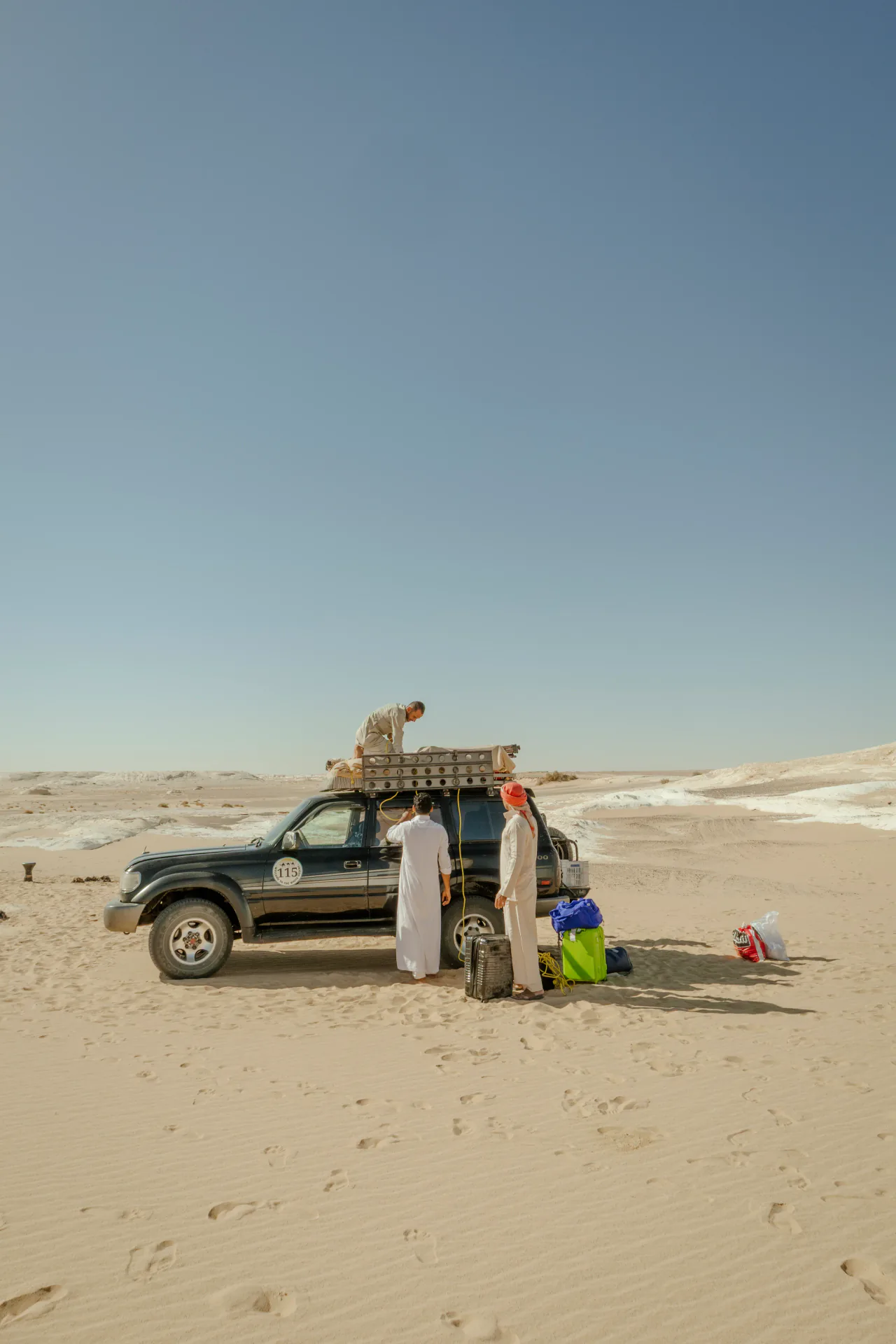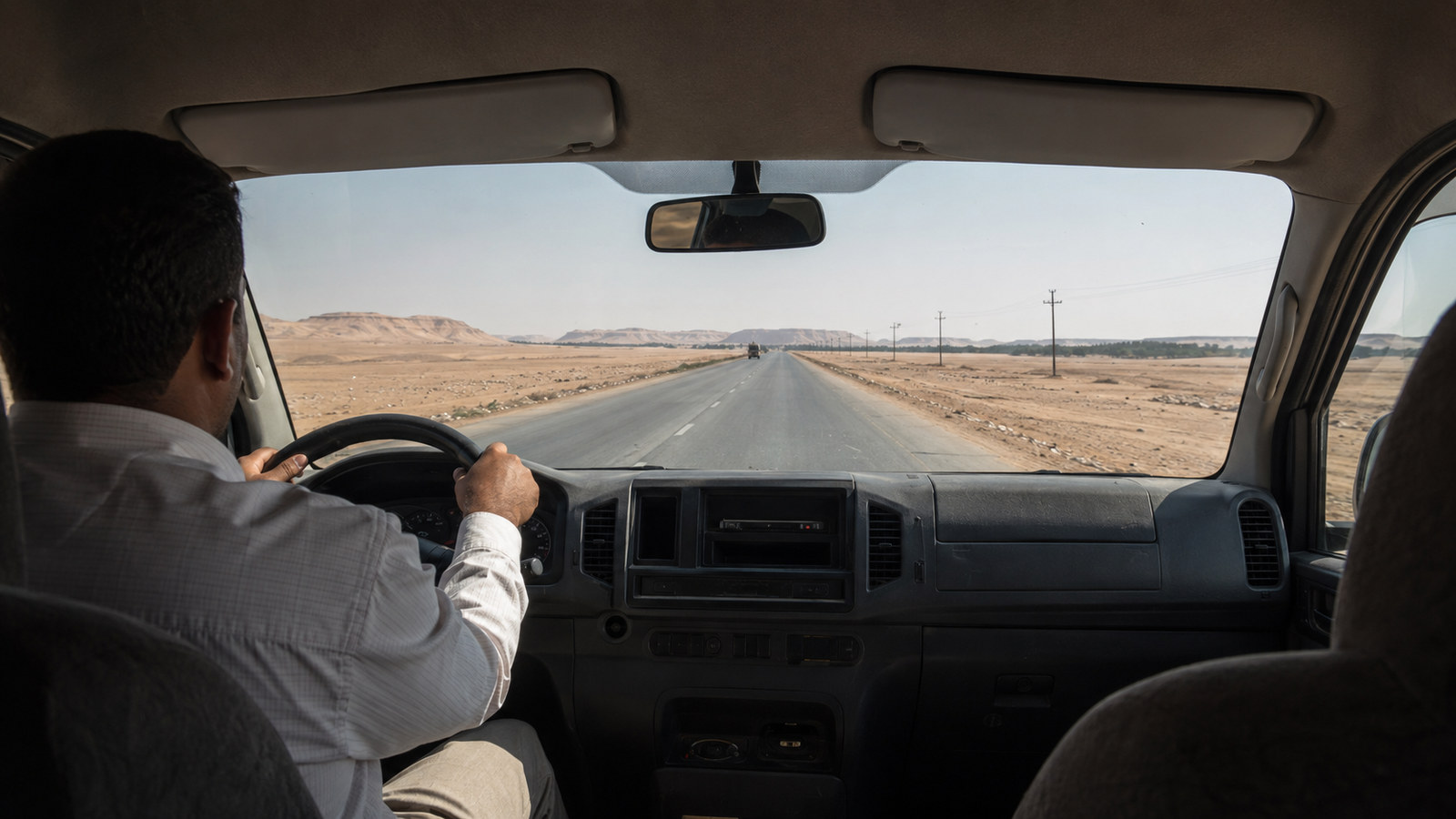
The Cairo to Bahariya Oasis journey is the main overland route into one of Egypt’s most rewarding Western Desert regions.
Egypt’s official tourism portal places Bahariya approximately 370 kilometers southwest of Cairo and identifies it as the Western Desert oasis closest to the capital. A well-organized private transfer normally requires around 4.5 to 5.5 hours, although the real duration changes with the pickup district, Cairo traffic, rest stops, checkpoints, road conditions and the final hotel or camp location.
The drive is not simply transportation between two hotels. It is the transition from the dense urban landscape of Cairo and Giza to open desert, oasis agriculture and the local operating base for Black Desert and White Desert journeys.
For the August 2, 2027 total solar eclipse, the route also has strategic importance. Cairo itself will see a deep partial eclipse, while representative Bahariya coordinates lie inside totality. Travelers who want the full event should not leave Cairo on eclipse morning. The safer plan is to reach Bahariya before the event, stay with a managed local operation and use a separately verified viewing field inside the totality path.
Cairo to Bahariya for the 2027 Solar Eclipse
For eclipse travelers, Bahariya is not simply a sightseeing stop. It is the operating base for reaching our managed Western Desert viewing region before 2 August 2027. The standard eclipse packages include organized pickup from Downtown Cairo, Giza and nearby Giza hotels, or Zamalek; pickups from other areas are quoted separately.
The package length changes how much time you spend in Bahariya and how the accommodation is structured:
- 2 days / 1 night: the shortest focused option, with one eclipse-camp night.
- 3 days / 2 nights: one Bahariya hotel night plus one eclipse-camp night.
- 4 days / 3 nights: two five-star Bahariya hotel nights plus one premium eclipse-camp night, with private transport available as an optional upgrade.
If your main goal is to travel from Cairo to a verified Western Desert eclipse operation rather than arrange the road, camp and field separately, compare the 2-, 3- and 4-day Bahariya eclipse packages.
Cairo to Bahariya Oasis Quick Facts
| Question | Practical answer |
|---|---|
| Official approximate distance | About 370 km southwest of Cairo. |
| Practical route range | Approximately 370–400 km, depending on the exact Cairo pickup and Bahariya destination. |
| Typical organized journey time | Plan around 4.5–5.5 hours, including a sensible rest stop. |
| Best transport for international travelers | Pre-arranged air-conditioned private or organized group transfer. |
| Is there a train? | No practical passenger rail service connects Cairo directly with Bahariya. |
| Are public buses available? | Giza Governorate lists scheduled services, but times and departure points must be reconfirmed locally. |
| Can you use a city taxi? | A pre-booked long-distance transfer is better than hailing an ordinary taxi without return and support arrangements. |
| Can you self-drive? | Possible on the paved road for experienced travelers, but not recommended for the eclipse program or an unsupported summer desert journey. |
| Where do most visitors arrive? | Bawiti, the main service town in Bahariya Oasis. |
| How do you continue to the White Desert? | Normally with a local team and suitable 4x4 vehicles after reaching Bahariya. |
| Should eclipse travelers leave Cairo on August 2? | No. Arrive in the Bahariya region before eclipse day. |
How Far Is Bahariya Oasis from Cairo?
The official destination guide published by Egypt’s tourism authority gives an approximate distance of 370 kilometers southwest of Cairo.
This is the most useful high-level figure, but it does not describe every door-to-door journey.
Online route tools may show figures from roughly 369 to just over 400 kilometers. That variation is normal because:
- Cairo is a very large metropolitan area.
- Airport pickup begins farther east than Giza pickup.
- New Cairo is farther from the Western Desert road than Sheikh Zayed.
- “Bahariya Oasis” can be pinned at different points.
- Bawiti, Qasr and individual hotels have different coordinates.
- The eclipse camp may be separate from the town.
- Road-routing systems may choose different city exits.
A traveler staying near the Giza Pyramids may have a shorter urban exit than someone collected from Cairo International Airport. A traveler going to a hotel in central Bawiti may travel a different total distance from someone continuing directly to a remote camp.
The correct booking question is therefore:
What is the expected door-to-door duration from my exact hotel or airport pickup to my confirmed Bahariya accommodation?
How Long Does the Cairo to Bahariya Oasis Drive Take?
A realistic planning range is approximately 4.5 to 5.5 hours in an organized air-conditioned vehicle.
The moving time may be shorter under ideal conditions. The complete journey should still include:
- Hotel loading.
- Cairo or Giza traffic.
- A toilet and refreshment stop.
- Checkpoint procedures.
- Safe driving speed.
- Arrival navigation inside Bahariya.
- Luggage unloading.
- Possible transfer to a local 4x4 or camp vehicle.
The journey can take longer when:
- Pickup is from Cairo Airport or eastern Cairo.
- Several hotels are used for group collection.
- Holiday or eclipse traffic is heavy.
- Guests require longer rest stops.
- Checkpoints are busy.
- Wind or dust reduces visibility.
- The final destination lies outside Bawiti.
- A vehicle change is required.
- The group carries extensive photography equipment.
An operator should provide a planning window rather than promise arrival at an exact minute.
What Route Does the Journey Follow?
The trip normally leaves the Greater Cairo and Giza urban area toward the Western Desert road serving the oases.
The broad experience has four stages.
Stage 1 — Cairo or Giza Pickup
Guests are collected from the agreed location:
- Cairo hotel.
- Giza hotel.
- Airport-area hotel.
- Cairo International Airport.
- A fixed group meeting point.
- Another confirmed private address.
Pickup from multiple hotels takes longer than a single private pickup.
Stage 2 — Leaving the Metropolitan Area
The first portion can be the least predictable because of urban traffic.
The vehicle moves from dense development toward the western or southwestern edge of Greater Cairo. Depending on the starting district, the route may involve ring-road sections or connections toward the oasis highway.
Stage 3 — The Desert Highway
After leaving the city, the landscape becomes open and services become less frequent.
Guests can expect:
- Long stretches of paved road.
- Broad desert views.
- Limited towns.
- Service points separated by substantial distances.
- Checkpoints.
- Trucks and long-distance vehicles.
- Strong sunlight.
- Occasional wind or dust.
- Mobile coverage that may vary.
This is why the vehicle should begin with sufficient fuel, water and a basic emergency plan.
Stage 4 — Arrival in the Oasis
The visual change is gradual.
Palm groves, farms, settlements and the surrounding hills announce the Bahariya depression. Most travelers arrive in Bawiti, where hotels, local teams and services are concentrated.
Read the complete Bahariya Oasis guide for the destination itself.
Private Transfer, Group Transfer, Bus or Self-Drive?
Private Air-Conditioned Transfer
This is the strongest option for many international travelers.
Advantages include:
- Hotel or airport pickup.
- Flexible departure time.
- Direct journey.
- Space for luggage and photography equipment.
- Controlled rest stops.
- Air conditioning.
- A driver familiar with the route.
- Coordination with the Bahariya team.
- Easier support if arrival is delayed.
- Private return scheduling.
A private transfer is particularly valuable for:
- Families.
- Older travelers.
- Guests with medical needs.
- Photographers with fragile equipment.
- Small private groups.
- Travelers arriving on an international flight.
- August 2027 eclipse guests.
Ask whether the quoted transfer is private to your booking or only described as “private transport” because it is not a public bus.
Organized Shared Transfer
A shared transfer can reduce cost while preserving tour coordination.
It commonly includes:
- Fixed hotel pickup window or meeting point.
- Air-conditioned minibus or van.
- Shared rest stop.
- Bahariya drop-off.
- Coordination with the package itinerary.
The trade-offs are:
- Multiple pickups.
- Less control over departure.
- Luggage limits.
- Waiting for other guests.
- Fixed toilet-stop timing.
- Less space for large camera cases.
For eclipse operations, shared transfers should have a clear manifest, vehicle capacity and backup plan.
Public Bus
Giza Governorate currently lists Cairo–Bahariya services and identifies a bus station in Bawiti.
Public transport can suit budget travelers whose trip ends in the town and who can manage local arrangements independently.
However:
- Schedules may change.
- Departure points require confirmation.
- Online ticketing may be limited.
- Luggage space may be restrictive.
- English-language assistance is not guaranteed.
- The bus does not solve White Desert permits or 4x4 transport.
- Arrival may not match hotel check-in or desert departure.
- The final eclipse camp may be far from the station.
- Summer comfort and stop quality may vary.
For a specialist eclipse journey, a coordinated transfer is usually the more reliable choice.
Ordinary Taxi or App-Based Car
A driver may agree to a long-distance trip, but an ordinary city ride is not automatically a complete desert-transfer solution.
Before accepting, confirm:
- The driver expects a one-way or return trip.
- The vehicle is suitable for the distance.
- Air conditioning works continuously.
- Luggage fits safely.
- Fuel is planned.
- The driver knows the destination.
- Checkpoint documents are in order.
- There is a breakdown plan.
- The Bahariya team knows the arrival vehicle.
- The final price and waiting terms are written.
A low app estimate should not be treated as a guaranteed long-distance booking.
Rental Car and Self-Drive
The road to Bahariya is paved, but the decision involves more than road surface.
Independent driving means the traveler is responsible for:
- Navigation.
- Fuel.
- Tire condition.
- Spare tire.
- Cooling system.
- Water.
- Checkpoints.
- Permit requirements.
- Limited phone coverage.
- Breakdowns.
- Night driving.
- Local onward transport.
- Return timing.
- Insurance restrictions.
- Desert-road exclusions in the rental contract.
A normal rental car should not be taken onto deep-desert tracks.
For August 2027, self-driving creates unnecessary risk when the trip has a fixed astronomical deadline and specialized camp arrangements.
Is There a Train or Flight to Bahariya?
There is no practical direct passenger train from Cairo to Bahariya Oasis.
There is also no normal scheduled domestic flight used by tourists for this route.
The standard journey is overland by road.
That is one reason Bahariya is operationally attractive for a Cairo-based eclipse product: guests can be collected from the international gateway and moved directly to the oasis without an additional domestic flight.
It is still a substantial road journey. The schedule should treat it as a travel day rather than a short local transfer.
What Should You Expect at the Rest Stop?
Most organized transfers include at least one planned stop.
The exact location should remain flexible because service operations and road conditions can change.
A suitable stop allows guests to:
- Use a toilet.
- Buy water or a drink.
- Stretch.
- Eat a light snack.
- Check on children.
- Take scheduled medication.
- Confirm luggage and equipment.
- Contact the receiving team.
- Avoid spending the entire journey seated.
Travelers should not assume every roadside facility matches an airport or city-hotel standard.
Carry:
- Tissues.
- Hand sanitizer.
- Small change.
- Personal medication.
- A refillable bottle.
- A light snack.
- A modest emergency food reserve.
The driver should avoid unnecessary long stops during extreme heat.
What Documents Should You Carry?
Keep the following accessible rather than buried in checked luggage:
- Passport.
- Copy of the passport identity page.
- Visa or entry documentation.
- Travel-insurance information.
- Operator confirmation.
- Hotel and camp addresses.
- Emergency contacts.
- Medical information.
- Prescription documentation where relevant.
- Permit details supplied by the operator.
Current UK travel guidance states that tourists entering Bahariya, Farafra, the White Desert and Black Desert areas should obtain permits in advance and use an official guide.
Permit procedures can change. The tour operator should confirm what information is needed and when it must be submitted.
How Much Luggage Should You Bring?
The Cairo vehicle may have more luggage space than the onward 4x4.
This matters because many White Desert routes involve a vehicle change in Bahariya.
A practical packing system is:
Main Travel Bag
Used for the broader Egypt journey or stored according to the operator’s arrangement.
Small Desert Bag
Contains what is needed for the camp:
- Clothing.
- Toiletries.
- Medication.
- Charging equipment.
- Hat.
- Sunscreen.
- Eclipse glasses.
- Camera accessories.
- Personal documents.
- Reusable water bottle.
Photography Case
Should be declared in advance, especially for:
- Long telephoto lenses.
- Tripods.
- Telescope mounts.
- Battery cases.
- Solar filters.
- Multiple camera bodies.
- Hard cases.
The operator must know the number and dimensions of large cases before assigning vehicles.
What to Wear During the Road Journey
Choose light, comfortable clothing suitable for both air conditioning and desert arrival.
Useful items include:
- Breathable long trousers.
- Lightweight long-sleeved shirt.
- Comfortable closed shoes.
- Hat stored within reach.
- Sunglasses for normal travel.
- Light layer for strong vehicle air conditioning.
- Compression socks if medically appropriate.
- Sunscreen for arrival.
Do not confuse ordinary sunglasses with safe solar viewers. Eclipse glasses are a separate specialized product.
For full August preparation, read how to prepare for Egypt’s desert heat.
Hydration and Food on the Road
Drink regularly without waiting for intense thirst.
The vehicle should carry sufficient water for the planned journey plus a reserve.
Travelers may also carry:
- Oral rehydration or electrolyte products if medically appropriate.
- Light salty snacks.
- Fruit that travels safely.
- Simple sandwiches.
- Medication that must be taken with food.
Avoid relying on only coffee, energy drinks or very sugary beverages.
Guests with diabetes, kidney disease, heart disease or fluid restrictions should follow their clinician’s advice rather than generic hydration targets.
Traveling with Children
The journey can be suitable for children when planned carefully.
Confirm:
- Age-appropriate car seats.
- Seat belts.
- Air-conditioning performance.
- Toilet-stop timing.
- Cold water.
- Snacks.
- Shade on arrival.
- Child medication.
- Supervision during luggage loading.
- The published child policy.
Children should not remain in a parked vehicle, even briefly.
A multi-day eclipse package is generally better than a compressed same-day journey because it allows rest before the event.
Traveling with Older Adults or Health Conditions
Ask for:
- Door-to-door pickup.
- Minimal vehicle steps.
- Comfortable seating.
- Planned rest stops.
- Medication refrigeration if required.
- Accessible toilets where possible.
- Assistance with luggage.
- A medical summary.
- Onward camp walking distances.
- Air-conditioned rest on arrival.
Guests should discuss significant heart, respiratory, mobility or heat-sensitivity concerns with a healthcare professional before the trip.
The route is long enough that comfort should be planned, not assumed.
What Happens When You Arrive in Bawiti?
A well-organized arrival normally includes several steps.
Welcome and Registration
The local team confirms guest names, rooms, dietary needs and onward program.
Lunch or Refreshments
Many itineraries include a meal before the desert program.
Hotel Check-In or Vehicle Change
Depending on the package, guests may:
- Check into a Bahariya hotel.
- Continue to a purpose-planned camp.
- Change to 4x4 vehicles.
- Begin an oasis tour.
- Rest before the next day’s desert excursion.
Safety Briefing
For an eclipse program, the briefing should cover:
- Heat.
- Hydration.
- Vehicle movement.
- Camp layout.
- Eclipse glasses.
- Medical support.
- Photography zones.
- Totality timing.
- Emergency communication.
Equipment Check
Photographers should confirm that tripods, filters and cases arrived without damage.
The first hours in Bahariya should not be overloaded with activities after a long summer transfer.
Bahariya Is the Gateway, Not the Entire White Desert
The paved-road journey ends in the oasis region.
The famous White Desert formations are part of a broader protected landscape associated with Farafra and longer Western Desert routes. Travelers commonly continue through a locally managed 4x4 itinerary.
A standard progression may include:
- Cairo to Bahariya by road vehicle.
- Rest, lunch or hotel check-in.
- Transfer to suitable 4x4 vehicles.
- Black Desert or oasis stops.
- Crystal Mountain and Aqabat on applicable routes.
- White Desert excursion or camp.
- Return to Bahariya.
- Road transfer to Cairo.
The exact route depends on permits, season, package length and current access.
Read the complete White Desert Egypt guide before selecting an itinerary.
Why Eclipse Travelers Must Arrive Before August 2
The eclipse occurs on a fixed astronomical schedule.
A delayed road journey cannot be recovered.
Travel from Cairo on eclipse morning could be affected by:
- Urban traffic.
- Group pickup delays.
- Checkpoints.
- Vehicle problems.
- Road incidents.
- Increased event traffic.
- Guests arriving late.
- Unexpected stops.
- Confusion about the viewing field.
The central event lasts minutes. Missing second contact means missing totality.
The safer plan is:
- Arrive in Cairo early enough to recover from the flight.
- Travel to Bahariya one or more days before the eclipse.
- Stay near the operational base.
- Inspect the field.
- Attend the briefing.
- Test equipment.
- Rest.
- Use only a short controlled movement on eclipse day.
This is one of the strongest reasons to choose a multi-day managed package rather than a one-day transfer.
Why Organized Travel Matters More in August
The conventional White Desert season is cooler.
August 2027 is exceptional because travelers are accepting demanding summer conditions for a rare astronomical event.
A professional transfer should provide:
- Reliable air conditioning.
- Cold water.
- Trained driver.
- Vehicle inspection.
- Spare tire and tools.
- Fuel planning.
- Backup communication.
- Arrival coordination.
- Heat-aware stops.
- Medical information.
- Alternative vehicle procedure.
The camp should provide climate-controlled sleeping or rest areas beside the open viewing field.
The combination of air-conditioned road transport and a specialist camp changes the trip from an improvised summer safari into a managed event operation.
Private Transfer vs One-Day Tour
A one-day Cairo–Bahariya–Cairo journey is physically possible for ordinary sightseeing, but it creates a very long day.
It may include:
- Four to five hours outbound.
- Local activities.
- Four to five hours return.
- Heat exposure.
- Limited rest.
- Night arrival in Cairo.
For the eclipse, a one-day round trip is not a sensible central plan.
A multi-day itinerary provides:
- Recovery after the road journey.
- Time in Bahariya.
- White Desert experiences.
- Equipment preparation.
- A safer eclipse morning.
- Flexibility after totality.
- Less pressure on drivers and guests.
Where Should You Stay Before and After the Road Journey?
Before Departure
A hotel in Cairo or Giza with straightforward vehicle access is useful.
Travelers arriving internationally should normally sleep in Cairo before beginning the road journey rather than connect directly after a long overnight flight.
In Bahariya
Options may include:
- Hotel in Bawiti.
- Oasis guesthouse.
- Eco-lodge.
- Farm-based property.
- Desert camp.
- Purpose-built eclipse camp.
The booking must identify the category and actual arrangement.
After the Eclipse
Travelers can:
- Return to Cairo.
- Continue a White Desert itinerary.
- Stay an additional oasis night.
- Connect with a broader Egypt program.
Avoid scheduling an inflexible international flight immediately after a long return drive.
Return Journey from Bahariya to Cairo
The return normally uses the same road corridor.
Allow for:
- Hotel checkout.
- Luggage loading.
- Rest stop.
- Cairo traffic.
- Different drop-off districts.
- Airport terminal access.
- Post-eclipse vehicle demand.
A 4.5-hour map estimate should not be used to book a tight flight connection.
A responsible operator provides an estimated arrival window and asks for flight details before confirming the schedule.
Questions to Ask Before Booking the Transfer
- Is pickup from my exact Cairo or Giza hotel included?
- Is airport pickup available?
- Is the vehicle private or shared?
- What vehicle model or category is planned?
- Does the air conditioning operate throughout the journey?
- How many guests and bags share the vehicle?
- Is a toilet stop included?
- Is bottled water provided?
- Is the driver familiar with Bahariya?
- Are permits handled by the operator?
- What passport information is required?
- What happens if the vehicle breaks down?
- Is there a backup vehicle?
- Where exactly are we dropped in Bahariya?
- Do we change into 4x4 vehicles?
- Can large tripods and camera cases be carried?
- Is lunch included?
- Is the return transfer included?
- What is the expected Cairo arrival window?
- Which costs are excluded?
- What is the cancellation policy?
- Is the eclipse field separate from the hotel?
- Will we arrive before eclipse day?
- Is the camp air-conditioned?
- How do I contact the local team if my flight is delayed?
Review the booking and cancellation policy before paying a deposit.
Common Mistakes
Treating 370 km as a Guaranteed Door-to-Door Distance
The number depends on the exact points.
Booking a Same-Day International Arrival and Desert Transfer
Flight delays and fatigue can disrupt the plan.
Choosing the Cheapest Taxi Without Support
The return, checkpoints and breakdown plan matter.
Assuming the Public Bus Reaches the Camp
It normally reaches the town, not a private eclipse field.
Carrying Too Much Luggage
The onward 4x4 may have less space.
Leaving Documents in a Large Bag
Keep identification accessible.
Underestimating Summer Hydration
The vehicle must carry water and the camp must provide a reserve.
Departing Cairo on Eclipse Morning
This risks missing totality.
Assuming Bahariya and the White Desert Are the Same Point
They play different geographic and operational roles.
Booking a Camp Without Confirmed Coordinates
The eclipse field must be independently verified inside totality.
Frequently Asked Questions
How far is Bahariya Oasis from Cairo?
Egypt’s official tourism portal gives approximately 370 kilometers southwest of Cairo. Door-to-door routes can be longer.
How long does the drive take?
Plan approximately 4.5–5.5 hours in an organized vehicle, including a rest stop.
Is there a train from Cairo to Bahariya?
No practical direct passenger train serves the route.
Is there a flight?
No normal scheduled tourist flight is used for this journey.
Is there a public bus?
Giza Governorate lists services, but schedules and departure points must be reconfirmed.
Is a private transfer better?
It is usually the most comfortable and coordinated option for international, family and eclipse travelers.
Can I take a taxi?
A pre-arranged long-distance transfer is safer operationally than hailing an ordinary taxi without a support plan.
Can I rent a car?
The paved road can be driven, but self-drive is not recommended for an unsupported summer eclipse program or deep-desert continuation.
Is the road paved?
The main Cairo–Bahariya route is paved. White Desert tracks require appropriate local vehicles.
Are there toilets on the route?
Organized transfers normally plan a service stop, but facility standards vary.
Do I need a permit?
Current travel guidance states that visitors entering Bahariya and associated Western Desert areas should arrange permits in advance and use an official guide.
Is mobile coverage available?
Coverage can vary, and some Western Desert areas have limited reception.
Can I travel directly from Cairo Airport?
A private airport pickup can be arranged, but sleeping in Cairo first is usually more comfortable after a long international flight.
Where do I arrive in Bahariya?
Most visitors arrive in or around Bawiti before hotel check-in or a local vehicle change.
Is Bahariya the White Desert?
No. Bahariya is the gateway and local operating base; White Desert excursions continue farther into the Western Desert.
How many days should I allow?
At least two days for a focused desert trip. Three or four days provide a better eclipse and oasis itinerary.
Can children make the journey?
Yes with an appropriate vehicle, car seats, cooling, water and a family-suitable itinerary.
Is it suitable for older travelers?
It can be, but seating, rest stops, mobility and medical needs should be discussed before booking.
Should I leave Cairo on eclipse morning?
No. Reach Bahariya before August 2, 2027.
How do I reserve the eclipse transfer and camp?
Compare the published packages or submit the availability form with your group, room and pickup requirements.
Final Takeaway
The journey from Cairo to Bahariya is long enough to require planning but straightforward when it is coordinated by a local team.
Use approximately 370 kilometers as the official destination distance and 4.5–5.5 hours as a practical travel window. Confirm the exact pickup point, vehicle type, luggage allowance, rest stop, permit process and final Bahariya destination.
For an ordinary White Desert trip, Bahariya is the place where the paved-road journey becomes a locally managed desert expedition.
For the 2027 eclipse, it becomes even more important. Cairo sees a partial eclipse, while a separately verified field near Bahariya can provide totality. Guests should arrive before eclipse day, rest near the viewing site and use a fully supported, air-conditioned camp rather than attempting a same-day summer transfer.
Explore the managed White Desert eclipse camp, compare the 2-, 3- and 4-day eclipse packages, or check availability.