For a normal winter safari, choosing a tour can feel straightforward: compare the route, the price, the photographs and the number of nights. A total solar eclipse expedition is different. On August 2, 2027, the viewing location must be inside the path of totality, guests must reach it on time, the operation must work in extreme summer heat, and every part of the day—from solar-viewing safety to vehicles, water, shade, charging and emergency communication—has to support an event that cannot be postponed.
That is why travelers comparing a local eclipse tour team in Egypt with a regular desert safari should not ask only, “Who can drive us into the White Desert?” The more useful question is: “Who can manage a remote Western Desert operation built around a fixed astronomical event?”
A good ordinary safari operator may know the desert extremely well. However, a standard safari itinerary is normally designed around sightseeing, camping and seasonal conditions. A specialist eclipse program has a different center of gravity: exact coordinates, totality timing, guest positioning, heat management, optical safety, equipment needs, controlled capacity and a coordinated chain from Cairo or Giza to Bahariya Oasis and onward by 4x4.
This guide explains the difference without claiming that every local guide is automatically qualified or that every large international eclipse company understands the Western Desert. The strongest model combines verified astronomy, licensed travel operations and genuine Bahariya-based desert knowledge.
Regular Desert Safari vs Specialist Eclipse Operation
| Planning Area | Regular Desert Safari | Specialist Eclipse Operation |
|---|---|---|
| Primary goal | Landscapes, camping and sightseeing | Successful totality viewing plus a managed desert journey |
| Location choice | Scenic route and approved camping areas | Verified point inside totality with horizon, access and operating space |
| Timing | Usually flexible within the itinerary | Built backward from a fixed event on August 2, 2027 |
| Season | Most commonly October–April | Extreme summer operation requiring heat-specific planning |
| Camp | Traditional small safari camp | Event infrastructure for cooling, shade, sanitation, power and viewing |
| Solar safety | Normally outside the itinerary scope | Briefing, verified viewers and camera/telescope filter rules |
| Photography | Landscape stops and ordinary charging needs | Tripod spacing, solar filters, power, setup time and light control |
| Guest flow | Small group following a scenic route | Controlled arrivals, viewing zones, briefings and post-totality movement |
| Contingency | Route adjustment for normal safari conditions | Backup plans for vehicles, power, communications, heat and field access |
The table does not mean a regular safari is poorly organized. It means the two products solve different problems.
1. A Beautiful Desert Location Is Not Automatically Inside Totality
The first job of an eclipse team is not selecting the most photogenic rock formation. It is confirming that the observation field lies within the 2027 path of totality.
NASA’s interactive map shows the northern and southern limits of the central path and the centerline. Only locations between those limits receive the total phase. The eclipse lasts longer closer to the centerline, but duration is not the only factor: access, horizon, field size, permits, surface conditions, heat management and the ability to move people and equipment also matter.
This creates a crucial distinction for White Desert marketing.
The White Desert is a broad travel experience associated with the protected area near Farafra and approached by many travelers through Bahariya Oasis. Its famous chalk formations can form part of an eclipse itinerary. But the name “White Desert” does not prove that any selected camp or landmark is inside totality.
A responsible local eclipse team should be able to explain:
- the process used to select the observation field;
- whether the coordinates have been astronomically checked;
- the expected local contact times and totality duration;
- the distance from the path limits and centerline;
- the quality of the eastern, southern and western horizons;
- the final access and permit status;
- whether a practical alternative field is available if access conditions change.
Until the site is finalized, wording such as “viewing area in confirmed Western Desert eclipse-camp region between the White Desert and the Black Desert, inside the path of totality, with White Desert experiences” is more accurate than promising totality at every famous formation.
2. The Eclipse Dictates the Itinerary, Not the Other Way Around
A conventional safari can often change its order. If wind, road conditions or guest energy make one stop inconvenient, the guide may visit it later or replace it with another landscape.
The total solar eclipse cannot be moved.
The partial phase begins at a calculated time. Totality begins and ends within a narrow interval. Vehicles cannot arrive “later in the afternoon.” A late Cairo departure, delayed vehicle change, unplanned lunch stop or route misunderstanding can threaten the central purpose of the entire trip.
A specialist team plans backward from totality:
- Guests sleep close enough to the viewing field on August 1.
- Equipment and viewing zones are prepared before guests need them.
- The morning schedule protects setup and briefing time.
- Vehicle movement near the field is controlled.
- Food service does not conflict with the eclipse phases.
- Solar filters are used throughout the partial phases.
- The group knows exactly what changes at second and third contact.
- Post-eclipse movement begins only after safe procedures and guest checks.
That sequence is why the current Solar Eclipse Tours programs reach the main event base the night before totality rather than attempting a same-day Cairo run.
3. August Requires a Different Camp from a Winter Safari
The conventional White Desert season is cooler. A winter safari camp can be comfortable with tents, bedding, meals, a fire and basic mobile facilities.
August 2027 requires another standard entirely.
The specialist operation must plan for daytime heat, hot ground, sun exposure, dehydration risk, food storage, sleeping conditions, sanitation, equipment temperature and guests who may be older, very young or managing chronic health conditions.
Cooling should not be treated as a decorative promise. Travelers should ask what is being cooled, how the cooling is powered and what happens if a primary system fails.
The current Observatory Camp concept includes air conditioning and cooling across the event base, supported by shaded rest areas, drinking water, charging, toilets, meals and medical support. Final specifications still need to be confirmed in writing before travel because a planned facility is not the same as a commissioned and tested facility.
A specialist team should also distinguish between:
- the open viewing field, where guests need an unobstructed sky;
- the viewing-support zone, where shade, seating, water and cooling can be positioned nearby;
- the sleeping area;
- the dining and food-service area;
- the medical and first-aid point;
- the generator and technical zone, placed to control noise, fumes and trip hazards;
- the vehicle and emergency access route.
This is event-site management, not simply camping.
4. Local Drivers and 4x4 Knowledge Are Operational Infrastructure
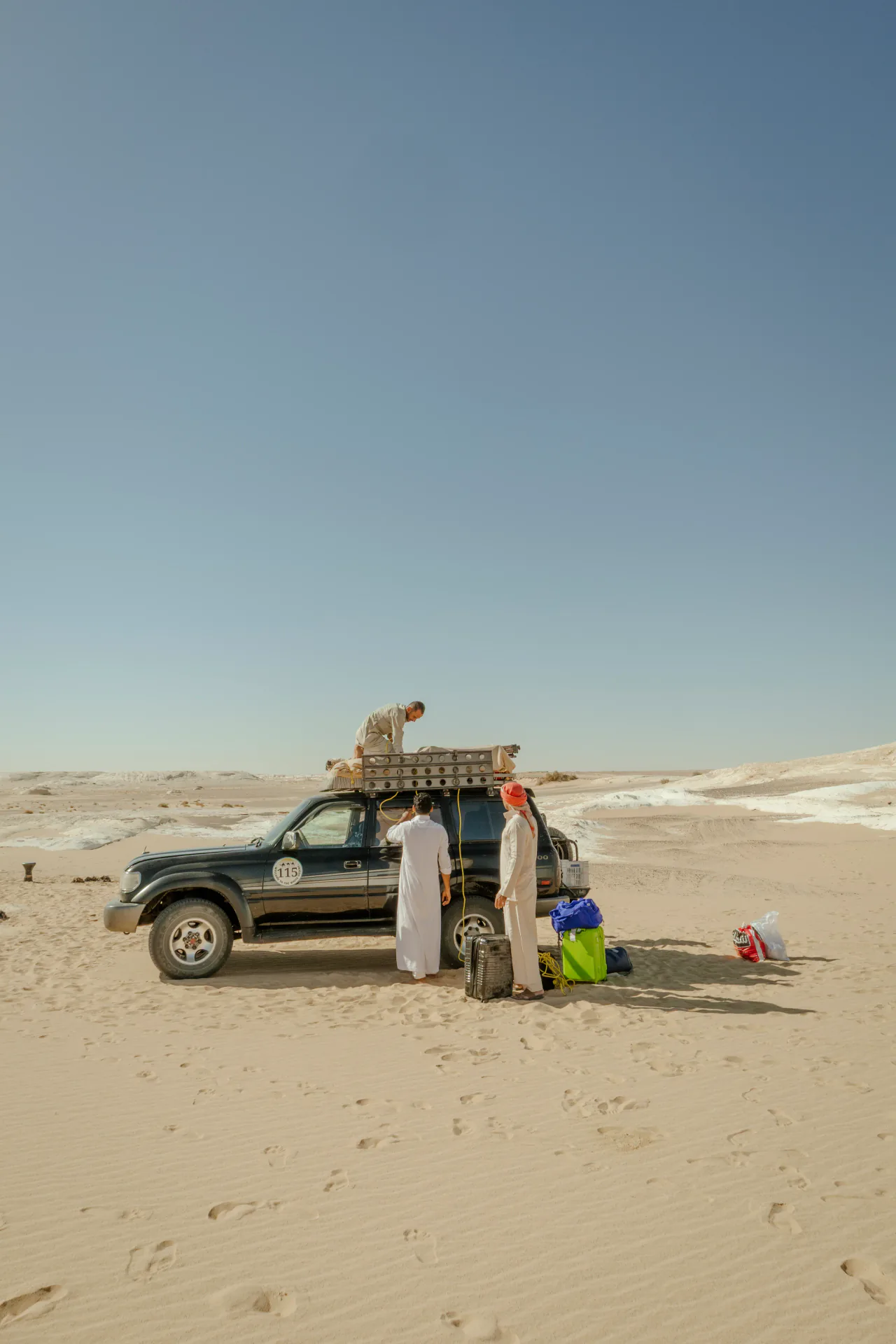
From Cairo or Giza, travelers normally reach Bahariya by paved road. The operating model then changes: desert-ready 4x4 vehicles and local drivers handle the off-road section.
The vehicle is only part of the equation.
Local drivers understand route surfaces, sand conditions, practical stopping points, fuel needs, loading, tire pressure, recovery procedures and how travel time changes with heat and group size. They also know how to move through the landscape without treating a protected desert as an unrestricted driving playground.
For the 2027 event, the transport chain should answer questions that a small safari can often solve informally:
- How many guests are assigned to each vehicle?
- How is photography equipment loaded and protected?
- Which vehicle carries water and emergency supplies?
- Is there spare capacity if a vehicle becomes unavailable?
- How are drivers contacted when mobile coverage is weak?
- What is the convoy procedure?
- Who confirms that every guest has moved from the Cairo vehicle to the correct 4x4?
- How is luggage separated from equipment that guests need on eclipse morning?
A locally based team can respond faster because Bahariya is not merely a stop on its itinerary; it is its operating base.
5. Permits, Access and Licensing Cannot Be Improvised
The Western Desert includes protected landscapes, controlled routes and areas where access requirements may change. Travelers should not assume that paying someone with a vehicle automatically creates a legal or permitted expedition.
Current U.S. government travel advice specifically says that Western Desert travel should be undertaken with a professionally licensed tour company. Other governments may describe the area differently, so travelers should check advice relevant to their nationality and insurance.
A responsible booking process should identify:
- the legal entity or licensed company responsible for the trip;
- the party named on the invoice and payment receipt;
- how permits and protected-area fees are handled;
- what identity information is needed and when;
- whether professional filming or unusually large equipment requires separate permission;
- what route or security changes the operator is permitted to make;
- what happens if government instructions affect access.
Local familiarity is valuable here, but familiarity is not a substitute for licensing. The best arrangement is a locally rooted operations team working within a clear licensed structure.
6. Solar-Viewing Safety Needs Its Own Leader and Procedure
A desert guide can be excellent at navigation, camping and hospitality without automatically being qualified to manage optical safety.
The American Astronomical Society states that the uneclipsed or partially eclipsed Sun must be viewed through special-purpose solar filters. Ordinary sunglasses are not safe. Cameras, binoculars and telescopes require suitable filters over the front of the optics during partial phases.
An eclipse operation should therefore assign responsibility for:
- obtaining or verifying safe eclipse viewers;
- inspecting viewers before distribution;
- explaining safe use to adults and children;
- identifying the partial and total phases;
- supervising the transition at the beginning and end of totality;
- preventing guests from combining eclipse glasses with unfiltered magnifying optics;
- briefing photographers about front-mounted solar filters;
- providing an indirect viewing option when appropriate;
- communicating instructions in clear language.
The strongest model combines the local desert team with an astronomy or eclipse-safety advisor. Neither expertise should pretend to replace the other.
7. Photographers Need More Than a Scenic Stop
Eclipse photographers often carry equipment that changes the camp plan:
- tripods with wide footprints;
- long lenses and heavy heads;
- cameras running interval sequences;
- external batteries and power banks;
- laptops or storage drives;
- solar filters that must be removed and replaced at precise times;
- multiple camera bodies;
- chairs, shade and personal bags.
A regular safari can stop at a scenic viewpoint and give everyone time to take pictures. An eclipse field must prevent tripods from blocking movement, vehicles from creating dust, guests from standing in front of lenses and power cables from becoming hazards.
The team should establish:
- a photography zone with spacing rules;
- a separate general viewing area;
- setup access well before first contact;
- vehicle restrictions near exposed equipment;
- a plan for safe battery charging;
- quiet or low-light expectations the night before;
- a procedure for large or professional filming equipment;
- a clear warning that connectivity is not guaranteed.
Photographers should still remain self-sufficient. They should bring tested solar filters, spare batteries, memory cards, dust protection and a practiced exposure sequence. The operator provides a managed field, not a guarantee that unfamiliar equipment will work.
8. Controlled Capacity Changes the Guest Experience
A small winter safari may have a few guests and two vehicles. The 2027 eclipse brings concentrated demand on one date.
Capacity affects nearly everything:
- number of vehicles;
- water storage;
- toilets and cleaning;
- meals and food safety;
- sleeping space;
- shaded seating;
- charging load;
- briefing audibility;
- medical response;
- loading and departure time;
- size of the observation field.
Solar Eclipse Tours currently describes a controlled event capacity rather than an open public gathering. The exact final capacity should match the tested camp specification and approved operating plan.
A specialist team does not simply sell every possible seat. It understands that capacity is a safety and service limit.
9. One Team Should Own the Full Guest Journey
The trip includes several operational handoffs:
- Cairo or Giza pickup.
- Road transfer to Bahariya.
- Guest and luggage check.
- Lunch or lodge arrival, depending on the package.
- Transfer to 4x4 vehicles.
- Desert route and permitted stops.
- Arrival at the event camp.
- Eclipse briefing and viewing.
- Post-totality White Desert itinerary.
- Return to Bahariya and Cairo or Giza.
When each segment belongs to an unrelated supplier, responsibility can become unclear. A local operating team should know which driver, guide, lodge, cook, camp supervisor and technical contact owns each step.
This does not mean every service must be performed by one company employee. It means the guest should not have to solve supplier coordination personally.
10. Contingency Planning Must Be Specific
No operator can guarantee clear skies, perfect road conditions, uninterrupted Wi-Fi or failure-free equipment.
The value of a specialist lies partly in identifying failures before they happen and reducing their impact.
Useful contingency questions include:
- Is there backup power for critical camp functions?
- Are spare vehicles or recovery resources available?
- What communication method is used beyond ordinary mobile service?
- Is the viewing field accessible by more than one practical route?
- What happens if government authorities change access?
- Who has decision authority on the morning of the eclipse?
- How are guests informed about a field adjustment?
- Is the medical point easy for vehicles to reach?
- What is the plan for a severe heat illness?
- Which services are essential and which are comfort features?
The answer does not need to expose confidential security details. It should be clear enough to show that the operator has planned beyond the sales page.
Why Being Based in Bahariya Matters
Bahariya is a practical gateway from Cairo into the Black Desert and onward toward wider White Desert routes. It has road access, accommodation, local services, desert vehicles, drivers and people whose daily lives are connected to the region.
Elzaghandi Group states that its founder, Eyad Elzaghandi, is based in Bahariya Oasis and has seven years of experience organizing Western Desert journeys for international travelers. The team’s model covers transport, accommodation, meals, camps, guides and the guest journey from Cairo into the desert.
That background offers several practical advantages:
- route knowledge developed through repeated operations rather than one reconnaissance visit;
- existing relationships with drivers, lodges, cooks and camp teams;
- a clearer understanding of what international guests need explained;
- faster communication with Bahariya-based suppliers;
- knowledge of the difference between a normal winter safari and the planned August event;
- a personal connection to the places being visited.
However, travelers should still verify written terms, licensing, insurance compatibility and final event specifications. “Local” should be evidence of operational depth, not a reason to skip due diligence.
Local Desert Expertise vs Astronomy Expertise
Travelers sometimes frame this as a choice: book with local Bedouin guides or book with astronomers.
That is the wrong comparison.
A successful expedition needs both types of knowledge.
The local operations team contributes:
- route and terrain knowledge;
- vehicles and drivers;
- camp construction and supplies;
- permits and local coordination;
- meals and water;
- guest transport;
- desert communication;
- cultural interpretation;
- emergency movement.
The astronomy or eclipse advisor contributes:
- path and coordinate verification;
- local contact times;
- solar-viewing procedure;
- eclipse briefing;
- photography timing guidance;
- identification of the corona, Baily’s beads and diamond-ring phases;
- updates if more accurate path calculations become available.
The ideal product is not “locals instead of experts.” It is local desert operations supported by appropriate eclipse expertise.
When Is a Regular White Desert Safari the Right Choice?
A normal safari remains an excellent product when:
- you are traveling during the cooler season;
- your main goal is geology, landscapes and camping;
- your dates are flexible;
- you are not planning around a total solar eclipse;
- you prefer a very small traditional camp;
- you do not need event infrastructure or specialist viewing support.
The warning is not “never book a regular safari.” It is “do not assume a regular safari automatically becomes an eclipse expedition because it operates on August 2.”
If a normal operator offers an eclipse departure, ask what has been added beyond the date printed on the itinerary.
Questions to Ask Before Booking an Egypt Eclipse Tour
Use this checklist with any operator, including Solar Eclipse Tours.
Company and responsibility
- What is the legal or licensed company responsible for the trip?
- Whose name appears on the invoice?
- Who receives the payment?
- Who is the on-ground operations leader?
- Who is responsible for permits and access?
Viewing field
- Have the coordinates been checked against the 2027 totality path?
- When will final coordinates be shared?
- What is the expected local duration of totality?
- Is there a clear horizon?
- What is the field capacity?
- Is there an alternative field procedure?
Camp and heat
- Which areas are air-conditioned or actively cooled?
- What provides the power?
- What is the backup plan?
- How much shade and seating are available?
- How is drinking water distributed?
- How many toilets serve the group?
- What medical support is present?
Transport
- What vehicles operate Cairo–Bahariya and Bahariya–desert?
- How many guests share each vehicle?
- Can private transport be requested?
- How is large photography equipment handled?
- What happens if a vehicle fails?
Eclipse safety
- Are eclipse glasses included or supplied separately?
- Who verifies the glasses?
- Who leads the viewing briefing?
- What are the rules for cameras, binoculars and telescopes?
- Are children directly supervised by their parents?
Commercial terms
- What is included and excluded?
- What deposit is required?
- When is the balance due?
- What are the cancellation terms?
- What happens if clouds prevent viewing?
- What can change for safety, permits or government instructions?
Red Flags That Deserve More Questions
Be cautious when an operator:
- promises totality without providing a coordinate-verification process;
- treats “99% eclipse” as equivalent to totality;
- markets any White Desert landmark as automatically inside the path;
- plans to leave Cairo on eclipse morning;
- offers August camping with no specific heat plan;
- cannot identify the responsible licensed company;
- says ordinary sunglasses are sufficient;
- advises using eclipse glasses through binoculars or a camera;
- guarantees clear skies;
- provides no written cancellation or weather policy;
- cannot explain toilets, water, power or medical response;
- accepts unlimited guests without a capacity plan;
- has no process for professional camera equipment;
- relies entirely on mobile reception;
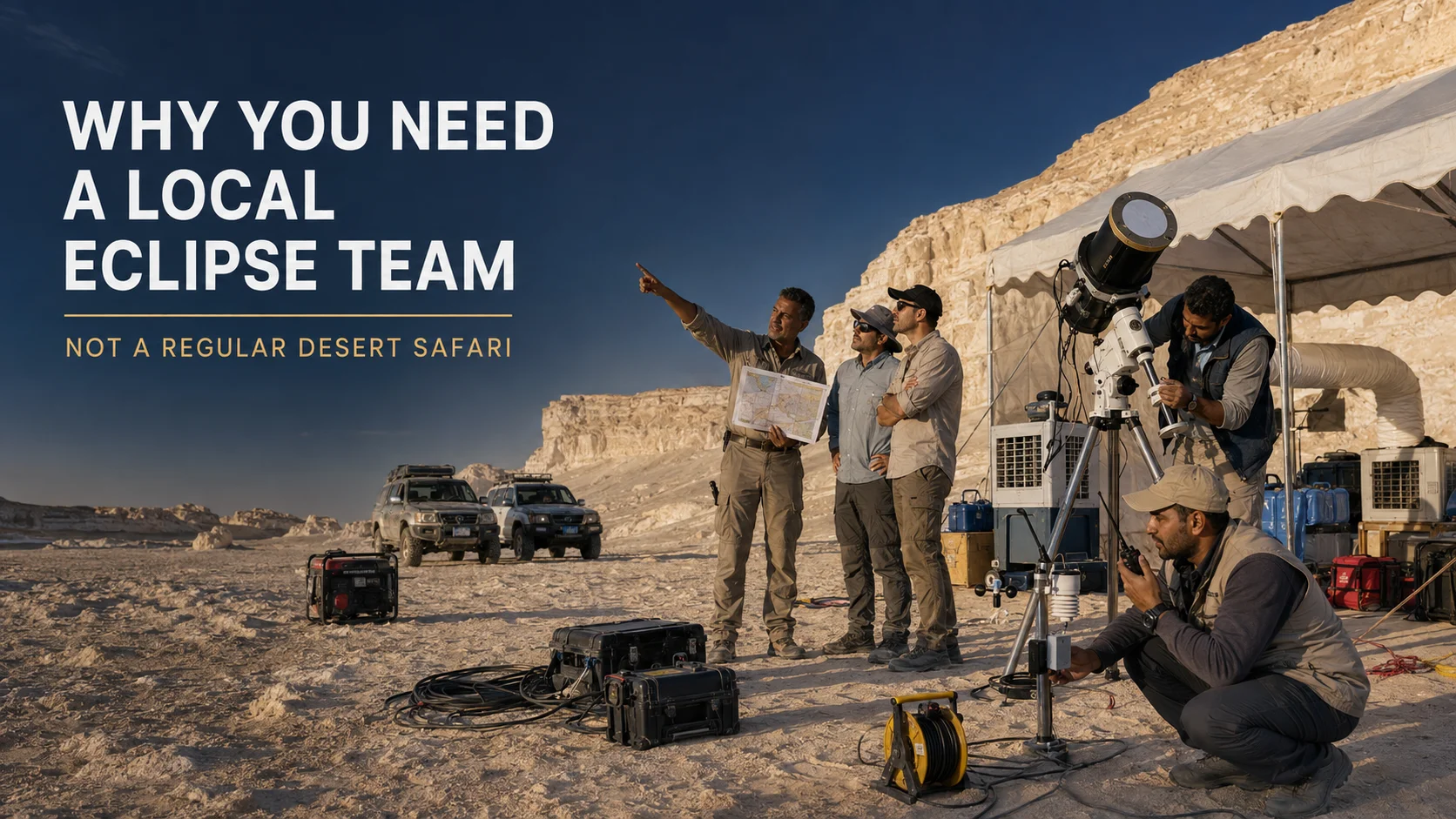
- uses only AI images and cannot show real operations or team members.
One red flag does not always prove that a company is unsafe, but it is a reason to stop and request documentation.
Which Travelers Benefit Most from a Specialist Local Team?
First-time visitors to Egypt
They benefit from one coordinated chain from Cairo or Giza into Bahariya and the desert, rather than arranging drivers, 4x4 vehicles, permits and camp services separately.
Eclipse chasers
They need coordinate accuracy, viewing-field discipline, equipment access and a team that understands why totality cannot be approximated.
Photographers
They need setup time, tripod space, dust control, charging and clear rules for solar filters.
Families
They need child-specific solar supervision, heat management, water, sleeping information and controlled movement around vehicles and equipment.
Seniors and travelers with health conditions
They need honest information about heat, 4x4 access, toilets, camp distances, medication storage and medical limitations. A specialist operation can provide details, but it cannot replace medical clearance or guarantee suitability.
Private groups and astronomy teams
They may need early access, reserved field space, power planning, equipment transport and several days of preparation. These requirements must be discussed before booking rather than added on arrival.
How the Three Current Packages Use the Same Local Operation
Solar Eclipse Tours currently offers 2-day, 3-day and 4-day programs.
The 2-day journey is the shortest complete route, with Cairo or Giza transfer, a Bahariya change to 4x4 vehicles, one night at the event camp, totality and White Desert sightseeing before the return.
The 3-day journey adds one Bahariya hotel night after the eclipse-camp experience, giving travelers more recovery time before the return to Cairo.
The 4-day journey starts on July 31 with the first of two five-star Bahariya hotel nights, includes oasis sightseeing, one premium eclipse-camp night and private transport, then returns to a second five-star Bahariya hotel night after totality.
The eclipse itself is not longer because the package is longer. The difference is pace, accommodation and how much Bahariya and White Desert experience surrounds totality.
Compare the 2-, 3- and 4-day eclipse packages before choosing.
What a Local Team Cannot Guarantee
Honest planning includes limits.
A local specialist cannot guarantee:
- cloud-free weather;
- a perfectly dust-free atmosphere;
- uninterrupted internet;
- that government access rules will never change;
- that every traveler will tolerate the heat or camp comfortably;
- that a camera or telescope will work;
- that the final field will never need an operational adjustment;
- that medical care in a remote desert equals a major city hospital.
The operator’s responsibility is to describe the product accurately, reduce avoidable risks, plan realistic backups and communicate changes. The traveler’s responsibility includes insurance, truthful medical disclosure when requested, safe equipment, personal preparation and compliance with team instructions.
Final Verdict: Choose the Team, Not Only the Itinerary
For the 2027 total solar eclipse, the itinerary is only the visible layer.
Behind it should be a chain of decisions about path verification, permits, licensed responsibility, vehicles, drivers, camp layout, cooling, food, water, sanitation, power, communications, viewing safety, photography and emergency access.
A normal White Desert safari can be a memorable journey. A specialist eclipse operation must be that and more.
The strongest choice is a team that can demonstrate three things at the same time:
- Real Western Desert experience rooted in Bahariya and supported by local drivers and camp staff.
- A clear legal and operational structure for permits, transport, payment and responsibility.
- Verified eclipse planning for the totality field, timing and safe observation.
Explore the Western Desert eclipse camp, review the current 2027 packages, meet the Elzaghandi Group local team, or check availability.
Frequently Asked Questions
Do I legally need a tour company for the Western Desert?
Current U.S. travel advice says Western Desert travel should be undertaken with a professionally licensed tour company. Access and permit requirements can change, and travelers should check the latest official guidance for their nationality and insurance policy.
Can any White Desert safari see totality in 2027?
No. The viewing point must be checked by exact coordinates against the path of totality. A famous formation, oasis or general regional name does not prove that the location receives totality.
Why not leave Cairo on the morning of August 2?
The journey to Bahariya takes several hours before the off-road section begins. Same-day travel adds unacceptable exposure to traffic, vehicle, transfer and access delays. The current programs reach the event camp on August 1.
Is a local guide the same as an astronomer?
No. A local guide provides desert and operational expertise. An astronomer or eclipse advisor provides path, timing and optical-safety expertise. A strong program combines both.
Are local teams better than international eclipse companies?
Not automatically. International companies may have deep eclipse experience, while local teams have destination operations knowledge. The best model is collaboration between credible eclipse expertise and qualified local execution.
What is different about an August camp?
It needs a serious plan for heat, cooling, water, shade, sanitation, food storage, sleeping conditions, medical response and power. A traditional winter camp setup should not simply be copied into August.
Will the viewing area itself be air-conditioned?
Totality must be viewed under an open sky. Cooling and climate-controlled rest areas should be positioned beside the open observation field rather than described as a closed viewing room.
Are eclipse glasses included?
The current package structure treats eclipse glasses as a separate item unless specifically confirmed otherwise. Travelers should bring or purchase viewers from a reputable source and follow current solar-viewing guidance.
Can I use eclipse glasses with binoculars?
No. Eclipse glasses are not a substitute for a front-mounted solar filter on binoculars, telescopes or camera lenses. Magnifying optics require their own correctly fitted solar filters during partial phases.
Does a local team guarantee clear weather?
No operator can guarantee clear skies. A team can choose a climatologically promising region, monitor conditions and maintain practical flexibility, but weather remains a natural risk.
What should photographers tell the operator?
Disclose large tripods, long lenses, multiple cases, telescopes, tracking mounts, high power requirements and professional filming equipment before booking. Some items may affect transport, permits or field allocation.
Is Wi-Fi essential for eclipse viewing?
No. Connectivity is useful for communication and forecasts, but the core viewing operation should not depend on uninterrupted public internet.
Which package is best if I want the easiest pace?
The 4-day itinerary provides the slowest arrival because it includes two five-star Bahariya hotel nights around one premium eclipse-camp night, with private transport. Travelers must still assess whether remote camping and August heat suit their individual needs.
Can a specialist team accommodate medical needs?
Some needs may be supported when disclosed early, but a remote camp has limits. Travelers should discuss the itinerary with their clinician and obtain written confirmation from the operator about any essential arrangement.
How do I verify an operator before paying?
Request the responsible company name, invoice details, written itinerary, inclusions, cancellation terms, permit process, camp specification, viewing-location method and a clear contact person. Review independent evidence of real operations rather than relying only on promotional images.
Sources and Verification Notes
This article was researched on August 17, 2026. Reconfirm operational details against current official guidance and the live operator plan before guest travel.
- NASA GSFC: Total Solar Eclipse of August 2, 2027
- American Astronomical Society: How to View a Solar Eclipse Safely
- U.S. Department of State: Egypt Travel Advisory
- Solar Eclipse Tours: About Elzaghandi Group
- Solar Eclipse Tours: Eclipse Tours and Packages
- Solar Eclipse Tours: White Desert Traveler’s Guide
- Solar Eclipse Tours: Western Desert Eclipse Camp
Government advice, access rules, package inclusions, camp facilities, viewing coordinates, team roles and capacity may change before August 2027. The latest written booking documents should control where they differ from an older article.