White Desert solar eclipse 2027: quick answer
White Desert solar eclipse 2027: See why a Bahariya-based Western Desert eclipse tour can offer a stronger 2027 totality experience through verified viewing, managed transport, controlled camp logistics and White Desert activities.
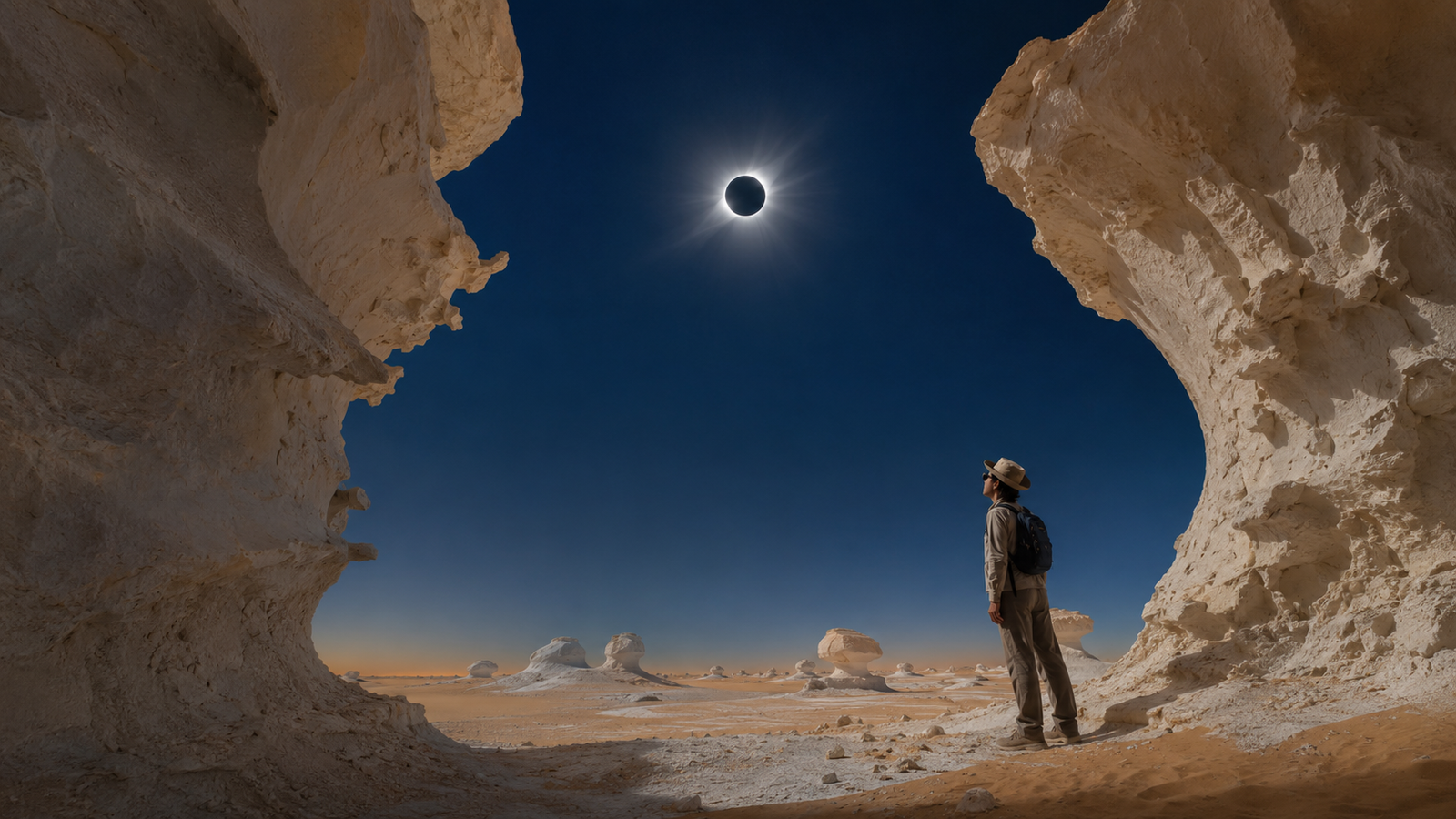
The White Desert solar eclipse 2027 experience can be one of the strongest ways to witness the August 2 total solar eclipse in Egypt—but only when the product is described accurately.
The famous White Desert is a broad protected landscape associated with the Farafra region. It is not one single coordinate, and common Farafra or standard excursion points should not automatically be advertised as total-eclipse locations. Some representative coordinates in the wider region remain outside totality.
The stronger plan is a confirmed Western Desert eclipse-camp region between the White Desert and the Black Desert, inside the path of totality at a separately verified viewing field inside the path of totality, combined with White Desert, Black Desert and oasis experiences before or after eclipse day.
Representative Bahariya coordinates receive approximately 6 minutes 17 seconds of totality. That is only about five seconds shorter than representative Luxor calculations and more than twice the maximum duration of the 2017 United States eclipse.
The main advantage is not simply the number of seconds. A private, purpose-planned field can control guest capacity, vehicle movement, tripod zones, sound, artificial lighting, shade, cooling, water, toilets, medical support and the departure schedule. Guests can arrive before eclipse day and stay close to the observation field rather than depending on a long transfer through a crowded city on the morning of the event.
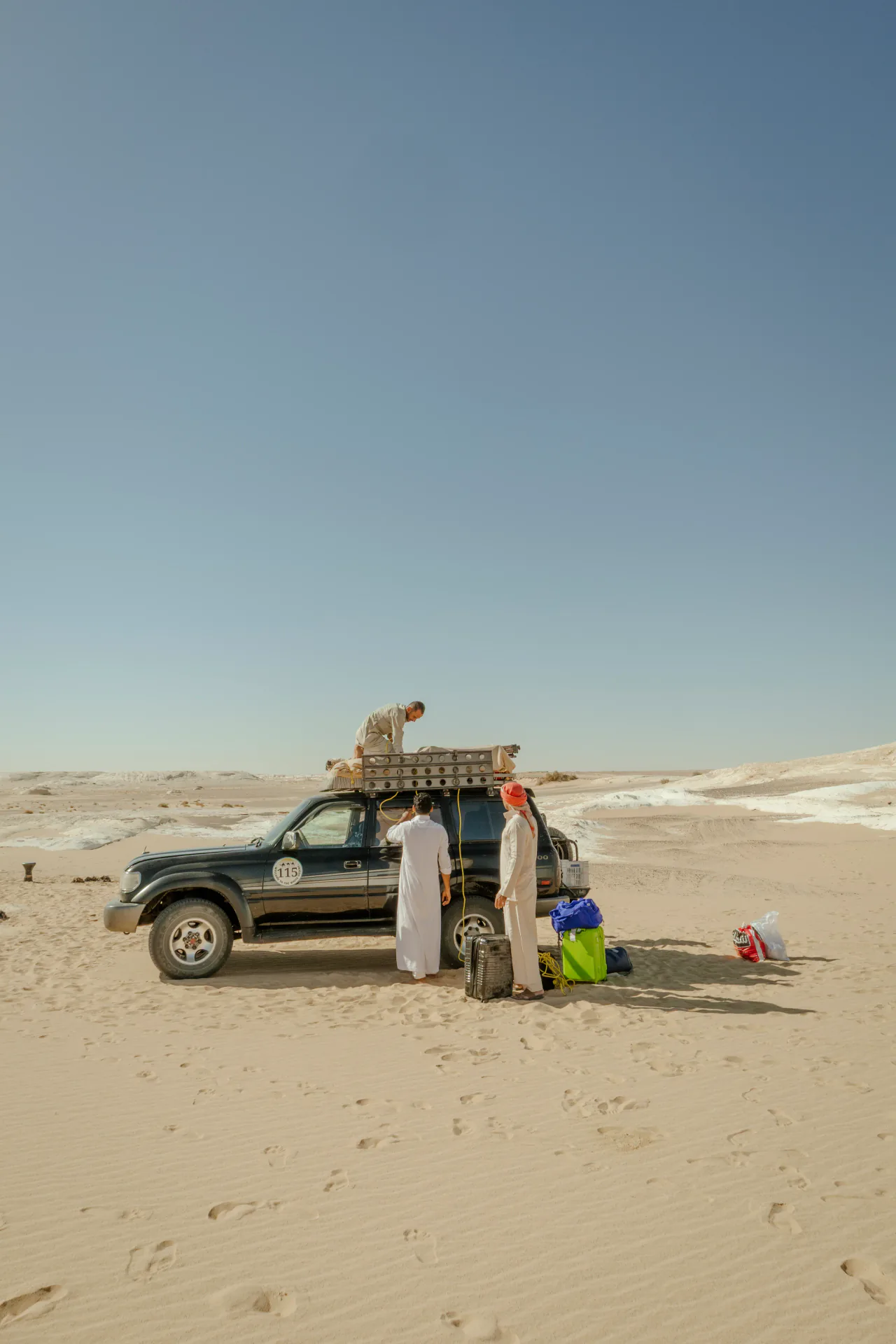
The White Desert journey also provides meaningful travel value beyond the eclipse. Travelers can experience Bahariya Oasis, the Black Desert, Crystal Mountain, Aqabat and the famous white chalk formations as part of one Western Desert program.
For the exact national route, first review the 2027 eclipse path across Egypt.
Why Choose a Bahariya-Based Eclipse Tour?
The key advantage is not simply “the White Desert.” It is the way a Bahariya-based operation can connect Cairo pickup, oasis accommodation, local desert vehicles, a separately verified totality field and the eclipse camp as one managed journey.
That matters because many eclipse trips fail at the handoff points: hotel to bus, bus to field, field to camp, or camp to return transfer. A locally integrated Bahariya operation reduces those handoffs and keeps the fixed eclipse event at the center of the itinerary.
Our current options are:
- 2 days / 1 night: one eclipse-camp night for the shortest focused program.
- 3 days / 2 nights: one Bahariya hotel night plus one eclipse-camp night.
- 4 days / 3 nights: two five-star Bahariya hotel nights plus one premium eclipse-camp night, with private transport available as an optional upgrade.
Compare the live Bahariya and Western Desert eclipse packages for current dates, prices and availability.
Quick Answer: Why Choose the Western Desert?
| Reason | Practical advantage |
|---|---|
| Long totality | Approximately 6m17s at representative Bahariya coordinates; final camp duration depends on exact GPS location. |
| Private-field potential | Capacity, vehicles, tripods and guest movement can be controlled. |
| Arrival before eclipse day | Reduces the risk of missing totality because of traffic or a delayed same-day transfer. |
| Open overhead sky | A broad field can avoid buildings, roofs, antennas and shade structures blocking the high Sun. |
| Purpose-built comfort | Cooling, shade, water, toilets, power and medical support can be designed around the event. |
| Lower urban distraction | Less city noise, public traffic and uncontrolled access at a capped private camp. |
| Photography control | Dedicated tripod zones and vehicle-free observation areas can be planned. |
| Complete travel experience | Bahariya, Black Desert and White Desert excursions create value beyond the eclipse. |
| Cairo access | The route can begin with an organized road transfer from the main international gateway. |
| Local operations | Bahariya-based drivers and guides understand the roads, terrain, supplies and support network. |
The Western Desert is not automatically the best because it is remote. It becomes the best choice for many travelers when the remoteness is supported by professional infrastructure.
Is the White Desert Really Inside the Path of Totality?
This question requires careful wording.
The term “White Desert” may refer to:
- The official protected area.
- Famous formations near Farafra.
- A multi-day route beginning in Bahariya.
- The broader Western Desert tourism circuit.
- A tour product using White Desert imagery.
- A separate eclipse field positioned elsewhere in the region.
These locations do not share one eclipse result.
NASA’s path map shows a wide corridor crossing Egypt’s Western Desert. Some Western Desert locations are inside totality, while other familiar reference points are outside it. A generic map label called “Western Desert” or “White Desert” is not enough to confirm a booking.
The eclipse product should therefore publish or provide:
- The viewing-field coordinates.
- The local eclipse type.
- The calculated duration.
- The distance from the path boundary.
- The source used for calculation.
- The last verification date.
- A clear explanation if the field is separate from the White Desert excursion route.
NASA notes that detailed lunar-limb effects may move the effective path limits by approximately 1–3 kilometers and change local durations by around 1–3 seconds. A responsible field should therefore lie comfortably inside totality rather than close to a boundary.
The accurate commercial phrase is:
The confirmed Western Desert eclipse-camp region between the White Desert and the Black Desert, inside the path of totality, where the final astronomically verified viewing point will provide at least 6 minutes of totality at a separately verified totality field, combined with White Desert experiences.
It is stronger and more trustworthy than claiming that the entire White Desert is “inside the path completely.”
Long Totality Without Chasing the Absolute Maximum
NASA places the greatest duration of the 2027 eclipse inside Egypt at approximately 6 minutes 23.2 seconds.
Representative local planning values include:
- Luxor: about 6m22s.
- Bahariya: about 6m17s.
- Asyut: about 6m07s.
- Siwa: about 5m33s.
- Marsa Alam: about 5m28s.
For most travelers, the difference between Bahariya and Luxor is only a few seconds.
Those seconds should be compared with much larger operational differences:
- Is the field confirmed?
- Can guests reach it before first contact?
- Is attendance capped?
- Are vehicles stopped before totality?
- Is the Sun visible above all structures?
- Can photographers set up without people crossing their lenses?
- Is there shade during the partial phases?
- Are cold water and toilets available?
- Can medical staff reach every zone?
- Is there a safe, staged departure plan?
A well-run 6m17s field can provide a better experience than a poorly managed 6m22s city event.
The full Egypt location comparison examines all major destinations.
Why an Open Desert Field Matters
The Sun will be very high during totality in Egypt. Near the strongest part of the path, NASA’s central-line data places the Sun at roughly 81–82 degrees above the horizon.
That means a distant mountain or low horizon obstruction is unlikely to be the main issue. The important viewing direction is nearly overhead.
A suitable field needs:
- Clear overhead sky.
- No large roof or fixed awning over the observation zone.
- No antennas or poles crossing the solar position.
- Safe walking routes.
- Stable tripod areas.
- Vehicle separation.
- Enough space between family viewers and long-lens photographers.
- Shade nearby rather than directly over the field.
- A layout tested at a similar time of day.
The White Desert’s visual appeal is powerful, but the famous mushroom formations are not automatically the ideal field. Protected status, ground conditions, guest capacity, access and exact eclipse coordinates all matter.
A less famous field with stronger logistics can be the correct operational choice.
Does Light Pollution Matter During a Total Solar Eclipse?
Many competitor pages promote “zero light pollution” as one of the main eclipse benefits.
That phrase needs context.
Light pollution is critical for night-sky astronomy, meteor showers, Milky Way photography and stargazing. A total solar eclipse occurs during daytime. Ordinary urban skyglow is not the main factor determining whether the corona is visible.
However, a remote field still has relevant visual advantages:
- Fewer uncontrolled artificial lights switching on during darkness.
- Fewer vehicle headlights.
- Less illuminated advertising.
- Less urban haze or smoke in some conditions.
- No tall buildings blocking the overhead view.
- Better control of screens and camera lights.
- A darker and calmer surrounding landscape during totality.
- Strong post-eclipse night-sky experiences at camp.
The better claim is therefore not simply “no light pollution.”
It is:
A low-distraction, controlled desert environment with minimal artificial light, vehicle movement and urban obstruction.
That is the more accurate way to describe the operational advantage.
Can the White Desert Guarantee Clear Skies?
No location and no operator can guarantee weather.
Egypt’s desert climate has favorable summer characteristics, and many eclipse travelers are attracted by historically low cloud levels. Nevertheless, visibility on one specific afternoon can be affected by:
- High thin cloud.
- Dust.
- Wind.
- Haze.
- Smoke.
- Heat shimmer.
- Unusual weather.
- Local atmospheric conditions.
Long-range climatology helps compare destinations. It does not predict the exact weather on August 2, 2027.
A responsible camp plan should include:
- Historical climate review.
- Forecast monitoring close to the event.
- Dust and wind updates.
- A final operational site inspection.
- Limited relocation options where permits and roads allow.
- Clear communication with guests.
- No promise of a successful visual observation.
- A complete desert program that remains valuable even if cloud interferes.
The phrase “clear desert skies” can describe a typical advantage. It should never become “guaranteed clear sky.”
Private Camp vs Public City Event
The Western Desert’s strongest advantage is the possibility of a private, capacity-controlled operation.
| Factor | Managed Bahariya camp | Major public city event |
|---|---|---|
| Capacity | Can be capped according to facilities and vehicles | Independent arrivals may be difficult to control |
| Field access | Registered guests and staff only, if the land is private and permitted | May include public access or shared roads |
| Tripod layout | Can be marked in advance | Space may be competitive |
| Vehicle movement | Can be stopped before critical contacts | Traffic and parking may remain active |
| Announcements | One coordinated contact-time system | Multiple events or inconsistent instructions |
| Cooling | Can be positioned beside the field | Depends on hotel, bus or public-event design |
| Departure | Can be staged after totality | Simultaneous public departure may create pressure |
A city event can be excellent if it uses a private field and strong operations. A desert camp can be poor if it lacks water, power or medical support.
The format alone is not enough. Execution decides.
Why Staying Near the Field Is Better Than Traveling on Eclipse Morning
A total solar eclipse has a fixed schedule.
If a vehicle breaks down, traffic stops, a checkpoint causes delay or a group leaves late, totality will not wait.
Guests should reach the viewing region before eclipse day.
At a managed camp, the schedule can include:
- Arrival one or more days early.
- Check-in and cooling.
- Site orientation.
- Eye-safety briefing.
- Equipment testing.
- Photography rehearsal.
- Medical and dietary review.
- Final field inspection.
- A short controlled movement on eclipse morning.
- Enough time to observe first contact.
- Rest after totality before departure.
This structure removes one of the biggest risks in eclipse tourism: a long same-day transfer from a partial-eclipse city.
The Final Ten Minutes Before Totality
The quality of an eclipse operation becomes visible immediately before second contact.
At a prepared camp:
- All vehicles are stationary.
- Guests know where to stand.
- Children are with assigned adults.
- Eclipse glasses are in use.
- Camera filters are checked.
- The tripod zone is closed to casual movement.
- Staff announce the remaining time.
- Shade structures do not block the Sun.
- Medical staff are positioned.
- Artificial lights and screens are controlled.
- No new guest is still trying to enter the field.
- The third-contact safety warning is ready.
The longest possible duration cannot compensate for confusion at this moment.
This is why a purpose-planned field can outperform a more famous destination.
A Camp Designed for August, Not Winter
The White Desert is traditionally associated with cool-season camping.
August 2027 is different.
The central eclipse occurs around midday, and the partial phases extend across several hours. A standard winter tent and a bottle of water are not adequate.
A specialized camp should provide:
Climate-Controlled Rest
Sleeping and recovery spaces should be cooled. The website must state exactly which spaces are air-conditioned and how many guests they can support.
Shade
Shade should be available near the field without blocking the high Sun.
Drinking Water
Cold water must be available continuously, not only at meal times.
Power
Generators or another verified system must support cooling, refrigeration, communications, charging and medical equipment, with backup capacity.
Toilets and Hygiene
Sanitation must match the guest count and remain operational in high heat.
Medical Support
The operator should define first aid, heat-illness response, evacuation vehicles, communication and the route to the nearest medical facility.
Food Safety
Cold storage, kitchen hygiene and meal timing are especially important.
Vehicle Backup
The road transfer and desert movement need suitable vehicles, drivers, maintenance and spare capacity.
Communications
The camp should state whether mobile reception, radio, satellite communication or internet is available. It should not promise uninterrupted connectivity without verification.
The air-conditioned eclipse camp guide explains these systems in more detail.
Why a Bahariya-Based Local Team Matters
Remote desert events depend on local operational knowledge.
A Bahariya-based team understands:
- The Cairo road.
- Oasis services.
- Local drivers.
- Fuel and maintenance.
- Water supply.
- Food sourcing.
- Desert tracks.
- Land access.
- Permits.
- Weather and dust patterns.
- Nearby settlements.
- Medical routes.
- Vehicle recovery.
- White Desert excursion logistics.
A company can design the entire journey as one connected operation rather than purchasing disconnected services from multiple suppliers.
Local expertise should still be verified. Travelers should ask about the company’s license, legal entity, insurance, confirmed suppliers and written responsibilities.
Read About Elzaghandi Group for the operator background.
White Desert Experience Beyond the Eclipse
The eclipse is the central event, but the Western Desert program can offer much more.
Bahariya Oasis
The oasis provides accommodation, local communities, palm groves, springs, desert-edge views and the operating base for the journey.
Black Desert
Dark volcanic hills and black stone create a strong contrast with the pale formations farther south.
Crystal Mountain
A well-known geological stop with exposed crystals and mineral-rich formations. Visitors should not remove material.
Aqabat
A dramatic landscape of white cliffs, sand and isolated forms.
White Desert Formations
The protected landscape contains mushroom-like rocks, towers, domes and sculpted chalk forms.
Stargazing
The night before or after the eclipse can provide a genuine low-light desert experience when weather and Moon conditions allow.
Photography
The trip offers landscape, wildlife, camp, night-sky and eclipse photography.
Local Hospitality
Meals, drivers, guides and oasis knowledge make the journey more than a purely astronomical event.
The complete evergreen destination information is available in the White Desert Egypt traveler’s guide.
White Desert vs Luxor
Luxor remains the strongest conventional city option.
| Factor | Bahariya and Western Desert | Luxor |
|---|---|---|
| Representative totality | About 6m17s | About 6m22s |
| Main experience | Private desert camp and Western Desert journey | Ancient sites, Nile and city tourism |
| Arrival | Organized road transfer from Cairo | Domestic flight, rail, road or cruise |
| Viewing-field control | Potentially strong at a private permitted field | Depends on selected private field or event |
| Public demand | Camp can cap its own guest count | Likely to attract major international attention |
| Accommodation | Oasis hotel plus specialist camp | Wide hotel and cruise inventory, subject to demand |
| Best for | Totality-first travelers and desert enthusiasts | First-time Egypt visitors and culture-first travelers |
Luxor is not a weak option. The commercial argument is that Bahariya sacrifices only a few representative seconds while potentially gaining more control over the complete guest experience.
Read Western Desert vs Nile Valley on eclipse day for the detailed comparison.
White Desert vs Siwa
Siwa offers an exceptional remote oasis atmosphere and approximately 5 minutes 33 seconds at representative coordinates.
Bahariya may be stronger for this product because:
- The representative totality is longer.
- The Cairo road journey is shorter.
- The local team can connect directly with White Desert routes.
- The camp can be designed around the final field.
- Multi-day package lengths can be more flexible.
- The route may be easier to integrate with Cairo arrivals.
Siwa may remain preferable for travelers whose main goal is specifically to experience Siwan culture and landscapes.
White Desert vs Marsa Alam
Marsa Alam combines totality with a Red Sea resort holiday.
Its strengths include:
- Conventional resort comfort.
- Diving and snorkeling.
- Airport access through selected gateways.
- Totality at representative coordinates.
The Western Desert can offer:
- A fixed private land field.
- Lower dependence on a specific resort coordinate.
- Controlled tripod and vehicle zones.
- A complete overland journey from Cairo.
- White Desert landscapes.
- A locally integrated camp operation.
Beach-first travelers may prefer Marsa Alam. Totality-first and desert-focused travelers may prefer Bahariya.
Photography Advantages
A well-designed private field can be especially valuable for photographers.
It can include:
- Long-lens tripod zone.
- Wide-angle zone.
- Telescope area.
- Media area.
- Vehicle-free perimeter.
- Clear walkways.
- Equipment tables.
- Charging.
- Filter checks.
- Contact-time announcements.
- Night-before rehearsal.
- Post-totality equipment cooling and storage.
The high Sun creates a challenge. A landscape-and-eclipse composition may require a very wide lens or a composite. Any composite image should be disclosed.
Cameras, binoculars and telescopes require front-mounted solar filters during the partial phases. Eclipse glasses worn by the photographer do not protect the eye from unfiltered magnified sunlight.
See the 2027 eclipse photography guide.
Families and Children
A private camp can be suitable for families if it includes:
- Correctly fitting eclipse viewers.
- Adult supervision.
- Child-friendly safety briefing.
- Cooling.
- Shade.
- Water.
- Toilets.
- Seating.
- Simple meals.
- Short walking distances.
- A defined family zone.
- No unsupervised telescopes or binoculars.
- Medical response.
Parents should review the Child Policy before booking.
Older Travelers and Accessibility
Remote does not have to mean inaccessible, but the operator must provide details.
Ask about:
- Distance from vehicle to tent.
- Ground surface.
- Steps.
- Bed type and height.
- Seating.
- Accessible toilets.
- Cooling.
- Medication storage.
- Mobility assistance.
- Vehicle access to the viewing field.
- Medical support.
- Emergency evacuation.
Travelers should not rely on generic words such as “luxury camp” or “comfortable camp.”
Eclipse Eye Safety
Except during confirmed totality, direct solar viewing requires proper protection.
Use approved eclipse glasses or a handheld viewer. Ordinary sunglasses are not safe.
At a confirmed totality field:
- Glasses remain on during the partial phases.
- They may be removed only when the bright photosphere is completely covered.
- They must be replaced before direct sunlight returns.
At any partial location—including standard White Desert coordinates that are outside the path—glasses remain on throughout.
The camp must base announcements on the actual field, not on a generic Egypt timetable.
Sample Journey Structure
Day 1 — Cairo Arrival
Airport pickup, hotel rest and initial equipment check.
Day 2 — Cairo to Bahariya
Air-conditioned transfer, planned stops, oasis arrival and briefing.
Day 3 — Western Desert Experience
Black Desert, Crystal Mountain or selected White Desert excursion, followed by camp orientation.
Day 4 — Eclipse Preparation
Rest, filter checks, photography rehearsal, heat briefing and final field inspection.
Day 5 — Eclipse Day
Early breakfast, hydration, controlled field access, partial phases, totality, lunch and staged departure.
Day 6 — White Desert or Oasis Extension
Continue the destination experience rather than leaving immediately after the event.
The exact schedule depends on the chosen package.
What to Verify Before Booking
Ask for written answers to these questions:
- What are the viewing-field coordinates?
- Is the field inside totality?
- What local duration is calculated?
- Which source is used?
- How far is the field from the path boundary?
- Is the land permitted?
- Is the field separate from the White Desert excursion area?
- Where will guests sleep?
- How far is accommodation from the field?
- Which spaces are air-conditioned?
- What is the guest capacity?
- How many guests share each vehicle?
- What toilets are provided?
- Is cold water continuously available?
- What is the power and backup-power plan?
- What medical staff or equipment is present?
- What is the evacuation route?
- Are eclipse glasses included?
- Is there a dedicated tripod zone?
- What communication systems are available?
- What happens if the site changes?
- What is the weather policy?
- What is included and excluded?
- What are the child arrangements?
- What are the cancellation terms?
Review the Booking and Cancellation Policy before paying.
Common Mistakes
Assuming the Entire White Desert Is Total
The final coordinate decides.
Choosing a Famous Rock Formation Instead of a Safe Field
Scenery is only one criterion.
Treating Clear-Sky Climate as a Guarantee
No operator controls weather.
Focusing on Nighttime Light Pollution
For the eclipse, field control and atmospheric clarity are more important.
Using a Standard Winter Camp in August
The heat requires specialist systems.
Traveling from Cairo on Eclipse Morning
Arrive in the region before the event.
Booking Without Coordinates
A destination name is not enough.
Believing Longer Is Always Better
Five extra seconds do not fix poor logistics.
Ignoring Protected-Area Rules
Permits and authorized access matter.
Removing Glasses Too Early
Wait for confirmed totality.
Frequently Asked Questions
Is the White Desert the best place for the 2027 eclipse?
It can be one of the best complete travel experiences when the viewing field is separately verified inside totality and the camp is professionally designed for August.
Is every White Desert location inside totality?
No. The region is broad, and common Farafra or excursion coordinates may be partial.
Is Bahariya inside totality?
Representative Bahariya coordinates are inside and receive approximately 6 minutes 17 seconds. The final camp must be calculated separately.
How does Bahariya compare with Luxor?
Luxor receives about five more representative seconds. Bahariya can offer stronger private-field control and a Western Desert journey.
Can weather be guaranteed?
No.
Is light pollution important?
It matters for night-sky activities. During the daytime eclipse, uncontrolled lights, vehicles, urban obstruction and atmospheric conditions are more relevant.
Will the camp be air-conditioned?
The package must state exactly which sleeping and rest spaces are cooled. Verify the technical plan before booking.
Can I watch from the famous White Desert formations?
Only if the exact site is permitted, operationally suitable and confirmed inside totality. Do not assume this.
Is the camp suitable for photographers?
It can be if it includes dedicated tripod areas, power, filter checks and controlled vehicle movement.
Is it suitable for children?
Yes when cooling, supervision, toilets, water and properly fitting eclipse glasses are provided.
Is it suitable for older travelers?
It depends on walking distances, ground conditions, toilets, cooling and medical support.
How should I travel from Cairo?
Use an organized transfer and arrive before eclipse day.
Are eclipse glasses required?
Yes during all partial phases. They may be removed only during confirmed totality at the actual field.
Is the White Desert camp better than a Nile cruise?
It may offer a fixed land coordinate and more tripod space. A cruise offers conventional cabins but requires exact vessel-position verification.
How do I reserve?
Compare the live packages and submit the availability form with your dates, group size and room needs.
Final Takeaway
The White Desert is not automatically the best eclipse site simply because it is beautiful and remote.
It becomes one of Egypt’s strongest eclipse products when four elements are combined:
- A separately verified Bahariya-area viewing field securely inside totality.
- A managed private camp designed for August heat and guest safety.
- A local team that controls transport, land, water, power, medical support and field operations.
- Authentic Bahariya, Black Desert and White Desert experiences around the central event.
Representative Bahariya totality is only a few seconds shorter than Luxor. The potential gain is a controlled field, capped capacity, open observation space, accommodation close to the site and a complete Western Desert journey.
For travelers prioritizing temples and conventional hotels, Luxor remains an excellent choice.
For travelers prioritizing totality, field control, desert atmosphere and a locally managed experience, the confirmed Western Desert eclipse-camp region between the White Desert and the Black Desert, inside the path of totality can be the better overall option.
Explore the White Desert eclipse camp, compare the 2027 eclipse packages, or check availability.
Authoritative planning reference
Use NASA 2027 eclipse path data as a primary reference, then verify local circumstances for the exact location.