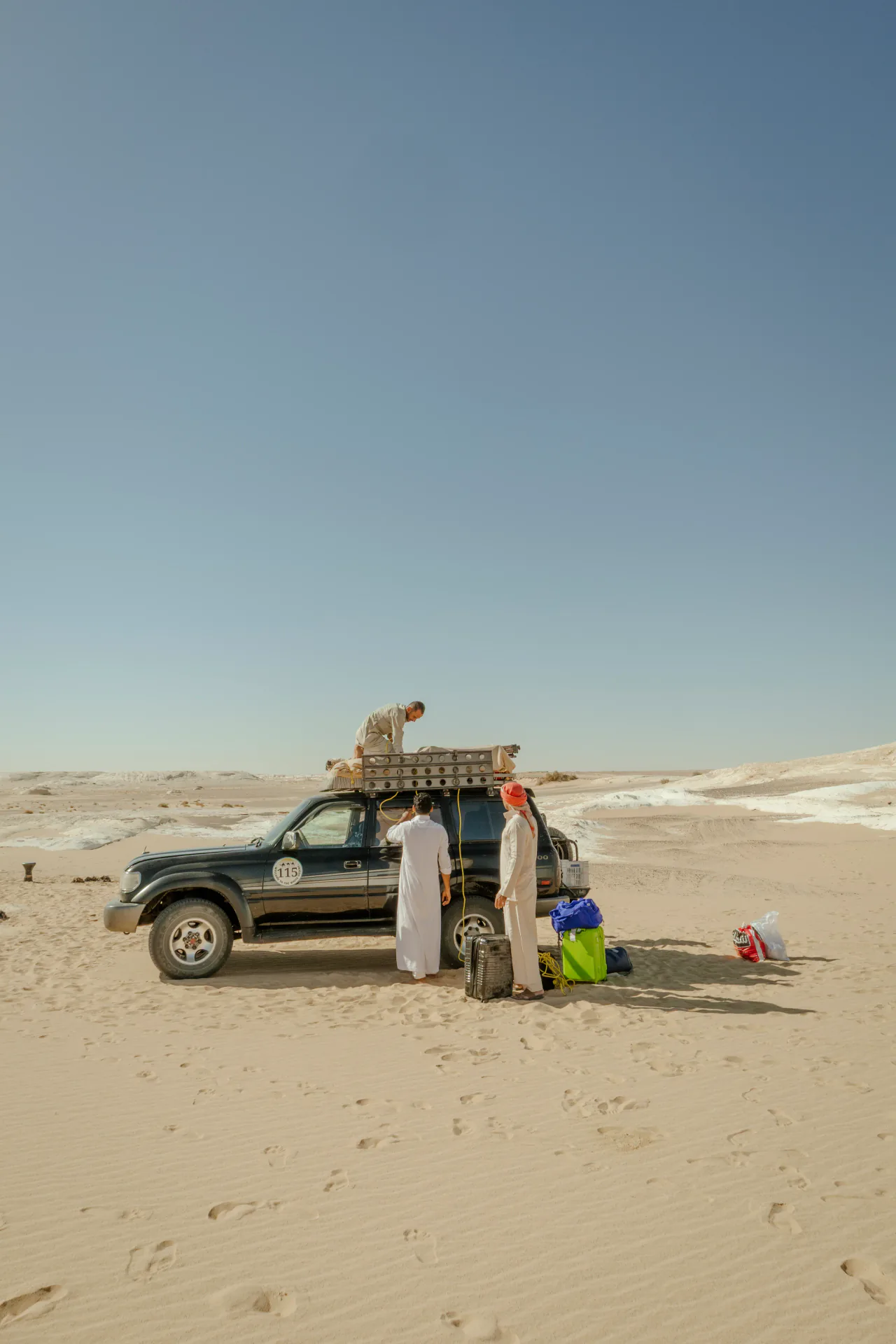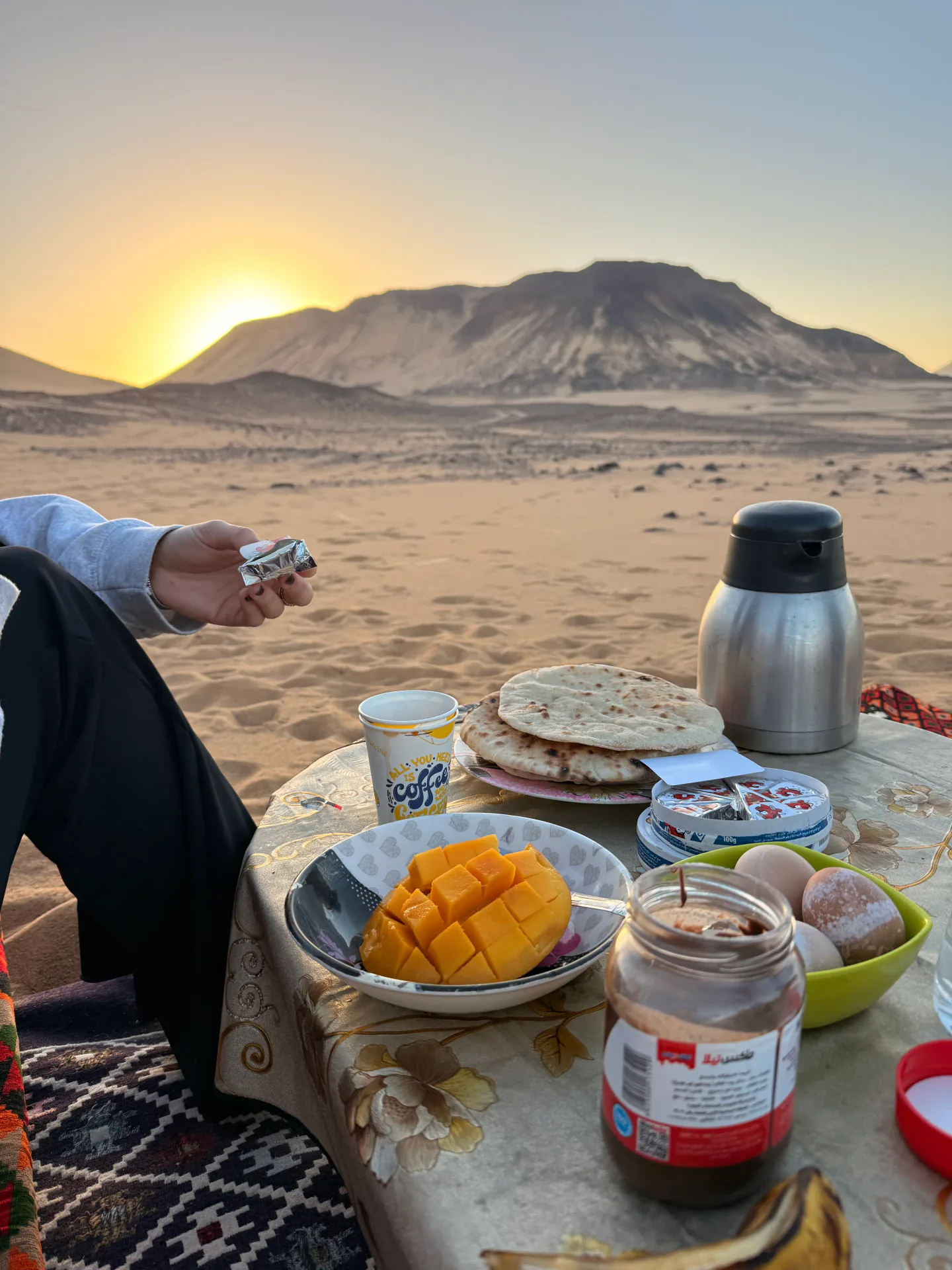
If you are comparing 2027 eclipse trips in Egypt, the phrase eclipse camp facilities should mean much more than “a tent in the desert.” On August 2, 2027, guests will be dealing with a fixed astronomical schedule, midday summer heat, camera equipment, long road transfers and the need to remain comfortable enough to enjoy totality rather than simply endure the hours around it.
That is why the 2027 Western Desert observatory camp is being planned as an event base rather than a normal overnight safari stop. The operating concept includes air-conditioned rest and accommodation areas at the observatory camp, Wi-Fi, charging, toilets, food service, drinking water, shade, first-aid and medical support, controlled guest capacity and a dedicated viewing field.
The important distinction is this: the air-conditioned facilities are part of the eclipse observatory camp operation. We are not claiming that every traditional White Desert safari camp or every remote sightseeing stop is air-conditioned. The White Desert, Black Desert, Crystal Mountain and Bahariya experiences are part of the wider journey. The eclipse camp and open-sky viewing area will be inside the path of totality, in the zone between the White Desert and the Black Desert. The exact operational point and coordinates will be shared later with confirmed guests after final terrain, access, safety, horizon and viewing-condition checks. These checks are designed to choose the best practical terrain, horizon and viewing conditions. The selected point will be astronomically verified to provide at least 6 minutes of totality.
What Exactly Is the 2027 Western Desert Eclipse Camp?
The camp is best understood as a managed eclipse observatory base in Egypt’s Western Desert, associated with the Bahariya and White Desert travel program.
It is not simply a normal tourist campsite reused for one busy day.
The event base is intended to combine several functions:
- A place for guests to rest before the eclipse.
- A controlled accommodation and service area.
- A heat-management base with cooled areas.
- A logistics hub for food, water, toilets and charging.
- A staging point for astronomy and photography equipment.
- A location from which guests can access the verified totality viewing field.
- A support point for staff, first aid and medical response.
- A controlled-capacity environment rather than an uncontrolled roadside crowd.
The broader journey can include Bahariya Oasis and White Desert attractions, but the observation field is chosen for eclipse geometry and event operations rather than because it is the most famous tourist rock formation.
Read the Western Desert eclipse camp overview for the main event concept.
Is the Eclipse Camp Air-Conditioned?
The observatory camp is planned with air-conditioned areas.
That point needs to be stated precisely because “air-conditioned camp” can be interpreted in different ways.
The purpose of cooling is not to create a city hotel in the middle of the desert. It is to give guests a genuine place to recover from August heat before and after outdoor viewing.
The viewing field itself must remain open to the sky. You cannot watch a total solar eclipse from inside a closed, fully air-conditioned room and still have the same experience.
The operating model is therefore:
- Rest and recovery in cooled observatory-camp areas.
- Shade for outdoor waiting.
- Open-sky observation during the key phases.
- Return to cooling when appropriate.
This is especially relevant during the long partial phase. Guests do not need to remain under direct midday sun from first contact until totality.
The separate article Inside the Air-Conditioned 2027 Eclipse Observatory Camp explains the heat-management concept in depth.
Air Conditioning Is at the Observatory Camp — Not Every Desert Stop
This distinction is worth repeating because accuracy matters.
A White Desert itinerary can include remote sightseeing and traditional desert environments where infrastructure is naturally more limited.
The cooling concept applies to the eclipse observatory camp and its planned guest areas.
We should not describe every safari stop, 4x4 route, natural attraction or informal desert rest point as climate-controlled.
Travelers should therefore separate two parts of the experience:
The excursion experience: Bahariya, Black Desert, Crystal Mountain, White Desert landscapes and 4x4 desert touring.
The eclipse event operation: the managed observatory camp and verified totality viewing field.
This makes the promise clearer and more credible.
Why Cooling Matters So Much on August 2, 2027
The eclipse occurs in August and the important phases happen around midday in Egypt.
The danger is not only one high temperature reading. Heat load accumulates through:
- Direct solar radiation.
- Hot ground.
- Walking.
- Carrying camera equipment.
- Long outdoor waiting.
- Dehydration.
- Poor sleep.
- Road transfers.
- Age.
- Some medications.
- Heart, respiratory, kidney or metabolic conditions.
A guest might feel comfortable at 11:30 am and much more fatigued an hour later.
The purpose of cooled facilities is to reduce the amount of continuous heat exposure.
WHO heat guidance recommends reducing time in hot environments and using cooler spaces during extreme heat when possible. That principle is built into the camp concept.
For detailed preparation, read How to Prepare for Egypt’s August Desert Heat.
Is Wi-Fi Available at the Eclipse Camp?
Wi-Fi is part of the planned observatory-camp service.
However, travelers should understand what internet access means in a remote desert event.
Do not assume:
- Fiber-like speed.
- Guaranteed 24-hour performance.
- Unlimited bandwidth for every guest.
- Perfect video calls.
- Instant upload of hundreds of RAW files.
- Zero interruption.
Remote connectivity can depend on local network conditions, equipment, power and the number of simultaneous users.
The most realistic use cases are:
- Messaging family.
- Receiving operational updates.
- Basic email.
- Checking travel information.
- Lightweight browsing.
- Limited cloud communication.
For photographers, Wi-Fi should be treated as a convenience, not a backup system for your only copy of eclipse images.
Keep your files locally.
Will Mobile Phone Service Work?
Do not build your safety or travel plan around perfect mobile coverage.
Network strength can vary by location and provider.
That is one reason a managed camp should have its own communications plan rather than assuming every guest’s roaming SIM will work equally well.
Before leaving Cairo or Bahariya:
- Download tickets.
- Save booking confirmations offline.
- Download maps.
- Screenshot emergency information.
- Save your itinerary.
- Store contact numbers locally.
- Download any eclipse timing information you need.
- Do not depend on a cloud-only copy of a prescription or passport scan.
The best remote-event plan still works when the internet becomes slow.
Charging Phones, Cameras and Batteries
Charging is one of the most important eclipse camp facilities for a modern event.
Guests may arrive with:
- Smartphones.
- Camera batteries.
- Power banks.
- Laptops.
- Tablets.
- Intervalometers.
- Tracking mounts.
- Hearing-aid chargers.
- Medical equipment.
- Portable fans.
- Communication devices.
The observatory-camp plan includes charging access.
But capacity matters.
Even with a controlled guest capacity, many devices can create concentrated demand at the same time, so travelers should not treat camp charging as unlimited personal power.
A responsible guest should still arrive with:
- Fully charged devices.
- Spare camera batteries.
- A power bank.
- Correct charging cables.
- Plug adapters where required.
- Labeled chargers.
- A plan that does not depend on finding one outlet five minutes before totality.
Charging is support infrastructure, not a substitute for preparation.
What Plug Type Is Used in Egypt?
Egypt commonly uses plug types C and F with 220V, 50Hz electrical supply.
Many modern phone and laptop chargers accept 100–240V automatically, but travelers should check the label on their own device.
You may need a plug adapter depending on your home country.
Do not confuse an adapter with a voltage converter.
If your device does not support the local voltage, ask the manufacturer what you need.
Should Photographers Bring Their Own Power Banks?
Yes.
Even with camp charging, photographers should create redundancy.
A total eclipse cannot be repeated because one battery was left on a charger.
A good photography power plan includes:
- Fully charged main battery.
- Multiple charged spares.
- Power bank.
- Camera charger.
- Tracker power if used.
- Remote-release battery.
- Phone power.
- Spare cable.
The 2027 eclipse photography guide includes a more detailed camera workflow.
What Food Is Available at the Eclipse Camp?
Food service is part of the camp operating plan.
The exact final menu should be confirmed closer to the event, because large-event catering depends on supplier arrangements, guest count, dietary requests and operational timing.
The more important principle is that eclipse-day food should support the event schedule rather than interfere with it.
A practical catering plan should prioritize:
- Simple service.
- Reliable hydration.
- Foods that tolerate the environment safely.
- Meal timing that does not conflict with the eclipse.
- Options for common dietary requirements where arranged in advance.
- Controlled food storage.
- Clean serving areas.
Guests should not expect the key eclipse period to become a long formal lunch service.
The astronomy timetable comes first.
Will Breakfast Be Included?
Package inclusion depends on the tour selected.
The 2-day, 3-day and 4-day eclipse programs do not necessarily have identical meal structures.
That is why guests should check the exact package inclusions rather than assuming every camp article defines every tour.
Use the 2027 eclipse tour package comparison for a package-by-package view.
Are Vegetarian or Special Meals Available?
Dietary requirements should be disclosed before travel.
Reasonable requests may include:
- Vegetarian meals.
- Vegan preferences.
- Food allergies.
- Gluten-related needs.
- Religious dietary requirements.
- Diabetes-related meal timing.
- Other medically important requirements.
Remote event catering has practical limits.
Do not arrive at the desert camp and disclose a severe allergy for the first time.
For serious allergies, travelers should carry prescribed emergency medication and discuss cross-contamination risk with the operator before confirming the trip.
No remote kitchen should be casually described as completely allergen-free unless that can genuinely be guaranteed.
Drinking Water: One of the Most Important Camp Facilities
In August, drinking water is not an optional amenity.
It is core event infrastructure.
The operating plan includes water availability for guests.
Travelers should still carry a personal refillable bottle so water remains accessible when moving between:
- Accommodation.
- Vehicles.
- Shade.
- Viewing area.
- Photography zone.
Do not leave your only water bottle in a vehicle parked far from the observation field.
Guests with medical fluid restrictions should follow their clinician’s advice rather than a generic hydration target.
Coffee, Tea and Soft Drinks
Beverage service may form part of the camp operation, but water remains the priority in August heat.
Coffee, tea and soft drinks can add comfort, especially in the evening or early morning.
They should not replace a proper hydration plan.
Guests should also be cautious about heavy alcohol intake before eclipse day because it can impair sleep, hydration and judgment.
What Toilets Are Available?
Toilet facilities are part of the planned observatory camp.
This is an important difference between a managed event base and an improvised roadside observation point.
Capacity matters as much as existence.
For a large eclipse event, operators need to think about:
- Number of toilets.
- Cleaning.
- Water and sanitation.
- Lighting.
- Waste management.
- Queue management.
- Distance from sleeping areas.
- Distance from viewing areas.
- Accessibility needs.
- Handwashing or sanitizing facilities.
Final event layouts should be confirmed as infrastructure is finalized.
Are There Showers?
Shower availability can depend on the exact camp layout and package configuration.
Do not assume a city-hotel bathroom standard from the phrase “eclipse camp.”
If private showers or specific bathing facilities are important to you, confirm the exact arrangement for your selected package before booking.
The safest content strategy is to promise only what is operationally confirmed.
Is There Shade?
Yes, shade is part of the event concept and it matters enormously in August.
Shade areas allow guests to:
- Wait between viewing intervals.
- Eat.
- Rest.
- Prepare equipment.
- Sit with children.
- Recover after outdoor exposure.
- Avoid unnecessary direct sunlight.
Shade should be securely installed for desert wind and positioned so it does not obstruct the observation field.
The open viewing zone and shaded guest zone serve different purposes.
Is Seating Provided?
Seating is an important part of a managed observatory camp.
Not every guest wants to stand for a long partial phase.
Seating is particularly valuable for:
- Older travelers.
- Families.
- Guests with mobility limitations.
- People recovering from heat.
- Anyone waiting between eclipse phases.
Photographers may use their own stools or equipment chairs, but they should keep them out of walking routes and tripod zones.
How Close Is the Viewing Field to the Camp?
The goal of the observatory-camp model is to avoid unnecessary movement during the hottest and most time-sensitive part of the day.
The viewing field should be operationally connected to the camp so guests can move between rest, shade, services and observation without a complicated last-minute transfer.
Final walking distances and field layout should be confirmed when the exact operational map is released.
That matters for:
- Older travelers.
- Families with young children.
- Photographers carrying gear.
- Travelers with mobility limitations.
- Medical response.
Is the Camp Actually Inside Totality?
The camp operation is built around a viewing area in confirmed Western Desert eclipse-camp region between the White Desert and the Black Desert, inside the path of totality.
That distinction matters because not every site marketed under the broad label “White Desert” is automatically inside the total path.
The famous White Desert tourist formations should not be treated as the observation coordinate unless they have been independently verified.
Read the 2027 path of totality in Egypt guide for the geographic framework.
Why the Camp Is Linked to Bahariya Rather Than a Random Desert Point
Bahariya provides a practical gateway from Cairo into the Western Desert.
It supports:
- Road access.
- Local desert expertise.
- 4x4 operations.
- Fuel and supplies.
- Accommodation.
- Staff logistics.
- Food sourcing.
- Water.
- Vehicle coordination.
- Access to White Desert excursions.
The eclipse field itself is selected for totality and operations, not simply for proximity to one tourist attraction.
Read Bahariya Oasis: Your Gateway to Egypt’s Western Desert for the broader route.
First Aid and Medical Support
First aid and medical support are part of the planned event operation.
This is important because remote desert travel changes how quickly outside medical care can be reached.
A serious plan should include:
- First-aid capability.
- Staff responsibilities.
- Communication.
- Vehicle access.
- Escalation procedures.
- Awareness of heat illness.
- A route to appropriate medical care.
The camp should never be marketed as a hospital.
It is an event operation with medical preparedness, not a substitute for a medical facility.
Travelers with significant health conditions should discuss the trip with their clinician and disclose operational needs before travel.
Read Eclipse Travel for Seniors and Travelers With Health Conditions for detailed planning.
What Happens if Someone Develops Heat Exhaustion?
The first response is to stop exposure and move the person to a cooler environment.
Symptoms can include:
- Weakness.
- Dizziness.
- Headache.
- Nausea.
- Heavy sweating.
- Unusual fatigue.
- Faintness.
A person should not be pressured to remain outside because totality is approaching.
Confusion, collapse, seizure or loss of consciousness can indicate a medical emergency and require urgent professional response.
The eclipse is never more important than the patient.
Are There Facilities for Seniors?
The camp model is intended to reduce unnecessary exertion, which benefits older travelers.
Useful features include:
- Seating.
- Shade.
- Cooling.
- Toilets.
- Vehicle access.
- Water.
- Shorter movement between services and viewing.
- Staff support.
- Medical planning.
However, “senior-friendly” does not automatically mean wheelchair accessible.
Travelers with specific mobility needs should ask about:
- Ground surface.
- Steps.
- Toilet access.
- Vehicle entry.
- Walking distance.
- Wheelchair or walker storage.
- Assistance.
Is the Camp Suitable for Children?
Families can join when children are able to participate safely and parents understand the environment.
Useful camp features for children include:
- Shade.
- Cooling.
- Seating.
- Water.
- Toilets.
- Controlled guest areas.
- Safe eclipse glasses.
- Clear supervision rules.
Parents should not expect staff to replace parental supervision.
During partial phases, children need correct solar viewers and direct adult supervision.
Read Solar Eclipse Safety for Children.
Eclipse Glasses at the Camp
The viewing operation should include a clear solar-safety briefing.
During partial phases, direct solar viewing requires safe eclipse glasses or another proper solar-viewing method.
Ordinary sunglasses are not sufficient.
Cameras, binoculars and telescopes need separate front-mounted solar filters.
Guests should inspect viewers before use and follow event instructions about when protection can be removed during true totality and when it must be replaced.
Read the ISO 12312-2 eclipse glasses guide.
Is There a Dedicated Photography Area?
A managed field benefits from separating serious photography setups from general guest movement where practical.
Photographers may arrive with:
- Long telephoto lenses.
- Trackers.
- Multiple tripods.
- Video cameras.
- Audio equipment.
- Large battery systems.
A dedicated or organized photography zone can reduce:
- Trip hazards.
- View obstruction.
- Accidental tripod movement.
- Bright screen disturbance.
- Congestion during C2 and C3.
Final field zoning should be confirmed closer to the event.
Can I Bring a Telescope?
Potentially, but specialized equipment should be discussed in advance.
Large telescopes or mounts affect:
- Vehicle loading.
- Storage.
- Setup space.
- Power needs.
- Field spacing.
- Safety.
Solar observation also requires proper front-aperture solar filters during partial phases.
Do not bring an unfiltered telescope to a public eclipse field and attempt to improvise.
How Much Luggage Can I Bring?
Desert transport is different from a hotel transfer.
4x4 vehicles, support vehicles and camp logistics have finite capacity.
Guests with large photography cases, mobility devices, medical equipment or oversized luggage should notify the operator before travel.
Do not assume that a vehicle can absorb unlimited hard cases.
A well-organized manifest makes the event safer.
Wi-Fi vs Charging vs Communications: Three Different Things
Travelers often combine these into one question, but they are different systems.
Wi-Fi is guest internet access.
Charging is electrical power for devices.
Operational communications are how staff coordinate vehicles, field teams and emergencies.
A resilient camp should not depend on guest Wi-Fi for operational safety.
Likewise, guests should not assume that charging access guarantees uninterrupted high-speed internet.
Understanding the distinction helps set realistic expectations.
What About Backup Power?
Backup power is important for a heat-sensitive event.
The camp operating plan needs to account for power demand from:
- Cooling.
- Lighting.
- Charging.
- Communications.
- Food service.
- Medical support equipment where applicable.
Final generator and redundancy specifications should be treated as operational details that may evolve as capacity is finalized.
The key question for travelers is not the brand of generator.
It is whether the operator has planned for power failure.
How Controlled Capacity Improves the Facilities
One of the least glamorous camp facilities is capacity control.
It may be one of the most important.
A camp can have excellent toilets, water, charging and shade on paper but fail if guest numbers exceed the infrastructure.
Controlled capacity lets the operator match:
- Water volume.
- Toilet capacity.
- Food service.
- Vehicle seats.
- Shade.
- Charging.
- Staff.
- Medical coverage.
- Parking.
- Photography spacing.
- Cooling.
- Waste management.
This is why “how many people?” is a facilities question, not only a crowd question.
What Happens to Waste?
A remote camp should have a waste-management plan.
That includes:
- Food waste.
- Plastic.
- Bottles.
- Sanitary waste.
- General litter.
- Equipment packaging.
The Western Desert is not a disposable event venue.
Responsible operations should remove waste and minimize impact on the landscape.
Guests can help by using refillable bottles where practical and keeping personal waste contained.
Is the Camp a Luxury Glamping Resort?
It is better to think of it as a specialized eclipse observatory camp with comfort infrastructure.
The purpose is not to imitate a five-star city resort.
The purpose is to solve the problems that matter for August 2027:
- Heat.
- Rest.
- Toilets.
- Food.
- Water.
- Power.
- Charging.
- Connectivity.
- Medical preparedness.
- Viewing access.
- Crowd control.
Some travelers may describe that as luxury because it is far more comfortable than basic desert camping.
But operational accuracy is stronger than exaggerated language.
What Is Included in My Exact Package?
This article explains the camp infrastructure.
It does not replace the inclusions list for your tour.
The 2-day, 3-day and 4-day programs may differ in:
- Number of nights.
- Hotel accommodation.
- Desert excursions.
- Meals.
- Transfers.
- Sightseeing.
- Activities.
- Camp nights.
- Return schedule.
Use the 2027 eclipse tour package comparison and the eclipse packages page for package-specific inclusions. If these camp facilities are important to your decision, the packages page is the next step: choose the 2-day, 3-day or 4-day Western Desert structure, then continue to availability and booking.
What Should I Still Bring Even if the Camp Is Well Equipped?
A managed camp reduces risk but does not remove personal preparation.
Bring:
- Passport.
- Booking documents.
- Personal medication.
- Refillable water bottle.
- Sun hat.
- Lightweight long sleeves.
- Sunscreen.
- Normal sunglasses.
- Safe eclipse glasses.
- Phone.
- Power bank.
- Charging cable.
- Plug adapter if needed.
- Camera batteries.
- Memory cards.
- Comfortable shoes.
- Personal hygiene items.
- Small flashlight or headlamp.
- Prescription glasses.
- Hearing-aid batteries if needed.
- Travel-insurance details.
A facility should support your trip, not replace basic packing.
What You Should Not Expect
Setting realistic expectations is part of good trip planning.
Do not assume the camp provides:
- Unlimited high-speed internet.
- A private hotel bathroom for every guest unless specifically confirmed.
- Instant urban hospital access.
- Unlimited electrical sockets.
- A guaranteed cloud-free sky.
- City-level mobile coverage.
- Unlimited luggage capacity.
- Every possible dietary product.
- A completely dust-free environment.
- Air conditioning at every sightseeing stop in the desert.
The observatory camp is designed to be significantly more supported than ordinary desert camping, but it remains a remote-event operation.
How the Camp Differs From a Normal White Desert Safari
A normal cool-season White Desert safari may prioritize simplicity:
- 4x4 travel.
- Traditional camp.
- Open-air meals.
- Stargazing.
- Basic desert sleeping.
- Minimal power.
That experience can be wonderful in the right season.
An August eclipse operation needs more infrastructure because guests are gathering for a fixed midday astronomical event.
The observatory camp adds a different operational layer:
| Facility | Normal Desert Safari | 2027 Eclipse Observatory Camp Concept |
|---|---|---|
| Cooling | Often limited or unnecessary in cool season | Air-conditioned observatory-camp areas planned for August heat |
| Power | Basic or limited | Planned event power and charging |
| Internet | May be limited | Wi-Fi planned, subject to remote-network conditions |
| Toilets | Varies by camp style | Event toilet capacity included in operations |
| Medical support | Guide first aid may be the main layer | First aid and medical support included in event planning |
| Guest numbers | Small safari group | Controlled event capacity matched to infrastructure |
| Viewing area | Chosen for camping and scenery | Chosen for verified totality plus event operations |
That distinction explains why the eclipse camp should not be judged by ordinary safari expectations.
A Sample Eclipse-Day Facilities Flow
The exact event schedule will depend on the final coordinates and operating plan, but the camp is designed around a flow like this.
Early Morning
Guests wake, eat, hydrate, prepare medication and camera equipment, and attend a safety briefing.
Charging can be completed before the critical viewing period.
Before First Contact
Guests move between shaded or cooled areas and the observation field.
Photographers finalize setup.
Families identify toilets, water and seating.
Partial Phase
Guests use eclipse glasses and observe selected intervals.
They do not need to remain outdoors continuously.
Cooling, shade, food and water remain accessible.
Before Totality
Unnecessary activity slows down.
Guests return to the viewing field.
Staff focus on timing, safety and crowd control.
Totality
The event becomes the only priority.
After Totality
Eye protection returns as bright sunlight reappears.
Guests move back toward shade and cooling.
Food, water and toilets become important again.
Equipment is packed gradually.
Departure
Vehicles leave in a controlled sequence rather than everyone rushing at once.
Why Facilities Matter More Than an Extra Few Seconds of Totality
Travel marketing often focuses on one number: totality duration.
But a six-minute eclipse is not enjoyable if a guest is dehydrated, standing in a toilet queue, trying to charge a dead camera or unable to find shade.
A strong eclipse site balances:
- Duration.
- Weather climatology.
- Access.
- Comfort.
- Safety.
- Capacity.
- Logistics.
That is why facilities are part of the astronomical experience.
They protect the few minutes that travelers have crossed the world to see.
Frequently Asked Questions
Is the 2027 eclipse camp fully air-conditioned?
The observatory-camp plan includes air-conditioned guest areas for rest and recovery. The outdoor viewing field itself is open to the sky. Air conditioning should not be interpreted as applying to every White Desert excursion stop.
Is there Wi-Fi at the eclipse camp?
Wi-Fi is part of the planned camp service, but remote connectivity may not perform like city broadband. Guests should keep important documents and eclipse information available offline.
Can I charge my phone?
Charging access is part of the operating plan. Arrive with devices already charged and bring a power bank as backup.
Can I charge camera batteries?
Yes, charging is part of the planned infrastructure. Serious photographers should still bring multiple charged batteries.
Is food included?
Food service is part of the camp operation, but exact meal inclusion depends on the tour package. Check the specific package itinerary.
Is drinking water available?
Water availability is a core part of the August camp plan. Guests should also carry a refillable personal bottle.
Are there toilets?
Yes, toilet facilities are part of the planned event infrastructure. Final quantity and layout depend on confirmed event capacity.
Are there showers?
Specific shower arrangements should be confirmed for the selected package and final camp configuration.
Is there medical support?
First aid and medical support are part of the planned event operation. The camp is not a hospital, and travelers with significant health concerns should speak with their clinician before travel.
Is the camp suitable for seniors?
The design includes features such as seating, shade, cooling, toilets and vehicle access that can reduce exertion. Travelers with specific mobility or medical needs should confirm suitability individually.
Is the camp wheelchair accessible?
Do not assume full wheelchair accessibility without confirming the final surface, toilet and vehicle arrangements. Desert ground can be uneven.
Can children attend?
Families can participate when parents supervise children and follow heat and solar-viewing safety guidance.
Are eclipse glasses provided?
No. The current package information states that eclipse viewers are planned to be available separately. The viewing operation should still include a clear solar-safety briefing, and guests may choose to bring their own verified spare viewers.
Can I bring a telescope?
Specialized astronomy equipment should be discussed in advance because of transport, power, space and solar-filter requirements.
Is there a photography zone?
The event concept allows for organized photography setup so tripods and large equipment can be separated from general guest movement where practical.
Is the camp in the White Desert?
The product is part of a Bahariya/White Desert Western Desert program, but the eclipse observation field is a separately verified totality location. Do not assume the famous White Desert formations themselves are the totality point.
Can I upload photos from the camp?
Possibly, but do not rely on remote Wi-Fi for large RAW uploads. Back up images locally first.
Is there backup electricity?
Power resilience is part of the event-planning requirement. Final generator and redundancy specifications should be reconfirmed before travel.
Can you guarantee a clear sky?
No operator can guarantee eclipse visibility. Historical climatology helps location selection, but clouds, dust or haze remain possible.
What is the biggest facility advantage?
The biggest advantage is not one amenity. It is the combination of cooling, shade, water, toilets, power, charging, communications, medical preparedness and controlled capacity close to the viewing operation.
Final Takeaway
The 2027 eclipse camp is not being designed as a normal desert campsite with a few extra chairs.
It is being designed as an observatory camp for a fixed, high-demand astronomical event in August.
The planned infrastructure includes air-conditioned observatory-camp areas, Wi-Fi, charging, food service, water, toilets, shade, seating, first aid, medical support, controlled capacity and organized access to a verified totality viewing field.
Some facilities will be familiar from a hotel.
Others are specifically important because this is a remote eclipse event.
The standard to judge the camp by is therefore not “does it feel like a city resort?”
The better question is:
Does the camp solve the operational problems that could stop me from enjoying totality?
For the full setup, see the Western Desert eclipse camp. For the cooling concept, read Inside the Air-Conditioned 2027 Eclipse Observatory Camp. Then compare the 2-day, 3-day and 4-day eclipse packages and check availability.
Sources and Verification Notes
The operational description in this article is based on the current Solar Eclipse Tours observatory-camp plan, which includes air conditioning at the observatory camp, Wi-Fi, charging, toilets, food service, water, first aid, medical support and controlled capacity.
For health and solar-viewing principles, final publication should continue to reference current guidance from:
Operational details, final capacity, Wi-Fi configuration, toilet quantities, field layout, meal schedule and electrical redundancy should be reconfirmed against the live camp plan before travel.