longest solar eclipse 2027: quick answer
longest solar eclipse 2027: The longest solar eclipse of 2027 will occur on August 2, when a total solar eclipse crosses parts of southern Europe, North Africa and the Middle East. At the point of greatest duration, NASA GSFC calculations give a maximum totality of approximately
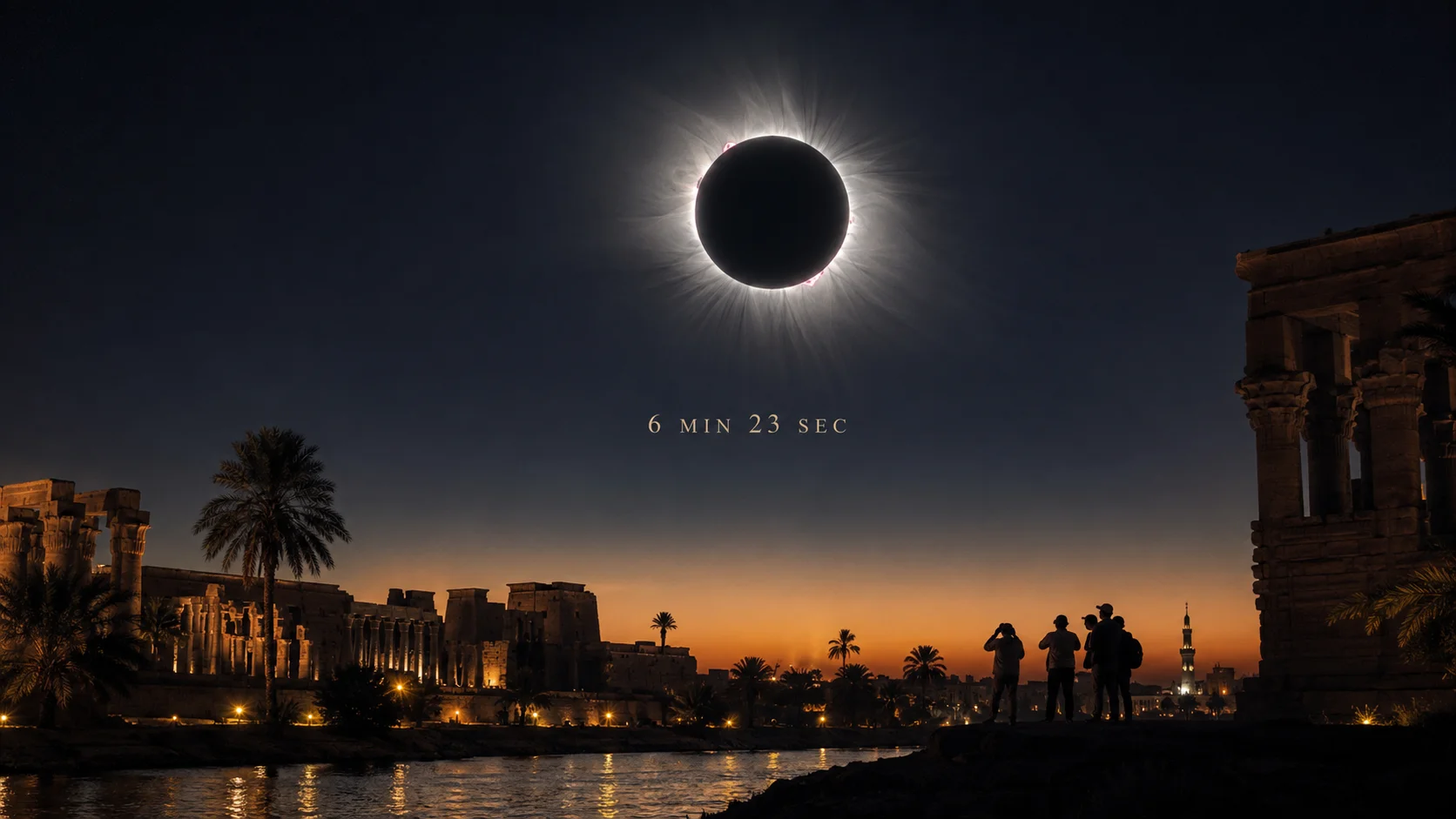
The longest solar eclipse of 2027 will occur on August 2, when a total solar eclipse crosses parts of southern Europe, North Africa and the Middle East. At the point of greatest duration, NASA GSFC calculations give a maximum totality of approximately 6 minutes 23.2 seconds. That makes the event unusually long by modern eclipse standards and the longest total solar eclipse since July 22, 2009.
The number is remarkable, but it must be used correctly. Six minutes 23.2 seconds is the maximum along the entire global path. It is not the duration at every city, oasis, desert camp or tour location. A site’s actual totality depends on its exact latitude and longitude and its position within the path of the Moon’s central shadow.
For Egypt, this distinction is especially important. NASA places both greatest eclipse and greatest duration at coordinates within Egypt, giving the country an exceptional astronomical position. However, travelers still need a verified viewing coordinate, reliable access, a clear horizon and a safe plan for spending several hours outdoors in August conditions.
This guide explains why the eclipse lasts so long, how it compares with other major eclipses, what the 6-minute figure means for observers and why a successful viewing experience depends on much more than choosing a famous destination.
The Verified 2027 Eclipse Numbers
NASA GSFC publishes two related reference points for the August 2, 2027 total solar eclipse.
The point of greatest eclipse is the location where the axis of the Moon’s shadow passes closest to the center of Earth. NASA lists it near latitude 25°30.3′ north and longitude 33°11.0′ east. At that point, the central duration is about 6 minutes 22.6 seconds, the Sun is more than 81 degrees above the horizon and the path is approximately 257.7 kilometers wide.
The point of greatest duration is the location where totality lasts longest. NASA lists it near latitude 26°49′ north and longitude 31°08′ east. There, totality reaches approximately 6 minutes 23.2 seconds, with the Sun nearly 81 degrees high and a path width of about 257.2 kilometers.
These two points are not identical. “Greatest eclipse” and “greatest duration” describe different aspects of the geometry. In ordinary travel marketing, the difference of less than one second between them is not important. In accurate eclipse writing, however, the distinction should be preserved.
The strongest public-facing statement is therefore:
The August 2, 2027 total solar eclipse can reach approximately 6 minutes 23 seconds of totality at the point of greatest duration in Egypt.
It is less accurate to say that every Egyptian viewing location receives 6 minutes 23 seconds, or that every place within the path has the same duration.
Why Is the 2027 Total Solar Eclipse So Long?
A long total solar eclipse requires several favorable conditions to occur together. No single factor explains the duration by itself.
1. The Moon Appears Large Enough to Cover the Sun Generously
A total solar eclipse is possible because the Moon can appear almost the same size as the Sun in our sky. Although the Sun is physically much larger, it is also much farther away.
The apparent size of the Moon changes because its orbit around Earth is elliptical. When it is closer to Earth, it looks slightly larger. When it is farther away, it looks smaller.
For a long total eclipse, the Moon must appear large enough not only to cover the Sun, but to create a relatively broad and deep umbral shadow. The 2027 eclipse has an eclipse magnitude of approximately 1.0790 in NASA’s catalog. In simple terms, the apparent lunar disk is comfortably large enough to cover the solar disk along the central path.
This does not mean the Moon is at its absolute closest possible distance, nor should the event be reduced to a slogan about a “supermoon.” Eclipse duration depends on the combined geometry of the Moon, Sun and Earth, not a single popular label.
2. The Sun’s Apparent Size Is Favorable
Earth’s orbit around the Sun is also elliptical. The Sun’s apparent diameter changes slightly during the year.
The August 2027 geometry helps create a favorable apparent-size relationship between the Moon and Sun. The larger the Moon appears relative to the Sun, the longer it can take for the Sun’s bright face to re-emerge after totality begins.
Again, this is a combined effect. A large-looking Moon helps, but shadow speed and the observer’s position are equally important.
3. The Shadow Passes Across Low-Latitude Regions
The 2027 path crosses regions relatively close to the equator compared with many high-latitude eclipse paths.
Earth rotates fastest in linear surface speed near the equator. The Moon’s shadow is also moving across Earth. When Earth’s rotational motion and the shadow’s movement combine favorably, an observer can remain inside the umbra longer.
This is one reason long total eclipses often reach their greatest durations in tropical or subtropical latitudes rather than near the poles.
The relationship is not as simple as “closer to the equator always means longer.” The direction of the path, shadow geometry and Earth-Moon distances all matter. But the low-latitude route of the 2027 eclipse contributes to its long duration.
4. The Shadow Axis Passes Relatively Close to Earth’s Center
NASA’s eclipse catalog gives the event a gamma value of approximately 0.1421.
Gamma describes how far the axis of the Moon’s shadow passes from the center of Earth, measured in Earth radii. A value close to zero means the shadow axis passes relatively near Earth’s center. This generally supports a broad, favorable central path and a high Sun near the central portion.
The 2027 gamma is not exactly zero, but it is small enough to place the central eclipse across low latitudes with strong geometry.
5. The Sun Is Very High at the Key Egyptian Locations
At greatest duration, NASA gives a solar altitude of about 80.9 degrees. At greatest eclipse, it is about 81.7 degrees.
A high Sun is valuable for several reasons.
Astronomically, it reflects the central, favorable geometry of the path. Practically, it reduces the chance that mountains, buildings or a low horizon will block the event. It also creates a broad range of potential observing areas.
A high Sun does not eliminate the need to inspect the local horizon. Dust, clouds, nearby terrain, equipment placement and camp structures can still affect visibility. It also creates a serious heat-management challenge because the eclipse occurs around midday in August.
6. The Observer Near the Centerline Crosses a Deeper Part of the Umbra
The path of totality has northern and southern boundaries and a central line.
Near the path boundaries, the observer only clips the edge of the Moon’s umbra, so totality is short. Moving toward the center generally increases duration because the observer passes through a wider portion of the shadow.
The exact point of greatest duration is more nuanced than simply “the centerline,” but for travelers the practical rule is useful: a location securely inside the path and reasonably close to its central region usually receives a longer total phase than a site near the edge.
This is why precise coordinates matter more than a broad destination name.
Is 6 Minutes 23 Seconds a Record?
No. The 2027 eclipse is exceptionally long, but it is not the longest total solar eclipse in history, the millennium or the 21st century.
NASA’s long-eclipse catalog lists the July 22, 2009 total solar eclipse at approximately 6 minutes 39 seconds at greatest duration. That event was longer than the 2027 eclipse.
NASA also lists future total eclipses that will exceed the 2027 duration. The June 3, 2114 eclipse reaches approximately 6 minutes 32 seconds, while the June 13, 2132 eclipse reaches approximately 6 minutes 55 seconds. The exceptionally long July 16, 2186 total solar eclipse is calculated at about 7 minutes 29 seconds.
The accurate claim is:
The August 2, 2027 eclipse will be the longest total solar eclipse since 2009, and no longer total eclipse occurs until 2114.
That is still a powerful distinction. It places the event within an interval of more than a century between longer total eclipses, without inventing an “87-year record” or describing it as the longest eclipse of the century.
Why the “Longest Since 2009” Wording Matters
Eclipse content is often copied and simplified until accurate statements become misleading.
For example:
- “The longest eclipse in 100 years” is not precise.
- “The longest totality since 1991” is false because 2009 was longer.
- “The longest eclipse until 2114” is incomplete unless it says no longer total solar eclipse occurs before then.
- “Egypt gets 6 minutes 23 seconds everywhere” is false.
- “The White Desert gets the maximum duration” requires an exact coordinate and cannot be assumed from the regional name.
Trust is particularly important for eclipse travelers. Many experienced observers compare maps, durations and path tables before booking. An operator that uses cautious, source-based language can build credibility rather than trying to win attention with an exaggerated record.
How the 2027 Eclipse Compares With Other Modern Total Eclipses
| Eclipse | Maximum totality | Why it matters |
|---|---|---|
| July 22, 2009 | About 6m39s | Longer than 2027; previous longer total eclipse |
| August 21, 2017 | About 2m40s | Crossed the United States and introduced many travelers to totality |
| April 8, 2024 | About 4m28s | Long North American totality, but still substantially shorter than 2027 |
| August 12, 2026 | About 2m18s | The total eclipse immediately before 2027 |
| August 2, 2027 | About 6m23.2s | Longest total eclipse since 2009; greatest duration in Egypt |
| July 22, 2028 | About 5m10s | Long event across Australia and nearby regions, but shorter than 2027 |
| June 3, 2114 | About 6m32s | First later total eclipse to exceed the 2027 maximum |
These figures compare global maxima, not durations at every observing location.
The difference between 2024 and 2027 is particularly striking. A four-and-a-half-minute total eclipse is already considered generous. Adding nearly two more minutes gives observers significantly more time to look at the corona, notice the horizon, photograph changing exposure levels and experience the environment without the entire total phase feeling instantaneous.
Six Minutes Can Still Feel Very Short
On a timetable, six minutes sounds long. During totality, it can feel surprisingly brief.
The transition into totality commands attention. The final light disappears, the corona emerges and the landscape changes rapidly. Observers may want to photograph the diamond ring, examine prominences, look for planets, study the corona, turn around to see the horizon and simply absorb the scene.
Trying to complete too many tasks can make even a long totality feel rushed.
The advantage of the 2027 duration is not that every second should be filled with equipment adjustments. It gives observers room to slow down.
A sensible personal plan may divide totality into broad priorities:
- Watch the beginning with your own eyes.
- Allow preconfigured cameras to operate with minimal intervention.
- Examine the corona and horizon.
- Notice temperature, wind and the reactions of the group.
- Prepare calmly for the return of direct sunlight.
- Replace eye protection immediately after totality ends.
A long totality rewards preparation because less time is lost deciding what to do.
Duration at a Tour Camp Must Be Calculated Separately
A tour operator should not copy the global maximum into a package page as though it were the camp duration.
The correct workflow is:
- Fix the exact viewing coordinates.
- Check the coordinate against NASA GSFC path data.
- Calculate local first, second, third and fourth contact times.
- Calculate local totality duration.
- Check solar altitude and azimuth.
- Verify the site on the ground.
- Publish the coordinate or a sufficiently clear mapped location when operationally appropriate.
- State the source and date of the calculation.
- Recheck the figures before final guest documentation.
Minor differences can also appear between calculators because of lunar-limb models, elevation, Earth rotation assumptions and rounding. Close to the path boundaries, the mountains and valleys along the Moon’s edge matter more.
For a camp well inside the path, these refinements are unlikely to change a multi-minute totality into a partial eclipse, but they can change contact times and the final stated duration.
Why Egypt Is Central to the 2027 Eclipse
Egypt is not merely one of many countries touched by the path.
NASA places the point of greatest duration and the point of greatest eclipse inside Egypt. This gives the country a central role in the global event.
The path enters North Africa after crossing southern Spain and the Mediterranean region, then continues through countries including Morocco, Algeria, Tunisia and Libya before crossing Egypt and moving toward the Red Sea and Arabian Peninsula.
Within Egypt, the totality corridor is broad enough to include multiple potential viewing regions. This creates choice, but it also creates competing claims.
Some travelers will prioritize Luxor and its archaeological landscape. Others may consider the Red Sea, Siwa or areas of the Western Desert. The correct choice depends on more than duration.
A location comparison should evaluate:
- Verified totality duration.
- Distance from the path boundaries.
- Historical cloud and dust conditions.
- Horizon quality.
- Road access.
- Accommodation capacity.
- Crowd density.
- Heat protection.
- Medical and emergency support.
- Ability to control lights and equipment zones.
- Permits and environmental restrictions.
- Local operational experience.
The best place in Egypt to watch the 2027 eclipse should therefore be presented as a reasoned comparison, not a universal slogan.
Is the White Desert the Point of Greatest Duration?
Not as a general geographic claim.
The phrase “White Desert” can refer to the protected landscape and tourism routes associated with Farafra, while tours may also use the name more broadly for Western Desert itineraries involving Bahariya, the Black Desert and other formations.
NASA’s point of greatest duration is an exact coordinate. Whether a named camp or excursion area lies near it must be checked directly.
The confirmed operational position is:
Our eclipse camp and viewing point are confirmed in the Between the White Desert and the Black Desert, inside the path of totality region, with White Desert experiences included according to the selected itinerary.
Once the exact operational GPS coordinate is finalized, the operator can publish the calculated local duration.
This distinction protects both scientific credibility and customer expectations.
Duration Is Not the Only Measure of a Good Viewing Site
A location offering a few additional seconds is not automatically better than a site with stronger access, comfort and contingency planning.
For most travelers, the difference between 6 minutes 5 seconds and 6 minutes 15 seconds will matter less than:
- Whether they arrive before roads become congested.
- Whether they can remain hydrated.
- Whether the toilet facilities are adequate.
- Whether there is shade and an air-conditioned recovery area.
- Whether the horizon is unobstructed.
- Whether vehicles and tripods are organized safely.
- Whether the team can communicate contact phases clearly.
- Whether an emergency response plan exists.
- Whether the site is legally permitted.
Eclipse chasing always involves uncertainty. Clouds can affect even a perfectly selected coordinate. The goal is to combine strong astronomical circumstances with responsible operations.
Why August Heat Changes the Planning Equation
The eclipse occurs near midday on August 2.
A high solar altitude is excellent for avoiding low-horizon obstacles, but it also means guests will be exposed to strong summer conditions during the long partial phases.
The full event is much longer than totality. Guests may arrive early to avoid traffic, set up equipment and receive safety briefings. They may remain on site through the post-totality partial phase before departure.
A six-minute totality can therefore require many hours of controlled outdoor operations.
A specialized camp should plan for:
- Continuous access to drinking water.
- Electrolyte and meal planning.
- Shade close to the viewing field.
- Air-conditioned lounges or rest tents.
- Air-conditioned sleeping accommodation where promised.
- Backup generators and fuel.
- Toilets and handwashing.
- Staff trained to identify heat stress.
- Medical supplies and an escalation plan.
- Communications between the camp and vehicles.
- Schedule adjustments that avoid unnecessary exertion.
- Separate arrangements for children and vulnerable travelers.
The phrase “fully air-conditioned camp” should be defined accurately. The observation field itself must remain open to the sky. Climate-controlled spaces should sit beside it, allowing guests to rest before and after the central phase.
Eclipse Safety Does Not Change Because Totality Is Long
Six minutes of totality does not mean six minutes of flexible safety rules.
During the partial phases before and after totality, observers must use safe eclipse glasses or handheld solar viewers when looking directly at the Sun.
Only when the Sun’s bright face is completely covered may observers inside the path look directly without solar viewers. Eye protection must be replaced as soon as direct sunlight returns.
Cameras, binoculars and telescopes require proper solar filters over the front of the optics during partial phases. Wearing eclipse glasses behind an unfiltered optical instrument is unsafe because the concentrated light can damage the filter and the eye.
A managed camp should not rely on every guest following an app independently. Clear announcements should identify the approach of totality, the safe interval and the moment when glasses must return.
The 2027 Eclipse and Saros 136
The August 2, 2027 eclipse belongs to Saros series 136.
A Saros is a cycle of approximately 18 years, 11 days and 8 hours after which the Sun, Moon and Earth return to a similar eclipse geometry. Eclipses in the same Saros family share related characteristics, but their paths occur in different parts of Earth because of the extra eight hours.
The long July 22, 2009 eclipse also belongs to Saros 136. The 2027 event is its next member.
This relationship helps explain their similarity. Both have large eclipse magnitudes and long totality durations. As the series evolves, its eclipses shift in latitude and their durations gradually change.
Saros relationships do not make the events identical. Weather, geography, accessibility and local duration differ. But the family link provides useful scientific context for why 2009 and 2027 appear together in discussions of long total eclipses.
Why the 2027 Eclipse Is Valuable for First-Time Observers
A short total eclipse can be overwhelming. The first appearance of the corona may consume most of an observer’s attention before the return of sunlight.
The long 2027 totality gives first-time viewers more opportunity to understand what they are seeing.
They can notice that the corona is structured rather than a uniform halo. They may see streamers extending farther in some directions. They can inspect the horizon and compare its glow with the dark overhead sky. They can notice the behavior of people, wind and temperature.
The additional time also helps families. Adults can supervise children through the transition, confirm that glasses are removed only during totality and still have time to experience the scene themselves.
Long duration does not remove the need for rehearsal, but it makes the event more forgiving.
Why the Eclipse Is Valuable for Photographers
Photographers benefit from the wider time window, especially when using automated or preprogrammed sequences.
Potential targets include:
- The final partial crescent.
- Baily’s beads.
- The first diamond ring.
- Chromosphere and prominences.
- Inner corona.
- Extended corona.
- Earthshine on the Moon in advanced exposures.
- Wide-angle landscape scenes.
- The 360-degree horizon.
- The second diamond ring.
No single exposure captures the entire dynamic range of the corona. Photographers often bracket exposures, then process them carefully later.
A long totality provides more opportunities to bracket without sacrificing the entire personal experience. The best advice remains to automate as much as possible and spend part of the event looking away from the screen.
A dedicated viewing field should provide clear equipment spacing and prevent late vehicle movement near tripods.
Can Weather Cancel the Astronomical Event?
The eclipse occurs regardless of local weather. Clouds can prevent observers from seeing it.
No operator can guarantee visibility, even in a region with favorable historical climate.
This should be stated clearly in booking terms and educational content. The value of a professional plan lies in:
- Selecting a region with a strong seasonal case.
- Monitoring forecasts and local conditions.
- Understanding dust and cloud patterns.
- Preserving mobility where possible.
- Avoiding promises that conflict with permits or road realities.
- Explaining the weather risk before payment.
- Delivering the planned travel services even if the Sun is obscured.
A long astronomical duration cannot compensate for complete cloud cover. Weather planning is therefore as important as the path calculation.
Common Myths About the Longest Solar Eclipse of 2027
“It will be the longest eclipse ever”
False. Longer total eclipses have occurred and will occur again.
“It is the longest total eclipse of the 21st century”
False. The 2009 total eclipse was longer.
“It lasts 6 minutes 23 seconds everywhere in Egypt”
False. That is the global maximum at the point of greatest duration.
“Every location in the path has almost the same duration”
False. Duration falls toward the path edges and varies with exact geometry.
“The famous tourist destination with the longest hotel list is automatically the best site”
False. A viewing site must balance astronomy, weather, access, crowds and safety.
“The centerline is the only safe place to watch”
False. Any coordinate securely inside the path can receive totality. The center region generally offers longer duration, but operational quality also matters.
“Eclipse glasses are not needed because the event is total”
False. They are essential during the partial phases before and after totality.
“Six minutes is enough time to learn camera settings during the event”
Technically possible, but a poor plan. Equipment should be tested and configured in advance.
How to Evaluate a 2027 Eclipse Tour Claim
Before booking, ask the operator for clear answers.
- What is the intended viewing region?
- Has the exact coordinate been checked against NASA path data?
- What is the local calculated totality duration?
- Is that duration a local value or the global maximum?
- How far is the site from the path boundary?
- What is the Sun’s altitude and direction?
- What are the road and permit arrangements?
- How is August heat managed?
- Are safe eclipse glasses included?
- Is there an astronomy or safety briefing?
- What happens if weather is unfavorable?
- What services remain deliverable if the eclipse is obscured?
- How many guests share the site?
- What medical and communication support exists?
- Are the cancellation terms consistent with the eclipse-visibility disclaimer?
A credible operator should be comfortable separating confirmed facts from plans still being finalized.
What Totality Duration Should Travelers Expect?
The answer depends on the selected site.
Travelers should expect a multi-minute total eclipse only if their coordinate is inside the path. Sites near the central region in Egypt can receive exceptionally long totality, but the exact figure must be calculated.
A package page can initially use language such as:
Experience one of the longest total solar eclipses of the century, with local duration to be confirmed from the final NASA-verified camp coordinate.
After verification, it can be updated to:
Calculated totality at our viewing coordinate: X minutes Y seconds, based on NASA GSFC path data checked on [date].
This is more persuasive than vague superlatives because it demonstrates process and transparency.
Frequently Asked Questions
How long is the 2027 total solar eclipse?
The maximum totality anywhere on the global path is approximately 6 minutes 23.2 seconds according to NASA GSFC. Local duration varies by coordinate.
Is the 2027 eclipse the longest ever?
No. The 2009 total solar eclipse lasted about 6 minutes 39 seconds at maximum, and longer future eclipses are predicted.
Is it the longest total solar eclipse since 2009?
Yes. NASA’s catalog shows no total eclipse between 2009 and 2027 with a longer maximum duration.
When is the next total eclipse longer than 2027?
NASA’s long-eclipse catalog lists the June 3, 2114 total solar eclipse at about 6 minutes 32 seconds, exceeding the 2027 maximum.
Where is greatest duration in 2027?
NASA gives the point of greatest duration near latitude 26°49′ north and longitude 31°08′ east, in Egypt.
Does Luxor receive 6 minutes 23 seconds?
Do not assume the global maximum for Luxor or any other city. Local contact times and duration must be calculated for the exact coordinate.
Does the White Desert receive the maximum duration?
The regional name alone is not enough to answer. The exact camp coordinate must be checked against NASA path data.
How wide is the 2027 totality path at maximum?
NASA lists a path width of approximately 257 kilometers around greatest duration.
Can I look at the eclipse without glasses for all six minutes?
Only during confirmed totality, when the Sun’s bright face is completely hidden. Eclipse glasses are required throughout the partial phases.
Why is the eclipse so long?
The duration results from favorable Moon-Sun apparent sizes, shadow geometry, low-latitude path, Earth’s rotation and the observer’s position within the umbra.
Is the longest site always the best place to watch?
No. A few extra seconds may be less valuable than better weather prospects, road access, crowd management, safety and comfort.
Can an operator guarantee that the eclipse will be visible?
No. Clouds or dust can obscure it. An operator can provide good site selection and planning, but not guaranteed clear skies.
Final CTA
The August 2, 2027 eclipse offers an extraordinary amount of totality, but only from a correctly selected coordinate inside the path. Compare our Egypt eclipse tour packages or check availability for the specialized Western Desert camp.
Authoritative planning reference
Use NASA 2027 eclipse path data as a primary reference, then verify local circumstances for the exact location.