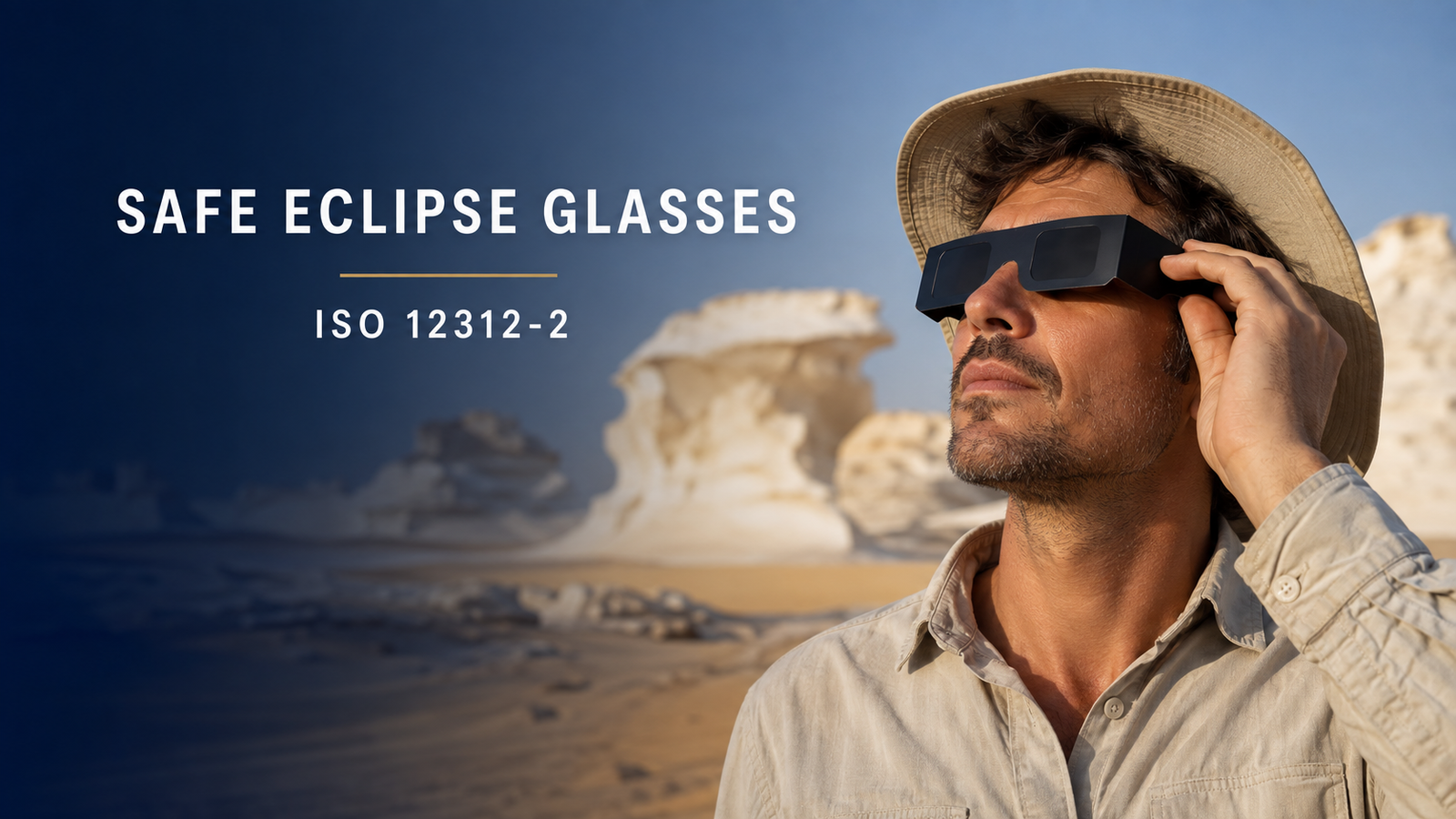
safe eclipse glasses ISO 12312-2: quick answer
safe eclipse glasses ISO 12312-2: Safe eclipse glasses are one of the most important pieces of equipment for anyone planning to watch a solar eclipse, but they are also one of the easiest products to buy incorrectly. A pair of glasses can look professional, carry an ISO
Safe eclipse glasses are one of the most important pieces of equipment for anyone planning to watch a solar eclipse, but they are also one of the easiest products to buy incorrectly. A pair of glasses can look professional, carry an ISO number, use dark film and still fail to give you the confidence you need unless you know where it came from and how it was tested.
For the August 2, 2027 total solar eclipse in Egypt, safe eye protection matters during every partial phase before and after totality. Only during the brief interval of true totality, when the Sun’s bright photosphere is completely covered from your exact location inside the path of totality, may ordinary direct naked-eye viewing be possible. Everywhere outside the path, and at every other time, proper solar viewing protection is required.
This guide explains how to buy, inspect, store and use safe eclipse glasses that conform to ISO 12312-2, how to avoid counterfeit or misleading products, how to supervise children, how to handle the transition into and out of totality, and why eclipse glasses are not a substitute for filters on cameras, binoculars or telescopes.
Quick Answer: What Makes Eclipse Glasses Safe?
Safe eclipse glasses are special-purpose solar viewers designed for direct, unmagnified observation of the Sun.
They must reduce visible light to a safe level while also controlling ultraviolet and infrared radiation. They should conform to the requirements of ISO 12312-2, the international standard for filters used for direct observation of the Sun.
NASA advises that safe solar viewers should comply with ISO 12312-2. NASA also makes an important point that travelers often misunderstand: NASA does not approve specific brands of eclipse glasses.
The American Astronomical Society adds another level of practical consumer guidance. It warns that a printed ISO claim by itself is not proof. A manufacturer can print an ISO number on a product, so the safest consumer strategy is to buy from a manufacturer or authorized reseller that the AAS Solar Eclipse Task Force has confirmed has appropriate test documentation from an accredited laboratory.
In simple terms, a safe purchase depends on three things:
- The product is designed for direct solar viewing.
- The product has been properly tested against the relevant standard.
- You can trace the product to a trustworthy manufacturer or authorized seller.
The third point matters because counterfeit products can copy names, logos, certificates and packaging.
Why Ordinary Sunglasses Are Not Safe
Ordinary sunglasses are made for normal daylight.
They reduce visible brightness and improve comfort, but they are not designed to make direct viewing of the solar photosphere safe.
Even extremely dark sunglasses are not a substitute for solar viewers.
The Sun may look dimmer through sunglasses, but a comfortable appearance does not mean the radiation level is safe for your eyes.
This is why stacking several pairs of sunglasses together is also unsafe.
Dark appearance is not the safety standard.
Safe solar viewers are many times darker than ordinary sunglasses and are engineered around limits relevant to direct solar observation.
If someone at an eclipse event says, “These sunglasses are very dark, so they should be enough,” that is a warning sign that the person does not understand solar-viewing safety.
What Is ISO 12312-2?
ISO 12312-2 is the international standard that applies to certain filters intended for direct observation of the Sun.
It covers products such as:
- Eclipse glasses.
- Handheld solar viewers.
- Other nonmagnifying solar viewers used directly by the eyes.
The standard addresses properties including:
- Visible-light transmittance.
- Ultraviolet transmittance.
- Infrared transmittance.
- Uniformity of the filter.
- Material quality.
- Surface quality.
- Mounting.
- Labeling.
The purpose is not simply to make the Sun look darker. The viewer must control the parts of solar radiation that can reach and damage the eye.
ISO 12312-2 Is for Direct Viewing, Not Magnifying Optics
This is one of the most important distinctions in the entire topic.
ISO 12312-2 is primarily intended for nonmagnifying, nonfocusing products used directly by the eye.
It does not mean you can hold eclipse glasses in front of binoculars, a telescope or a camera lens.
Magnifying optics collect and concentrate sunlight. That concentrated energy can damage a filter placed at the wrong location and can cause serious eye injury.
Solar filters for cameras, binoculars and telescopes must be designed and mounted for those instruments and placed securely over the front aperture, before sunlight enters the optical system.
If you plan to photograph the 2027 eclipse, read the 2027 Total Solar Eclipse Photography Guide separately. Eye protection and camera filtration are related topics, but they are not interchangeable.
“ISO Certified” Is Not the Right Consumer Test
You may see product listings that say:
- ISO certified.
- ISO approved.
- ISO registered.
- NASA approved.
- NASA certified.
These phrases can create false confidence.
ISO develops standards. ISO does not personally test every pair of eclipse glasses sold online and does not issue a consumer approval sticker for each product.
Likewise, NASA does not approve commercial brands of solar viewers.
The correct question is not:
Does the package have an ISO logo?
The better questions are:
- Who manufactured the viewer?
- Was that manufacturer’s product tested by a properly accredited laboratory?
- Is the seller an authorized reseller?
- Can I trace the product back to the genuine manufacturer?
- Is the product undamaged?
That is a much stronger safety process than trusting printed marketing language.
How to Buy Safe Eclipse Glasses
Step 1: Start With a Trusted Supplier List
The American Astronomical Society Solar Eclipse Task Force maintains a list of manufacturers and suppliers of solar viewers and filters that it has reviewed for appropriate safety documentation.
That list is one of the best starting points for consumers.
Do not begin with the cheapest advertisement you see in a search engine or marketplace.
Begin with a trusted source, identify a manufacturer, then follow that manufacturer’s official purchasing links or authorized reseller information.
Step 2: Buy Direct or From an Authorized Seller
Counterfeit products can copy the name of a legitimate manufacturer.
Therefore, seeing a familiar manufacturer name on a marketplace listing is not enough.
The seller should be traceable as an authorized source.
This is particularly important as major eclipse dates approach and demand increases.
High-demand events attract opportunistic sellers, and eclipse glasses are a simple-looking product that is easy to imitate visually.
Step 3: Do Not Buy Based on Reviews Alone
Customer reviews are useful for shipping quality, packaging and fit.
They are not a substitute for laboratory testing.
A customer cannot reliably verify ultraviolet and infrared transmission with the naked eye.
Thousands of positive reviews do not prove that a filter meets the relevant optical safety requirements.
Step 4: Avoid Last-Minute Purchases
Buying eclipse glasses at the last possible moment creates unnecessary risk.
You may face:
- Limited stock.
- Unknown sellers.
- Counterfeit products.
- Delayed shipping.
- No time to verify the manufacturer.
- No time to replace damaged viewers.
For a major international trip, buy your viewers well in advance and store them safely.
Step 5: Buy Spares
A spare pair is useful because eclipse glasses can be scratched, bent, punctured, dropped or damaged during travel.
For families, groups and tour operators, spares are especially important.
You do not want to discover a damaged lens five minutes before first contact.
How Can You Tell If Eclipse Glasses Are Safe?
The difficult answer is that a consumer cannot fully verify filter performance simply by looking at the glasses.
That is why trusted sourcing matters.
The AAS explains that consumers can often identify an obviously unsafe viewer, but they cannot personally prove full compliance without laboratory equipment.
Warning Signs Before You Even Look at the Sun
Discard or reject viewers if:
- The film is torn.
- The filter is punctured.
- The surface is scratched.
- The lens is peeling away from the frame.
- The cardboard is badly bent around the filter.
- The product has water damage.
- The manufacturer cannot be identified.
- The seller makes unverifiable “NASA approved” claims.
- The product arrived loose with no traceable packaging or seller information.
The Indoor Check
Put the viewer on indoors.
A proper solar viewer should appear extremely dark.
You should generally not be able to see ordinary household objects through it.
Very bright light sources may appear faint, depending on the product, but a solar viewer should not behave like ordinary sunglasses.
If you can clearly see furniture, walls, people or a television through the viewer, do not use it for solar observation.
The Outdoor Check
If the viewer came from a trusted source and passes inspection, go outside.
With the viewer on, the environment should remain extremely dark.
You should not have a normal view of the landscape.
If the product behaves like dark sunglasses, stop using it.
A Brief Solar Check
The AAS describes a cautious check in which, after the viewer has passed the earlier tests, the user briefly looks at the Sun through the viewer and should see a sharply defined solar disk that is comfortably bright against a dark background.
The Sun may appear:
- White.
- Bluish white.
- Yellow.
- Orange.
Color alone does not determine safety.
Different safe filter materials can produce different apparent colors.
If the Sun looks painfully bright, if you see glare that feels wrong, or if you are uncertain about the viewer’s origin, stop and use a viewer from a trusted source instead.
How to Use Eclipse Glasses Correctly
Even excellent eclipse glasses can be used incorrectly.
The safest method is simple.
Step 1: Inspect Them Before Every Viewing Session
Look for scratches, punctures, tears or loose filter material.
Do this before eclipse day and again before the event.
Step 2: Put the Glasses On Before Looking Up
Stand still.
Place the eclipse glasses over your eyes before you turn toward the Sun.
This prevents the common mistake of looking at the Sun while trying to position the glasses.
Step 3: Look at the Sun Through the Filter
Once the viewer is correctly positioned, look up at the Sun.
Step 4: Look Away Before Removing the Glasses
Turn your face away from the Sun first.
Then remove the glasses.
Do not remove them while still looking directly toward the bright Sun.
This habit is especially important with children.
What If You Wear Prescription Glasses?
Keep your normal eyeglasses on.
Place eclipse glasses over them, or hold a properly designed handheld solar viewer in front of your prescription glasses.
Do not remove medically necessary prescription eyewear just to use eclipse glasses unless you normally view comfortably without it.
For some travelers, handheld viewers are easier than cardboard eclipse glasses because they can be positioned in front of large prescription frames.
Test your setup before eclipse day.
The first time you try to fit eclipse glasses over prescription frames should not be during the final minutes before totality.
Contact Lenses and Eclipse Glasses
Contact lenses do not provide solar protection.
If you normally wear contact lenses, you still need safe eclipse glasses or a handheld solar viewer during the partial phases.
The solar viewer is the protective element.
Children and Eclipse Glasses
Children require active supervision.
Do not simply hand a child a pair of eclipse glasses and assume the safety problem is solved.
A child may:
- Remove the glasses while still looking upward.
- Look around the edge of the filter.
- Wear them incorrectly.
- Swap them for normal sunglasses.
- Use damaged glasses without noticing.
- Look through binoculars while wearing eclipse glasses.
A responsible adult should demonstrate the full sequence:
- Stand still.
- Put the viewer on.
- Confirm that the eyes are covered.
- Look toward the Sun.
- Look away.
- Remove the viewer.
Practice indoors first.
For younger children, a handheld viewer may be easier to control because an adult can help position it.
The dedicated Solar Eclipse Safety for Children guide should be read by families before the 2027 event.
When Can You Remove Eclipse Glasses During a Total Solar Eclipse?
This is where total eclipses are different from partial and annular eclipses.
During a total solar eclipse, observers inside the path of totality can experience a brief phase when the Moon completely covers the Sun’s bright photosphere.
Only during that confirmed total phase may ordinary direct viewing without eclipse glasses be possible.
Before totality, the glasses stay on.
After totality, the glasses go back on immediately when the first bright part of the Sun returns.
Do Not Guess Based on Darkness
The landscape may become very dark before totality.
That does not mean the photosphere is fully covered.
Do not remove eclipse glasses because:
- The sky looks dark.
- The temperature drops.
- People around you start cheering.
- You see a thin crescent.
- Someone nearby removes their glasses.
The correct trigger is the actual complete disappearance of the bright solar photosphere at your location.
At a professionally managed eclipse event, trained staff should make clear announcements before second contact and again before third contact.
Outside the Path of Totality, Never Remove Them for Direct Viewing
A 99% partial eclipse is still a partial eclipse.
If your location is outside the path of totality, there is no safe naked-eye total phase.
This is why exact eclipse geography matters so much.
Read Total vs Partial vs Annular Solar Eclipse to understand why nearly total is not the same as total.
What About Baily’s Beads and the Diamond Ring?
Baily’s beads and the diamond-ring effect happen very close to the transitions into and out of totality.
These are beautiful but safety-critical moments because direct photospheric sunlight is still present during portions of these effects.
For casual observers, the safest approach is to follow the event leader’s timing and keep solar viewers in place until totality is confirmed.
Photographers using magnifying optics need a separate, rehearsed filter-removal procedure appropriate to their equipment.
Do not use the timing of a neighbor or a livestream from another location. Contact times vary by exact coordinates.
Eclipse Glasses and Cameras: A Dangerous Combination if Misused
Never look through an unfiltered camera, telescope or binoculars while wearing eclipse glasses.
This is one of the most important NASA warnings.
Magnifying optics collect and concentrate sunlight. That concentrated energy can damage the viewer and your eyes.
The correct solar filter for optical equipment must be mounted securely over the front of the optical system.
For example:
- A telescope needs a suitable aperture filter over the front opening.
- Binoculars need proper filters over both objective lenses.
- A camera lens needs a correctly sized front-mounted solar filter.
An eclipse-glasses lens taped behind a telescope eyepiece is not an acceptable substitute.
A piece of eclipse-glasses film held in front of your eye while looking through binoculars is dangerous.
This is not a minor technical detail. It is a completely different optical situation.
Can You Use Eclipse Glasses With a Phone Camera?
If you are photographing the Sun directly with a phone, especially through any attachment lens or optical accessory, follow equipment-specific solar imaging guidance rather than improvising with eclipse glasses.
For simple wide-angle landscape photography where the Sun is only a small part of the scene, the risks and exposure considerations differ from a close-up solar image.
If your goal is a large image of the solar disk, treat the phone as an optical imaging device and use a purpose-appropriate solar filter setup.
Do not sacrifice your eclipse glasses by cutting them into small pieces for random camera experiments unless the manufacturer explicitly supports that use and the filter is mounted safely.
Can You Make Homemade Eclipse Glasses?
No homemade substitute should be treated as equivalent to a properly tested solar viewer.
Avoid:
- Smoked glass.
- Exposed photographic film.
- Dark plastic.
- CDs or DVDs.
- X-ray film.
- Candy wrappers.
- Stacked sunglasses.
- Improvised tinted acrylic.
These materials may reduce visible brightness without controlling ultraviolet and infrared radiation appropriately.
For indirect viewing, however, homemade projection devices can be useful because you are not looking directly through a filter at the Sun.
A pinhole projector is the classic example.
Pinhole Projection: The Best Backup Plan
If you do not have safe eclipse glasses, do not improvise a direct-viewing filter.
Use indirect projection instead.
A pinhole projector allows sunlight to pass through a small opening and form an image of the Sun on another surface.
The important rule is:
Do not look at the Sun through the pinhole.
Keep the Sun behind you and look at the projected image.
Natural pinhole projections can also appear through small gaps between tree leaves during the partial phases.
For large tour groups, indirect projection is a useful educational backup because several people can see the changing solar shape at once.
Do Eclipse Glasses Expire?
Modern eclipse glasses do not automatically become unsafe after three years simply because of age.
The AAS notes that viewers less than about ten years old may be reusable if:
- The manufacturer’s product was properly tested.
- The viewer is genuinely traceable to that manufacturer.
- The filter is not scratched.
- The filter is not punctured.
- The filter is not torn.
- The filter is not separating from the frame.
- The viewer has been stored properly.
Older warnings that say “discard after three years” or “do not view for more than three minutes” may reflect outdated instructions associated with older products.
The condition and provenance of the viewer matter.
For a major 2027 trip, however, replacement is inexpensive compared with the cost of international travel. If you are uncertain about the age, source or condition of old glasses, buy a new traceable pair from a trusted supplier.
How to Store Eclipse Glasses
Store them at normal room temperature in a way that protects the filter from:
- Scratches.
- Punctures.
- Moisture.
- Folding.
- Crushing.
- Dirt.
Good storage options include:
- The original protective sleeve.
- A clean envelope.
- A rigid document folder.
- A small protective case.
Do not throw eclipse glasses loose into a backpack with keys, camera mounts, batteries or tools.
For international travel, carry at least one pair in hand luggage rather than putting every pair in checked baggage.
How to Clean Eclipse Glasses
Cleaning depends on the product.
For hard plastic solar viewers, a manufacturer-supplied microfiber cloth may be appropriate.
For cardboard viewers, keep the frame dry.
A soft, nonabrasive tissue or cloth can be used carefully on the filter when appropriate.
Avoid soaking cardboard glasses.
Do not use aggressive cleaners or solvents unless the manufacturer specifically permits them.
If the filter becomes damaged while cleaning, replace the viewer.
Can You Use Welding Glass Instead?
Welding filters have a long history in solar observation, but the shade number matters.
The AAS notes that welding filters with shade number 12 or higher can reduce solar radiation to a safe range for direct unmagnified viewing, while lower shade numbers are not suitable.
Shade 13 and 14 are often more comfortable for solar viewing than shade 12, which some people find bright.
However, welding glass is not the best solution for most eclipse travelers because:
- The shade number must be known with confidence.
- It can be less convenient to hold.
- The image is often green.
- It is not designed for a family tourism environment.
- It should not be used as a telescope filter.
Purpose-made, traceable eclipse glasses are generally the simpler option.
Counterfeit Eclipse Glasses: What to Watch For
Counterfeits become a bigger concern as major eclipses approach.
Common red flags include:
- A marketplace seller with no manufacturer traceability.
- Extremely low prices for large quantities.
- “NASA approved” branding.
- A copied manufacturer name with a different seller identity.
- Missing instructions.
- Poor-quality printing.
- Filters loosely glued into the frame.
- A normal view of the room through the lenses.
- Unclear packaging.
- A seller that cannot provide an official website or authorized-reseller relationship.
The safest strategy is not to become a counterfeit detective.
It is to avoid uncertain supply chains in the first place.
What Tour Operators Should Do
A professional eclipse tour should treat eye protection as an operational responsibility.
A good program should:
- Purchase viewers from a traceable trusted source.
- Order them well before the event.
- Maintain purchase records.
- Store them safely.
- Inspect them before distribution.
- Keep spare units.
- Brief guests before eclipse day.
- Demonstrate correct use.
- Supervise children.
- Separate eye-viewer guidance from camera-filter guidance.
- Announce the approach to totality.
- Announce when eye protection must be replaced.
- Provide indirect projection as an educational option.
The operator should never advertise glasses as “NASA approved.”
A stronger statement is:
Solar viewers supplied for the event are sourced from a manufacturer or authorized supplier whose products have been verified for conformity with ISO 12312-2 through appropriate accredited testing.
That is more accurate and more credible.
What Guests Should Do Before Traveling to Egypt
Do not wait until you arrive in the desert to think about eclipse glasses.
Before travel:
- Buy from a trusted source.
- Check the manufacturer and reseller.
- Inspect the filters.
- Practice putting them on before looking upward.
- Test how they fit over prescription glasses.
- Teach children the procedure.
- Pack at least one spare.
- Store them in a protective sleeve.
- Keep them in hand luggage.
- Do not cut or modify them.
If your tour includes viewers, you may still wish to bring your own verified pair as backup.
Eclipse Glasses on the 2027 Egypt Eclipse Day
A simple event-day sequence is useful.
Before First Contact
- Inspect your viewer.
- Keep it accessible.
- Do not leave it under heavy equipment.
- Confirm your child’s viewer fits.
- Attend the safety briefing.
During the Partial Phase
- Put the viewer on before looking up.
- Look through the filter.
- Turn away before removing it.
- Take breaks rather than staring continuously.
As Totality Approaches
- Follow the official site announcement.
- Keep protection on until the bright photosphere is fully covered at your exact location.
- Do not copy the timing of another city or online broadcast.
During Confirmed Totality
- Direct naked-eye viewing is possible only while the photosphere is completely hidden.
- Enjoy the corona and the darkened sky.
- Keep your glasses ready in your hand or secured where you can replace them instantly.
At the End of Totality
- Replace eye protection as soon as direct sunlight returns.
- Continue using it throughout the remaining partial phase.
Why 99% Is Not Safe Without Protection
This deserves repetition.
A very deep partial eclipse can look dramatic.
The light can become strange. Shadows sharpen. The temperature may fall.
But if any part of the photosphere remains visible, direct viewing still requires protection.
That is why Cairo, Alexandria, central Aswan and other deep-partial locations do not offer a naked-eye totality phase in 2027.
If your goal is the full experience, verify that your viewing field is inside the path of totality. The 2027 Total Solar Eclipse in Egypt guide explains the geography.
Common Eclipse Glasses Mistakes
Mistake 1: Trusting the ISO Number Alone
Anyone can print text on a frame.
Buy through a traceable source.
Mistake 2: Buying Whatever Appears First in Search Results
Advertising placement is not a safety certification.
Mistake 3: Assuming NASA Approves Brands
NASA does not approve specific commercial solar-viewer brands.
Mistake 4: Using Regular Sunglasses
Dark sunglasses are not solar filters.
Mistake 5: Stacking Sunglasses
Multiple sunglasses still do not become a certified solar viewer.
Mistake 6: Looking Through Binoculars While Wearing Eclipse Glasses
This is dangerous because the optics concentrate sunlight.
Mistake 7: Removing Glasses When the Sky Becomes Dark
Darkness is not the definition of totality.
Mistake 8: Giving Children Unsupervised Viewers
Children need active instruction and supervision.
Mistake 9: Using Scratched Glasses
Replace damaged viewers.
Mistake 10: Keeping Glasses Loose in a Camera Bag
Hard equipment can scratch or puncture the filter.
Mistake 11: Cutting the Filter Film
Cutting can damage the filter or create poor mounting and gaps.
Mistake 12: Treating a Camera Filter and Eye Viewer as the Same Product
They serve different optical configurations.
Frequently Asked Questions
What does ISO 12312-2 mean on eclipse glasses?
It refers to the international safety standard for certain filters intended for direct observation of the Sun. The printed number alone is not proof that a product was genuinely tested.
Does NASA approve eclipse glasses?
No. NASA publishes safety guidance but does not approve particular commercial brands.
Are all eclipse glasses with ISO 12312-2 printed on them safe?
Not necessarily. The label can be copied. Buy from a trusted manufacturer or authorized reseller with traceable test documentation.
Can I use ordinary sunglasses during the partial phase?
No.
Can I wear eclipse glasses over my normal glasses?
Yes. Keep your prescription glasses on and place the eclipse glasses over them, or use a handheld solar viewer in front.
Are contact lenses safe during an eclipse?
Contact lenses do not provide solar protection. You still need safe solar viewers during the partial phases.
Can children use eclipse glasses?
Yes, with active adult supervision and correct fit and technique.
Can I use eclipse glasses with binoculars?
No. Binoculars require properly designed solar filters secured over the front objective lenses.
Can I use eclipse glasses with a telescope?
No. Use a suitable front-mounted telescope solar filter and follow expert guidance.
Can I use eclipse glasses for my camera?
Do not improvise. Use an appropriate front-mounted filter designed for the camera lens or solar-imaging setup.
When can I take eclipse glasses off during the 2027 total eclipse?
Only during confirmed totality at a location inside the path, when the bright solar photosphere is completely covered.
What if I am outside the path of totality?
Keep proper solar protection on whenever looking directly at the Sun. There is no naked-eye total phase.
Do eclipse glasses expire after three years?
Not automatically. Modern viewers may remain usable for years if they are traceable, properly tested, stored well and undamaged. AAS guidance notes that many can be reused for up to around ten years under the right conditions.
Should I throw away scratched glasses?
Yes. Replace any viewer with scratches, tears, punctures or loose filter material.
Can I clean cardboard eclipse glasses with water?
Avoid getting cardboard frames wet. Use a soft, dry, nonabrasive material if cleaning is needed and follow the manufacturer’s instructions.
Is welding glass safe?
Welding filters of shade 12 or higher can be suitable for direct unmagnified solar viewing, but known shade and condition are essential. Purpose-made eclipse viewers are usually easier for travelers.
Can I look through a pinhole projector?
No. A pinhole projector is for looking at the projected image, not through the hole at the Sun.
How many pairs should I bring?
At least one reliable pair per person is convenient, and a spare pair or two is sensible for a family or group.
Should a tour operator provide eclipse glasses?
A professionally managed eclipse tour should provide or clearly specify safe solar-viewing protection and give instructions on correct use.
Final Takeaway
Safe eclipse glasses are inexpensive, but they deserve the same care you would give any critical piece of travel safety equipment.
Do not buy based on darkness, price, reviews or a printed ISO number alone.
Use a traceable supplier. Inspect the viewer. Store it carefully. Practice correct use. Supervise children. Keep it on during every partial phase. Remove it only during confirmed totality at a verified total-eclipse location, and replace it immediately when direct sunlight returns.
Most importantly, never confuse eye viewers with filters for magnifying optics.
For travelers planning Egypt in 2027, combine this eye-safety preparation with the complete 2027 eclipse guide, the children’s safety guide, the photography guide and the current eclipse tour packages. When your dates and group are ready, check availability.
Authoritative Sources
Use the latest versions of these resources and recheck them close to the event:
- NASA Eclipse Viewing Safety
- AAS: How to View a Solar Eclipse Safely
- AAS: How Can You Tell If Your Eclipse Glasses Are Safe?
- AAS: About the ISO 12312-2 Standard for Solar Viewers
- AAS: Suppliers of Safe Solar Viewers & Filters
Safety guidance and supplier lists can change. Recheck them before the 2027 eclipse.