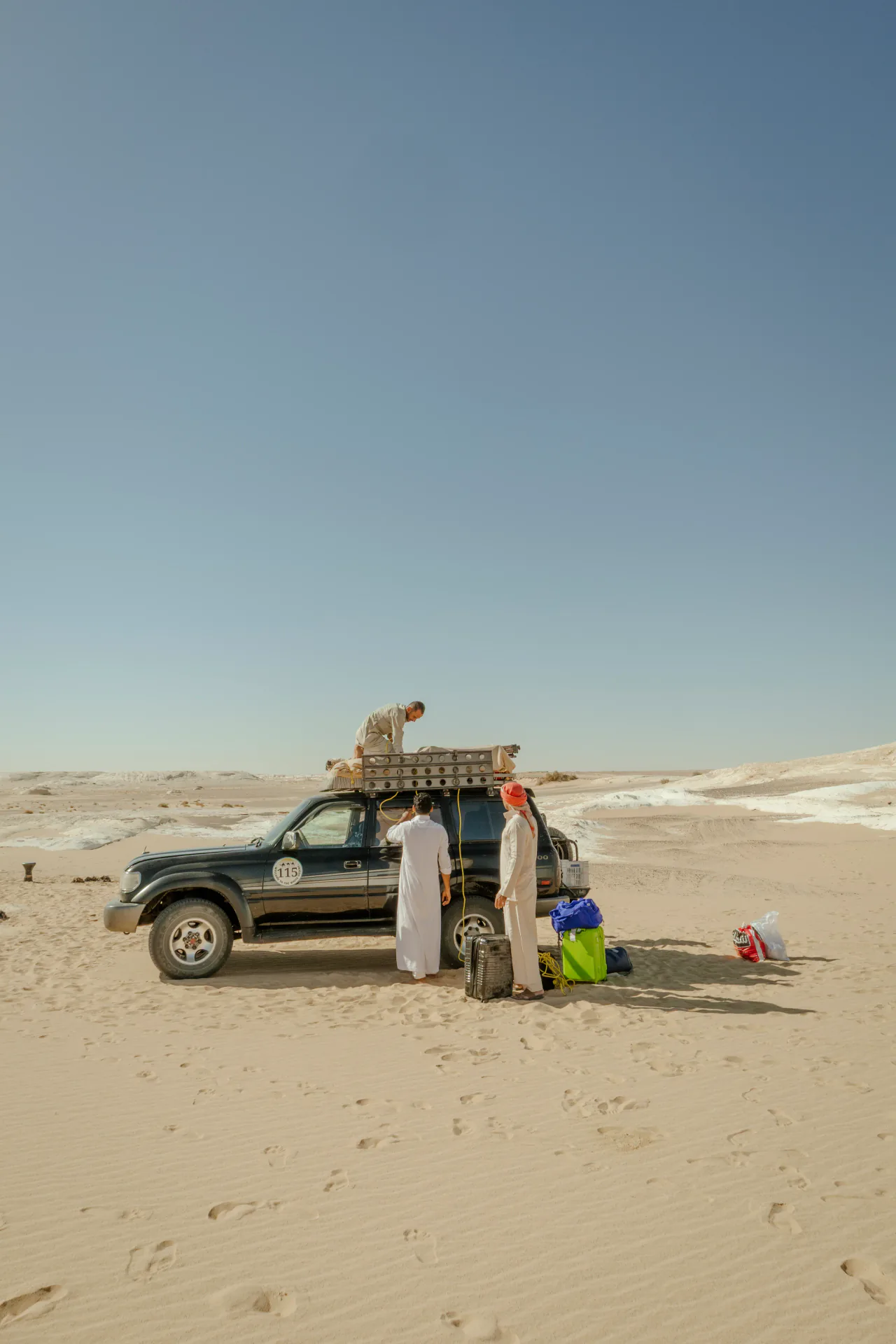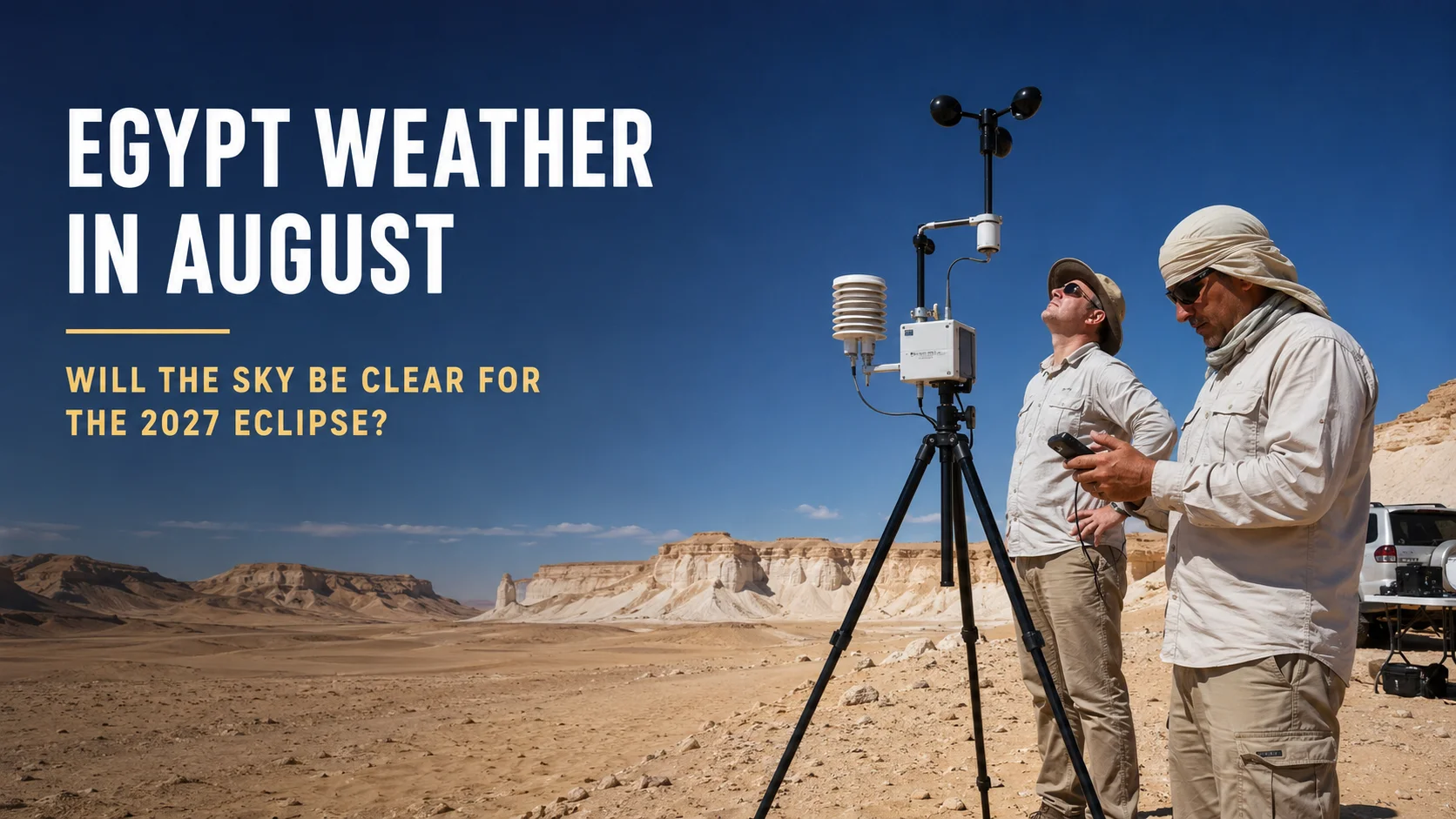
Egypt is one of the most promising countries on the path of the August 2, 2027 total solar eclipse, but “promising” is not the same as “guaranteed.” The country’s arid interior, intense summer sunshine and low-rainfall climate create a strong planning advantage. Yet a successful eclipse view still depends on the actual sky at one location during one narrow period around midday.
For travelers researching Egypt eclipse weather in August 2027, the most honest answer is encouraging but conditional: historical climate data support Egypt—especially parts of the Western Desert—as a serious eclipse destination, but no forecast made in 2026 can tell us whether the Sun will be unobstructed at totality in 2027.
Cloud is only one part of the problem. High thin cloud may soften the corona. Dust can reduce transparency without forming a cloud. Heat haze can affect long-lens photography close to the horizon or over hot ground. Coastal humidity can create haze on the Red Sea. Wind can move sand and challenge tripods. A completely blue-looking sky can still have atmospheric conditions that matter to photographers.
This guide explains the difference between climate and weather, compares Egypt’s main eclipse regions, identifies the atmospheric risks that matter, and gives travelers a realistic forecast-monitoring timeline from long-range planning to eclipse morning.
Climate Is Not the Same as Weather
Before comparing destinations, travelers need three separate concepts.
Climate
Climate describes typical patterns over many years. It can tell us that Egypt’s interior is normally very dry in August, that rainfall is rare, and that average cloud conditions are generally more favorable than in many maritime or mountain-influenced destinations.
Climate is what you use in 2026 to choose a country and broad region for a 2027 eclipse.
Seasonal outlook
A seasonal outlook describes whether a month or season may lean hotter, cooler, wetter or drier than a long-term baseline. It does not normally tell you whether a specific field will be cloudy at 1:00 pm on a specific date.
Seasonal information can help with resource planning, but it cannot select the final viewing field.
Weather forecast
A weather forecast tries to predict the actual atmospheric conditions during the days and hours around the event.
ECMWF’s medium-range ensemble system provides a range of possible conditions out to 15 days. NOAA explains that forecasts become less reliable as lead time increases; it describes five-day forecasts as substantially more accurate than forecasts beyond ten days.
The practical lesson is simple:
In 2026, choose by climate. In late July 2027, manage by forecast. On eclipse morning, verify by observations.
What Does “Clear Sky” Actually Mean for an Eclipse?
Travel websites often use “clear” as a binary label.
For eclipse observers, sky quality has several layers.
Total cloud cover
This is the fraction of the sky covered by cloud. It is useful but incomplete because a sky with scattered cloud can still hide the Sun at the critical moment—or miss it completely.
Cloud at the Sun’s position
The eclipse does not require every part of the sky to be clear. It requires the solar direction to remain sufficiently unobstructed during the partial phases and totality.
This is why satellite imagery and cloud movement matter on eclipse morning.
Cloud level
Low cloud, mid-level cloud and high cirrus affect the view differently. Thick low cloud can block the eclipse completely. Thin cirrus may allow the partial Sun to remain visible but reduce contrast in the outer corona.
Atmospheric transparency
Even with no cloud, dust, smoke, moisture or pollution can scatter light and reduce contrast.
Visibility
Visibility is especially important for a 360-degree horizon view, landscape photography and vehicle movement in dust.
Wind
Wind affects blowing sand, temporary structures, shade, telescope stability and long-lens photography.
Temperature and heat load
Temperature does not usually “block” an eclipse, but extreme heat affects people, batteries, electronics, food, water, generators and the time guests can safely remain exposed.
Why Egypt’s August Climate Is So Attractive
Egypt’s main advantage is its aridity.
Large parts of the eclipse path cross desert or semi-desert environments where August rainfall is unusual and persistent storm systems are far less common than in many humid destinations.
Long-term datasets such as ERA5 can be used to examine variables including cloud cover, temperature, wind and pressure from decades of reconstructed atmospheric conditions. NASA POWER also provides global solar and meteorological data derived from satellite observations and models.
These datasets support broad site screening, but they have limits:
- they represent grids rather than every exact field;
- averages can hide rare events;
- monthly means do not show the exact time of day of the eclipse;
- cloud fraction does not automatically equal the chance of the Sun being blocked;
- dust and transparency may need separate data;
- local terrain and human activity can create conditions not visible in coarse climatology.
The correct conclusion is not “Egypt will definitely be clear.”
It is:
Egypt’s dry summer climate gives it a strong statistical starting point, while operational planning must still account for cloud, dust, wind, heat and local access.
Egypt Eclipse Weather by Region
| Region | Main Weather Strength | Main Atmospheric Concern | Operational Character |
|---|---|---|---|
| Western Desert near Bahariya | Dry interior, open horizon, low urban humidity | Dust, wind, heat and remote-site logistics | Potentially mobile and controlled with 4x4 support |
| Luxor and Nile Valley | Very dry summer and near-maximum totality | Urban haze, local dust, crowd pressure and heat | Strong hotels and transport, less field mobility in congestion |
| Siwa Oasis | Arid western location and long totality | Long access route, dust and limited capacity | Distinct oasis trip with more difficult Cairo logistics |
| Red Sea / Marsa Alam area | Dry climate and resort infrastructure | Coastal humidity, haze, wind and exact path location | Comfortable fixed base but coastline geography limits westward movement |
| Cairo and Alexandria | Major transport and accommodation hubs | Humidity, pollution, haze and no totality at representative city coordinates | Useful gateways, not total-eclipse destinations |
The table is qualitative. It does not replace a location-specific climatology study or the forecast in late July 2027.
Western Desert Weather Near Bahariya
For Solar Eclipse Tours, this is the central weather question.
The eclipse camp and open-sky viewing area will be inside the path of totality, in the zone between the White Desert and the Black Desert. The exact operational point and coordinates will be shared later with confirmed guests after final terrain, access, safety, horizon and viewing-condition checks. These checks are designed to choose the best practical terrain, horizon and viewing conditions. The selected point will be astronomically verified to provide at least 6 minutes of totality.
Main advantages
- Dry continental setting.
- Broad open horizon.
- Less coastal moisture than Mediterranean or Red Sea locations.
- Lower urban pollution than Cairo.
- Potential space to separate vehicles, guests and tripods.
- 4x4-based operations that may preserve some local flexibility.
- Ability to sleep near the viewing field rather than travel from Cairo on eclipse morning.
Main risks
- Blowing dust or sand.
- Wind affecting shade structures and cameras.
- Severe heat exposure.
- Heat shimmer above the ground.
- Limited mobile observations compared with major airports or cities.
- Road or access constraints that may reduce theoretical mobility.
- Rare high or mid-level cloud crossing an otherwise clear region.
The Western Desert should therefore be sold as high-potential climatology plus a purpose-managed field, not as a weather guarantee.
Luxor and the Nile Valley
Luxor is one of the strongest city-based eclipse destinations on the entire 2027 path.
It offers very long totality, extensive hotels, an airport, hospitals, guides and well-developed tourism infrastructure. Its summer climate is also extremely dry.
Weather planning in Luxor is less about rain and more about:
- high or thin cloud;
- local dust;
- atmospheric haze;
- urban or agricultural aerosols;
- extreme heat;
- viewing-field congestion;
- limited ability to move large groups through busy roads if conditions vary.
Luxor may outperform the Western Desert on infrastructure and totality duration. A Bahariya-based camp may outperform Luxor on controlled space, open desert immersion and the possibility of localized 4x4 repositioning.
Weather alone should not be used to claim that one is universally better. The best destination depends on the traveler’s balance of climate, logistics, comfort, crowd tolerance and desired experience.
Siwa Oasis
Siwa lies in western Egypt and receives genuine totality.
Its arid setting is attractive, but it is farther from Cairo than Bahariya and has a different capacity and access profile.
The weather considerations include:
- dry August conditions;
- dust and wind;
- high temperatures;
- limited observation density;
- long road logistics;
- the ability—or inability—to move a large group quickly if forecasts favor another point.
Siwa is strongest for travelers who specifically want a Siwa holiday. Bahariya can be more practical for a focused eclipse camp with White Desert extensions.
Red Sea Coast and Marsa Alam
The Red Sea offers air-conditioned resort accommodation and established tourism services.
However, travelers must verify exact coordinates. Representative Marsa Alam-area locations can lie within totality, while representative Hurghada coordinates are outside the total path.
The weather profile also differs from the interior.
Coastal moisture can create haze even during otherwise cloud-free conditions. Wind can be useful for comfort but challenging for telescopes and temporary viewing setups. Mountains and coastline geometry can influence local flow.
A resort base provides excellent recovery from heat, but a fixed beach or hotel lawn may offer less mobility than a desert vehicle operation.
Cairo and Alexandria
Cairo and Alexandria are useful international gateways but not totality destinations at representative city coordinates.
Their weather concerns include urban haze, pollution, Mediterranean humidity in Alexandria and crowding. More importantly, a clear partial eclipse is not equivalent to totality.
Travelers should not remain in Cairo because the forecast looks easy and assume that 99% coverage provides the same experience. To see the corona and full total phase, they must be inside the central path shown on NASA’s map.
Clouds Are Not the Only Threat: Dust and Aerosols
North Africa is one of the world’s major dust regions.
WMO explains that sand and dust storms can reduce visibility, affect air quality, disrupt transport and influence solar-energy operations. Its Sand and Dust Storm Warning Advisory and Assessment System supports regional forecasting for North Africa and the Middle East.
For eclipse travelers, dust matters in several ways.
Optical contrast
Fine dust scatters light. Totality can still be visible, but the outer corona and faint details may have lower contrast.
Photography
Dust can reduce image clarity, settle on lenses and filters, and enter equipment during filter changes.
Health
Travelers with asthma or respiratory disease may be more sensitive to elevated particulate levels.
Transport
Strong dust events can reduce road visibility and complicate desert movement.
Power and cooling
Dust can affect filters, fans, generators and electronics if systems are not protected and maintained.
A weather plan that monitors only cloud percentage is incomplete.
Heat Haze and Atmospheric Seeing
Heat haze is not a cloud. It results from turbulent layers of air with different temperatures and densities.
For most guests watching the eclipse with the naked eye through proper viewers, it is not the main risk. For photographers using long focal lengths, it can soften fine detail or make the solar limb appear unstable.
Site design can reduce—not eliminate—the effect:
- avoid pointing over nearby engines or generators;
- keep vehicles away from the photography line;
- avoid placing long lenses directly above intensely heated metal surfaces;
- use stable tripods;
- set up early so equipment can acclimatize;
- protect cameras from direct solar heating when practical;
- practice focus and filter removal before eclipse day.
Because the Sun will be high, the optical path through the lower atmosphere is shorter than during a low-altitude eclipse. That is generally useful, but local turbulence can still affect high-resolution imaging.
Can the Eclipse Change the Weather?
During totality, incoming solar energy drops rapidly. Observers commonly experience a noticeable temperature fall, changes in wind and a shift in local boundary-layer behavior.
However, travelers should not assume that the eclipse will dissolve existing cloud or clear dust at the right moment.
The atmosphere’s response depends on cloud, wind, surface type, humidity and local circulation. The eclipse may change the immediate environment, but it is not a reliable weather-control mechanism.
Plan for the sky that forecast models and observations indicate before totality.
How Far Ahead Can We Forecast August 2, 2027?
This timeline is more useful than checking a consumer weather app a year early.
Now to early 2027: climatology phase
Use long-term datasets to compare regions.
Useful sources include:
- Copernicus ERA5 reanalysis;
- NASA POWER meteorological and solar data;
- historical satellite cloud analysis;
- WMO dust climatology and annual bulletins;
- local operational experience.
At this stage, the output should be a regional risk assessment—not an hourly forecast.
Several months before the eclipse: seasonal context
Seasonal products may indicate broad temperature or circulation anomalies. They can support heat, water and capacity planning.
They still cannot promise a clear Sun at totality.
46 days before: sub-seasonal signals
ECMWF provides week-by-week sub-seasonal guidance out to about 46 days. This can show broad anomalies and evolving patterns, not reliable field-level cloud at one exact hour.
15 days before: ensemble monitoring begins
ECMWF medium-range ensembles provide a range of possible weather scenarios out to 15 days.
At this stage, the operations team should monitor:
- total, low, medium and high cloud;
- wind direction and speed;
- dust forecasts;
- temperature;
- pressure patterns;
- agreement between ensemble members;
- whether alternative fields repeatedly appear more favorable.
One dramatic model map should not trigger a move. Trends and ensemble agreement matter more.
7 days before: operational planning
Forecast confidence improves.
The team can refine staffing, shade, water, generator load, equipment protection and possible field alternatives. Guests should receive calm updates rather than daily alarm based on individual model runs.
72 hours before: site decision window
High-resolution guidance, satellite trends, dust models and local observations become much more useful.
Any movement decision must balance sky improvement against road access, permits, camp infrastructure, medical support and the time required to relocate people safely.
The clearest theoretical point is not automatically the safest operational point.
Eclipse morning: nowcasting
The final stage uses:
- satellite imagery;
- visible cloud movement after sunrise;
- local observations;
- dust and visibility reports;
- wind measurements;
- updated short-range model guidance;
- confirmation of roads and field access.
The event leader should have a defined decision deadline. Moving too late can be worse than accepting a small cloud risk at a prepared field.
Forecast Timeline at a Glance
| Lead Time | Best Evidence | Decision Use |
|---|---|---|
| 12+ months | Climatology and reanalysis | Choose country and broad region |
| 1–3 months | Seasonal and sub-seasonal context | Heat, capacity and resource planning |
| 15 days | Medium-range ensembles | Identify persistent risk patterns |
| 7 days | Ensembles plus regional forecasts | Refine operational alternatives |
| 72 hours | High-resolution models, dust guidance, observations | Make realistic site adjustments |
| Eclipse morning | Satellite, nowcasting and field observations | Final go/no-go or limited movement decision |
Which Forecast Sources Should the Team Use?
No single source should control the operation.
Egyptian national and local meteorological information
Local warnings and official observations should be included whenever available.
ECMWF ensembles
These provide a probability-based view rather than one deterministic answer. Ensemble spread helps show uncertainty.
Satellite imagery
On eclipse morning, satellite observations reveal actual cloud development and movement.
WMO-supported dust forecasting
The Barcelona Dust Regional Center and related WMO systems provide North Africa and Middle East dust guidance.
NASA POWER and ERA5
These are valuable for climate and historical analysis, not for replacing the short-range forecast.
Local field observations
A remote desert field may differ from the nearest city app. The operations team should observe wind, visibility, dust and cloud directly.
Should an Eclipse Tour Be Mobile?
Mobility is valuable, but it is often oversold.
A small team with two vehicles can relocate more easily than a serviced camp with dozens of guests, toilets, shade, food, power, medical support and photography zones.
The right question is not “Can we chase clear sky anywhere?”
It is:
What amount of movement is safe, permitted and operationally realistic?
Possible mobility levels include:
- Micro-adjustment: move within the approved field or nearby area to improve horizon or avoid dust.
- Local alternative: use a second pre-checked field within a manageable 4x4 radius.
- Regional relocation: move the full operation to a different area, requiring permits, logistics and advance notice.
- Long-distance chase: drive many hours based on forecast—usually unrealistic for a large desert camp on eclipse morning.
A specialist team should define its mobility level before selling “weather flexibility.”
Heat Is Certain Even When Cloud Is Uncertain
Cloud risk is probabilistic. August heat is a core planning assumption.
WHO recommends keeping cool and hydrated, avoiding unnecessary strenuous activity, using light clothing and spending time in a cool place when possible during extreme heat.
The eclipse camp therefore needs:
- cooled or air-conditioned rest areas;
- shade beside the open viewing field;
- reliable drinking water distribution;
- seating;
- reduced unnecessary walking;
- toilets within a practical distance;
- medical and first-aid capacity;
- safe food handling;
- protected medication storage where confirmed;
- backup power planning;
- guest monitoring before symptoms become severe.
No cloud forecast removes these requirements.
Weather Planning for Photographers
Photographers should monitor more variables than total cloud cover.
High cloud
Thin cirrus may preserve a visible Sun while reducing corona contrast.
Dust optical depth
Dust affects transparency and color balance.
Wind gusts
Gusts can shake long lenses and damage loosely fitted filters.
Temperature
Heat affects batteries, storage media, displays and the photographer’s concentration.
Dew point and humidity
Interior desert dew is unlikely to resemble a humid coastal night, but equipment moving between strong air conditioning and hot outdoor air can experience condensation. Allow time for acclimatization.
Ground conditions
Tripods need stable surfaces. Fine sand, vehicle tracks and guest movement can introduce vibration.
Use the 2027 eclipse photography guide to prepare a filter and exposure sequence before travel.
Weather Planning for Families, Seniors and Health Conditions
Families and older travelers may interpret “clear and sunny” as good holiday weather. In the August desert, continuous sun increases heat exposure.
The weather plan should therefore include:
- supervised eclipse viewers for children;
- scheduled cooling breaks;
- accessible water;
- seating and shade;
- clear symptoms that require medical attention;
- medication discussions before travel;
- honest information about walking and 4x4 access;
- an option to remain in a cooled area during parts of the partial phase.
Travelers with heart, lung, kidney or metabolic conditions should discuss the itinerary with a clinician. The operator can describe facilities; it cannot determine personal medical fitness.
Common Weather Myths About the 2027 Egypt Eclipse
Myth 1: It never clouds in Egypt in August
False. Persistent rain is unusual in many eclipse regions, but high, middle or local cloud can still occur.
Myth 2: A blue sky guarantees perfect transparency
False. Dust and aerosols can reduce contrast without forming obvious cloud.
Myth 3: Historical averages predict the exact day
False. Climate indicates probability, not a specific outcome.
Myth 4: A forecast one month ahead can select the field
False. Sub-seasonal products describe broad patterns; field-level decisions need shorter-range evidence.
Myth 5: The operator can always drive to clear sky
False. Permits, roads, field capacity, fuel, guest safety and setup time limit mobility.
Myth 6: Luxor is cloudy while the Western Desert is always clear
False. Both have strong dry-summer climatology. Their larger differences are operational setting, infrastructure, crowding and mobility.
Myth 7: Dust is only a camera problem
False. Dust can affect health, visibility, roads, power systems and camp operations.
Myth 8: Clouds make eclipse glasses unnecessary
False. If the partial Sun is visible, safe solar filters are still required. Cloud is not an approved solar filter.
What Travelers Should Check Before the Event
Before booking or traveling, look for clear public information about:
- the final viewing coordinates when operationally appropriate;
- a location-specific climate methodology;
- the variables analyzed, not just “sunshine days”;
- the forecast sources the team will monitor;
- the dust-monitoring source;
- the mobility level and decision authority;
- the final weather-update schedule for guests;
- a clear no-guarantee statement;
- what happens commercially if weather blocks the eclipse;
- the camp heat and power plan;
- the date of every weather-page update.
This is stronger than publishing a single unsupported “98% clear” number.
Final Verdict: Will the Sky Be Clear?
Egypt deserves its reputation as one of the strongest weather prospects on the 2027 eclipse path.
The dry interior, low rainfall, open horizons and intense summer sunshine make the Western Desert especially attractive. Luxor also has excellent dry-summer climatology and stronger city infrastructure. Siwa and parts of the Red Sea offer credible alternatives with different access and atmospheric trade-offs.
But the final answer cannot be known in August 2026.
The scientifically responsible position is:
- Use climatology now to select Egypt and the broad region.
- Verify the field lies inside totality.
- Build heat, dust and wind resilience into the camp.
- Begin ensemble monitoring around two weeks before the eclipse.
- Use high-resolution forecasts, dust guidance and satellite imagery in the final days.
- Make only safe, permitted and realistic field adjustments.
- Never guarantee clear skies.
For travelers who want a controlled desert environment, compare the managed Western Desert eclipse camp and the 2-, 3- and 4-day eclipse packages, then check availability.
Frequently Asked Questions
Will Egypt have clear skies for the 2027 eclipse?
Egypt has favorable August climatology, especially in dry interior regions, but no one can guarantee the weather for one future hour. Short-range forecasts will become meaningful closer to August 2, 2027.
What is the best-weather region in Egypt?
Several interior regions have excellent dry-summer prospects. The Western Desert near Bahariya is attractive for open horizons and controlled-field potential; Luxor combines excellent climatology with strong infrastructure. Final choice should include access, heat, dust, crowds and field operations.
Is the Western Desert always cloudless in August?
No. Cloud is generally uncommon compared with many destinations, but high or local cloud can still cross the region.
Can dust block the eclipse?
Severe dust can reduce visibility substantially. More commonly, fine dust may reduce transparency and photographic contrast even when the Sun remains visible.
Is Luxor cloudier than Bahariya?
It is not responsible to make a categorical claim without a consistent location- and time-specific analysis. Both locations have strong dry-summer climatology, while their logistics and local atmospheric environment differ.
When will the forecast for August 2 become reliable?
Monitoring should begin with ensemble guidance about 15 days out, become more operational around seven days, and use high-resolution forecasts and observations during the final 72 hours. Confidence generally improves as the event approaches.
Can we trust a 30-day weather app forecast?
Not for exact eclipse-hour cloud at one field. Longer-range products can show broad patterns but should not be treated as deterministic field forecasts.
What is an ensemble forecast?
It is a group of model forecasts with small differences in initial conditions or physics. Agreement suggests greater confidence; wide spread indicates uncertainty.
Will the team move if cloud is forecast?
Only if movement is safe, permitted, timely and operationally realistic. A prepared alternative field may be possible; an unlimited cross-country chase is not a realistic promise for a serviced camp.
Does the eclipse itself clear clouds?
No reliable planning strategy assumes that. The eclipse can cool the surface and alter local winds, but it cannot be counted on to remove cloud or dust.
Does heat haze ruin eclipse photography?
It can reduce fine detail at long focal lengths. A high Sun, good field placement, vehicle separation and stable equipment help, but atmospheric turbulence cannot be fully eliminated.
Is coastal Marsa Alam better because it is cooler?
Resort comfort can be better, but the coast may introduce humidity, haze and wind. Exact path coordinates also matter. It is a different trade-off, not an automatic weather win.
Are clouds safe to look through without eclipse glasses?
No. Cloud does not provide certified eye protection. Use safe solar viewers whenever any part of the bright solar surface is visible.
What weather data should photographers check?
Total and layered cloud, dust or aerosol guidance, wind and gusts, temperature, humidity, visibility and satellite imagery.
What happens if weather blocks totality?
The natural event remains outside the operator’s control. Travelers should read the booking policy, understand the weather disclaimer and obtain suitable travel insurance where available.
Why arrive before eclipse day?
Arriving early protects the trip from road delays and gives the team time to prepare the field, review forecasts, brief guests and make limited operational adjustments.
Sources and Verification Notes
This article was researched on August 17, 2026. It describes climate and forecast methodology, not a prediction for August 2, 2027.
- NASA GSFC: Total Solar Eclipse of August 2, 2027
- Copernicus Climate Data Store: ERA5 Monthly Averaged Data
- NASA POWER: Global Solar and Meteorological Data
- NASA POWER: Climatology API Documentation
- ECMWF: Medium-Range Ensemble Forecasts
- ECMWF: Sub-Seasonal Forecasts
- NOAA NESDIS: How Reliable Are Weather Forecasts?
- WMO: Sand and Dust Storms
- WHO: Staying Safe in Extreme Heat
- Solar Eclipse Tours: 2027 Egypt Eclipse Path
- Solar Eclipse Tours: Western Desert vs Nile Valley
Cloud probabilities, dust conditions, camp coordinates, mobility options and operational plans must be updated as better data become available. Add the article’s latest review date whenever material changes are made.