Cairo solar eclipse 2027: quick answer
Cairo solar eclipse 2027: The Cairo solar eclipse 2027 will be dramatic, but it will not be total. On Monday, August 2, 2027, observers in Cairo will see the Moon cover most of the Sun. The partial eclipse begins at approximately 11:33 am, reaches maximum at
The Cairo solar eclipse 2027 will be dramatic, but it will not be total.
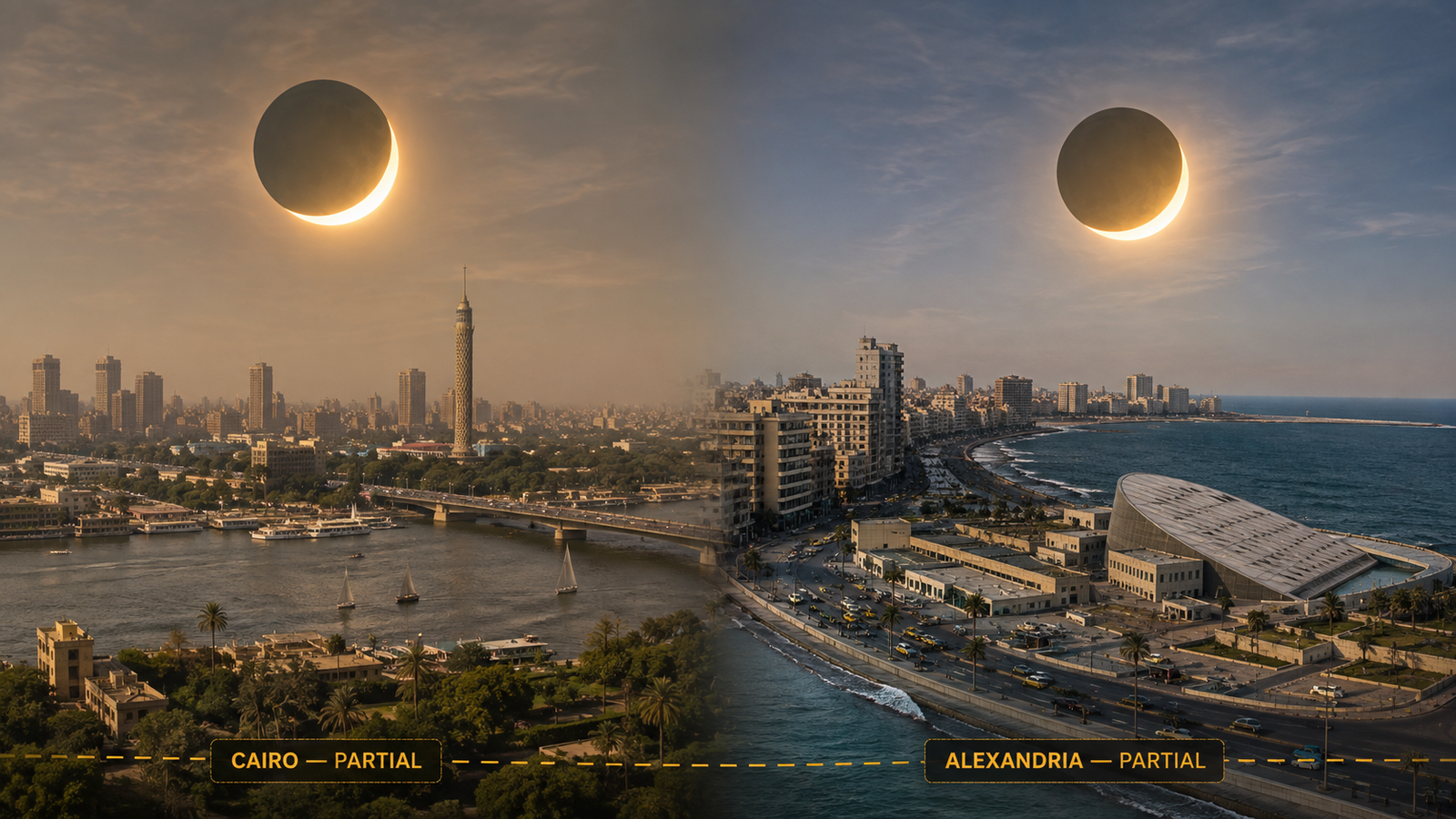
On Monday, August 2, 2027, observers in Cairo will see the Moon cover most of the Sun. The partial eclipse begins at approximately 11:33 am, reaches maximum at about 12:56 pm with a magnitude near 0.946, and ends around 2:16 pm local summer time.
Alexandria also remains outside the path of totality. Its partial eclipse begins around 11:29 am, reaches maximum near 12:51 pm with magnitude close to 0.934, and ends around 2:12 pm.
Both cities will experience a deep partial eclipse. Neither will experience the defining total phase when the Sun’s photosphere disappears completely, the corona becomes visible and eclipse glasses may briefly be removed.
This distinction matters because many search results, tour titles and social posts refer broadly to the “2027 total solar eclipse in Egypt.” The global event is total, and a wide corridor across Egypt is inside totality, but the local eclipse type changes from place to place. A traveler standing at the pyramids, in central Cairo, beside the Alexandria Corniche or at a city hotel remains outside the central shadow.
Cairo is still one of the best gateways for international eclipse travelers. It offers major airport access, hotels, cultural attractions and the most practical starting point for an organized road journey to Bahariya Oasis. The stronger totality-first plan is to use Cairo for arrival, then continue before eclipse day to a confirmed Western Desert eclipse-camp region between the White Desert and the Black Desert, inside the path of totality.
For the national route, see the 2027 eclipse path across Egypt.
Quick Answer: Are Cairo and Alexandria Inside Totality?
No. Both are outside the central path.
| Question | Cairo | Alexandria |
|---|---|---|
| Local eclipse type | Partial | Partial |
| Partial eclipse begins | About 11:33 am | About 11:29 am |
| Maximum eclipse | About 12:56 pm | About 12:51 pm |
| Magnitude | About 0.946 | About 0.934 |
| Partial eclipse ends | About 2:16 pm | About 2:12 pm |
| Totality duration | None | None |
| Can eclipse glasses be removed? | No | No |
Times are rounded planning values for representative city coordinates. Final seconds vary slightly within each metropolitan area.
Why Google Calls It a Total Eclipse When Cairo Sees a Partial Eclipse
The phrase “total solar eclipse” describes the global event.
A solar eclipse can be total in one place and partial in another at the same moment. The Moon casts a narrow central umbral shadow and a much wider penumbral shadow.
Observers inside the umbra see totality. Observers in the penumbra see a partial eclipse.
On August 2, 2027:
- The umbra crosses parts of Egypt.
- Cairo lies north of the totality corridor.
- Alexandria also lies north of it.
- Both cities remain inside the broader partial-eclipse region.
Search snippets may therefore show:
- “Total Solar Eclipse — Egypt.”
- “Partial Solar Eclipse — Cairo.”
- “Partial Solar Eclipse — Alexandria.”
These statements are not contradictory. The first describes the event nationally or globally; the others describe the local result.
The total vs partial vs annular eclipse guide explains the geometry in more detail.
Cairo Eclipse Timeline
At a representative Cairo coordinate, the planning schedule is:
| Phase | Approximate local time | What the observer sees |
|---|---|---|
| First contact | 11:33 am | The Moon begins covering the Sun. |
| Maximum eclipse | 12:56 pm | The solar disk becomes a thin, bright crescent. |
| Fourth contact | 2:16 pm | The Moon completely leaves the Sun. |
Egypt is expected to use UTC+3 summer time on August 2 under current law. The legal time rule should be checked again before final guest instructions are issued.
What Will Cairo Look Like Near Maximum?
Cairo may experience:
- Unusual, muted daylight.
- Sharper shadows.
- Crescent projections through small openings.
- A modest temperature change.
- Increased public attention.
- Heavy demand for rooftops and open spaces.
- A visibly thin solar crescent through safe viewers.
The city will not experience:
- A fully black Sun.
- A visible corona comparable with totality.
- A safe naked-eye interval.
- Second and third contact.
- A full diamond-ring transition into and out of totality.
- The same depth of midday darkness found inside the umbra.
Alexandria Eclipse Timeline
At a representative Alexandria coordinate:
| Phase | Approximate local time | What the observer sees |
|---|---|---|
| First contact | 11:29 am | The partial phase begins. |
| Maximum eclipse | 12:51 pm | The Moon covers most, but not all, of the Sun. |
| Fourth contact | 2:12 pm | The partial phase ends. |
Alexandria reaches maximum a few minutes earlier than Cairo because it lies farther west.
The Mediterranean setting can provide an attractive background for photography, but the eclipse remains partial at the Corniche, Montaza, central hotels, beaches and representative city locations.
Is Cairo’s Magnitude of 0.946 the Same as 94.6 Percent Darkness?
No.
Eclipse magnitude measures how much of the Sun’s diameter is covered along the line through the centers of the Sun and Moon. It is not a direct measurement of daylight darkness, emotional impact or the percentage of solar area hidden.
Obscuration measures the fraction of the Sun’s apparent area covered. It is a different value.
A third concept is the environmental experience: how the sky, landscape and human eye respond to remaining sunlight.
These quantities should not be mixed.
A location with magnitude 0.946 still has part of the photosphere exposed. That exposed solar surface is intensely bright. It dominates the corona and makes direct viewing unsafe.
A deep partial eclipse is impressive. It is not a weaker version of totality in a simple percentage scale.
Why the Final Few Percent Matter So Much
Travelers often ask whether it is worth leaving Cairo when most of the Sun will already be covered.
Yes, when the goal is totality.
During partial eclipse:
- The photosphere remains visible.
- Eclipse glasses stay on.
- The corona remains hidden by direct sunlight.
- The sky remains significantly brighter.
- Totality contacts do not occur.
- The full horizon twilight does not develop.
- Bright planets and stars are less prominent.
- The temperature and animal responses can be less dramatic.
During totality:
- The photosphere disappears.
- The corona becomes visible.
- The sky falls into deep twilight.
- The black Moon becomes visible.
- Prominences may appear.
- Approved viewers can be removed for the confirmed total phase only.
- The environmental transformation reaches its maximum.
Crossing the path boundary changes the type of event, not merely the score.
Will the Pyramids of Giza See Totality?
No.
The Giza pyramid complex lies within Greater Cairo and remains outside the totality path.
Travelers can photograph the partial eclipse from a suitable permitted location with the pyramids as a cultural setting, but the Sun will not become fully covered there.
Several practical restrictions also apply:
- Heritage-site opening and access rules.
- Tripod and professional-photography regulations.
- Heat.
- Public crowds.
- Security.
- Shade and water.
- The Sun’s high altitude.
- Difficulty including both the Sun and pyramids in one natural frame.
No company should promise a private eclipse event at the pyramids without formal authorization.
The pyramids can be part of the pre-eclipse Cairo itinerary. They should not be presented as the totality viewing site.
Will the Alexandria Corniche See Totality?
No.
The Corniche and the representative coastal city coordinates remain partial.
A sea-facing location may offer open sky, but openness does not change the path.
The observer still needs safe solar protection throughout.
Coastal considerations include:
- Humidity.
- Haze.
- Crowds.
- Traffic.
- Limited controlled space.
- Reflections and heat.
- Rooftop or balcony capacity.
- Restrictions on large tripods.
Alexandria is a useful cultural extension, not the strongest totality base.
Can You Watch from a Cairo Hotel Roof?
Possibly, for the partial eclipse.
The hotel must confirm:
- Roof access.
- Capacity.
- Railings.
- Shade structures.
- Emergency exits.
- Antennas and obstructions.
- Tripod rules.
- Food and water service.
- Guest supervision.
- Whether the roof is open during the full event.
A rooftop does not create totality.
Guests should understand that they are choosing a partial-viewing program rather than the full eclipse.
Cairo Is an Excellent Gateway, Not the Final Totality Site
Cairo has major advantages:
- International airport access.
- Large hotel inventory.
- Cultural attractions.
- Restaurants and services.
- Equipment shopping and support.
- Connections with tour operators.
- Road access toward Bahariya Oasis.
The best use of Cairo in a totality itinerary is:
- Arrive internationally.
- Rest at a Cairo hotel.
- Visit selected attractions.
- Attend an eclipse and safety briefing.
- Travel to the totality region before August 2.
- Remain near the viewing field overnight.
- Return to Cairo after the event or after the desert extension.
The main mistake is staying in Cairo until eclipse morning and attempting a last-minute journey.
Where Can You Travel from Cairo for Totality?
Several Egyptian regions lie inside the path, but they are not equally practical from Cairo.
Bahariya Oasis and the Western Desert
Representative Bahariya coordinates receive approximately 6 minutes 17 seconds of totality.
Advantages include:
- An organized road route from Cairo.
- Existing oasis and desert tourism operations.
- Local 4x4 teams.
- A potential managed viewing field.
- Open horizons.
- Controlled capacity.
- A combined Black Desert and White Desert itinerary.
The final camp coordinate must be verified. The accurate product wording is:
confirmed Western Desert eclipse-camp region between the White Desert and the Black Desert, inside the path of totality.
Siwa Oasis
Siwa is total for approximately 5 minutes 31–33 seconds at representative coordinates.
It is a valid desert option but involves a longer road journey and lower accommodation capacity.
See the Siwa Oasis eclipse guide.
Luxor
Luxor receives approximately 6 minutes 22 seconds and offers major hotel and cultural infrastructure.
It may involve a domestic flight, overnight train or long itinerary from Cairo, and it is likely to attract intense international demand.
Read the Luxor eclipse guide.
Asyut and Other Nile Valley Locations
Several Upper Egyptian cities lie inside totality, but each needs a dedicated viewing field, land permission, transport and accommodation plan.
Why the Bahariya and White Desert Program Is the Strongest Conversion from Cairo
For a visitor who found this article by searching “Cairo solar eclipse 2027,” the Bahariya route creates a natural next step.
It Starts from Cairo
The traveler can arrive at Cairo International Airport, rest, complete cultural visits and join an organized road transfer.
The Operational Base Can Be Near Totality
Instead of sleeping in a partial-eclipse city and making a rushed morning transfer, guests can arrive in the Western Desert before the event.
Representative Totality Is Long
Bahariya reference coordinates receive approximately 6 minutes 17 seconds—far beyond any partial experience in Cairo or Alexandria.
The Viewing Field Can Be Controlled
A dedicated field can manage:
- Group size.
- Vehicles.
- Tripods.
- Lighting.
- Announcements.
- Shade.
- Water.
- Toilets.
- Medical access.
- Departure timing.
It Adds a Real Travel Experience
The route can include:
- Bahariya Oasis.
- Black Desert.
- Crystal Mountain.
- Agabat.
- White Desert formations.
- Local desert guides and drivers.
- A managed eclipse camp.
It Avoids a False White Desert Claim
Common Farafra coordinates and many standard White Desert tourism sites are outside totality. The viewing field should be separately verified near Bahariya, while White Desert experiences form part of the wider itinerary.
Cairo vs Alexandria vs Bahariya Eclipse Camp
| Factor | Cairo | Alexandria | Bahariya-based camp |
|---|---|---|---|
| Eclipse type | Partial | Partial | Total at representative coordinates |
| Central phase | None | None | About 6m 17s at the reference point |
| Main role | International gateway and cultural stay | Mediterranean extension | Totality viewing base |
| Viewing control | Depends on public or hotel space | Depends on public or hotel space | Potentially high at a managed private field |
| Open horizon | Urban obstructions possible | Coastal horizon but urban crowding | Wide desert sky |
| White Desert experiences | No | No | Yes as part of the itinerary |
| Eclipse glasses | Remain on throughout | Remain on throughout | Removed only during confirmed totality |
Should You Leave Cairo on Eclipse Morning?
No, not for a long totality transfer.
The eclipse cannot wait for:
- Traffic.
- A delayed breakfast.
- Luggage problems.
- Vehicle issues.
- Checkpoints.
- Road congestion.
- Toilet stops.
- Heat.
- A wrong map pin.
- Parking delays.
Guests should reach the totality region at least one day before the event. A multi-day desert itinerary is safer than a rushed day trip.
The Cairo to Bahariya Oasis journey guide should explain the route, vehicle expectations, stops, luggage and preparation.
A Recommended Cairo-to-Eclipse Itinerary
Day 1 — International Arrival
Arrive in Cairo, transfer to the hotel and rest.
Day 2 — Cairo Cultural Program
Visit selected attractions, avoiding an exhausting schedule. Confirm documents and equipment.
Day 3 — Transfer to Bahariya
Travel with the organized group. Check in, hydrate and attend an orientation.
Day 4 — Desert Experience and Rehearsal
Explore selected Western Desert landscapes. Practice eclipse-glasses use and camera procedures.
Day 5 — Eclipse Day
- Early breakfast.
- Hydration briefing.
- Short controlled transfer or walk to the field.
- Setup before first contact.
- Totality at the verified coordinate.
- Rest, lunch and post-eclipse program.
- Staged vehicle departure.
Following Day
Continue White Desert experiences or return toward Cairo, depending on the chosen package.
The actual 2-, 3- or 4-day structure may differ, but the principle is constant: be near totality before August 2.
Eye Safety in Cairo and Alexandria
Because both cities are partial, there is no safe naked-eye phase.
Use:
- Approved eclipse glasses.
- A handheld solar viewer.
- Indirect projection.
- Correctly filtered instruments.
Do not use:
- Ordinary sunglasses.
- Smoked glass.
- Exposed film.
- CDs.
- Homemade dark plastic.
- Unfiltered cameras.
- Unfiltered binoculars.
- Unfiltered telescopes.
Eclipse glasses worn behind unfiltered optics are dangerous because concentrated sunlight can damage the viewer and the eye.
Children require active supervision.
Read How to Use Eclipse Glasses Safely.
Safety Inside Totality
At a confirmed totality field, glasses remain on until the photosphere disappears completely.
They may be removed during totality only.
They must be replaced before direct sunlight returns.
A group leader should provide clear announcements before second and third contact.
Heat and Hydration
The event occurs around midday in August.
Whether the guest remains in Cairo or travels to the desert, the plan needs:
- Cold water.
- Shade.
- Air-conditioned recovery.
- Seating.
- Hats.
- Sunscreen.
- Light clothing.
- Toilets.
- Medical support.
- Reduced unnecessary walking.
- Medication storage.
- Emergency cooling.
The long partial phases create more heat exposure than the few minutes of totality.
Photography in Cairo
Cairo can produce strong partial-eclipse photography.
Possible concepts include:
- A filtered solar crescent above the city.
- Crescent projections.
- A time-lapse.
- The changing light on architecture.
- Public viewing and education.
- A labeled composite above the pyramids.
The solar filter remains on the camera throughout.
A photographer cannot capture the total corona from Cairo.
Photography in Alexandria
Potential compositions include:
- A filtered Sun above the Mediterranean.
- The Corniche.
- Coastal silhouettes.
- A sequence of the partial phases.
- Public observation.
Humidity and haze may reduce contrast.
Tripods in public areas require crowd awareness and safe cable management.
Photography at the Western Desert Camp
Inside totality, photographers can capture:
- Diamond rings.
- Baily’s beads.
- Prominences.
- The inner corona.
- Extended coronal structure.
- A 360-degree twilight.
- Desert landscape reactions.
A managed field can separate long-lens tripods from general guests and control vehicle movement.
The 2027 eclipse photography guide covers the full workflow.
Weather Considerations
No Egyptian destination can guarantee clear skies.
Cairo
Possible issues include:
- Urban haze.
- Pollution.
- Dust.
- High thin cloud.
- Heat shimmer.
Alexandria
Possible issues include:
- Coastal humidity.
- Marine haze.
- Cloud.
- Wind.
Western Desert
Possible issues include:
- Dust.
- Wind.
- High thin cloud.
- Heat shimmer.
Historical climatology helps compare destinations. Short-range forecasting becomes important closer to the event.
A tour’s value should not depend entirely on clear sky. Cultural and desert experiences make the journey meaningful even if weather interferes.
Families and Children
A city-based partial event may be easy logistically, but children must keep viewers on throughout.
A managed totality trip requires stronger education because the glasses rule changes during the central phase.
Families should confirm:
- Child-friendly glasses.
- Adult supervision.
- Shade.
- Water.
- Toilets.
- Seating.
- Air-conditioned rest.
- Medical support.
- Sleeping arrangements.
- Package age policy.
- Food requirements.
See the Child Policy.
Older Travelers and Accessibility
Ask about:
- Walking distance.
- Ground surface.
- Steps.
- Vehicle proximity.
- Seating.
- Accessible toilets.
- Cooling.
- Medical care.
- Medication.
- Emergency departure.
A private camp must explain accessibility honestly. Desert terrain varies and may not be suitable for every mobility requirement without additional arrangements.
What to Ask Before Booking from Cairo
- Is the viewing field inside totality?
- What are its coordinates?
- Is the coordinate final or provisional?
- What is the local duration?
- How far is it from the path boundary?
- When will the group leave Cairo?
- Will guests sleep near the viewing field?
- What vehicle type is used?
- What happens if a vehicle breaks down?
- What cooling is provided?
- Are toilets available?
- Is water unlimited or rationed?
- Is medical support present?
- Are eclipse glasses included?
- Is there a photography zone?
- Are White Desert visits separate from the eclipse field?
- What is the cancellation policy?
- What happens if the site changes?
- Can weather be guaranteed? The correct answer is no.
- When will final coordinates and timings be issued?
Common Mistakes
Staying in Cairo Because the Eclipse Is “94 Percent”
Magnitude is not a percentage of the total experience.
Believing the Pyramids Are Inside Totality
They are not.
Assuming Alexandria Is Closer to Totality
Its representative magnitude is lower than Cairo’s, and it remains partial.
Leaving on Eclipse Morning
A long transfer introduces avoidable risk.
Booking a Tour That Does Not Publish the Viewing Region
A destination name is not enough.
Confusing the White Desert with the Totality Field
The final field must be verified separately.
Removing Glasses in Cairo
There is no safe naked-eye phase.
Comparing Only Prices
A cheaper partial-viewing package is not equivalent to a totality journey.
Assuming Every “Egypt Eclipse Tour” Watches in Cairo
Many itineraries include Cairo only as an arrival and sightseeing city. Read the day-by-day schedule carefully.
Frequently Asked Questions
Will Cairo see a total solar eclipse in 2027?
No. Cairo sees a partial solar eclipse.
What time does the eclipse begin in Cairo?
Approximately 11:33 am local time.
What time is maximum eclipse in Cairo?
Approximately 12:56 pm.
What is the eclipse magnitude in Cairo?
Approximately 0.946 at the representative coordinate.
What time does it end?
Approximately 2:16 pm.
Will the pyramids see totality?
No.
Can I remove eclipse glasses in Cairo?
No.
Will Alexandria see totality?
No. Alexandria sees a partial eclipse.
What time is maximum in Alexandria?
Approximately 12:51 pm.
Which city has the deeper partial eclipse?
Cairo has a higher representative magnitude than central Alexandria.
Is a deep partial eclipse worth seeing?
Yes, but it is physically and visually different from totality.
Where should I travel from Cairo for totality?
Bahariya Oasis and a verified Western Desert field offer a strong road-based option. Luxor, Siwa and other total locations are alternatives.
Is Bahariya inside totality?
Representative Bahariya coordinates are inside and receive approximately 6 minutes 17 seconds. The final camp requires its own calculation.
Is the White Desert inside totality?
The name covers a broad tourism region. Many standard Farafra-area sites are partial. The viewing field must be separately verified near Bahariya, with White Desert experiences added to the itinerary.
Can I make a day trip from Cairo?
A rushed eclipse-day trip is not recommended. Reach the viewing region earlier.
Is Luxor longer than Bahariya?
Representative Luxor totality is approximately 6 minutes 22 seconds, about five seconds longer than representative Bahariya. Operational control, crowding and travel style may matter more than those seconds.
Can clear sky be guaranteed?
No.
Final Takeaway
Cairo and Alexandria will experience impressive partial solar eclipses on August 2, 2027, but neither city lies inside totality.
Cairo reaches maximum around 12:56 pm with magnitude near 0.946. Alexandria reaches maximum around 12:51 pm with magnitude near 0.934. Eclipse glasses remain necessary throughout in both cities.
Travelers should use Cairo as the arrival gateway rather than the final viewing site. For a totality-first journey, the strongest road-based conversion is the confirmed Western Desert eclipse-camp region between the White Desert and the Black Desert, inside the path of totality. It can place guests near a verified totality field before eclipse day, provide controlled viewing operations and add a complete desert journey rather than a rushed transfer from a partial-eclipse city.
Explore the White Desert eclipse camp, compare the 2-, 3- and 4-day eclipse packages, or check availability.
Authoritative planning reference
Use NASA 2027 eclipse path data as a primary reference, then verify local circumstances for the exact location.