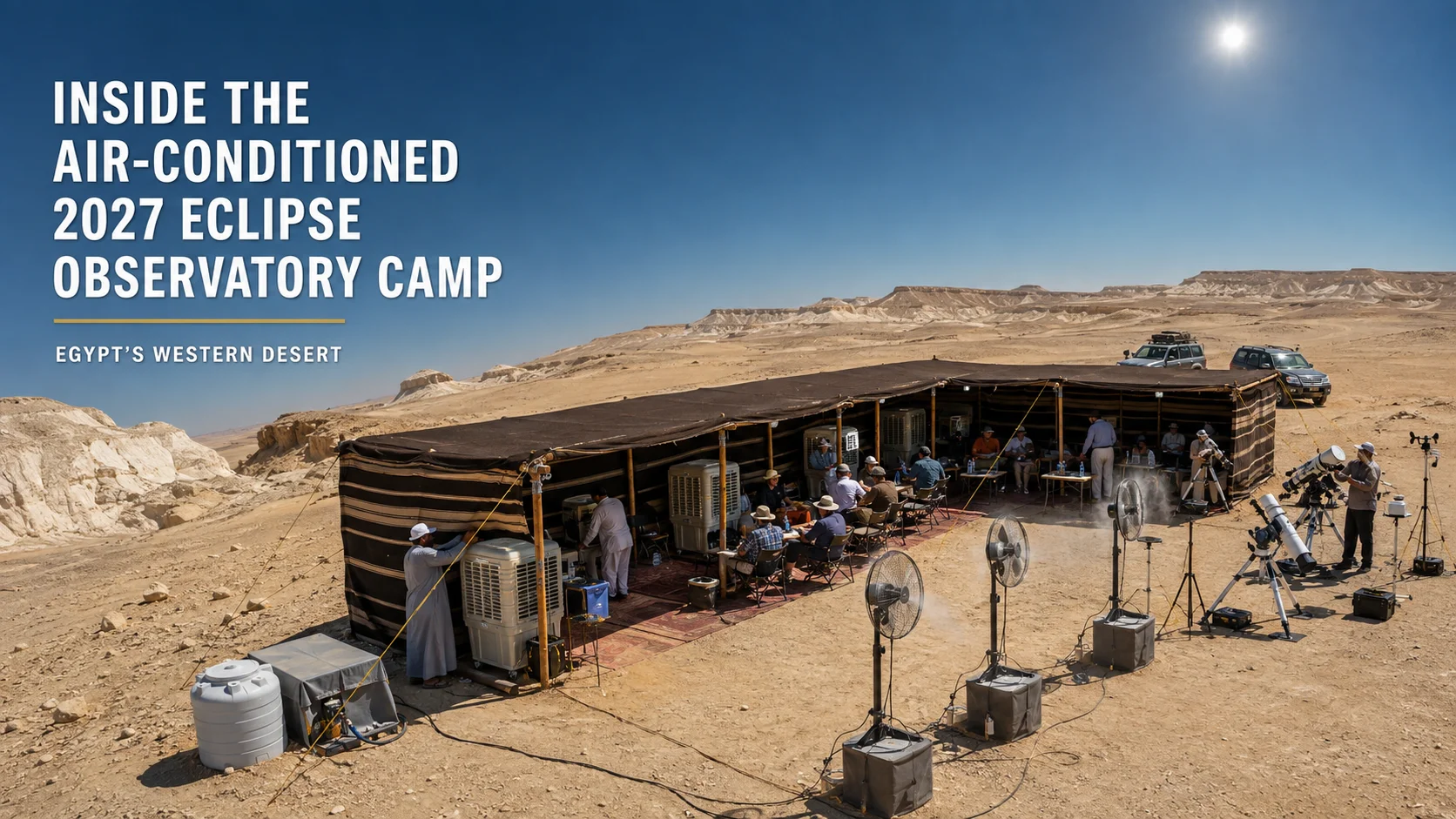
An air-conditioned eclipse camp in the White Desert region sounds almost contradictory. The Western Desert is famous for silence, open horizons, chalk formations and nights under the stars — not climate-controlled event infrastructure. But the August 2, 2027 total solar eclipse is not a normal winter safari, and the main observatory camp has been designed around that difference.
For the 2027 program, Solar Eclipse Tours is using a purpose-built Observatory Camp in Egypt’s Western Desert as the event base for eclipse night and eclipse day. Air-conditioning is available at the Observatory Camp, while the actual solar-viewing area remains open to the sky, as it must. The operating plan also includes Wi-Fi, charging, toilets, first aid and an on-site medical professional. The standard published event-camp model is capped at 40 guests; bookings close when the 40 available places are filled.
That distinction matters. “Air-conditioned camp” should not be interpreted as a sealed indoor eclipse experience, and it should not be confused with every small safari camp used elsewhere in the White Desert. It means the eclipse operation includes climate-controlled recovery and camp space alongside an open desert observation field.
For travelers worried about August heat, older guests, families, photographers with sensitive equipment, and eclipse chasers who want a controlled base rather than an improvised roadside stop, the Observatory Camp is one of the most important parts of the 2027 Western Desert program.
What Is the 2027 Observatory Camp?
The Observatory Camp is the main event base used for the Western Desert total solar eclipse program.
It is designed around one fixed fact: August 2, 2027 will be hot.
A normal cool-season White Desert trip can rely on open-air meals, simple sleeping tents, blankets and long periods outside. That model works because the most popular safari season is much milder.
The eclipse is different.
Guests may arrive with telephoto lenses, telescopes, binoculars, batteries, power banks, medication, eclipse glasses, children, older family members, mobility needs, expensive electronics and a strong emotional investment in a once-in-a-lifetime event.
The event base therefore has to work as more than a place to sleep.
It needs to act as:
- a recovery space from the heat;
- a briefing point;
- a charging base;
- a communications point;
- a meal and hydration base;
- a medical-support location;
- a staging area before totality;
- a controlled departure point after the eclipse.
The observation area remains outside, under an unobstructed sky.
Is the Entire Camp Air-Conditioned?
This is where the wording must be precise.
The current published operating information states:
Air-conditioning is available at the Observatory Camp.
That does not mean the whole Western Desert is climate-controlled. It does not mean guests watch totality through glass. Longer itineraries add hotel nights rather than additional desert camps.
All three programs include one night at the main eclipse camp. The 3-day program adds one Bahariya hotel night, and the 4-day program adds two 5-star hotel nights.
Therefore:
- Observatory Camp: event base with air-conditioning and eclipse support.
- Observation field: open outdoor sky-viewing area inside the path of totality.
- Longer-program accommodation: one Bahariya hotel night in the 3-day package and two 5-star hotel nights in the 4-day package.
This distinction protects the traveler from misleading expectations.
Why Air-Conditioning Matters So Much on August 2
Air-conditioning is not being added because desert travelers are unable to tolerate any warmth.
It is being added because heat exposure accumulates.
The World Health Organization describes heat stress as a serious health risk and notes that heat can worsen cardiovascular, respiratory, kidney, metabolic and other chronic conditions. Older adults, children and people with some health conditions can be more vulnerable.
The eclipse occurs around the middle of the day in Egypt.
Without a cooling plan, guests could spend a long period standing in direct sunlight, carrying equipment, waiting for totality, concentrating on cameras, forgetting to drink, sitting in a hot tent or moving between vehicles and the viewing field.
A climate-controlled base changes the structure of the day.
Instead of remaining outside from first contact until the end of the partial phase, guests can use a rotation:
- view selected partial phases;
- return to the Observatory Camp;
- cool down;
- drink;
- check equipment;
- return outside before totality;
- experience totality;
- return to cooling afterward.
This is a much more controlled model than expecting every guest to remain exposed continuously.
Read the full Egypt August Desert Heat Safety Guide for the detailed health framework.
The Camp and the Viewing Field Are Two Different Things
A common misconception is that an air-conditioned eclipse camp somehow interferes with astronomical viewing.
It does not, because the two functions are separated.
The camp provides support.
The viewing field provides sky.
The eclipse camp and open-sky viewing area will be inside the path of totality, in the zone between the White Desert and the Black Desert. Final access instructions are managed by the local team and relevant authorities.
The viewing field remains open to the sky in the confirmed zone between the White Desert and the Black Desert.
The wider program combines Bahariya Oasis, Western Desert routes and White Desert experiences with the confirmed eclipse camp and viewing point.
The eclipse field is chosen for astronomy and operations, not merely because one rock formation looks good in a brochure.
Quick Facts: Observatory Camp 2027
| Feature | Current published plan |
|---|---|
| Region | Between the White Desert and the Black Desert, inside the path of totality |
| Main purpose | Purpose-built event base for the August 2, 2027 total solar eclipse |
| Air-conditioning | Available at the Observatory Camp |
| Viewing | Open-sky viewing point in the confirmed zone between the White Desert and the Black Desert, inside the path of totality; final point astronomically verified for at least 6 minutes of totality |
| Standard published capacity | Maximum 40 guests |
| Connectivity | Wi-Fi listed as event support; remote performance can vary |
| Power | Charging available as part of event support |
| Toilets | Included in the event-support plan |
| Medical support | First aid and an on-site medical professional listed in the operating plan |
| Desert transport | Locally operated 4x4 vehicles |
| Exact field coordinates | Operational coordinates managed with relevant authorities and finalized separately |
Operational details remain subject to final written confirmation, permits, safety planning and supplier arrangements.
What “Climate-Controlled Event Base” Really Means
The phrase matters because the Observatory Camp is not being positioned as a conventional hotel transplanted into the desert.
It is an event base.
Its value comes from the combination of functions.
A guest should be able to leave the outdoor viewing zone and return to a more controlled environment without making a long transfer back to an oasis hotel.
That is important because the eclipse cannot be paused.
If the nearest effective cooling is an hour away, it is not operationally useful during the partial phase.
If the cooling base is integrated into the event setup, guests can reduce exposure while staying close to the astronomy.
For families, seniors and heat-sensitive travelers, that can change the trip from an endurance exercise into a managed experience.
How This Differs From a Normal White Desert Safari Camp
A normal White Desert safari is usually designed for the cooler travel season.
Typical goals are sunset, dinner, campfire, stargazing, sunrise, off-road exploration, simple desert sleeping and atmosphere.
The 2027 Observatory Camp has a different job.
It must support a fixed astronomical timetable, August heat, a larger coordinated guest group, solar-viewing safety, communications, charging, toilets, medical readiness, photography equipment, structured briefing, controlled vehicle movement, eclipse-day seating and recovery, and post-totality departure.
The two experiences are not competitors.
They serve different purposes.
All three itineraries use the main eclipse camp for one night. The 3-day itinerary adds one Bahariya hotel night, while the 4-day itinerary adds two 5-star hotel nights.
Why the Standard Capacity Is Capped at 40 Guests
The current published event-camp model is capped at a maximum of 40 guests.
That number is not only a marketing decision.
A desert event has physical limits: vehicle capacity, toilet capacity, food service, water, shade, cooling, power, charging, staff, medical coverage, walking routes, parking, photography spacing, permits and emergency access.
If an organizer requests a group larger than 40, the current partner plan requires a separate feasibility review covering site capacity, permits, transport, cooling, catering and staffing.
That is the responsible way to scale a desert event.
The alternative — accepting unlimited guests and solving logistics later — creates exactly the kind of crowd and heat problems the Western Desert option is supposed to avoid.
Why Controlled Capacity Matters for Eclipse Photography
Photographers need space.
A long-lens eclipse setup may include a tripod, telephoto lens, second camera, tracker, power bank, filter case, chair, camera bag and cables.
If tripods are packed too tightly, one person moving at the wrong moment can shake another photographer’s setup.
Crowded fields also create trip hazards, blocked sightlines, bright screens, accidental contact and confusion around filter timing.
A controlled event field can separate general viewing space from photography-heavy zones where practical.
Photographers can prepare equipment, return to cooling, then come back to a setup that remains ready.
Read How to Photograph the 2027 Total Solar Eclipse in Egypt before choosing gear.
Charging: Why It Matters in a Remote Eclipse Camp
A modern eclipse group carries a surprising amount of electronics.
Guests may need to charge phones, camera batteries, power banks, smart watches, tablets, telescope controllers, tracking mounts, communication devices and medical devices.
Charging is listed as part of the Observatory Camp event support.
That does not mean travelers should arrive with empty batteries.
A better plan is to charge everything before leaving Cairo or Bahariya, then use camp charging as support rather than as the only source.
Photographers should still bring multiple charged batteries, labeled chargers, power banks where permitted, spare cables, adapters and a clear charging plan.
For critical medical devices, requirements should be disclosed and confirmed separately before travel.
Wi-Fi in the Desert: Useful, but Do Not Build Your Life Around It
Wi-Fi is included in the event-support plan.
That is useful for messaging family, operational updates, basic communications, sharing selected images, checking information and coordinating staff.
But this is still a remote desert environment.
Travelers should not assume the connection will behave like fiber internet in a Cairo hotel.
Bandwidth, upstream mobile links, congestion, equipment and weather can affect performance.
If you need a critical document, eclipse timetable, ticket, passport copy or medical note, store it offline before leaving the city.
Photographers should not expect to upload hundreds of RAW files from camp.
Toilets Are an Operational Feature, Not a Footnote
For a normal one-night safari with a small group, simple toilet arrangements may be accepted as part of the experience.
For an eclipse event with up to 40 guests, toilets become core infrastructure.
They affect hygiene, older travelers, children, medication routines, hydration, dignity, crowd movement and event timing.
Toilets are included in the published Observatory Camp support plan.
Before final booking, travelers with accessibility requirements should ask specifically about step-free access, distance from seating, nighttime lighting, handwashing, support rails if required and surface conditions.
“Bathrooms available” does not automatically answer accessibility questions.
First Aid and the On-Site Medical Professional
The current event-support plan includes first aid and an on-site medical professional.
That is especially relevant because the 2027 event combines heat, sun exposure, remote travel, older guests, children, long road transfers and uneven desert surfaces.
An on-site medical professional does not turn the camp into a hospital.
It means there is a stronger first-response layer than an unsupported desert stop.
The full medical plan should still include communication, vehicle access, escalation, route to an appropriate facility, guest medical disclosures where voluntarily provided, medication planning and emergency contact information.
Travelers with significant health conditions should read Eclipse Travel for Seniors and Travelers With Health Conditions and consult their own clinician before booking.
Water, Meals and the Heat Strategy
The published multi-day packages include meals and drinks as part of the program.
But food service in August is not only about hospitality.
It is also about timing and heat.
The event base should avoid creating situations where guests must queue in direct sun, wait a long time for water, carry meals far across the field or miss critical eclipse phases because service is poorly timed.
A good eclipse-day food plan is simple:
- breakfast before the active viewing period;
- water available continuously;
- light service around the partial phase where appropriate;
- no complicated meal timing immediately before totality;
- post-eclipse food after the critical phase.
Dietary requirements should be disclosed early.
Shade and Air-Conditioning Serve Different Jobs
Shade is essential.
Air-conditioning is also useful.
They do not replace each other.
Shade reduces direct solar radiation and gives guests somewhere to sit outside without full sun exposure.
Air-conditioning provides a lower-temperature recovery environment.
The strongest plan uses both.
Guests may want to remain outdoors for conversation, equipment checks or short observations, but they should not be forced to choose between full sun and a sealed room.
The exact final layout — shade structures, seating zones, cooled areas and observation lanes — should be confirmed as the camp build is finalized.
What Eclipse Morning Should Feel Like at the Camp
The best eclipse morning is not frantic.
Guests should wake with the major logistics already solved.
A well-structured sequence is:
Breakfast and personal preparation
Guests eat, hydrate, take normal medication, apply sunscreen, dress for heat and collect eclipse glasses.
Safety briefing
The group receives clear instructions covering eye protection, camera filters, timing, viewing zones, totality, heat, medical support, toilets, water and departure procedure.
Equipment setup
Photographers move to the designated area early enough to avoid rushing.
Cooling period
Once setups are complete, guests do not need to remain outside continuously.
They can return to the Observatory Camp.
Partial phase
Guests move between cooling, shade and selected viewing intervals.
Final approach to totality
Everyone returns to the observation field with time to settle.
Totality
The focus is the sky.
Post-totality recovery
Solar protection returns, guests move back toward shade and cooling, hydrate, eat and prepare for the next part of the itinerary.
That is what event infrastructure is supposed to accomplish: remove chaos from the hours around an unrepeatable moment.
Families: Why the Observatory Camp Model Helps
Children can enjoy a total eclipse, but the adult must manage both eye safety and heat.
An event base with cooling, toilets, seating and water creates options.
A child does not need to remain outside for the entire partial phase.
Parents can view the early phase, return to cooling, let the child rest, eat or drink, and come back before totality.
That is much easier than supervising a tired child in an exposed field for several hours.
Read Solar Eclipse Safety for Children for the full parent guide.
Older Travelers: Why Proximity Matters
For an older traveler, “air-conditioned camp available” is only helpful if it is reasonably close to the eclipse activity.
Long walks between the rest base and the observation field would reduce the benefit.
The final operational setup should therefore prioritize short movement routes, seating, vehicle access, clear walking lanes, nearby toilets, shade and the ability to skip optional activities.
Travelers with mobility needs should ask for exact distances and surfaces once the final site plan is available.
Does Air-Conditioning Guarantee Safety?
No.
Air-conditioning is one tool.
A safe August operation also needs drinking water, shade, reduced outdoor exposure, suitable clothing, trained staff, first aid, medical escalation, reliable vehicles, communication and guest cooperation.
A person can still become unwell if they spend too long in the sun, ignore symptoms or fail to follow medical advice.
Likewise, no camp can guarantee a cloud-free eclipse.
Comfort infrastructure solves heat and logistics problems. It does not control the atmosphere.
Does the Observatory Camp Guarantee a Clear Sky?
No eclipse operator can guarantee weather.
The Western Desert is attractive partly because August cloud climatology is favorable in large parts of Egypt’s desert, but climatology is not a day-specific forecast.
Possible visibility issues include cloud, dust, haze, wind and other atmospheric conditions.
The correct claim is that the region offers strong historical viewing prospects, not that clouds are impossible.
The actual viewing site can also be adjusted for operational or weather reasons when practical.
Why the Western Desert Instead of a Crowded Nile Valley Site?
Luxor is one of the world’s headline destinations for the 2027 eclipse, and its totality duration is exceptional.
The Western Desert offers a different proposition.
It prioritizes open landscape, controlled capacity, local desert operations, less urban congestion, a dedicated event base and direct integration with Bahariya and White Desert experiences.
For a traveler who values temples and maximum duration, Luxor may be ideal.
For someone who values open desert, controlled guest numbers and a purpose-built event setting, the Western Desert can be highly attractive.
Read Why the Western Desert Beats the Crowded Nile Valley on Eclipse Day for the detailed comparison.
Is the Observatory Camp Actually in the White Desert?
The location is now confirmed and can be stated clearly.
The program is a Bahariya Oasis and White Desert eclipse journey.
The eclipse camp and open-sky viewing area will be inside the path of totality, in the zone between the White Desert and the Black Desert.
The viewing point remains an open-sky site in the confirmed zone between the White Desert and the Black Desert.
The accurate positioning is:
The confirmed eclipse-camp region between the White Desert and the Black Desert, inside the path of totality, where the final astronomically verified viewing point will provide at least 6 minutes of totality.
The 2-Day Package: One Night at the Event Camp
The 2-day program is the shortest complete version.
The structure is:
August 1: Cairo or Giza to Bahariya, lunch, then 4x4 desert route and arrival at the eclipse event camp.
August 2: breakfast, eclipse preparation and totality viewing, then White Desert sightseeing and return toward Bahariya and Cairo/Giza.
This option is best for travelers who want the eclipse and desert experience without adding extra nights.
It uses the Observatory Camp as the central overnight/event base.
The 3-Day Package: One Camp Night + One Bahariya Hotel Night
The 3-day program includes one night at the main eclipse camp and one comfortable hotel night in Bahariya Oasis.
Guests receive the same fully serviced eclipse-camp experience, with the additional Bahariya hotel night providing time to rest and explore the oasis.
There is no second desert camp in the current 3-day itinerary.
This is an important distinction.
The eclipse-camp night uses the main fully serviced event camp.
The hotel night adds comfort while the itinerary still includes the published White Desert experiences.
The 4-Day Package: Two 5-Star Hotel Nights + One Camp Night
The 4-day option begins on July 31 and includes two nights in 5-star hotels plus one night at the main eclipse camp.
This is the comfort-first luxury structure currently published for the 4-day package.
The two hotel nights allow more time for rest around the White Desert and eclipse experience.
Guests stay one night at the main eclipse camp and do not continue to a second White Desert camp.
Travelers can compare the current options on the 2027 Eclipse Tour Packages page. If the Observatory Camp facilities are one of the main reasons you are considering the Western Desert, use that package page to choose the 2-day, 3-day or 4-day structure and continue to booking.
What to Bring Even When the Camp Has Cooling and Power
Good infrastructure does not eliminate personal preparation.
Bring:
- refillable water bottle;
- sun hat;
- sunscreen;
- breathable clothing;
- comfortable closed shoes;
- eclipse glasses;
- medication;
- power bank;
- charging cable;
- spare camera batteries;
- dust protection for electronics;
- small torch or headlamp;
- offline copies of important documents.
Photographers should still arrive with batteries charged.
Travelers with medication should still bring their own supply.
Families should still supervise children.
The camp reduces risk; it does not replace personal responsibility.
Questions to Ask Before Final Confirmation
Before paying the final balance, ask for the latest written answers to:
- Where exactly is the Observatory Camp?
- What are the final viewing-field coordinates?
- Which areas are air-conditioned?
- How many guests share each cooled space?
- What type of sleeping setup is provided?
- How close is the observation field?
- What shade is available?
- What toilets are provided?
- Is Wi-Fi operational across the camp or in a central zone?
- What charging sockets and voltages are available?
- Is backup power provided?
- Who is the on-site medical professional?
- What first-aid and evacuation plan is used?
- How many guests are booked?
- What vehicles are assigned?
- How are photographers separated from general viewing?
- What happens if strong wind or dust affects the site?
- What is the water-distribution plan?
- How are dietary needs handled?
- Which hotel nights are included in the selected package?
A serious operator should be comfortable answering operational questions.
Common Misunderstandings About the Air-Conditioned Camp
“We will watch the eclipse from inside.”
No. Totality is viewed outdoors under the open sky.
“Longer packages include a second desert camp.”
No. Every package includes one night at the main eclipse camp. The longer packages add hotel nights: one Bahariya hotel night in the 3-day program and two 5-star hotel nights in the 4-day program.
“The camp is a hotel.”
No. It is a purpose-built desert event base.
“Wi-Fi means guaranteed high-speed internet.”
No. Remote connectivity can vary.
“A medical professional means the site is a hospital.”
No. It provides on-site medical support and first response; remote-site evacuation planning still matters.
“40 guests means larger groups are impossible.”
The standard published camp is capped at 40 guests. If a larger private group is ever considered, it would require a separate operational feasibility review covering land, permits, vehicles, cooling, toilets, catering, staffing and medical support; it should not be assumed to be available under the standard package.
“Is the viewing region confirmed?”
Yes. The eclipse camp and open-sky viewing area will be inside the path of totality, in the zone between the White Desert and the Black Desert.
Why This Camp Matters Strategically for Egypt
Egypt already has major advantages for the 2027 eclipse: very long totality in parts of the country, strong August sunshine climatology, iconic landscapes, international tourism infrastructure and multiple viewing regions.
The weak point for desert travel is obvious: heat.
The Observatory Camp addresses that weakness directly.
Instead of pretending August is comfortable, the product is designed around the fact that it is hot.
That makes the commercial argument stronger, not weaker.
Travelers do not need marketing that says the desert will feel like spring.
They need a system that says:
- yes, August is hot;
- this is how we reduce exposure;
- this is where you cool down;
- this is where you charge;
- this is where the toilets are;
- this is who provides first aid;
- this is how many guests we accept;
- this is where you view totality.
That is a more credible product.
Frequently Asked Questions
Is the 2027 White Desert eclipse camp air-conditioned?
Air-conditioning is available at the main Observatory Camp used for the eclipse event. Totality is observed outdoors at the confirmed open-sky viewing point beside the camp.
Where is the Observatory Camp?
The Observatory Camp is confirmed in the zone between the White Desert and the Black Desert, inside the path of totality. Bahariya Oasis is the journey’s local gateway and operating base.
Is the camp inside the path of totality?
Yes. The confirmed White Desert viewing point is inside the path of totality. Final access instructions will be issued by the local operating team.
How many guests will be at the camp?
The standard published event-camp model is capped at 40 guests. Bookings close when the 40 available places are filled.
Does the camp have Wi-Fi?
Wi-Fi is listed as part of the event support. Because the location is remote, travelers should expect real-world performance to vary.
Can I charge my camera?
Charging is included in the event-support plan. Photographers should still arrive with fully charged batteries and backups.
Are there toilets?
Yes, toilets are included in the published event-support plan.
Is there medical support?
The current plan includes first aid and an on-site medical professional. This is not equivalent to a hospital, so the operation also needs emergency transport and escalation procedures.
Will the viewing area have air conditioning?
No. The viewing field must remain open to the sky. Cooling is provided at the Observatory Camp so guests can reduce exposure before and after critical viewing periods.
Can children use the camp?
Families can benefit from cooling, toilets and controlled event infrastructure, but parents remain responsible for supervision and eclipse-eye safety.
Is the camp suitable for seniors?
It can be a stronger option than an unsupported viewing field because cooling, seating and medical support are part of the operating concept. Travelers with health or mobility concerns should obtain personal medical advice and confirm accessibility details.
Is this a luxury glamping camp?
The key positioning is a purpose-built, climate-controlled eclipse event base, not a generic luxury glamping promise. Final sleeping and service specifications should be confirmed in the booked package.
Will we also visit the White Desert?
The published packages combine the eclipse event with Western Desert and White Desert experiences. Exact route and included stops depend on the chosen itinerary.
Can I stay only for eclipse day?
The published packages are structured as 2-day, 3-day and 4-day journeys rather than a casual same-day roadside viewing stop.
Are eclipse glasses included?
No. The current package information states that eclipse viewers are planned to be available separately. Every traveler must still have safe solar-viewing protection for the partial phases, and any camera, binoculars or telescope requires its own correctly fitted solar filter.
Can the camp guarantee clear weather?
No. No operator can guarantee eclipse visibility. Weather, cloud, dust and haze remain natural risks.
Final Takeaway
The most important feature of the 2027 Western Desert eclipse camp is not that it makes the desert feel like a city hotel.
It is that it changes the operational model.
A normal White Desert safari is built around adventure.
The Observatory Camp is built around a fixed midday astronomical event in August.
That is why air-conditioning, Wi-Fi, charging, toilets, first aid, medical support, controlled guest capacity and an open-sky viewing plan all belong in the same conversation.
The formula is simple:
cool when you need to recover, open sky when you need to observe.
That balance is what makes a purpose-built Observatory Camp more useful than an improvised desert stop.
For the full event base, review the Western Desert Eclipse Camp. Compare the 2027 Eclipse Tour Packages, read the August Desert Heat Safety Guide, and check availability.
Sources
Operational details in this article reflect the current Solar Eclipse Tours 2027 camp plan. Reconfirm final camp facilities, access, field layout and support arrangements against the live package information before booking and again before travel.
External safety and astronomy references: