The 2027 total solar eclipse in Egypt will take place on Monday, August 2, 2027, when the Moon’s central shadow crosses the country from the Western Desert toward the Nile Valley and Red Sea. Travelers standing inside the path of totality will see the Sun’s bright face disappear completely, revealing the solar corona and turning the midday landscape into a brief twilight.
Egypt is one of the most important countries on the global path. NASA’s standard calculations place both the point of greatest eclipse and the point of greatest duration inside Egypt. The maximum central totality reaches approximately 6 minutes 23.2 seconds, while the path is about 257 kilometers wide near the strongest part of the event.
Those headline figures do not apply equally to every city, resort or desert location. Luxor, Bahariya, Siwa, Asyut, Qena and selected Marsa Alam coordinates lie inside totality. Cairo, Alexandria, Hurghada, central Aswan and common Farafra coordinates remain outside it, even though some will see an extremely deep partial eclipse.
This guide brings together the science, verified path information, local timing, viewing safety, destination comparisons and travel planning needed to understand the event. It also explains the difference between a broad tourism name such as “White Desert” and a verified eclipse viewing field inside totality.
2027 Total Solar Eclipse Egypt: Quick Facts
| Fact | Verified Planning Value | What It Means for Travelers |
|---|---|---|
| Date | Monday, August 2, 2027 | Arrive before eclipse day; do not depend on a same-day long-distance transfer. |
| Eclipse type | Total solar eclipse | Only observers inside the central path experience totality. |
| Maximum global duration | About 6m 23.2s | This is the greatest-duration value, not the duration at every Egyptian site. |
| Greatest-duration location | Approximately 26°49′N, 31°08′E | The calculated longest point lies in Egypt. |
| Greatest-eclipse location | Approximately 25°30.3′N, 33°11.0′E | The shadow axis passes closest to Earth’s center at another Egyptian coordinate. |
| Path width near maximum | About 257 km | The totality corridor is broad, but its boundaries remain decisive. |
| Sun altitude near greatest eclipse | About 81.7° | The Sun will be very high, helping visibility but complicating heat, shade and photography. |
| Expected Egyptian civil time | UTC+3 under current daylight-saving law | Local clock conversion must be rechecked before the event. |
NASA’s central-path data provides the scientific framework. Detailed local circumstances should be calculated for the exact viewing field once it is fixed.
What Happens During a Total Solar Eclipse?
A total solar eclipse occurs when the Moon passes directly between the Sun and Earth and appears large enough to cover the Sun’s bright photosphere.
The alignment must be extremely precise. The Moon casts several shadow regions, but two are most important for observers:
- The umbra is the darkest central shadow. People inside it see totality.
- The penumbra is the wider partial shadow. People inside it see only part of the Sun covered.
The complete explanation of alignment, new Moon, orbital tilt, umbra and penumbra is covered in How Does a Total Solar Eclipse Happen?.
First Contact
The Moon begins to cover the Sun. The change is initially small and should be watched only through approved eclipse glasses or a correctly filtered instrument.
Deep Partial Phase
The visible solar crescent becomes thinner. Light and shadows may begin to look unusual, but the remaining photosphere is still dangerous to view directly.
Second Contact
At a total location, the final points of photospheric sunlight disappear. Baily’s beads and the diamond-ring effect may be visible for seconds.
Totality
The photosphere is completely covered. The black lunar disk appears surrounded by the corona. Bright planets, some stars, prominences and a twilight horizon may be visible.
Only during confirmed totality at a location inside the path may ordinary solar viewers be removed.
Third Contact
The first direct sunlight returns. Eclipse glasses and front-mounted camera filters must already be back in place.
Final Partial Phase
The Moon gradually moves away until the Sun is fully uncovered at fourth contact.
A total eclipse is not simply “a slightly better partial eclipse.” The transition is a physical threshold. Read Total vs Partial vs Annular Solar Eclipse to understand why 99 percent coverage is not equivalent to totality.
Why the August 2, 2027 Eclipse Is Exceptional
The 2027 event is unusually long because several astronomical conditions work together.
The Moon will appear relatively large. The Sun will appear relatively small. The central shadow crosses Earth with favorable geometry, and the strongest part of the path passes through Egypt while the shadow speed and Earth’s rotation support a long total phase.
NASA lists a maximum totality of approximately 6 minutes 23 seconds. That makes it the longest total solar eclipse since July 22, 2009, whose maximum lasted about 6 minutes 39 seconds. NASA’s long-range catalog indicates that no later total eclipse exceeds the 2027 maximum until June 3, 2114.
The accurate claim is therefore not “the longest eclipse in 87 years.” The reliable wording is:
The August 2, 2027 total solar eclipse is the longest total eclipse since 2009, and no longer total eclipse is expected until 2114.
The exact historical comparison and the difference between greatest eclipse and greatest duration are explained in Why the 2027 Eclipse Is So Rare.
How 2027 Compares With the 2017 United States Eclipse
Many international travelers first experienced totality during the Great American Eclipse of August 21, 2017.
The 2017 eclipse reached a maximum duration of about 2 minutes 40 seconds. The 2027 maximum is approximately 6 minutes 23 seconds—about 3 minutes 43 seconds longer and roughly 2.4 times the 2017 maximum.
The path is also much wider near greatest eclipse:
- 2017 path width: about 115 km.
- 2027 path width: about 258 km.
The Sun is significantly higher in Egypt during the 2027 central phase. That reduces horizon obstruction but increases midday heat and makes near-vertical camera positioning more difficult.
The complete travel, geography and photography comparison is available in 2027 Egypt Eclipse vs 2017 USA Eclipse.
Where Does the 2027 Path of Totality Cross Egypt?
The totality path enters Egypt from Libya, reaches the western part of the country, crosses the Western Desert and Upper Egypt, then continues through the Eastern Desert toward the Red Sea.
The path is broad, but Egypt as a whole is not inside totality.
Representative total locations include:
- Siwa Oasis.
- Bahariya Oasis and selected Western Desert fields.
- Asyut.
- Qena.
- Luxor.
- Parts of northern Aswan Governorate.
- Selected Eastern Desert sites.
- Marsa Alam and parts of the southern Red Sea coast.
Representative partial locations include:
- Alexandria.
- Cairo and Giza.
- Hurghada.
- Central Aswan city.
- Farafra at common city coordinates.
- Many familiar White Desert excursion areas around Farafra.
The national path, boundaries, centerline and city comparison are mapped in 2027 Eclipse Path of Totality in Egypt.
Why Exact Coordinates Matter
A city name can cover a large area. A governorate can extend across hundreds of kilometers. A tourism label such as “White Desert” can refer to different parks, camps, oasis routes and excursion sites.
The final answer must be based on latitude and longitude.
A responsible viewing-site claim should include:
- Final or representative coordinates.
- Local eclipse type.
- Distance from the nearest path boundary.
- Local totality duration.
- Source and calculation model.
- Date of last verification.
- Clear separation between confirmed and provisional details.
Lunar-Limb Refinements
NASA’s standard calculations use the Moon’s center of mass. The real lunar edge contains mountains and valleys. Detailed limb calculations can change contact times by seconds and adjust the effective path boundaries by a few kilometers.
This is another reason to place a camp comfortably inside the path rather than close to an edge and to avoid advertising exact seconds before the site is finalized.
Egypt Eclipse Times by City
The eclipse does not peak at the same clock time across Egypt. Western locations encounter the shadow earlier than eastern and southeastern locations.
The selected planning values below are rounded local times under the current assumption that Egypt will use UTC+3 on August 2, 2027.
| Location | Local Eclipse Type | Maximum Eclipse | Approximate Totality |
|---|---|---|---|
| Siwa | Total | About 12:45 pm | About 5m 31–33s |
| Bahariya / Bawiti reference | Total | About 12:53 pm | About 6m 17s |
| Alexandria | Partial | About 12:52 pm | None |
| Cairo | Partial | About 12:56 pm | None |
| Asyut | Total | About 1:00 pm | About 6m 05s |
| Luxor | Total | About 1:05 pm | About 6m 22s |
| Qena | Total | About 1:05 pm | About 6m 10s |
| Hurghada | Partial | About 1:05 pm | None |
| Aswan city | Deep partial | About 1:08 pm | None at the city-center reference |
| Marsa Alam | Total at representative coordinates | About 1:11 pm | About 5m 27s |
See the full contact times, city explanations and time-zone notes in 2027 Solar Eclipse Times in Egypt by City.
Best Places in Egypt to Watch the Eclipse
There is no single best place for every traveler. The right choice depends on path position, duration, weather prospects, access, accommodation, heat management, crowd control and the type of travel experience desired.
Luxor
Luxor receives approximately 6 minutes 22 seconds of totality at representative coordinates.
Its strengths include:
- Near-maximum totality.
- International tourism infrastructure.
- Hotels and Nile cruises.
- Airport access.
- Major archaeological attractions.
- Established guides and transport.
Its challenges include:
- Strong international demand.
- Traffic and public crowd pressure.
- August heat.
- Restrictions around protected archaeological sites.
- Limited control unless a private viewing field is secured.
The dedicated 2027 Solar Eclipse in Luxor Guide explains the timing, high Sun, viewing fields and honest limits on temple access.
Siwa Oasis
Siwa receives approximately 5 minutes 31 to 33 seconds at representative coordinates.
It offers an oasis setting, open desert and a more remote atmosphere. The trade-offs include a long road journey, smaller accommodation capacity and dependence on strong vehicle and medical planning.
Read the Siwa Oasis Solar Eclipse 2027 Guide.
Bahariya and the Western Desert
Representative Bahariya coordinates receive approximately 6 minutes 17 seconds.
The region offers:
- Road access from Cairo.
- Local desert teams and 4x4 operations.
- Open horizons.
- Space for a controlled event camp.
- Lower urban density.
- A natural connection with Black Desert and White Desert excursions.
Its challenges are summer heat, remote logistics, water and power, communications, land permission and emergency planning.
Marsa Alam
Representative Marsa Alam coordinates lie inside totality and receive approximately 5 minutes 27 seconds.
The region can combine a resort holiday with the eclipse, but each resort or inland field requires separate verification. The Red Sea coastline is long, and Hurghada does not share Marsa Alam’s eclipse type.
Asyut and Qena
Both regions offer long totality and can be attractive alternatives to Luxor. Their practical value depends on open land, road access, accommodation and event permissions.
Cairo and Alexandria
Both cities remain partial. They are useful as arrival gateways but cannot provide the full total-eclipse experience.
The main destination scorecard belongs in Best Place in Egypt to Watch the 2027 Solar Eclipse.
The White Desert Claim: What Is Accurate?
The phrase “2027 eclipse in the White Desert” is powerful, but it must be geographically precise.
The White Desert is a broad tourism and protected-area concept. It can describe routes from Bahariya through the Black Desert, Crystal Mountain, Agabat, Farafra and famous limestone formations.
Common Farafra coordinates are outside totality. A traveler standing there may see an extremely deep partial eclipse but not the corona and not a safe naked-eye total phase.
A responsible product should describe:
- A verified Western Desert eclipse camp inside totality.
- A Bahariya-based journey.
- White Desert excursions before or after the event.
- The confirmed White Desert camp and viewing point inside the path of totality, with exact operational GPS managed by the local team.
It should not claim that the entire White Desert or every familiar tourist stop lies inside totality.
This distinction does not weaken the product. It strengthens trust. The experience can combine a verified totality field with authentic White Desert travel without creating a false geographic promise.
Why Consider a Western Desert Eclipse Camp?
A Western Desert camp can offer a different experience from a city-based viewing event.
Open Sky
A carefully selected field can provide wide sightlines and minimal visual obstruction.
Controlled Capacity
A private event can manage vehicle movement, group size, lights, sound and tripod areas more effectively than an uncontrolled public gathering.
Time to Prepare
A multi-day program allows guests to arrive before eclipse morning, attend a briefing, test filters, rest and avoid a risky same-day transfer.
Local Knowledge
Desert travel depends on drivers and hosts who understand local roads, terrain, settlements, fuel, weather and access.
A Valuable Journey Beyond the Eclipse
Bahariya, the Black Desert and White Desert landscapes give the trip meaning even if weather interferes with the central event.
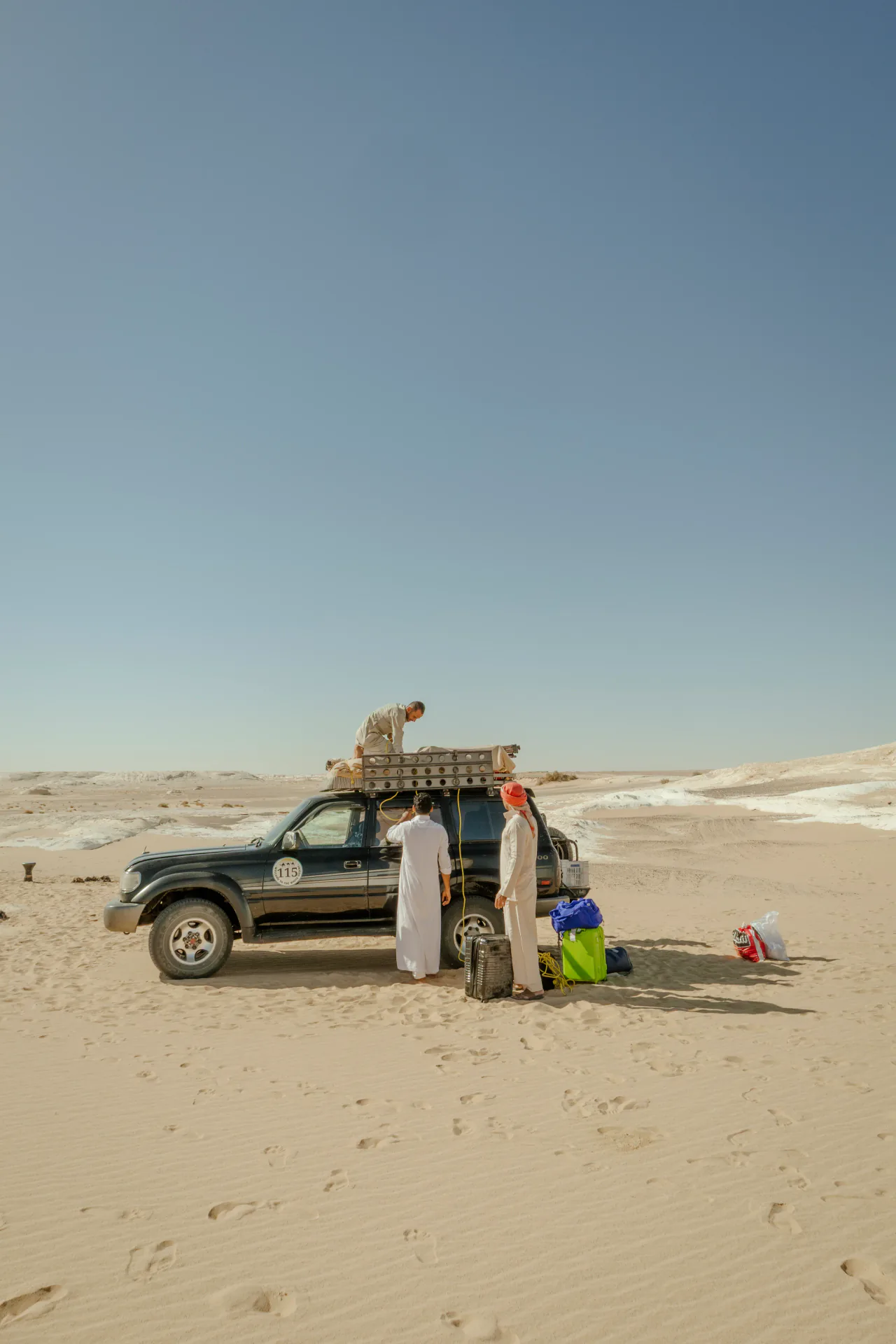
Solar Eclipse Tours is operated by Elzaghandi Group in Bahariya Oasis. The current website includes pickup from Downtown Cairo, Giza and nearby Giza hotels, or Zamalek, with other pickup areas quoted separately, an air-conditioned road transfer to Bahariya, locally operated 4x4 desert travel and a purpose-planned eclipse camp.
The live 2027 Egypt solar eclipse tours and packages should remain the source for current package details, inclusions and prices.
What the Eclipse Camp Should Provide
An August desert camp should not be treated like a normal winter camping program.
A safe operational base needs:
- Climate-controlled sleeping and rest areas.
- Shade beside the open observation field.
- Cold drinking water.
- Electrolytes where appropriate.
- Fresh food.
- Dedicated toilets.
- Charging.
- Backup power.
- Communications.
- Medical support.
- Controlled guest capacity.
- Organized vehicles.
- Emergency access.
- A staged departure plan.
The final observation area must remain open to the sky. Air-conditioned lounges can sit close to it, but a covered or enclosed space cannot be the main viewing field.
The current White Desert Eclipse Camp page explains planned facilities. Published wording now confirms the White Desert camp and viewing point inside the path of totality, while facility details remain subject to final supplier and safety planning.
Choosing Between the 2-, 3- and 4-Day Packages
The current tour structure offers three main lengths.
2-Day Journey
Best for travelers who want the most focused route to the camp and eclipse with minimal additional days.
3-Day Journey
Best for travelers who want more time in the desert and a less compressed experience after totality.
4-Day Journey
Best for travelers who want an air-conditioned Bahariya hotel night, oasis touring and the most complete combination of comfort and desert travel.
Package prices and inclusions can change as transport, accommodation and camp operations are finalized. For current prices and inclusions, use the live package pages because transport, accommodation and camp details may change as the event approaches.
Use the current package comparison for the latest published information, then check availability for the actual group, room and vehicle requirement.
Eye Safety: The Rules That Cannot Be Compromised
Except during confirmed totality, it is unsafe to look directly at the Sun without specialized solar viewing protection.
NASA’s guidance is clear:
- Use safe eclipse glasses or a handheld solar viewer during the partial phases.
- Regular sunglasses are not safe.
- Inspect viewers and discard damaged products.
- Supervise children.
- Do not look through an unfiltered camera, telescope or binoculars while wearing eclipse glasses.
- Optical equipment requires a suitable solar filter secured over the front of the optics.
- Remove ordinary viewers only when the photosphere is completely covered.
- Replace them as soon as any direct sunlight returns.
An organized camp should include repeated briefings and clear announcements before second and third contact.
The dedicated safety cluster should link from this pillar to:
Glasses should never be described as “NASA approved,” because NASA does not approve specific commercial brands.
Heat, Hydration and August Conditions
The central phase occurs around midday in August.
Heat planning is therefore part of eclipse safety.
Guests may be outside during several hours of partial phases. Photographers may set up earlier. Children, older travelers and people with medical conditions may become tired before totality arrives.
A responsible schedule includes:
- Hydration before outdoor exposure.
- Cold water available continuously.
- Shade.
- Air-conditioned recovery.
- Light meals.
- Hats and sun-protective clothing.
- Reduced unnecessary walking.
- Seating.
- Medical monitoring.
- Safe storage for medication.
- Cooling for vulnerable travelers.
- Protection for batteries and electronics.
Symptoms such as confusion, nausea, dizziness, headache, unusual weakness or fainting require immediate attention.
The future White Desert Summer Safety Warning should be linked prominently from the package and camp pages.
Weather: Favorable Climate Is Not a Guarantee
Egypt’s desert and Upper Egyptian regions are attractive because of dry summer climatology. That does not guarantee a clear sky at one specific time on August 2, 2027.
Visibility can still be affected by:
- High thin cloud.
- Dust.
- Wind.
- Haze.
- Coastal humidity.
- Local smoke or pollution.
- Heat shimmer.
- Rare weather changes.
A trustworthy operator should explain historical patterns without promising success.
Weather planning should include:
- Long-range climatology for site comparison.
- Short-range forecasts close to the event.
- Dust and wind monitoring.
- A site inspection.
- Limited mobility where practical.
- Honest guest communication.
- A trip with genuine cultural and landscape value even if cloud blocks totality.
No refund or visibility statement should imply control over the weather unless the written policy explicitly defines it.
Photography Planning
The high Sun is one of the main photographic challenges.
Near the strongest Egyptian section of the path, the Sun is approximately 81 degrees above the horizon.
Equipment
Photographers should consider:
- A stable tripod.
- A head that can point near vertical.
- A front-mounted solar filter.
- Spare batteries.
- Remote release.
- A rehearsed exposure sequence.
- A lens shade that does not interfere with the filter.
- Secure storage away from direct heat.
- A second wide-angle camera if desired.
Partial Phases
Keep the solar filter on the camera.
Totality
Remove the filter only after full coverage and replace it before direct sunlight returns.
Rehearsal
Practice at a similar solar altitude. Confirm that the lens, tripod, cables and camera body do not collide.
Experience Before Equipment
A long totality provides more time than many eclipses, but photographers should still reserve part of it for direct observation rather than spending every second adjusting settings.
See the full 2027 Total Solar Eclipse Photography Guide.
Families, Children and Older Travelers
The event can be suitable for families when safety and comfort are designed into the day.
Children need:
- Properly fitting solar viewers.
- Active adult supervision.
- Shade.
- Water.
- Toilets.
- Air-conditioned rest.
- Simple instructions.
- A named adult responsible for them.
- No unsupervised binoculars, telescopes or cameras.
Older travelers and guests with limited mobility should ask about:
- Walking distance.
- Ground surface.
- Steps.
- Vehicle access.
- Seating.
- Accessible toilets.
- Cooling.
- Medication storage.
- Medical support.
- Emergency evacuation.
The current Child Policy should be linked from packages and booking pages. Age pricing and sleeping arrangements must remain consistent everywhere on the site.
When Is the Next Total Eclipse After 2027?
The 2027 event is not the final total solar eclipse for decades.
The next total solar eclipse globally occurs on July 22, 2028 and reaches a maximum of about 5 minutes 10 seconds.
The next total eclipse whose path crosses Egypt occurs on March 20, 2034, with a maximum of about 4 minutes 9 seconds.
Those events are important, but they do not reproduce the same combination of more than six minutes, high Sun, Egyptian geography and August travel conditions.
Read When Is the Next Total Solar Eclipse After 2027? for the future eclipse timeline.
Ancient Egypt and the Eclipse Experience
Egypt’s solar religion, calendars and astronomical traditions create a powerful emotional setting for a modern eclipse.
It is important not to convert that atmosphere into unsupported historical claims.
Ancient Egyptians certainly lived through solar eclipses during their long history. Modern calculations can identify possible ancient events. What remains difficult is proving that a surviving Egyptian text unambiguously records one specific total eclipse.
The historically responsible approach separates:
- Astronomical possibility.
- Textual or archaeological suggestion.
- Secure documentation.
Explore the evidence and uncertainty in Did Ancient Egyptians Witness a Total Solar Eclipse?.
How to Evaluate an Eclipse Tour
Before paying a deposit, ask for clear answers.
Astronomy
- Is the viewing field inside totality?
- Are the coordinates confirmed?
- What local duration is calculated?
- Which source and model are used?
- Is the site safely away from the path boundary?
Transport
- Where is pickup?
- How long is the drive?
- What vehicle type is used?
- How many guests share each vehicle?
- Are 4x4 transfers required?
- What happens if a vehicle breaks down?
Camp
- What is air-conditioned?
- Where is the open viewing field?
- What toilets are provided?
- Is water available continuously?
- What power and charging exist?
- Is internet promised or expected?
- What is the maximum capacity?
Health and Safety
- Is medical support present?
- What is the heat plan?
- Are eclipse glasses included or sold separately?
- How are children supervised?
- Is an emergency route identified?
Commercial Terms
- What deposit is required?
- When is the balance due?
- What happens if the customer cancels?
- What happens if the operator changes the site?
- What is the weather policy?
- Are hotel and camp categories clearly described?
- Which costs are excluded?
Read the Booking and Cancellation Policy before confirming and retain the invoice and written itinerary.
Recommended Booking Timeline
As Early as Practical
Compare destinations, identify the preferred package and understand the cancellation terms.
After Reservation
Confirm passport, flights, insurance, health needs and room or tent configuration.
Six to Twelve Months Before
Finalize international travel, equipment, prescription medication and any extension.
Three Months Before
Check baggage limits, photography filters, clothing and communication from the operator.
One Month Before
Review final transport, camp location, emergency contact, updated time zone and eclipse schedule.
Final Week
Follow weather and dust updates, charge equipment and attend the operator’s briefing.
The date will not change, and specialist capacity is finite. Early booking is sensible without using misleading “last eclipse ever” pressure.
Common Mistakes to Avoid
Assuming Cairo Is Inside Totality
It is not.
Treating 99 Percent as Equivalent to Totality
It is not.
Assuming the Entire White Desert Is Inside the Path
It is not.
Using Ordinary Sunglasses
They are unsafe.
Looking Through Unfiltered Optics
This can cause severe eye injury.
Arriving on Eclipse Morning
Transport disruption can cause the entire event to be missed.
Choosing Only by Maximum Seconds
A safe 6m17s site can be better than an impractical 6m23s coordinate.
Believing Clear Sky Is Guaranteed
No operator can guarantee weather.
Expecting Every Famous Monument to Host the Event
Protected sites require permission.
Ignoring Heat During the Partial Phases
The main health exposure lasts longer than totality.
Frequently Asked Questions
When is the 2027 total solar eclipse in Egypt?
Monday, August 2, 2027.
How long will totality last in Egypt?
The global maximum reaches approximately 6 minutes 23.2 seconds at a point in Egypt. Local duration depends on the exact coordinate.
Will Cairo see totality?
No. Cairo sees a deep partial eclipse.
Will Alexandria see totality?
No. Alexandria is outside the path of totality.
Will Luxor see totality?
Yes. Representative Luxor coordinates receive approximately 6 minutes 22 seconds.
Is Siwa inside totality?
Yes, at representative coordinates, with about 5 minutes 31 to 33 seconds.
Is Bahariya inside totality?
Representative Bahariya coordinates are inside totality. The final camp still requires independent verification.
Is the White Desert inside totality?
Some broad Western Desert locations are inside, while common Farafra and White Desert tourist coordinates can be outside. Use the exact viewing-field coordinate.
Is Aswan inside totality?
Central Aswan city is expected to see a deep partial eclipse. Some northern parts of the governorate may lie inside totality.
Is Hurghada inside totality?
Representative Hurghada coordinates are outside the total path.
Is Marsa Alam inside totality?
Representative Marsa Alam coordinates are inside, but every resort or viewing field must be checked.
What time is maximum eclipse in Luxor?
Approximately 1:05 pm local summer time under the current UTC+3 assumption.
Can I remove eclipse glasses during totality?
Only when the photosphere is completely covered at a confirmed total location. Replace them before direct sunlight returns.
Are ordinary sunglasses safe?
No.
Can I use eclipse glasses with binoculars?
No. Binoculars require correct filters secured over the front optics.
Is Egypt guaranteed to have clear skies?
No. Some regions have favorable climatology, but weather cannot be guaranteed.
Is the 2027 eclipse the longest ever?
No. It is the longest total solar eclipse since 2009, and no longer event occurs until 2114 according to NASA’s catalog.
Is there another total eclipse after 2027?
Yes. The next occurs in July 2028. Egypt’s next total eclipse is in March 2034.
How early should I arrive in the viewing region?
At least one day before the eclipse. Multi-day packages reduce same-day transport risk.
Where can I compare packages?
Use the live Eclipse Tours & Packages page.
How do I request availability?
Submit the Check Availability form.
Final Takeaway
The 2027 total solar eclipse places Egypt at the center of a remarkable global event.
The country contains the points of greatest eclipse and greatest duration, offers more than six minutes of totality at several suitable locations and combines the event with desert, Nile and Red Sea travel.
The opportunity also demands precision. A broad destination name does not establish totality. A favorable climate does not guarantee clear sky. A campsite is not automatically safe in August. The strongest journey combines verified coordinates, responsible solar viewing, heat management, reliable transport and clear commercial terms.
For travelers seeking a managed Western Desert experience, first explore our Eclipse 2027 Egypt Western Desert viewing experience, then compare the current 2027 eclipse tour packages and check availability.