Luxor total solar eclipse 2027: quick answer
Luxor total solar eclipse 2027: Plan the Luxor total solar eclipse on 2 August 2027 with approximate local times, about 6 minutes 22 seconds of totality, viewing-site guidance, heat safety and practical travel planning.
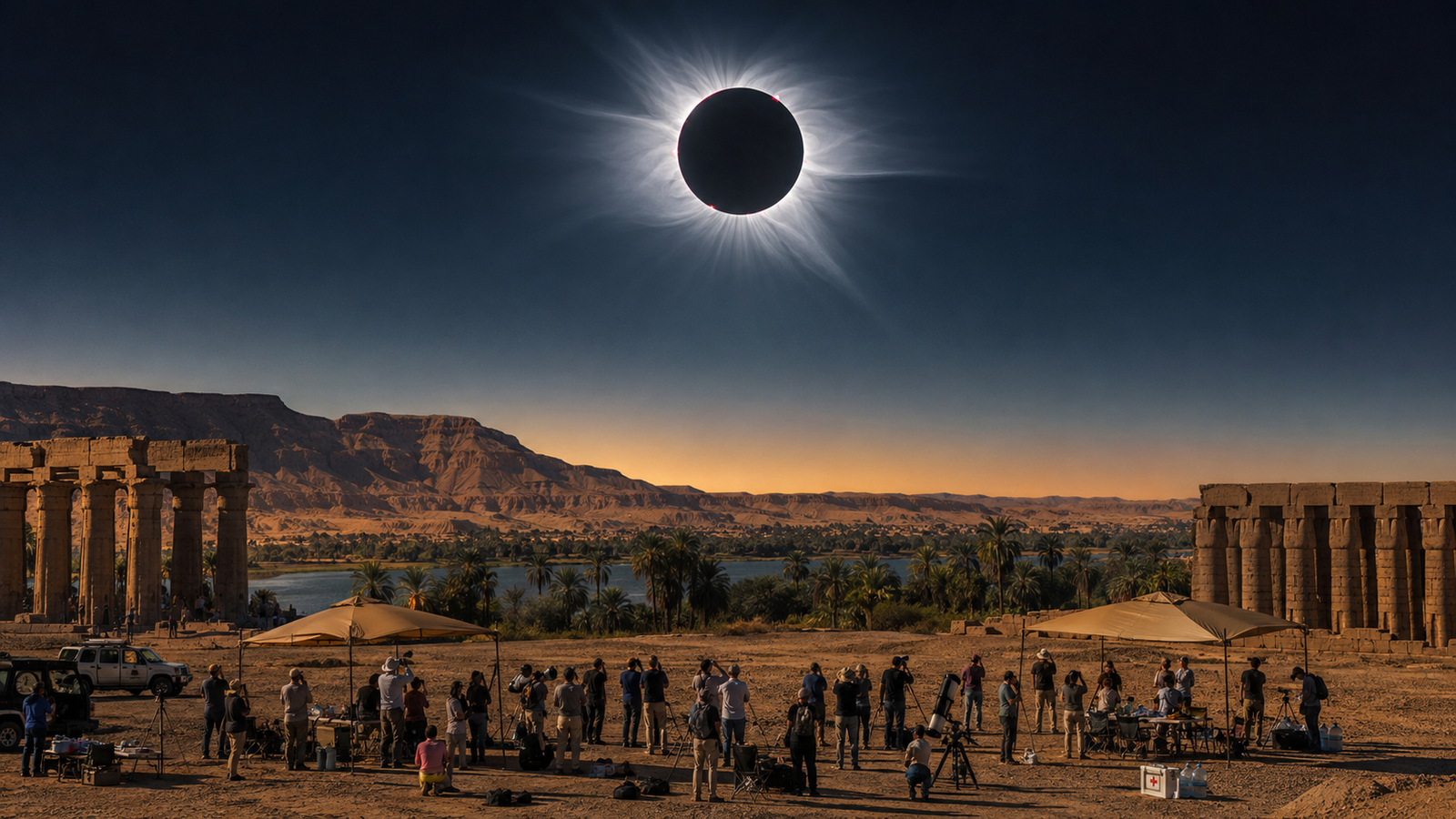
The Luxor total solar eclipse 2027 will offer one of the longest city-based totality experiences in Egypt. On Monday, August 2, 2027, the Moon will completely cover the Sun above Luxor for approximately 6 minutes 22 seconds at representative city coordinates. The partial eclipse begins around 11:40 am local time, totality begins shortly after 1:02 pm, maximum eclipse occurs near 1:05 pm, and direct sunlight returns shortly after 1:08 pm.
Those figures place Luxor close to the longest portion of the entire eclipse path. The global greatest duration is approximately 6 minutes 23 seconds, so Luxor loses only about one second compared with the theoretical maximum at favorable central locations.
The astronomy is exceptional. The practical experience requires more careful analysis.
Luxor is a major international tourism destination with established hotels, airport access, Nile cruises, guides, transport companies and globally recognized archaeological landscapes. These advantages make it easy to understand why it may become one of the most popular eclipse destinations in 2027.
Popularity can also create pressure. Hotels may fill early, roads can become busy, approved open land may be limited, and famous archaeological sites cannot be assumed to function as private eclipse-viewing venues. Temperatures will be extremely high around midday, and the Sun will stand close to overhead. A successful plan therefore depends on the exact viewing field, shade, cooling, water, toilets, medical support, traffic control and clear eye-safety procedures.
This guide explains what Luxor will see, where a viewing site should be located, what travelers should expect and how Luxor compares with the Western Desert, Siwa and other Egyptian eclipse destinations.
For the complete national route, read the 2027 eclipse path of totality across Egypt.
Quick Answer: Is Luxor Inside the Path of Totality?
Yes. Representative Luxor coordinates lie securely inside the path of totality.
The expected local circumstances are approximately:
| Phase | Approximate Luxor time | What happens |
|---|---|---|
| Partial eclipse begins | 11:40 am | The Moon begins covering the Sun; approved solar protection is required. |
| Totality begins | About 1:02 pm | The photosphere disappears and the corona becomes visible. |
| Maximum eclipse | About 1:05 pm | The Moon is most centrally aligned over the Sun for the location. |
| Totality ends | About 1:08 pm | Direct sunlight returns; eclipse glasses and camera filters must be in place. |
| Partial eclipse ends | About 2:26 pm | The Moon completely leaves the solar disk. |
| Approximate totality duration | 6m 22s | Local duration varies by exact viewing coordinate. |
Egypt is expected to use daylight-saving time on August 2, 2027 under current law, making the local clock UTC+3. The legal time rule should be checked again before final schedules are published.
For a city-by-city comparison, see the 2027 solar eclipse times in Egypt.
Why Luxor Receives Such Long Totality
Luxor sits near the center of the most favorable Egyptian section of the path.
NASA’s path table shows the shadow center crossing Upper Egypt around 10:04–10:06 UTC. At that stage:
- The Moon-to-Sun apparent-diameter ratio is approximately 1.079.
- The path is approximately 258 kilometers wide.
- Central-line totality is approximately 6 minutes 23 seconds.
- The Sun is about 82 degrees above the horizon.
Luxor is not exactly on the theoretical point of greatest duration, but it is close enough to receive almost the full maximum.
Several astronomical conditions combine to produce this result:
- The Moon appears relatively large.
- The Sun appears relatively small.
- The shadow crosses Earth with favorable geometry.
- Luxor lies deep inside the central path.
- The shadow speed is favorable near Egypt.
The result is more than twice the maximum totality of the 2017 United States eclipse. Read the 2027 Egypt eclipse vs 2017 USA eclipse comparison for the full context.
What Will Totality Look Like in Luxor?
The partial phase begins gradually. Through approved eclipse glasses, the Moon appears to take a small bite from the Sun. Over the next hour and twenty minutes, the solar disk becomes an increasingly thin crescent.
As totality approaches, the atmosphere and landscape may begin to look unusual.
Potential effects include:
- Sharper shadows.
- Crescent-shaped projections beneath leaves or small openings.
- A reduction in temperature.
- Changes in wind.
- A metallic or muted quality of daylight.
- A darker western or northwestern sky as the umbra approaches.
- Increased attention from birds, insects and animals, though behavior varies.
Seconds before totality, Baily’s beads may appear as sunlight passes through valleys along the Moon’s edge. The last bright point can create the diamond-ring effect.
When the photosphere is fully covered, the black lunar disk appears surrounded by the solar corona. Depending on solar activity and atmospheric clarity, observers may see:
- Bright inner corona.
- Extended streamers.
- Pink or red prominences.
- Bright planets.
- Some stars.
- A 360-degree twilight glow near the horizon.
- The illuminated landscape beyond the Moon’s shadow.
Six minutes is long enough to observe several aspects of the event without rushing, but totality still passes quickly. First-time viewers should reserve part of the central phase for unaided observation rather than watching through a phone or camera screen.
The Sun Will Be Almost Overhead
The Sun’s altitude near Luxor during totality will be close to 82 degrees.
This is one of the defining characteristics of the 2027 eclipse in Egypt.
Advantages of the High Sun
- Low buildings are unlikely to block it.
- Mountains and trees near the horizon matter less.
- Haze close to the horizon has less influence.
- A reasonably open field can provide a clear view.
- The eclipse can be observed from many orientations within a large site.
Challenges of the High Sun
- Guests must look steeply upward.
- Heavy telephoto lenses need a tripod head capable of near-vertical movement.
- Camera cables and plates may collide with tripod legs.
- Large shade structures can block the line of sight.
- Guests may accidentally stand under or in front of tilted lenses.
- The midday Sun increases heat exposure before totality.
- Wide-angle photographs that include both the eclipse and the landscape become more difficult.
A good viewing field should be inspected with the solar altitude in mind. Shade and cooling areas should stand beside the observation zone, while the central field remains open above.
Photographers should rehearse with the Sun at a similar altitude weeks or months before the trip.
Where Should You Watch the Eclipse in Luxor?
There is no single universal answer.
The best viewing field is not necessarily a famous monument or the center of the city. It is a permitted open site that offers secure totality, safe access and complete event operations.
A suitable field should provide:
- Exact coordinates securely inside totality.
- A wide unobstructed sky.
- Legal permission.
- Enough space for guests and tripods.
- Vehicle parking away from the observation zone.
- Emergency access.
- Shade and cooling nearby.
- Toilets.
- Water and food service.
- Medical staff or a defined medical response.
- Communication between guides and drivers.
- Controlled lighting and sound.
- A staged departure plan.
East Bank vs West Bank
Travelers often think about Luxor in terms of the east and west banks of the Nile.
Both sides lie inside totality at many representative coordinates, but their operational characteristics differ.
The east bank generally has a larger concentration of hotels, city services, restaurants, transport and airport access. It may also have greater urban obstruction and traffic.
The west bank can offer more open agricultural or desert-edge landscapes, depending on the exact site. It may still face access, land-use and archaeological-zone restrictions.
The correct decision should be based on the exact field rather than a general bank preference.
Desert Edge or Agricultural Land
An open desert-edge site may provide clean horizons and easier tripod layout. It can also lack infrastructure and require temporary services.
Agricultural land may be close to hotels and roads, but crops, irrigation channels, property rights and narrow access routes can create problems.
The operator must confirm land permission and site suitability. A field that appears empty on satellite imagery may be private, cultivated, protected or inaccessible to large vehicles.
Can You Watch the Eclipse from Karnak, Luxor Temple or the Valley of the Kings?
Do not assume so.
Luxor’s archaeological sites are protected cultural locations with controlled opening hours, visitor capacity, security systems and conservation rules. Their inclusion in a normal sightseeing itinerary does not mean they can host a large eclipse event.
An operator should advertise an archaeological-site viewing event only after receiving written confirmation from the responsible authority.
Questions include:
- Will the site be open during the eclipse hours?
- Are special-event permits required?
- How many guests are allowed?
- Can tripods be used?
- Are large bags and equipment permitted?
- Can shade, water and toilets be added?
- Is emergency access available?
- Can guests remain through the full partial phase?
- Are professional photography fees required?
- Will other public visitors be present?
Without confirmed answers, the responsible product should describe temple visits as separate cultural activities and use a dedicated open viewing field for the eclipse.
This distinction protects travelers from booking based on an attractive but unverified promise.
Luxor’s Main Advantages as an Eclipse Destination
Near-Maximum Totality
Approximately 6 minutes 22 seconds gives Luxor one of the longest city-based totality experiences in the world for 2027.
Established Tourism Infrastructure
Luxor already receives international visitors. The destination has hotels, guides, transport companies, restaurants, hospitals, tourism police and established excursion systems.
Airport Access
Travelers may reach Luxor through domestic or international flight arrangements, depending on their route and the schedules available in 2027.
Cultural Value
The trip remains valuable even if cloud or dust interferes with the eclipse. Guests can visit major historical attractions, travel on the Nile and explore Upper Egypt.
Multiple Accommodation Types
Luxor offers hotels, resorts, guesthouses and Nile-cruise options. Availability and standards must be verified for the final package.
Broad Path Margin
Luxor is not close to a totality boundary. Minor lunar-limb refinements will not change the city from total to partial.
High Solar Altitude
The Sun is unlikely to be blocked by low terrain or buildings if the viewing field is reasonably open.
Luxor’s Main Challenges
Demand and Crowding
Luxor’s fame and long totality are likely to attract substantial international interest. Exact visitor numbers cannot be predicted honestly, but hotels, vehicles, guides and event sites are finite.
August Heat
The partial phase begins before noon and ends in mid-afternoon. Guests may spend several hours outdoors during the hottest part of the day.
Limited Controlled Viewing Space
A public city or heritage environment can be difficult to control. A private permitted field may be safer and more comfortable.
Traffic
A large number of groups moving at similar times can create delays. The risk is greatest if visitors attempt a same-day transfer from distant hotels.
Archaeological Restrictions
Famous monuments cannot be assumed to function as viewing venues.
High Sun for Photographers
The near-overhead Sun complicates tripod geometry and landscape composition.
Price Pressure
High demand may increase hotel and transport rates. Travelers should examine package inclusions and cancellation rules rather than comparing headline prices only.
Heat Safety in Luxor on Eclipse Day
Heat is not a minor comfort issue. It is one of the main operational risks.
A proper plan includes:
- Early hydration.
- Cold drinking water available continuously.
- Electrolytes where appropriate.
- Shade with ventilation.
- Air-conditioned buses or rest spaces.
- Light meals.
- Sun-protective clothing.
- Hats and sunscreen.
- Medical screening for vulnerable guests.
- Reduced walking during the hottest hours.
- Seating for older travelers.
- A system to identify heat exhaustion.
- Emergency cooling.
Guests should be encouraged to report dizziness, nausea, confusion, headache or unusual weakness immediately.
The eclipse does not require standing in direct Sun for three continuous hours. Guests can observe selected partial phases, rest in shade and return to the field before totality.
The event schedule should avoid long archaeological excursions on the same morning. A temple visit before noon could leave guests dehydrated and tired before the central phase.
For broader summer planning, read the Egypt eclipse heat and safety guide.
Eye Safety During the Luxor Eclipse
Approved eclipse glasses are required during every partial phase.
They may be removed only after the Sun’s bright photosphere is completely covered and totality has begun. They must be replaced immediately before or when direct sunlight returns.
Key rules:
- Ordinary sunglasses are not sufficient.
- Damaged or scratched eclipse viewers should not be used.
- Children require active supervision.
- Guests should put glasses on before looking upward.
- They should look down before removing them.
- Cameras, binoculars and telescopes require front-mounted solar filters.
- Eclipse glasses worn behind unfiltered optics do not provide protection.
- Camera filters must be restored before third contact.
A managed group should hear clear announcements before second and third contact.
The full procedure belongs in the dedicated solar eclipse glasses safety guide.
Photography in Luxor
Luxor offers remarkable photographic potential, but the most obvious composition may not be practical.
Close-Up Solar Photography
A telephoto lens can record:
- Partial phases.
- Baily’s beads.
- Diamond rings.
- Prominences.
- Inner and outer corona.
The camera needs a suitable front-mounted solar filter during partial phases.
Wide-Angle Photography
Because the Sun is very high, including temples or mountains in the same frame may require an extremely wide lens or a carefully selected distant foreground.
A composite image can show the eclipse progression above a landscape, but it should be labeled as a composite rather than presented as one instant.
Tripod Layout
The viewing field should have a photography zone with:
- Marked tripod spaces.
- Clear walkways.
- No vehicle movement.
- Controlled lights.
- Power rules.
- Separation between casual observers and long lenses.
Rehearsal
Photographers should practice:
- Finding the Sun safely.
- Tracking near the zenith.
- Removing and replacing the filter.
- Exposure bracketing.
- Changing shutter speed rapidly.
- Operating without looking at a phone.
- Recovering from an equipment error.
The detailed workflow belongs in the 2027 eclipse photography guide.
Luxor Weather and Sky Prospects
Luxor is known for dry summer conditions, and supplementary historical datasets show very low average cloud cover around August 2. This is encouraging, not a guarantee.
Visibility can still be affected by:
- High thin cloud.
- Dust.
- Wind.
- Haze.
- Local smoke or pollution.
- Heat shimmer.
- Rare weather changes.
An operator should never promise clear skies.
The useful weather plan includes:
- Monitoring multiple forecasts.
- Watching dust and wind predictions.
- Inspecting the field on the previous day.
- Knowing whether a limited local move is possible.
- Communicating uncertainty honestly.
- Preparing the trip so it remains valuable even if the Sun is obscured.
Luxor’s cultural program is an important form of risk diversification. The destination has value beyond the eclipse.
Luxor vs the Western Desert
Luxor and a Bahariya-based Western Desert camp are two of the strongest Egyptian concepts. They serve different traveler preferences.
| Factor | Luxor | Western Desert near Bahariya |
|---|---|---|
| Totality | About 6m 22s at representative coordinates | About 6m 17s at representative Bahariya coordinates; final camp varies |
| Infrastructure | Strong hotel and tourism infrastructure | More expedition-style; temporary camp systems are essential |
| Crowd expectation | Likely to attract many organized groups | Potentially lower public density at a controlled private site |
| Viewing control | Depends on securing a private permitted field | Potentially stronger within a dedicated camp |
| Cultural setting | Temples, Nile Valley and ancient monuments | Oases, desert landscapes and White Desert excursions |
| Heat management | Hotels and buses can provide cooling | Requires purpose-built air-conditioned and shaded camp support |
| Access | Airport and established tourism transport | Long overland transfer from Cairo |
| Photography | Potential cultural foregrounds but complex permissions and high Sun | Open horizons and controlled tripod space |
The difference in representative totality is only a few seconds. The better choice depends on experience, not duration alone.
Travelers who value established hotels and ancient sites may prefer Luxor. Those who value a controlled camp, open horizon and lower urban density may prefer the Western Desert.
Read the Western Desert vs Nile Valley eclipse comparison and the best place in Egypt for the 2027 eclipse.
Luxor vs Siwa
Siwa offers roughly 5 minutes 33 seconds of totality at representative coordinates, shorter than Luxor by about 49 seconds.
Siwa may appeal to travelers seeking:
- Oasis culture.
- Western Desert scenery.
- A more remote atmosphere.
- Lower urban density.
Luxor offers:
- Longer totality.
- More hotel capacity.
- Better-known international attractions.
- Airport access.
- A broader established tourism network.
Siwa’s road journey and accommodation capacity may be limiting factors. Luxor’s crowd and price pressure may be more significant.
The Siwa Oasis eclipse guide covers the comparison in detail.
Luxor vs Marsa Alam
Representative Marsa Alam coordinates receive about 5 minutes 27 seconds of totality.
Marsa Alam may offer resort accommodation, Red Sea extensions and an easier beach-focused holiday. Luxor offers almost one additional minute of totality and a richer concentration of ancient sites.
The exact resort coordinate matters in Marsa Alam because the tourism region stretches along a long coastline.
Read the Hurghada and Marsa Alam eclipse comparison.
Who Should Choose Luxor?
Luxor may be the best fit for:
- First-time visitors to Egypt.
- Travelers who prioritize ancient history.
- Guests who prefer hotels over camps.
- People who want near-maximum totality.
- Travelers who value airport access.
- Nile-cruise guests.
- Families needing established services.
- Photographers who want a cultural travel program around the event.
It may be less suitable for:
- Travelers seeking solitude.
- Guests who strongly dislike large tourism concentrations.
- People expecting guaranteed access to a famous temple during totality.
- Travelers who want a private desert-camp atmosphere.
- Photographers requiring a very controlled field with extensive equipment space.
Families and Children
Luxor can work well for families if the event is organized around heat and safety.
The plan should include:
- Child-sized or well-fitting certified viewers.
- Repeated viewing practice.
- Shade.
- Air-conditioned rest.
- Cold water.
- Toilets.
- Seating.
- Short explanations of the eclipse phases.
- A named adult responsible for each child.
- No unsupervised optical equipment.
Children should not be expected to remain quietly outdoors for the entire partial phase. A family program can alternate short observation periods with indoor educational activities.
Families should review the child policy and confirm age, bedding and supervision requirements before booking.
Older Travelers and Accessibility
A site can be inside totality and still be unsuitable for someone with limited mobility.
Ask about:
- Walking distance from bus to field.
- Surface type.
- Steps and irrigation channels.
- Wheelchair access.
- Seating.
- Toilet accessibility.
- Shade distance.
- Air-conditioned recovery.
- Medical support.
- Medication storage.
- Vehicle availability during the event.
A well-designed field allows guests to experience totality without a long walk across uneven terrain.
Recommended Luxor Eclipse Itinerary Structure
A strong package should not place all important travel on eclipse morning.
Day 1 — Arrival and Rest
Guests arrive in Luxor, transfer to the hotel and recover from travel. Equipment remains packed until guests are rested.
Day 2 — Cultural Visits and Orientation
The group visits selected Luxor attractions during suitable hours and receives an introductory eclipse briefing.
Day 3 — Viewing-Site Inspection and Rehearsal
Photographers test equipment. Guests practice using eclipse glasses. The operator confirms transport and weather procedures.
Day 4 — Eclipse Day
- Early breakfast.
- Hydration briefing.
- Transfer to the field well before first contact.
- Equipment setup.
- Partial-phase observation.
- Totality around 1:02–1:08 pm.
- Rest and lunch.
- Completion of the partial phase.
- Staged return to the hotel.
Day 5 — Recovery and Flexible Touring
The morning remains relaxed. Guests may continue touring or join a Nile program.
The exact order should protect guests from fatigue and allow time for delays.
What to Ask Before Booking a Luxor Eclipse Package
Ask the operator:
- Is the final viewing field confirmed?
- What are its coordinates?
- What is the calculated local totality duration?
- Is it comfortably inside the path?
- Who owns or controls the land?
- Are permits confirmed?
- Is temple access part of the eclipse viewing claim or only sightseeing?
- How far is the field from the hotel?
- What time will guests leave?
- Is there air-conditioned transport?
- What shade is provided?
- How much drinking water is available?
- Are toilets located at the field?
- Is a medical professional present?
- Are eclipse glasses included?
- Is there a separate photography area?
- What happens if the site changes?
- What is the weather policy?
- What do cancellation terms cover?
- Are the hotel and cruise categories clearly described?
The answers should appear consistently across the itinerary, invoice, terms and website.
Common Luxor Eclipse Mistakes
Booking a Hotel Without a Viewing Plan
A room in Luxor confirms accommodation, not a safe field.
Assuming Every Temple Allows Eclipse Viewing
Access requires explicit approval.
Arriving on Eclipse Morning
Flight or road delays can destroy the entire purpose of the trip.
Ignoring Heat
The event occurs around midday in August.
Planning Only for Totality
Guests must remain safe through the longer partial phases.
Bringing Unfiltered Optics
Binoculars, telescopes and cameras require front-mounted solar filters.
Comparing Packages Only by Seconds
The difference between 6m17s and 6m22s is less important than field quality and safety.
Assuming Clear Weather Is Guaranteed
No destination can guarantee visibility.
Waiting Too Long to Reserve
Luxor has large tourism capacity, but the eclipse creates one fixed date and concentrated demand.
Frequently Asked Questions
Will Luxor see a total solar eclipse in 2027?
Yes. Representative Luxor coordinates lie securely inside totality.
How long will totality last in Luxor?
Approximately 6 minutes 22 seconds, depending on the exact location.
What time does the eclipse begin in Luxor?
The partial phase begins around 11:40 am local time.
What time does totality begin?
Around 1:02 pm at representative coordinates.
What time is maximum eclipse?
Approximately 1:05 pm.
What time does the eclipse end?
The final partial phase ends around 2:26 pm.
Will Luxor have the longest totality in Egypt?
It is extremely close to the maximum. NASA places the exact greatest-duration point farther northwest in Upper Egypt, where totality reaches about 6 minutes 23.2 seconds.
Can I watch from Karnak Temple?
Only if the responsible authority formally permits eclipse viewing there. Do not assume normal visitor access includes a large event.
Can I watch from my hotel roof?
Possibly, but the hotel must confirm roof access, safety, capacity, shade, railings and whether the Sun is unobstructed. A roof is not automatically safer than a ground field.
Is the east bank or west bank better?
Both can be inside totality. The exact permitted field, access and operations matter more than the bank name.
Will the Sun be high?
Yes, close to 82 degrees altitude around maximum eclipse.
Is Luxor too hot in August?
Heat is serious but manageable with professional planning, air conditioning, shade, water, reduced walking and medical support.
Is Luxor better than the Western Desert?
Luxor offers slightly longer representative totality and stronger hotel infrastructure. The Western Desert can offer a quieter controlled camp and open horizons. The best choice depends on traveler preferences.
Are eclipse glasses included in tours?
A responsible package should state this clearly. Guests should verify that the viewers come from a reputable source and meet appropriate safety standards.
Can the operator guarantee clear sky?
No. The operator can verify the path and prepare logistics, but cannot guarantee weather.
Final Takeaway
Luxor is one of the most astronomically powerful locations for the 2027 total solar eclipse. It combines approximately 6 minutes 22 seconds of totality with established tourism infrastructure and some of Egypt’s most important cultural experiences.
Its strengths also create pressure. Demand, traffic, heat and protected-site restrictions mean that a hotel booking alone is not an eclipse plan. Travelers still need a verified open field, legal access, cooling, toilets, medical support and a clear transport schedule.
Luxor is the stronger choice for travelers whose main priority is temples, Nile hotels and the longest city-based totality. The confirmed Western Desert eclipse-camp region between the White Desert and the Black Desert, inside the path of totality is the stronger choice for travelers who prioritize a private viewing field, controlled capacity, open horizons, direct local operations and a complete desert journey built around the eclipse.
The representative duration difference is only a few seconds—approximately 6m22s in Luxor versus around 6m17s near Bahariya—while the operational experience can be completely different. For many travelers, the control and immersion of the Western Desert are more valuable than the final five seconds.
Explore our Eclipse 2027 Egypt Western Desert viewing experience, compare the 2-, 3- and 4-day eclipse packages, or check current availability.
Authoritative planning reference
Use NASA 2027 eclipse path data as a primary reference, then verify local circumstances for the exact location.