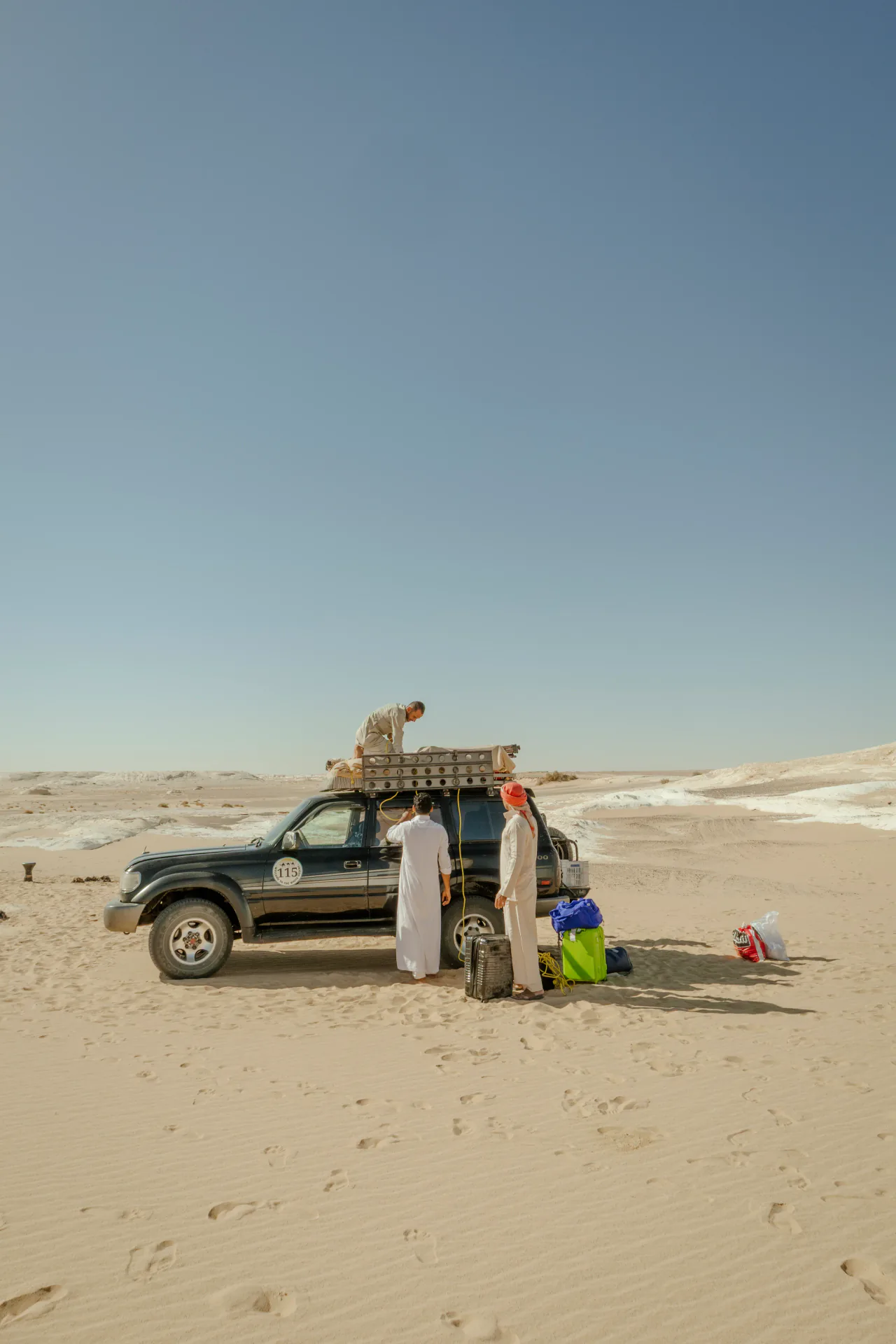
Quick answer: If you are already in Cairo or Giza, two days is the shortest practical package for reaching a prepared White Desert camp, seeing totality on 2 August 2027, and returning to Cairo. Three days is the best balance for many travelers because it adds a Bahariya hotel night after the eclipse instead of returning directly to Cairo. Four days is the most comfortable short option because it starts on 31 July and combines two five-star Bahariya hotel nights with one premium eclipse-camp night. Private transport can be requested as an optional upgrade. For an international trip, however, do not confuse the package length with your total time in Egypt: allow at least five to six nights, and preferably seven to ten days.
That distinction matters. A two-day eclipse tour can be complete, but a two-day international holiday is not. Flights can be delayed, luggage can arrive late, and jet lag can make a once-in-a-lifetime event harder to enjoy. The eclipse will not wait for a missed connection. Your itinerary should therefore protect the fixed event first and add sightseeing around it second.
This guide compares the realistic choices, provides sample itineraries from five to fourteen days, and explains which duration suits photographers, families, older travelers, first-time Egypt visitors, and anyone combining the eclipse with Cairo, Luxor, a Nile cruise, or the Red Sea.
The essential distinction: package days versus total trip days
There are two different questions hidden inside “How many days do I need?”
- How long should the organized eclipse package be? The practical White Desert choices are two days, three days, or four days.
- How long should the entire Egypt trip be? This includes international arrival, a buffer before departure to the desert, recovery after the eclipse, and any sightseeing.
For most overseas visitors, the strongest structure is a three- or four-day eclipse package inside a seven-, ten- or fourteen-day Egypt itinerary. Seven days works well for an efficient Cairo + eclipse trip, ten days gives more breathing room for Cairo and recovery, and fourteen days allows Luxor, a Nile cruise or the Red Sea without compressing the fixed eclipse operation. Travelers with very limited annual leave can still make a five- or six-night plan work, but they should arrive in Cairo at least two nights before the desert departure.
Before comparing lengths, read the Egypt solar eclipse tours and package overview, the side-by-side package comparison, and the 2027 Egypt eclipse tour buyer’s guide. The choice is not about whether one itinerary “has the eclipse” and another does not. All three are built around totality. The real differences are pace, comfort, activities, and what happens before and after the central event.
Why this trip cannot be planned like an ordinary holiday
A museum can usually be visited the following morning. A Nile cruise may have another sailing. A total solar eclipse is different: the Moon’s shadow crosses a precise corridor at a precise time on Monday, 2 August 2027. NASA’s interactive map shows that observers must be inside the path of totality to see the Sun’s bright photosphere fully covered. A near-total partial eclipse is not a substitute for totality.
The schedule therefore works backward from one immovable point. You want to be at the selected viewing field well before the partial phase begins, with camp operations, transport, water, shade, toilets, first aid, and observation procedures already in place. The 2027 eclipse path across Egypt explains why exact location matters, while the Egypt eclipse timing guide shows how the local timetable changes from west to east.
This is also why an overnight desert camp is operationally stronger than a same-day dash from Cairo. The road journey from Cairo or Giza to Bahariya is approximately four to five hours, followed by a transfer into locally operated 4x4 vehicles for the desert sector. A departure on eclipse morning would introduce unnecessary road, timing, and coordination risk. The two-, three-, and four-day options all place guests in the event-camp environment before eclipse day.
The short recommendation by traveler type
| Traveler | Recommended eclipse package | Recommended total time in Egypt | Why |
|---|---|---|---|
| Very limited leave, already adjusted to Cairo | 2 days | 5–6 nights | Covers the essential camp and totality experience with little spare time |
| Most first-time visitors | 3 days | 7–10 days | Best balance of eclipse security, White Desert depth, and Cairo time |
| Families, seniors, or comfort-focused travelers | 4 days | 8–10 days | Two five-star Bahariya hotel nights, one premium eclipse-camp night and private transport |
| Serious eclipse photographer | 3 or 4 days | 8–10 days | More time to organize equipment, adapt to conditions, and recover afterward |
| Cairo plus Luxor or Nile cruise | 3 or 4 days | 10–14 days | Avoids compressing the fixed eclipse operation and major sightseeing |
| Regional traveler with a short flight | 2 or 3 days | 5–7 nights | Less jet lag, but still needs protection against flight and baggage disruption |
Option 1: A two-day eclipse package
The two-day White Desert eclipse tour runs from 1 to 2 August 2027. It is the shortest complete route for a traveler who wants the White Desert, one night at the event camp, totality, and a return to Cairo or Giza after the event.
What the two days contain
On 1 August, pickup is planned from Cairo or Giza in the morning. The paved-road transfer to Bahariya takes approximately four to five hours. After lunch, the group changes to desert 4x4 vehicles, enters the Western Desert landscape, and continues to the purpose-built event camp before sunset. The evening is for dinner, orientation, equipment preparation, and sleep in the viewing region.
On 2 August, guests are already at the eclipse base. The day is organized around the partial phases, totality, observation safety, meals, shade, and camp logistics. After the event and the planned desert route, the group returns toward Bahariya and then Cairo or Giza.
Who should choose two days?
Choose it when every extra day matters, you are comfortable with a full road-and-desert schedule, and your wider Egypt itinerary already gives you a buffer in Cairo before 1 August. It can also suit travelers who have visited Egypt before and are coming primarily for the eclipse rather than an extended holiday.
The two-day option is not necessarily “rushed” inside the eclipse operation; it is deliberately focused. The pressure appears when travelers also compress their international flights. A good two-day-package plan still includes at least two Cairo nights before the pickup and one night after the return.
When not to choose it
It is not the best choice if you want a slow return after totality, more time among the White Desert formations, a second night away from the large event camp, or a gentler transition for children or older relatives. It also gives photographers less post-eclipse time for backing up images and enjoying the desert without the mental countdown to totality.
Option 2: A three-day eclipse package—the best balance for most people
The three-day White Desert eclipse tour runs from 1 to 3 August. It uses the same first-day journey and event-camp preparation as the two-day program, but it does not send you all the way back to Cairo immediately after the eclipse.
Instead, the experience continues through the Western Desert before an overnight stay at a Bahariya hotel and the return to Cairo the following day. That creates an important change in pace. Before totality, everyone is anticipating the event. Afterward, guests can absorb what they saw, share photographs, and experience the landscape without watching the clock for a long urban return.
Why three days is the sweet spot
Three days usually offers the strongest value-to-time ratio:
- It places you in the viewing region before eclipse day.
- It includes the organized eclipse-camp night and a Bahariya hotel night after totality.
- It gives the White Desert a meaningful role instead of treating it only as a backdrop.
- It adds a Bahariya hotel night after the eclipse, giving you recovery time before the return to Cairo.
- It returns you to Cairo on 3 August, leaving room for rest or onward travel on 4 August or later.
For many travelers, this is the answer to the headline question: book a three-day package and spend seven to ten days in Egypt overall.
Who benefits most?
This option is excellent for couples, solo travelers, small groups of friends, active families, and photographers who want both the celestial event and the desert journey. If you are comfortable combining one eclipse-camp night with a Bahariya hotel night, the extra day gives you more recovery time and a less compressed return to Cairo.
Read the White Desert travel guide to understand the terrain, 4x4 transfers, protected-area context, and why Bahariya functions as the operational gateway.
Option 3: A four-day eclipse package—the most complete short itinerary
The four-day Bahariya Oasis and White Desert eclipse tour runs from 31 July to 3 August. It starts one day earlier and combines two five-star Bahariya hotel nights with one premium fully air-conditioned eclipse-camp night and private transport throughout the itinerary.
That first day changes the experience. Instead of combining the Cairo road transfer, lunch, 4x4 transition and eclipse-camp arrival in one movement, guests settle into five-star Bahariya accommodation, eat, see part of the oasis, watch sunset and rest before the desert section begins the following day.
Why the extra day matters
The four-day itinerary is not simply the three-day tour with a spare day attached. It creates a staged arrival:
- Cairo or Giza to Bahariya.
- Five-star Bahariya hotel night and oasis experience.
- Western Desert route and premium eclipse-camp night.
- Eclipse day followed by a second five-star Bahariya hotel night.
- Return to Cairo on the final day.
That progression can reduce fatigue and gives travelers a better sense of Bahariya as a living oasis rather than only a transfer point. It is especially appealing after a long international journey.
Who should choose four days?
It is the strongest short package for families, older travelers who are comfortable with desert camping but want a softer first night, first-time visitors who value context, and photographers carrying more equipment. It is also the best choice for travelers who do not want to choose between a Bahariya stay and the deeper three-day White Desert experience.
Travelers with health, mobility, heat, or medication concerns should discuss their circumstances before booking and read the guides to August desert heat safety and eclipse travel for seniors and people with health conditions. An extra day may improve the pace, but it does not replace individual medical advice or an honest assessment of camping conditions.
Why international visitors should arrive at least two days early
The U.S. Centers for Disease Control and Prevention advises travelers to consider arriving at least two days before an important event so the body has time to adjust to jet lag. That advice is unusually relevant here. Jet lag can involve sleep disturbance, daytime sleepiness, reduced concentration, gastrointestinal symptoms, and general malaise. None is ideal during a long road transfer, desert setup, or careful solar observation.
Two early nights also protect against non-medical disruptions:
- A late connection or canceled sector.
- Checked luggage arriving on a later flight.
- Missing camera equipment, prescription supplies, or clothing.
- A passport, payment, or mobile-data issue that needs time to resolve.
- A traveler discovering that summer conditions require changes to hydration, clothing, or medication storage.
If your eclipse package begins on 1 August, aim to land in Cairo no later than 29 or 30 July. If you choose the four-day package beginning on 31 July, arriving on 28 or 29 July is more prudent. A traveler crossing only one time zone may need less biological adjustment, but flight and baggage buffers still matter.
Do not schedule a non-refundable international arrival on the same morning as the desert pickup. The first day includes a long overland transfer, coordinated group departure, local lunch, and a change to 4x4 vehicles. A delayed passenger cannot assume an entire convoy can wait or that an easy private catch-up transfer will be available.
Five nights: the absolute minimum international plan
A five-night trip is possible for a traveler taking the two-day package, especially from a nearby region, but it leaves little room for error.
Sample five-night plan
| Date | Plan |
|---|---|
| 29 July | Arrive Cairo; sleep and recover |
| 30 July | Full buffer day; check equipment and supplies |
| 31 July | Cairo or Giza sightseeing; early night |
| 1 August | Depart for Bahariya and the eclipse camp |
| 2 August | Total solar eclipse; return toward Cairo |
| 3 August | Depart Egypt late, or preferably add another night |
This schedule technically gives three nights before the eclipse package, but the departure day is tight if the return to Cairo on 2 August runs late. A six-night version, departing on 4 August, is much stronger. It provides a recovery night, protects against road timing changes, and lets you organize photographs and luggage without racing to the airport.
If five nights is all you have, place the buffer before the eclipse, not after it. Missing a flight home is costly; missing totality is irreversible.
7-Day Egypt Eclipse Itinerary: The Efficient Plan
Seven days is the practical minimum we would recommend to most international travelers. It works well with either the two- or three-day package and allows a modest Cairo experience.
Sample seven-day plan with the three-day package
| Date | Plan |
|---|---|
| 28 or 29 July | Arrive Cairo or Giza |
| 30 July | Recovery and buffer day |
| 31 July | Pyramids, museum, or relaxed Cairo day |
| 1 August | Cairo to Bahariya, 4x4 transfer, event camp |
| 2 August | Eclipse day; continue with the Western Desert program, then stay at a Bahariya hotel |
| 3 August | White Desert experience and return to Cairo |
| 4 August | Rest, backup images, flexible Cairo time |
| 5 August | Fly home or continue elsewhere |
This plan has breathing room on both sides of the fixed event. It is long enough to be enjoyable but short enough for travelers balancing work and budget.
Families should also review solar eclipse safety for children and secure genuinely compliant viewing protection. The guide to ISO 12312-2 eclipse glasses explains what the standard means and how to inspect viewers before use.
10-Day Egypt Eclipse Itinerary: Best for a First Visit
If this is your first journey to Egypt, eight to ten days is often the ideal range. It accommodates a three- or four-day eclipse package plus meaningful time in Cairo, without turning every day into a transfer.
Sample nine-day plan with the four-day package
| Date | Plan |
|---|---|
| 27 July | Arrive Cairo |
| 28 July | Recovery and buffer |
| 29 July | Giza Plateau and nearby sights |
| 30 July | Museum or flexible Cairo day; prepare desert bag |
| 31 July | Cairo to Bahariya; first five-star Bahariya hotel night |
| 1 August | Oasis morning, White Desert route, event camp |
| 2 August | Eclipse day; Western Desert activities, then second five-star Bahariya hotel night |
| 3 August | Return to Cairo |
| 4 August | Rest or final sightseeing |
| 5 August | Depart Egypt |
This is a particularly coherent itinerary. The first four nights absorb international travel and give Cairo proper attention. The four-day package then unfolds at a comfortable pace. The final Cairo night protects the flight home from a direct desert-to-airport connection.
Before finalizing dates, review Egypt’s August weather and eclipse cloud outlook. Longer stays do not move the eclipse to a different day, but they do let you arrive rested and allow the operator to execute the confirmed viewing plan without your personal flight schedule creating pressure.
14-Day Egypt Eclipse Itinerary: Add Luxor, a Nile Cruise or the Red Sea
Travelers flying from the Americas, East Asia, Australia, or other long-haul origins often find that ten to fourteen days better justifies the journey. That length can combine the eclipse with Cairo and one additional region, or with a structured Nile itinerary.
Possible combinations include:
- Cairo plus the three- or four-day eclipse package and Luxor.
- Cairo plus the eclipse and a short Nile cruise.
- Cairo plus the eclipse and Red Sea recovery.
- Cairo, Luxor, Aswan, and the eclipse, with carefully sequenced domestic transport.
The best sequencing depends on flight availability and how risk-averse you are, but the eclipse should sit inside the itinerary with buffers around it—not at the very beginning after a long-haul landing and not immediately before an inflexible international departure.
Sample twelve-day outline
| Trip phase | Days | Purpose |
|---|---|---|
| Cairo arrival and buffer | 3 | Recover, protect against disruption, see Giza/Cairo |
| Four-day eclipse package | 4 | Bahariya, event camp, totality, White Desert |
| Recovery and repositioning | 1 | Laundry, image backups, domestic connection buffer |
| Luxor or Red Sea | 3 | Cultural touring or rest |
| Final departure buffer | 1 | Return to international gateway without a same-day gamble |
With a Nile cruise, work from confirmed sailing days rather than forcing the cruise into an arbitrary sequence. Domestic flight and train schedules can change. Keep the night before the desert package in Cairo or Giza unless your operator explicitly confirms another pickup arrangement.
How many days do photographers need?
Photographers do not necessarily need a longer eclipse itself; everyone at the same viewing site receives the same totality. They do benefit from more preparation and recovery time.
A three- or four-day package is usually better than two days because it offers time to:
- Check mounts, tripods, intervalometers, filters, batteries, and storage before the event.
- Separate eclipse equipment from ordinary travel luggage.
- Practice the sequence without the stress of an immediate city return.
- Back up files in more than one place after totality.
- Make landscape and night-sky images during the wider desert journey.
- Rest after sustained concentration in heat and bright conditions.
The 2027 eclipse photography guide should be treated as a rehearsal document, not something to read for the first time at camp. Practice with your actual camera, lens, solar filter, and control method before leaving home. Visual observers also need approved eclipse viewers during all partial phases.
Photographers should arrive in Egypt with critical gear in cabin baggage wherever airline rules allow. A two-day pre-package buffer helps if a checked tripod or case is delayed, but it cannot guarantee replacement of specialized equipment in Cairo.
How many days do families need?
For families, the question is less about adding attractions and more about controlling pace. A four-day package and an eight- to ten-day total trip is the most comfortable general answer, especially when children are new to long road journeys or camping.
Useful planning principles include:
- Avoid landing after midnight and leaving for the desert the next morning.
- Give children at least one full recovery day in Cairo.
- Keep the pre-eclipse day calm; do not fill it with an exhausting city itinerary.
- Pack familiar snacks, sun-protective clothing, individual water habits, and quiet activities for transfers.
- Practice using eclipse viewers before travel and supervise children throughout the partial phases.
- Preserve a recovery day after the desert before another flight or intensive sightseeing day.
The two-day package can work for experienced traveling families, but the four-day staged route may be easier because it includes two five-star Bahariya hotel nights around the premium eclipse-camp night. Package age rules, seat availability, bedding arrangements, and child-specific needs should be confirmed before payment.
How many days do seniors or travelers with health conditions need?
There is no universal number based on age alone. A healthy, experienced older traveler may prefer the active three-day program, while a younger guest with heat sensitivity or limited mobility may need a different plan. In general, add time to reduce consecutive high-demand days.
The four-day package plus two or three Cairo nights beforehand and at least one afterward is the strongest starting framework. That means roughly eight to ten days in Egypt.
Ask detailed questions about:
- Vehicle entry and exit.
- Walking surfaces and distance from tents to toilets.
- Sleeping arrangements and ability to rest during the day.
- Medication storage requirements.
- Dietary needs and hydration.
- Emergency communications and escalation procedures.
- Whether a private vehicle or room upgrade is appropriate and available.
More days improve pacing, but they do not turn a remote desert camp into an urban hotel. Read the White Desert eclipse camp guide and discuss material medical or mobility concerns with both your clinician and the operator.
Does a longer trip improve your weather chances?
Not in the ordinary sense. The eclipse occurs once, so staying fourteen days does not create fourteen chances to see it. A longer trip does, however, strengthen the plan in three ways.
First, you arrive before the event rather than depending on a last-minute flight. Second, the operator has you inside the operational area before eclipse morning. Third, you are not forcing an immediate post-event airport connection that could influence decisions or create stress.
Weather and visibility depend on the actual observing location and conditions on 2 August, including cloud, haze, dust, and local horizon factors. Historical climate can inform planning but cannot guarantee a clear sky at a precise minute. Treat any claim of guaranteed visibility with caution.
The right strategy is to choose a competent operation with a verified site, credible weather monitoring, realistic mobility limits, and transparent contingency procedures. The article on why a local eclipse team differs from a regular desert safari explains why astronomy, crowd, camp, and timing expertise must work together.
Common itinerary mistakes
Arriving on 1 August
This puts your entire eclipse trip at the mercy of one flight. Even an on-time landing may not align with group pickup, baggage collection, city traffic, and the four- to five-hour road journey.
Flying home on the evening of 2 August
The two-day program returns after the eclipse and desert routing. A same-evening international flight creates an unnecessary and potentially impossible deadline. Sleep in Cairo and fly the following day at the earliest; an additional buffer night is better.
Booking the longest itinerary automatically
Four days is more complete, but it is not automatically right for someone who dislikes camping or has only five nights in Egypt. Choose based on pace, accommodation, and goals—not the assumption that more is always better.
Putting every famous sight before the eclipse
An exhausting pre-event schedule can undermine the reason for the trip. Keep 31 July calm if your package departs on 1 August. Hydrate, organize luggage, charge devices, and sleep.
Treating Cairo as an eclipse base on the day
Cairo is outside the path of totality. It is a convenient international gateway and pre-tour base, not a substitute for being at a verified totality site. See the Cairo and Alexandria partial-eclipse guide for the distinction.
Forgetting cancellation and payment terms
Before buying non-refundable flights, review the booking and cancellation policy and confirm what is included, deposit deadlines, balance dates, transfer arrangements, and any insurance requirements.
A decision framework you can use in five minutes
Start with these questions:
- How many nights can I spend in Egypt? If fewer than five, reconsider the trip structure. If five to six, focus on the two-day package. If seven to nine, choose three or four days. If ten or more, add another Egyptian region without compressing the eclipse.
- How much hotel comfort do I want around the eclipse camp? The 2-day package uses one eclipse-camp night only; the 3-day adds one Bahariya hotel night; the 4-day adds two five-star Bahariya hotel nights.
- Do I want private transport and the highest-comfort published structure? If yes, choose four days.
- How far am I flying? The more time zones and connections involved, the more valuable two or three pre-tour nights become.
- Am I carrying specialized equipment or managing family/health needs? Add setup and recovery time.
- What is my real priority? If the eclipse is the primary goal, protect it with buffers before adding sightseeing.
Then check current availability for the package that fits. Availability is not only a room count: desert vehicles, camp capacity, seats, and operational ratios can limit places.
Final recommendation
For the majority of international visitors, the best answer is:
Spend seven to ten days in Egypt and place a three- or four-day White Desert eclipse package in the middle of the trip. Arrive in Cairo at least two days before the package and keep at least one night after returning from the desert.
Choose two days if leave is genuinely limited and you have already protected the arrival. Choose three days for the best balance of time and experience. Choose four days for a staged Bahariya arrival, greater comfort, and the fullest short itinerary.
The eclipse lasts minutes, but the quality of the experience depends on days of sound sequencing. Build the trip around the immovable event, leave room for real-world travel disruption, and let the rest of Egypt enhance the journey instead of competing with it.
Frequently asked questions
Is two days enough for the 2027 Egypt eclipse?
Two days is enough for the organized White Desert eclipse experience if you are already in Cairo or Giza before 1 August. It is not enough for an entire international trip. Add at least two nights before the pickup and preferably one or two afterward.
What is the best eclipse package length for most travelers?
Three days. It includes the eclipse-camp night, totality, additional Western Desert time and one Bahariya hotel night before the return to Cairo.
Why would I choose the four-day package?
It begins on 31 July and includes two five-star Bahariya hotel nights, one premium eclipse-camp night and private transport. The staged arrival suits comfort-focused travelers, families, seniors and guests who want the most comfortable published short route.
How many days should I spend in Egypt overall?
Seven to ten days is the most useful general range. Five to six nights is a tight minimum, while ten to fourteen days allows Cairo plus Luxor, a Nile cruise, or the Red Sea.
When should I arrive in Cairo?
Arrive at least two days before your package begins. For a 1 August departure, land by 29 or 30 July. For a 31 July departure, land by 28 or 29 July.
Can I land in Cairo on 1 August and join the tour?
Do not plan on it. Group pickup, baggage, traffic, a four- to five-hour road transfer, lunch, and the 4x4 transition make same-day international arrival too risky.
Can I fly home immediately after the eclipse?
Do not book an international departure for the evening of 2 August. Stay in Cairo after the desert return. Flying on 3 August may work after the two-day package, but 4 August provides a better margin.
How long is the drive from Cairo to Bahariya?
The published itineraries describe approximately four to five hours by paved road, before transferring to locally operated 4x4 vehicles for the desert sector.
Does the two-day tour include a night before the eclipse?
Yes. It departs Cairo or Giza on 1 August and places guests at the event camp before totality on 2 August.
Does a longer stay give me another chance if it is cloudy?
No. Totality occurs once on 2 August 2027. Extra days improve arrival reliability, acclimatization, and itinerary resilience, but they do not create a second eclipse.
Which duration is best for photography?
Three or four days. The 3-day package adds a Bahariya hotel night after the eclipse, while the 4-day package adds two five-star Bahariya hotel nights plus private transport. Still arrive early in Cairo to check gear and manage delayed baggage.
Which duration is best for children?
Many families will find the four-day staged itinerary easiest, but experienced traveling families may prefer two or three days. Consider road tolerance, camp nights, heat, age rules, and eclipse-viewer supervision.
Which duration is best for older travelers?
Often four days within an eight- to ten-day Egypt trip, because the itinerary includes two five-star Bahariya hotel nights around the premium eclipse-camp night. Suitability depends on individual mobility, heat tolerance, camping comfort, and medical needs—not age alone.
Can I combine the eclipse with Luxor?
Yes. Plan ten to fourteen days if possible, and preserve buffers around the fixed eclipse package. Confirm domestic transport rather than relying on a tight same-day connection.
Can I combine it with a Nile cruise?
Yes, but work from the cruise’s confirmed sailing schedule. Avoid a cruise transfer that puts you far from Cairo immediately before the White Desert pickup.
Should I tour Cairo before or after the eclipse?
Both can work. At least two Cairo nights before the package provide essential protection. One or two nights afterward make the return and flight home more comfortable.
Is Cairo inside the path of totality?
No. Cairo sees a deep partial eclipse, not totality. The organized desert itinerary transfers guests to a verified viewing region inside the path.
Where can I compare prices and inclusions?
Use the 2027 package comparison and open each itinerary for its current inclusions, accommodation, age pricing, deposit, and schedule.
Sources and verification notes
- NASA GSFC: 2 August 2027 total solar eclipse interactive map — eclipse path and central-zone requirement.
- CDC Travelers’ Health: Jet Lag — recommendation to consider arriving at least two days before an important event.
- CDC Yellow Book: Jet Lag Disorder — symptoms, risk factors, and adjustment context.
- 2027 Egypt Eclipse Tour Packages — current two-, three-, and four-day package structure.
- National Eclipse: 2027 Total Solar Eclipse Tours — examples showing that wider Egypt eclipse holidays on the market commonly run from roughly six to fifteen days.
Package schedules, prices, inclusions, and availability can change. Confirm the current booking page and written terms before purchasing flights or other non-refundable services.