how does a solar eclipse happen: quick answer
how does a solar eclipse happen: How does a solar eclipse happen? A solar eclipse occurs when the Moon moves between Earth and the Sun, blocking part or all of the Sun from our view and casting a moving shadow across Earth. People standing inside the darkest central
How does a solar eclipse happen? A solar eclipse occurs when the Moon moves between Earth and the Sun, blocking part or all of the Sun from our view and casting a moving shadow across Earth. People standing inside the darkest central part of that shadow can experience a total solar eclipse, when the Sun’s bright surface is completely hidden for a short time and its delicate outer atmosphere, the corona, becomes visible.
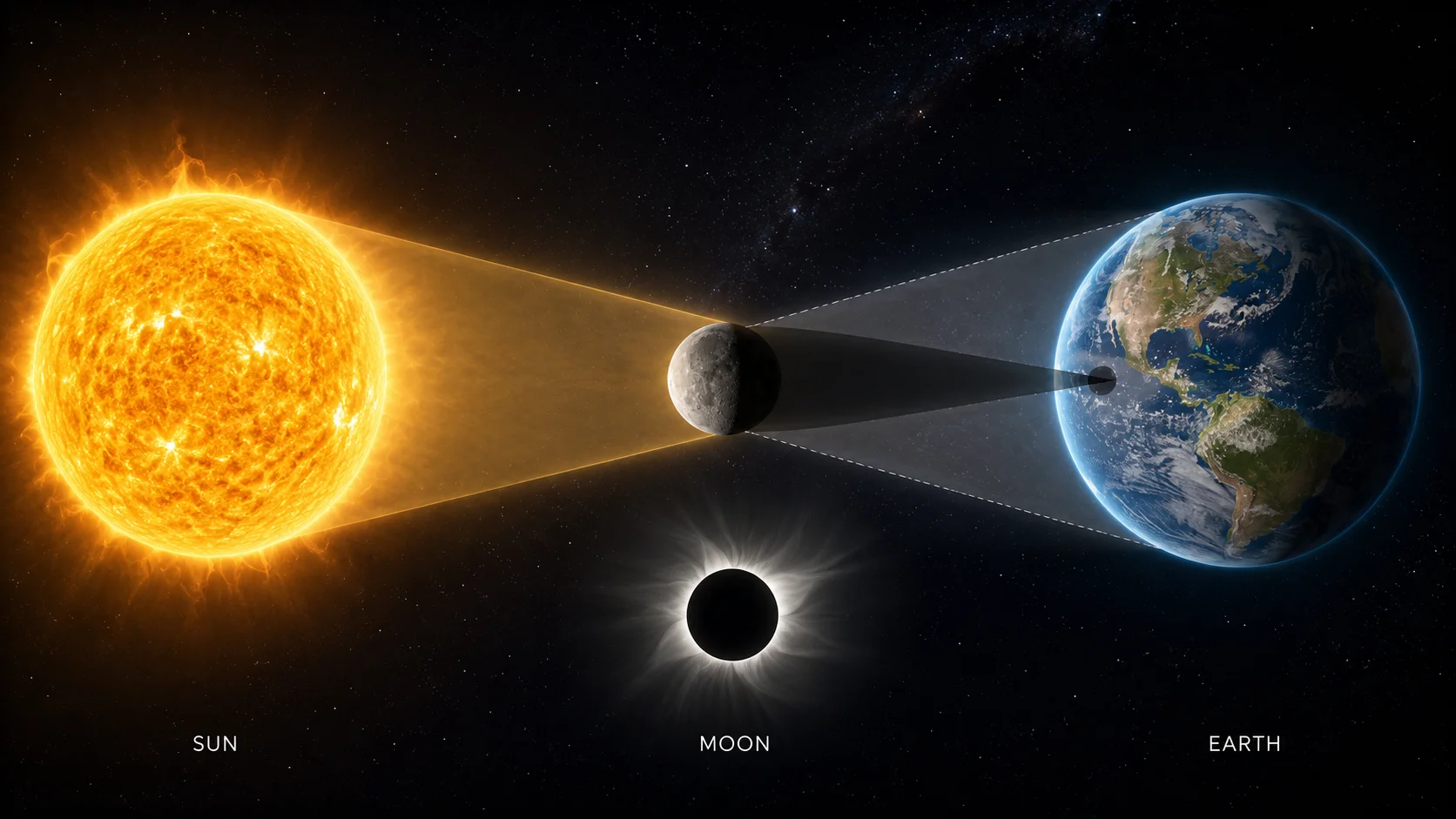
The basic idea is easy to picture: Sun, Moon and Earth line up. The full explanation is more interesting. The Moon must be in the correct phase, close to the right point in its tilted orbit, at the correct apparent size and positioned precisely enough for its narrow shadow to reach a particular location on Earth.
That precision is why a total solar eclipse is not simply a darker version of an ordinary day. It is a moving astronomical event with a limited path, a strict sequence of phases and important viewing-safety rules.
This guide explains the science in straightforward language, from the alignment of the three bodies to the umbra and penumbra, the reason eclipses do not occur every month, what observers see during totality and why location matters so much for the 2027 total solar eclipse in Egypt.
How Does a Solar Eclipse Happen Step by Step?
A solar eclipse begins with three astronomical bodies arranged in a particular order:
- The Sun produces the light.
- The Moon passes between the Sun and Earth.
- Earth receives the Moon’s moving shadow.
This can occur only around the new-moon phase. At new moon, the Moon is on the Sun-facing side of Earth. Its illuminated half faces away from us, so the Moon is normally difficult or impossible to see in the bright daytime sky.
Most new moons pass without an eclipse. When the Moon also reaches the correct part of its tilted orbit, however, it can cross directly in front of the Sun as seen from Earth. Its shadow then falls on Earth’s surface.
The process can be understood in five stages.
Stage 1: The Moon Approaches the Sun in Our Sky
The Moon orbits Earth while Earth orbits the Sun. From our viewpoint, the Moon appears to move eastward against the background sky. Near new moon, it passes the Sun’s direction.
Usually, it passes slightly above or below the Sun. During an eclipse season, the alignment is close enough for the Moon to overlap the solar disk.
Stage 2: The Moon Begins to Cover the Sun
At a location where an eclipse is visible, first contact occurs when the edge of the Moon appears to touch the edge of the Sun. A small dark “bite” then seems to grow across the solar disk.
This is the beginning of the partial phase. The Moon is not becoming illuminated or physically changing shape. Its dark silhouette is simply moving in front of the bright Sun.
During this entire partial phase, observers must use proper solar-viewing protection. The Sun remains intensely bright even when most of its visible surface is covered.
Stage 3: The Moon’s Shadow Reaches the Observer
The type of eclipse an observer experiences depends on which part of the Moon’s shadow passes over the location.
Inside the broad outer shadow, the Sun is partly covered. Inside the narrow central shadow, it can be completely covered. A location outside both regions sees no solar eclipse.
This explains why two people in the same country can have very different experiences. One may see totality, another may see a deep partial eclipse, and someone farther away may see much less coverage.
Stage 4: Totality Occurs Inside the Central Shadow
For observers inside the path of totality, the last visible points of the Sun disappear. The daytime landscape rapidly darkens, the corona becomes visible around the black disk of the Moon and the sky can resemble deep twilight.
Totality lasts only while the observer remains inside the Moon’s moving central shadow. Depending on the eclipse and the location within its path, this may last seconds or several minutes.
Stage 5: The Sequence Reverses
The Moon continues moving. The first bright point of sunlight reappears, ending totality. Solar-viewing protection must be used again immediately.
The partial phase continues as the Moon gradually uncovers the Sun. The eclipse ends when the Moon’s silhouette completely leaves the solar disk.
The Geometry Behind a Solar Eclipse Explained Simply
The Sun is the light source. Any opaque object placed in front of a light source creates a shadow. The Moon is no exception.
Because the Sun is much larger than the Moon and is not a single point of light, the lunar shadow has distinct regions. The two most important are the umbra and the penumbra. An additional region, the antumbra, is responsible for annular eclipses.
The Umbra: Where Totality Happens
The umbra is the darkest central region of the Moon’s shadow. Within it, the Moon blocks the Sun’s bright surface completely.
When the umbra reaches Earth, it creates a relatively narrow corridor called the path of totality. Only observers inside this moving path experience a total solar eclipse.
The path is narrow because the umbral shadow tapers as it extends away from the Moon. By the time it reaches Earth, its footprint covers only a limited part of the planet.
The shadow also moves quickly. Earth is rotating, the Moon is moving in its orbit and the geometry of the alignment is changing continuously. This causes the path of totality to sweep across continents and oceans rather than remaining fixed.
The Penumbra: Where the Eclipse Is Partial
The penumbra is the wider and lighter outer shadow. From inside this region, the Moon blocks only part of the Sun.
The closer a location is to the umbra, the greater the apparent coverage may be. However, even an eclipse with extremely high coverage remains partial if any part of the Sun’s bright surface stays visible.
That difference is crucial. A 99 percent partial eclipse does not reproduce the visual experience of totality. The remaining sliver of exposed photosphere is still bright enough to prevent the corona from appearing as it does during a total eclipse.
The Antumbra: Where an Annular Eclipse Happens
Sometimes the Moon appears slightly too small to cover the Sun fully. Its umbra ends before reaching Earth, and a continuation of the shadow called the antumbra reaches the surface.
Observers inside the antumbra see the Moon centered against the Sun but surrounded by a bright ring. This is an annular or “ring of fire” eclipse.
An annular eclipse is not a form of totality. The solar ring remains visible, so proper eye protection is required throughout the event.
For a detailed comparison of these experiences, see total vs partial vs annular solar eclipses.
Why Can the Moon Cover the Much Larger Sun?
The Sun is enormously larger than the Moon. It can still appear almost the same size in our sky because it is also vastly farther away.
NASA commonly describes this as an approximate 400-to-1 relationship: the Sun is roughly 400 times wider than the Moon and is also roughly 400 times farther from Earth. These are rounded comparisons, not perfectly fixed values, but they explain the apparent-size match.
Astronomers describe an object’s apparent size using angular diameter. Angular diameter measures how wide something appears from a particular viewpoint rather than its physical width.
Hold a small coin close to your eye and it can hide a much larger distant object. The coin has not become physically larger. It simply occupies a similar or greater angle in your field of view.
The Moon works in a comparable way during a total solar eclipse. Although it is small compared with the Sun, it is close enough to cover the solar disk when the alignment and apparent sizes are right.
The Apparent Sizes Are Always Changing Slightly
The Moon’s orbit around Earth is elliptical rather than perfectly circular. Its distance changes throughout each orbit. When it is closer, it appears slightly larger; when farther away, it appears slightly smaller.
Earth’s orbit around the Sun is also elliptical, so the Sun’s apparent size changes slightly during the year.
These variations help determine whether a central eclipse is total or annular. If the Moon appears large enough, it can cover the photosphere completely. If it appears too small, a ring of sunlight remains.
This is why the same Sun-Moon-Earth order can produce different types of solar eclipse.
Why Does a Solar Eclipse Not Happen Every Month?
This is one of the most common questions about eclipses.
A new moon occurs approximately once each lunar month. If a solar eclipse requires a new moon, why do we not see one every month?
The answer is orbital tilt.
The Moon’s orbit is inclined by about five degrees relative to the plane of Earth’s orbit around the Sun. That plane is known as the ecliptic plane.
Imagine two slightly tilted hoops crossing each other. One represents Earth’s orbital plane and the other represents the Moon’s orbit. They intersect at two points, called nodes.
During most new moons, the Moon is above or below the ecliptic plane from our perspective. Its shadow passes above or below Earth rather than landing on the surface.
A solar eclipse becomes possible when new moon occurs near one of the nodes. The Sun, Moon and Earth then line up closely enough for at least part of the lunar shadow to reach Earth.
Eclipse Seasons
The Sun appears to pass near each lunar node roughly twice a year. These periods are called eclipse seasons.
An eclipse season lasts long enough for at least one eclipse and sometimes more than one eclipse to occur. Solar and lunar eclipses are therefore grouped into seasons rather than distributed evenly month by month.
An eclipse season does not guarantee that every location on Earth will see an eclipse. It only means the geometry permits one somewhere on the planet.
Why Eclipses Occur in Families
Because the orbits and cycles repeat in predictable ways, eclipses can be grouped into long-running families known as Saros series. Eclipses in the same Saros family have similar geometry and occur about 18 years, 11 days and 8 hours apart.
The eight-hour fraction shifts the next eclipse path roughly one-third of the way around Earth in longitude. This is why successive eclipses in a Saros family occur in different geographic regions even though their geometry is related.
The Saros cycle is useful for understanding patterns, but it does not mean an eclipse returns to the same city every 18 years. A particular location may wait centuries between total solar eclipses.
What Is the Path of Totality?
The path of totality is the route traced across Earth by the Moon’s umbra.
It is not simply the region where the eclipse is “strong.” It is the specific corridor where the Sun becomes completely covered.
The path has northern and southern limits. A location just outside either limit sees only a partial eclipse. A location just inside may experience a very short total phase. Closer to the centerline, totality is generally longer, although local duration also depends on the full geometry.
Why Exact Coordinates Matter
Broad destination names are not precise enough for eclipse planning.
A governorate, oasis region, desert or coastal area can cover a large geographic zone. Part of it may be inside the path while another part is outside. Even within the path, totality duration can vary.
A responsible viewing plan should therefore use:
- Exact latitude and longitude.
- Verified northern and southern path boundaries.
- Expected local contact times.
- Solar altitude and direction.
- A clear horizon.
- Legal and practical access to the site.
- A backup or mobility plan where appropriate.
For the August 2, 2027 eclipse, NASA GSFC publishes path tables showing the limits, centerline and local circumstances at defined intervals. Those data provide the scientific foundation for mapping the event.
However, a travel product also needs ground-level verification. A mathematically good coordinate is not automatically a usable campsite. Road access, permits, terrain, emergency response, vehicle movement and heat management matter too.
Why Does Totality Last Only a Few Minutes?
The Moon’s shadow is moving across a rotating Earth. An observer remains inside the umbra only while that shadow footprint passes over the location.
The duration depends on several factors:
- The apparent size of the Moon.
- The apparent size of the Sun.
- The distance and geometry of the shadow.
- The observer’s position relative to the centerline.
- The speed of the shadow across the surface.
- Earth’s curvature and rotation.
Near the middle of a favorable eclipse path, the shadow may move in a way that produces several minutes of totality. Near the path limits, it may last much less.
The 2027 total solar eclipse is exceptional because the maximum duration anywhere along the global path reaches approximately 6 minutes 23 seconds. That maximum does not apply automatically to every viewing location in Egypt. Local duration must be calculated for the exact coordinates.
Read more about why the 2027 eclipse can produce exceptionally long totality.
What Happens During the Partial Phases?
A total solar eclipse is a long sequence, not only the brief total phase.
During the first partial phase, the Moon gradually covers more of the Sun. The change can initially be subtle. The landscape may still look bright because human vision adapts to changing light levels.
As coverage becomes deeper, several effects may become noticeable:
- Sunlight can feel less intense.
- Shadows may become unusually sharp.
- Small gaps between leaves can project crescent-shaped images of the Sun.
- The color and contrast of the landscape may appear different.
- Temperatures may begin to fall, depending on local conditions.
- Animals and birds may respond to the changing light.
These effects are interesting, but they do not indicate that it is safe to look directly at the Sun. Proper solar viewers remain essential until totality begins.
What Happens During Totality?
Totality begins when the Moon completely covers the Sun’s bright photosphere for observers inside the umbra.
Several dramatic phenomena can appear around this transition.
Baily’s Beads
The edge of the Moon is not perfectly smooth. Mountains, valleys and craters create an uneven lunar profile.
Just before totality, the remaining sunlight can shine through valleys along the Moon’s edge, producing separate bright points called Baily’s beads.
They appear only briefly and require appropriate experience and equipment to photograph safely.
The Diamond-Ring Effect
When one last intense point of sunlight remains beside the emerging corona, the combination can resemble a bright diamond on a luminous ring.
A similar effect occurs just after totality when the Sun begins to reappear.
The Solar Corona
The corona is the Sun’s outer atmosphere. It is always present but is normally overwhelmed by the much brighter photosphere and by scattered daylight in Earth’s atmosphere.
When the photosphere is completely hidden, the corona becomes visible as a pale, structured glow extending around the Moon.
Its appearance changes with solar activity. Streamers, loops and other structures may be visible in photographs and, under good conditions, to the unaided eye during totality.
Prominences and the Chromosphere
Bright pink or red features may appear near the edge of the Moon. These can include solar prominences—large structures of hot plasma—and brief views of the chromosphere, a layer of the solar atmosphere.
A Darkened Landscape
The horizon may remain brighter in several directions because observers outside the umbra are still in sunlight. The result can resemble a 360-degree twilight around the darker region beneath the shadow.
Bright planets and stars may become visible. The temperature may drop. The emotional effect can be powerful because the transition happens quickly and during a time of day when the Sun would normally dominate the sky.
The End of Totality
Totality ends as soon as the first bright part of the photosphere reappears.
This moment is critical for safety. Eclipse glasses or handheld solar viewers must be put back on immediately. Cameras, binoculars and telescopes must again use correctly fitted front-mounted solar filters.
Is It Safe to Look at a Total Solar Eclipse?
The answer depends on the phase and the observer’s location.
During the partial phases, it is not safe to look directly at the Sun without specialized solar-viewing protection. This remains true even when the Sun is mostly covered.
NASA states that direct viewing without eclipse glasses is permitted only during the brief total phase when the Moon completely covers the Sun’s bright face. This applies only to observers inside the path of totality.
People outside the totality path must use protection throughout because the bright Sun is never fully covered.
Eclipse Glasses Are Not Sunglasses
Ordinary sunglasses are not safe solar viewers, regardless of how dark they appear.
Safe eclipse glasses and handheld viewers should comply with the ISO 12312-2 international safety standard. They should be inspected before use and discarded if scratched, punctured, torn or otherwise damaged.
Children must be supervised closely. It is helpful to practice using viewers before eclipse day so they understand that the glasses must be in place before looking toward the Sun.
Optical Equipment Requires Its Own Filter
Eclipse glasses are designed for direct viewing with the eyes. They are not a substitute for a filter on a camera, telescope or binoculars.
Magnifying optics concentrate sunlight. A special-purpose solar filter must be securely installed over the front, Sun-facing end of the device.
Never look through unfiltered optics while wearing eclipse glasses. The concentrated light can damage the viewer and cause severe eye injury.
Indirect Viewing
A pinhole projector offers a safe way to follow the partial phases without looking at the Sun.
The projector forms an image of the solar disk on a surface. The observer looks at the projection, not through the hole toward the Sun.
Natural pinhole projections can also appear beneath trees, where small gaps between leaves project many images of the crescent Sun.
Why Understanding the Science Improves the Experience
Knowing how a solar eclipse happens changes the way you observe it.
The first contact is no longer just a “bite” in the Sun. It marks the Moon’s silhouette entering the solar disk from your location.
Crescent projections are not random shapes. They are images of the partially eclipsed Sun.
The rapid darkening before totality is the arrival of the umbra. The bright horizon is sunlight outside the central shadow. The corona is not a halo created by the Moon; it is the Sun’s own outer atmosphere, revealed when the photosphere is hidden.
This understanding also prevents common planning mistakes. A traveler who knows the difference between umbra and penumbra will not assume that very high partial coverage is equivalent to totality. A traveler who understands the path will ask for coordinates rather than relying on a broad destination name.
What the Science Means for the 2027 Total Solar Eclipse in Egypt
On August 2, 2027, the Moon’s umbra will cross parts of North Africa and the Middle East, including a corridor through Egypt.
The event combines exceptional astronomy with demanding travel conditions. The maximum duration along the global eclipse path is approximately 6 minutes 23 seconds, but the duration at any Egyptian site depends on its coordinates.
For visitors, four scientific and practical points matter.
1. The Viewing Site Must Be Inside the Umbra
A beautiful desert landscape alone is not enough. The exact site must lie within the verified path of totality.
Marketing language should never replace coordinate verification. The final camp or viewing field should be checked against NASA path data and updated calculations as the event approaches.
2. An Open Horizon Is Valuable
A clear field of view helps with observing the changing sky, the approach of the Moon’s shadow and the horizon during totality.
The site must still be safe and accessible. Soft sand, steep terrain or an isolated point without reliable vehicle access may look impressive but create unnecessary risk.
3. August Heat Is Part of the Planning
A solar eclipse can keep observers outside for hours through the partial phases, totality and the conclusion of the event.
In Egypt’s Western Desert, August conditions demand structured heat management. Shade, hydration, planned activity times, cooled rest areas, reliable transport and trained local support are not unrelated luxuries. They are part of creating a safe observing environment.
A specialized local team and a fully air-conditioned camp can provide a controlled place to rest before and after the outdoor viewing period, rather than leaving guests exposed in an ordinary safari setup designed for cooler seasons.
4. Safety Instructions Must Be Phase-Specific
Guests should know exactly when solar viewers are required, how totality will be announced and when eye protection must go back on.
A clear briefing is especially important for children, first-time eclipse viewers and guests using cameras.
A Simple Demonstration You Can Try at Home
You can model the basic alignment with a lamp, a small ball and a wall.
- Place the lamp so it acts as the Sun.
- Hold the ball between the lamp and the wall.
- Move the ball until its shadow falls on the wall.
- Notice the darker center and lighter outer area.
- Move the ball slightly upward or downward and watch the shadow miss the wall.
The model is not perfectly to scale, but it demonstrates why alignment matters and why a tilted orbit prevents an eclipse at most new moons.
Never use the real Sun for an unfiltered direct-viewing demonstration.
Common Misunderstandings About How Solar Eclipses Happen
“The Moon and Sun Become the Same Size”
They only appear similar in angular size from Earth. Their physical sizes remain enormously different.
“A Solar Eclipse Happens Everywhere at Once”
The Moon’s shadow covers a limited region and moves across Earth. Different locations see different phases, durations and eclipse types.
“A 99 Percent Partial Eclipse Is Almost the Same as Totality”
It is visually and physically different. The remaining photosphere is bright enough to keep the corona hidden and requires eye protection.
“Clouds Make It Safe to Look at the Sun”
Cloud cover is not a reliable solar filter. Harmful radiation can still reach the eyes, and cloud thickness can change quickly.
“You Can Use Eclipse Glasses Through Binoculars”
This is dangerous. Binoculars and other optics require dedicated filters on their front lenses.
“The Eclipse Itself Produces Dangerous Radiation”
The Sun does not suddenly emit special eclipse rays. The danger comes from looking at the ordinary bright Sun when natural discomfort signals may be reduced by partial coverage or curiosity.
Frequently Asked Questions
Is a solar eclipse caused by Earth’s shadow?
No. A solar eclipse occurs when the Moon’s shadow falls on Earth. A lunar eclipse occurs when Earth’s shadow falls on the Moon.
Does a solar eclipse happen only at new moon?
Yes. The Moon must be between Earth and the Sun, which corresponds to the new-moon phase. Most new moons do not produce eclipses because the Moon’s orbit is tilted.
Why is the path of totality so narrow?
The Moon’s dark umbral shadow narrows as it extends toward Earth. Its footprint covers a relatively small corridor compared with the much wider penumbra.
Can everyone in Egypt see totality in 2027?
No. Only locations inside the path of totality experience complete coverage. Other Egyptian locations will see a partial eclipse. Exact coordinates must be checked.
Can I remove eclipse glasses during totality?
Only if you are inside the path of totality and the Moon has completely covered the Sun’s bright face. Put the viewers back on immediately when any bright sunlight reappears.
Why can the Moon cover the Sun if it is much smaller?
The Moon is much closer to Earth. Its apparent angular size can therefore be similar to the much larger but much more distant Sun.
How long can a total solar eclipse last?
The duration varies by event and location. Totality at a particular site may last seconds or several minutes. The maximum for the August 2, 2027 eclipse is approximately 6 minutes 23 seconds along the global path, not at every location.
Is an annular eclipse a type of total eclipse?
No. During an annular eclipse, the Moon appears too small to cover the Sun completely, leaving a bright ring visible. Eye protection is required throughout.
Final Takeaway
A total solar eclipse happens when a new Moon passes precisely between the Sun and Earth and the Moon’s dark central shadow reaches a narrow corridor on Earth’s surface.
The event requires more than a straight line in a simple diagram. The Moon must be near an orbital node, its apparent size must be sufficient to cover the Sun and the observer must be inside the umbra at the correct time.
That is why location, coordinates and preparation are essential. It is also why totality is so different from a partial eclipse: only inside the umbra does the photosphere disappear and the corona emerge.
For travelers planning to see this alignment in person, explore the Egypt eclipse tour options or check availability for the 2027 total solar eclipse.
Authoritative planning reference
Use NASA 2027 eclipse path data as a primary reference, then verify local circumstances for the exact location.