Siwa Oasis solar eclipse 2027: quick answer
Siwa Oasis solar eclipse 2027: Plan the Siwa Oasis total solar eclipse on 2 August 2027 with approximate local times, 5 minutes 31–33 seconds of totality, Cairo access, heat safety and viewing-site guidance.
The Siwa Oasis solar eclipse 2027 will be a genuine total solar eclipse. On Monday, August 2, 2027, the Moon’s central shadow will cross Siwa and turn the midday desert landscape into twilight for approximately 5 minutes 31 to 5 minutes 33 seconds at representative oasis coordinates.
The partial eclipse begins around 11:22 am, totality begins shortly before 12:43 pm, maximum eclipse occurs around 12:45 pm, totality ends shortly after 12:48 pm, and the final partial phase ends around 2:08 pm under the expected Egyptian summer time of UTC+3.
Siwa is therefore a valid and attractive totality destination. It offers oasis culture, desert scenery, salt lakes, traditional architecture and a location away from the dense urban environment of the Nile Valley.
However, Siwa is not automatically the best Egyptian eclipse choice for every traveler.
It lies far from Cairo by road, has less accommodation capacity than major cities, receives almost fifty seconds less totality than Luxor and approximately forty-four seconds less than representative Bahariya coordinates. A large international group would also depend on long-distance transport, fuel, medical planning, communications and a carefully controlled local field.
Travelers should therefore compare Siwa with the managed Western Desert eclipse experience near Bahariya, where representative Bahariya coordinates receive approximately 6 minutes 17 seconds of totality. Bahariya is also closer to Cairo and can combine the eclipse with Black Desert and White Desert experiences through one local operating team.
This guide explains what Siwa will see, why it is inside totality, how to reach it, what August conditions require and why many totality-focused travelers may find the Bahariya and White Desert program more practical.
For the national route, read the 2027 eclipse path across Egypt.
Quick Answer
| Question | Answer |
|---|---|
| Is Siwa inside totality? | Yes, at representative oasis coordinates. |
| How long is totality in Siwa? | Approximately 5 minutes 31–33 seconds. |
| When does the partial eclipse begin? | Approximately 11:22 am local time. |
| When does totality begin? | Shortly before 12:43 pm. |
| When is maximum eclipse? | Approximately 12:45 pm. |
| When does the eclipse end? | Approximately 2:08 pm. |
| Is Siwa closer to the centerline than Bahariya? | No. Representative Bahariya coordinates receive a longer total phase. |
| Which is easier from Cairo? | Bahariya is generally the shorter and simpler road journey. |
| Which offers White Desert experiences? | The Bahariya-based Western Desert program. |
Why Siwa Is Inside the 2027 Path of Totality
The Moon’s umbral shadow enters Egypt from Libya and crosses the western part of the country before continuing southeast toward Upper Egypt and the Red Sea.
Siwa lies close to the western entry section of the Egyptian path. It is securely inside totality at common oasis reference coordinates, rather than sitting close to one of the northern or southern limits.
The local duration is shorter than the maximum because Siwa is farther from the most favorable part of the global route. NASA places the point of greatest duration farther southeast in Egypt, where totality reaches approximately 6 minutes 23.2 seconds.
Siwa’s approximately 5 minutes 33 seconds is still exceptionally long. It is more than twice the maximum duration of the 2017 United States eclipse and longer than many total eclipses experienced by modern travelers.
The important distinction is that totality duration changes across the path. Being inside the corridor establishes the eclipse type; the exact coordinate establishes the duration.
Siwa Eclipse Timeline
The representative local schedule is:
| Phase | Approximate local time | What the observer should do |
|---|---|---|
| First contact | 11:22 am | Use approved eclipse glasses or correctly filtered optics. |
| Second contact | About 12:43 pm | Remove solar viewers only after the photosphere disappears completely. |
| Maximum eclipse | 12:45 pm | Observe the corona, horizon and environmental change. |
| Third contact | About 12:48 pm | Replace glasses and instrument filters before direct sunlight returns. |
| Fourth contact | 2:08 pm | The Moon completely leaves the solar disk. |
These are rounded planning values. Final contact seconds should be calculated for the chosen field.
See 2027 Solar Eclipse Times in Egypt by City for the national comparison.
What Totality Will Look Like in Siwa
The first partial phase lasts approximately one hour and twenty minutes. Through safe viewers, guests will see the Moon gradually cover the Sun.
As the solar crescent becomes thinner, several environmental effects may become visible:
- Light may become pale or metallic.
- Shadows may look unusually sharp.
- Small openings can project crescent Suns.
- The temperature may fall.
- Wind behavior may change.
- Birds or animals may react, although no exact behavior can be guaranteed.
- The western horizon may begin to darken as the umbra approaches.
Immediately before totality, the final sunlight may break into Baily’s beads. The last bright point can form a diamond ring.
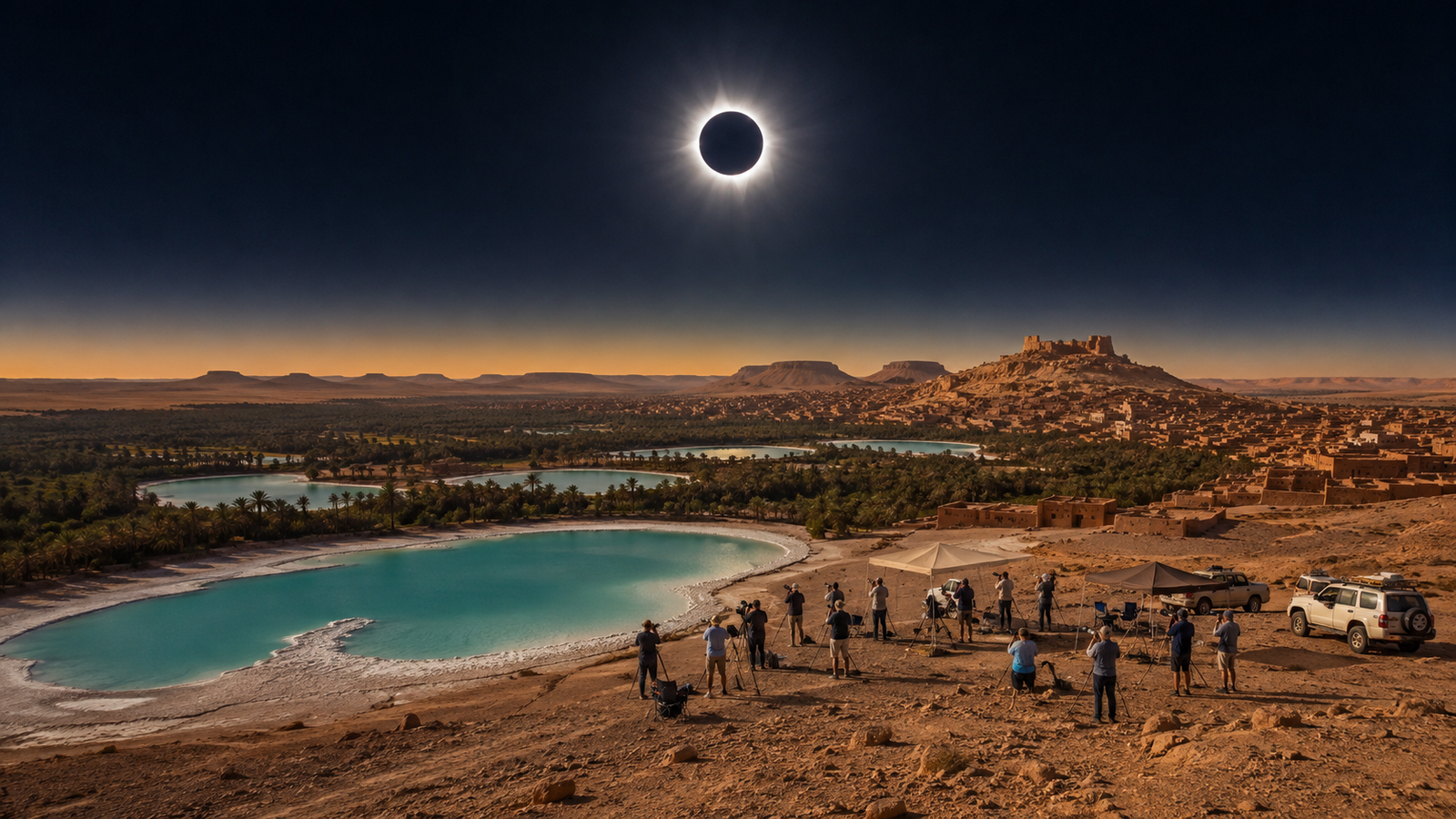
When full coverage begins, the dark Moon will appear surrounded by the corona. The broad desert and oasis horizon may display a twilight glow in all directions. Bright planets and some stars may become visible.
Five and a half minutes provides time to observe more than one feature, but totality still feels brief. Travelers should avoid spending the entire phase looking at a phone screen.
Why Siwa Attracts Eclipse Travelers
Genuine Totality
Siwa is securely inside the path at representative coordinates.
Long Duration
More than five and a half minutes is an excellent totality experience.
Open Desert Landscapes
A carefully selected field outside the settlement can provide broad sky views and minimal visual obstruction.
Oasis Culture
Siwa has a distinct cultural identity, local architecture, palms, springs, salt lakes and a long history shaped by geographic isolation.
Lower Urban Density
It offers a different atmosphere from Luxor or the Nile Valley.
Destination Value Beyond the Eclipse
Even if weather interferes, Siwa remains an interesting travel destination.
Siwa’s Main Challenges
Long Road Access
Siwa is far from Cairo. The journey requires a substantial overland transfer and should not be attempted on eclipse morning.
Limited Accommodation Capacity
The oasis has hotels and lodges, but less capacity than Cairo, Luxor or the Red Sea.
August Heat
Guests will experience the partial phases around midday in summer.
Medical and Emergency Planning
Remote travel needs a clear response plan, trained staff, reliable vehicles and communications.
Fuel and Vehicle Dependence
A large group requires disciplined fuel planning, maintenance and backup vehicles.
Event-Site Control
An attractive desert location still needs legal access, shade, toilets, water and emergency movement routes.
Distance from White Desert Experiences
Siwa is a different Western Desert destination from Bahariya and the White Desert route. Travelers cannot assume a normal Siwa trip also includes the famous White Desert landscapes.
How to Reach Siwa for the Eclipse
Most international travelers will enter Egypt through Cairo and continue by road or a domestic travel arrangement.
A road itinerary should account for:
- Total driving time.
- Rest breaks.
- Driver rotation.
- Fuel.
- Food and water.
- Luggage and photography equipment.
- Road conditions.
- Checkpoints.
- Vehicle breakdown contingency.
- Arrival before eclipse day.
Guests should arrive at least one full day before the event, preferably earlier.
The return journey also requires planning. Large groups leaving at the same time can create pressure on limited roads.
Where Should the Viewing Field Be?
The best field is not simply the most beautiful desert location.
It should have:
- Verified totality coordinates.
- A comfortable margin from the path boundary.
- Legal land access.
- Vehicle access.
- A stable surface.
- Space for tripods.
- Open sky.
- Shade nearby.
- Toilets.
- Drinking water.
- Medical support.
- Communications.
- A controlled parking area.
- A clear departure plan.
The Sun will be high, so a low horizon is less important than an unobstructed upper sky.
Can You Watch from Inside Siwa Town?
Astronomically, many town coordinates are inside totality.
Operationally, a town location may include buildings, palms, wires, narrow streets, traffic and public crowds.
A private desert-edge field can offer more control and better photography space, provided it has the necessary support.
Hotels should not promise roof access without checking capacity, railings, shade structures, antennas and emergency rules.
Siwa Weather in August
Siwa’s desert climate makes it attractive for eclipse planning, but no location offers guaranteed clear sky.
Potential visibility issues include:
- Dust.
- Wind.
- High thin cloud.
- Haze.
- Heat shimmer.
- Local smoke.
Historical climate helps compare destinations, while short-range forecasts become important near the event.
A responsible operator should never promise visibility.
Heat Safety
The event occurs during the hottest part of the day.
A professional site needs:
- Cold drinking water.
- Electrolytes where appropriate.
- Shade.
- Air-conditioned vehicles or recovery areas.
- Seating.
- Light meals.
- Toilets.
- Medical support.
- Reduced walking.
- Safe medication storage.
- A process for identifying heat exhaustion.
Symptoms such as dizziness, confusion, nausea, headache or unusual weakness should be treated immediately.
Eye Safety
Approved eclipse glasses are required during all partial phases.
They may be removed only after the Sun’s photosphere is completely covered. They must be replaced before the first direct sunlight returns.
Ordinary sunglasses are unsafe.
Cameras, binoculars and telescopes require suitable filters over the front aperture. Eclipse glasses worn behind unfiltered optics do not protect the eyes.
Children need active supervision.
Read the eclipse glasses safety guide.
Photography in Siwa
Siwa provides strong landscape potential, but the high Sun creates technical challenges.
Photographers should prepare for:
- Near-vertical tripod movement.
- Safe front-mounted filters.
- Exposure bracketing during totality.
- Spare batteries protected from heat.
- Wide-angle compositions with a very high Sun.
- Tripod separation from general guests.
- A rehearsed filter-removal sequence.
A composite image can show multiple eclipse phases above the oasis landscape, but it should be labeled as a composite.
Siwa vs Bahariya and the White Desert Eclipse Camp
This is the most important decision for travelers who want a Western Desert eclipse rather than a specific Siwa holiday.
| Factor | Siwa Oasis | Bahariya-based Western Desert camp |
|---|---|---|
| Representative totality | About 5m 31–33s | About 6m 17s |
| Access from Cairo | Longer road journey | Shorter and more direct road journey |
| Viewing base | Hotel or local field requires separate coordination | Camp can be built around the verified viewing field |
| White Desert experiences | Not part of a standard Siwa trip | Can include Black Desert, Crystal Mountain, Agabat and White Desert excursions |
| Local operator continuity | Depends on selected supplier | Elzaghandi Group is based in Bahariya Oasis |
| Controlled camp capacity | Possible but must be created separately | Core part of the proposed eclipse product |
| Photography field | Open desert possible | Dedicated field and tripod layout can be planned |
| Journey identity | Siwan culture and oasis travel | White Desert and Bahariya eclipse expedition |
The Duration Advantage
Representative Bahariya coordinates receive approximately forty-four seconds more totality than Siwa.
Forty-four seconds is meaningful during an eclipse, especially for photographers and first-time observers.
The Access Advantage
Bahariya is closer to Cairo. A shorter road route reduces guest fatigue, vehicle exposure and transport complexity.
The Camp Advantage
The Bahariya product can be designed so that guests arrive before the event, stay within the managed operation and reach the viewing field without a long eclipse-morning transfer.
The White Desert Advantage
The journey can include some of Egypt’s most distinctive Western Desert landscapes.
The accurate wording remains:
A verified eclipse camp near Bahariya with White Desert experiences.
It should not claim that every Farafra or standard White Desert coordinate lies inside totality.
The Local-Team Advantage
A Bahariya-based operator has direct local knowledge of roads, vehicles, settlements and desert logistics.
Who Should Choose Siwa?
Siwa may suit travelers who prioritize:
- Siwan culture.
- Salt lakes and oasis landscapes.
- A longer independent Egypt itinerary.
- A more remote western destination.
- More than five minutes of genuine totality.
- A smaller custom group with local arrangements.
Who Should Choose the Bahariya and White Desert Program?
The Bahariya program may suit travelers who prioritize:
- Longer totality.
- Easier access from Cairo.
- A controlled private camp.
- Air-conditioned rest areas.
- A dedicated photography field.
- White Desert experiences.
- Local operational continuity.
- 2-, 3- or 4-day package choices.
- A trip designed specifically around the eclipse.
Siwa vs Luxor
Luxor receives approximately 6 minutes 22 seconds at representative coordinates, almost fifty seconds more than Siwa.
Luxor offers stronger hotel and airport infrastructure but may experience greater demand and crowd pressure.
Siwa offers a quieter oasis setting but requires a longer road journey.
For a totality-first desert experience, Bahariya may provide a better balance between the two: long totality with a controlled desert camp and easier Cairo access.
Read the Luxor eclipse guide.
Siwa vs Aswan
Siwa city is total. Central Aswan city is partial.
An Aswan-based traveler must move north toward a verified totality field, while a Siwa traveler can remain within the oasis region.
However, both require careful local event planning. Bahariya remains the stronger site-specific conversion option because the camp can be organized directly around totality.
Read Is Aswan Inside the 2027 Eclipse Path?.
Recommended Siwa Itinerary
Day 1 — Cairo Arrival
Guests arrive, rest and confirm luggage and equipment.
Day 2 — Travel to Siwa
The group makes the long road journey with planned stops and driver support.
Day 3 — Siwa Orientation
Guests explore selected oasis attractions and attend a safety briefing.
Day 4 — Viewing-Site Rehearsal
The group visits the field, tests equipment and confirms transport.
Day 5 — Eclipse Day
- Early breakfast.
- Hydration briefing.
- Transfer to the field.
- Setup before 11:22 am.
- Totality around 12:43–12:48 pm.
- Rest and completion of the partial phase.
- Staged return.
Day 6 — Recovery
Guests rest or continue Siwa touring.
Day 7 — Return to Cairo
The group begins the long overland journey.
This structure demonstrates why Siwa usually requires more days than a focused Bahariya package.
What to Ask Before Booking a Siwa Eclipse Tour
- What are the exact viewing coordinates?
- How long is local totality?
- Is the field permitted?
- How far is it from accommodation?
- What vehicle type is used from Cairo?
- How many drivers are assigned?
- What backup vehicles are available?
- Are fuel and maintenance plans documented?
- What cooling is provided?
- Are toilets at the field?
- Is drinking water unlimited?
- Is medical support present?
- Are eclipse glasses included?
- Is there a photography zone?
- What happens if the field changes?
- What is the weather policy?
- What is the cancellation policy?
- Does the package include White Desert travel? Most Siwa programs do not.
- How many total road hours are included?
- Can the company guarantee clear sky? The correct answer is no.
Common Mistakes
Assuming Siwa Has the Longest Totality in Egypt
It does not.
Treating Siwa and the White Desert as the Same Destination
They are different Western Desert regions.
Arriving on Eclipse Morning
The road distance makes this unrealistic and unsafe.
Choosing a Scenic Field Without Services
A viewing location needs shade, water, toilets and medical access.
Comparing Only the Eclipse Percentage
Duration, access and operations matter.
Ignoring Return Traffic
The journey continues after the eclipse.
Using Ordinary Sunglasses
They are unsafe.
Expecting Clear Weather to Be Guaranteed
It cannot be guaranteed.
Frequently Asked Questions
Will Siwa see totality in 2027?
Yes.
How long will totality last?
Approximately 5 minutes 31–33 seconds at representative coordinates.
What time does the eclipse begin?
Around 11:22 am local time.
What time is maximum eclipse?
Around 12:45 pm.
When does the eclipse end?
Around 2:08 pm.
Is Siwa the best place in Egypt?
It is a valid totality destination, but not automatically the best. Bahariya and Luxor receive longer representative totality.
Is Siwa easier to reach than Bahariya?
No. Bahariya is generally closer and easier from Cairo.
Does a Siwa trip include the White Desert?
Not normally. The White Desert experience is associated with the Bahariya and Farafra route.
Which option is better for White Desert travelers?
The managed Bahariya-based eclipse program.
Can I remove eclipse glasses during totality?
Yes, but only after full coverage and only inside a confirmed totality location.
Can clear weather be guaranteed?
No.
Is Siwa suitable for children?
Potentially, if the long road journey, heat, supervision and facilities are appropriate.
Is a private field better than the town center?
Usually for crowd control and photography, provided it is permitted and fully serviced.
Final Takeaway
Siwa Oasis is genuinely inside the 2027 path and offers approximately 5 minutes 31–33 seconds of totality. It is a strong choice for travelers who specifically want Siwan culture and are comfortable with a long road journey and smaller tourism infrastructure.
It is not the strongest desert-eclipse option for every traveler.
The managed Western Desert eclipse experience near Bahariya can offer approximately 6 minutes 17 seconds at representative coordinates, easier access from Cairo, a viewing field designed around the event and a journey that includes authentic White Desert experiences.
Siwa is the better choice for a Siwa-focused holiday. Bahariya is the stronger choice for a dedicated eclipse package that uses the White Desert as the wider travel experience.
Explore our Eclipse 2027 Egypt Western Desert viewing experience, compare the 2-, 3- and 4-day packages, or check availability.
Authoritative planning reference
Use NASA 2027 eclipse path data as a primary reference, then verify local circumstances for the exact location.