Solar eclipse maps, forecasts, tour pages, and photography guides use a specialized vocabulary. Words such as totality, umbra, magnitude, obscuration, contact, and Saros may sound interchangeable when you first plan an eclipse trip, but they describe different parts of the event. Confusing them can lead to a serious planning mistake—such as believing that 99 percent obscuration is the same experience as a total eclipse or assuming that every place near the centerline receives exactly the global maximum duration.
This 2027 solar eclipse glossary explains the most important terms in plain English and connects them to the total solar eclipse crossing Egypt on Monday, August 2, 2027. It is written for first-time observers, travelers, photographers, tour planners, and anyone comparing locations such as Luxor, Bahariya, Siwa, the Red Sea, or the wider Western Desert.
NASA calculates a greatest duration of approximately 6 minutes 23.2 seconds for the 2027 eclipse, but that value belongs to one specific point. Local circumstances depend on the exact coordinate. A technically impressive number is useful only when the viewing field is accessible, inside totality, safely managed, and supported by realistic weather and transport planning.
For the full event overview, start with the 2027 Total Solar Eclipse in Egypt guide. If you have a practical travel question rather than a terminology question, use the 2027 Egypt Eclipse Tour FAQ.
The 12 Terms Every Traveler Should Know
| Term | Plain-English meaning | Why it matters in Egypt |
|---|---|---|
| Total solar eclipse | The Moon completely covers the Sun’s bright face | This is the event travelers must be inside the central path to experience |
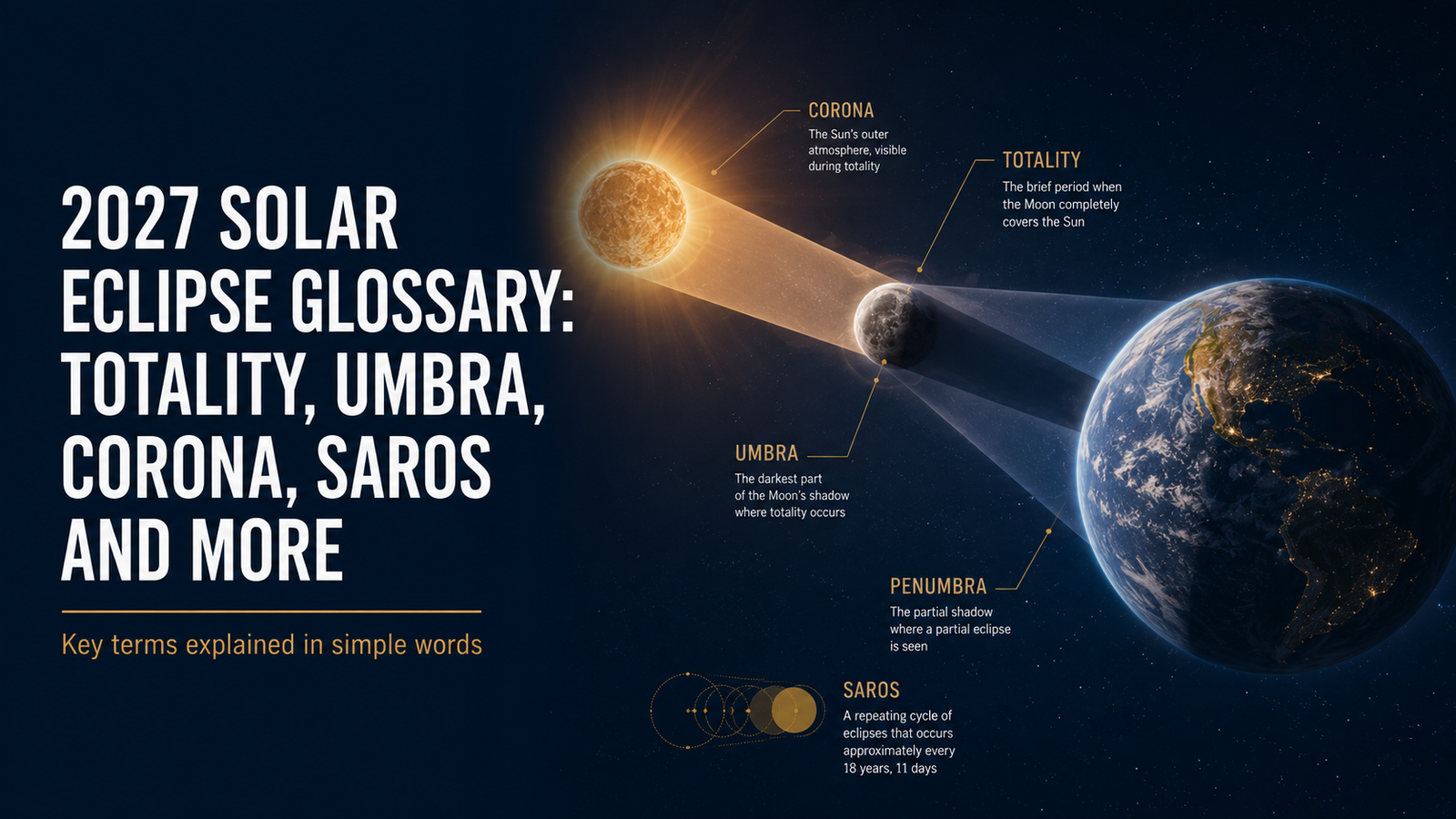
| Totality | The brief period of complete coverage | The only phase when the corona is visible to the unaided eye |
| Path of totality | The track of the Moon’s umbra across Earth | Cairo and Alexandria are outside it; selected Egyptian regions are inside |
| Umbra | The dark inner part of the Moon’s shadow | Observers inside it experience totality |
| Penumbra | The lighter outer shadow | Observers inside it see a partial eclipse |
| Centerline | The line near the middle of the eclipse path | Duration is generally longest near it, but access and safety also matter |
| Magnitude | Fraction of the Sun’s diameter covered along a line through the centers | It is not the same as percentage of area covered |
| Obscuration | Fraction of the Sun’s visible area covered | 99 percent obscuration still is not totality |
| Contacts | The four boundary moments of the eclipse | They define the start, totality, end of totality, and final end |
| Corona | The Sun’s faint outer atmosphere | The white halo revealed during totality |
| Solar filter | Specialized protection placed over the front of optics | Required for cameras, binoculars, and telescopes during partial phases |
| Saros | A repeating eclipse cycle of about 18 years 11 days | The 2027 eclipse belongs to Saros 136 |
How to Use This Glossary
The entries are arranged alphabetically. Some are astronomical definitions, while others are practical terms that appear in eclipse travel and photography. Each definition includes a 2027 Egypt planning note where relevant.
This glossary does not replace a coordinate calculation, an official weather forecast, current travel advice, medical guidance, or the instructions supplied with solar-viewing equipment. It gives you the vocabulary needed to understand those sources correctly.
A
Air Mass
Air mass describes how much atmosphere sunlight passes through before reaching an observer. When the Sun is high, light travels through less atmosphere than when it is close to the horizon. Lower air mass generally reduces atmospheric absorption, haze, and distortion.
The 2027 eclipse occurs with the Sun high in the sky across much of Egypt. That is favorable for a clear view above buildings and low horizon haze, but it also increases direct heat exposure. A high Sun is not permission to ignore shade, water, and skin protection. Read the August desert heat safety guide before planning a midday field.
Alignment
An alignment is the apparent arrangement of the Sun, Moon, and Earth that makes an eclipse possible. During a solar eclipse, the Moon passes between Earth and the Sun. The three bodies do not need to form a mathematically perfect line for every observer; the shadow geometry determines whether a location sees total, annular, or partial coverage.
The Moon’s orbit is tilted relative to Earth’s orbit around the Sun, so a solar eclipse does not occur at every new moon.
Altitude
Altitude is the angular height of an object above the horizon, measured in degrees. Zero degrees is on the horizon and 90 degrees is directly overhead at the zenith.
On an eclipse circumstances table, solar altitude tells you how high the Sun will be at a specific phase. It affects sightlines, tripod orientation, shade design, and lens framing. The high August 2027 Sun in Egypt means a northern or southern horizon obstruction is less important than overhead visibility and safe heat management.
Angular Diameter
Angular diameter is the apparent size of an object in the sky, expressed as an angle. The Sun is physically much larger than the Moon, but it is also much farther away, so their angular diameters appear similar from Earth.
A total solar eclipse occurs when the Moon’s apparent disk is large enough to cover the Sun’s photosphere. If the Moon appears too small, a bright ring remains and the eclipse is annular.
Annular Eclipse
An annular solar eclipse occurs when the Moon passes in front of the Sun but appears too small to cover it completely. A bright ring, or annulus, remains visible around the Moon.
An annular eclipse is never safe to view without appropriate solar protection because part of the bright photosphere remains visible throughout. The August 2, 2027 eclipse is total along its central path, not annular. See Total vs Partial vs Annular Solar Eclipse for a visual comparison.
Annularity
Annularity is the maximum phase of an annular eclipse, when the Moon appears centered over the Sun and the bright ring is visible. Unlike totality, annularity does not reveal the corona to the unaided eye and never creates a safe naked-eye interval.
Antumbra
The antumbra is the extension of the Moon’s shadow beyond the point where the umbral cone ends. An observer inside the antumbra sees the Moon completely in front of the Sun but apparently smaller, producing an annular eclipse.
For a total eclipse, the Moon’s umbra reaches Earth. For an annular eclipse, the antumbra reaches the observer instead.
Apogee
Apogee is the point in the Moon’s orbit where it is farthest from Earth. Near apogee, the Moon appears smaller. This can contribute to annular rather than total eclipse geometry.
The opposite term is perigee, when the Moon is closest to Earth and appears larger.
B
Baily’s Beads
Baily’s beads are points of intense sunlight that shine through valleys along the irregular edge of the Moon immediately before or after totality. They show that the lunar limb is not a smooth circle.
The beads are brief and not equally obvious from every position. They are an important safety signal: when bright beads remain or reappear, direct naked-eye viewing is no longer safe. Photographers plan exposures for them, but first-time observers should prioritize correct filter timing.
Besselian Elements
Besselian elements are a compact set of numerical parameters astronomers use to calculate the geometry and local circumstances of an eclipse. They describe the position and movement of the Moon’s shadow relative to Earth.
NASA’s Besselian elements for August 2, 2027 list an eclipse magnitude of 1.0790, gamma of 0.1421, and Saros 136, member 38 of 71. Most travelers never need to calculate with the elements directly, but mapping and timing software relies on them.
C
C1, C2, C3, and C4
These abbreviations represent the four contacts:
- C1 — First contact: the Moon first appears to touch the Sun’s disk; the partial eclipse begins.
- C2 — Second contact: the Moon completely covers the photosphere; totality begins.
- C3 — Third contact: the photosphere begins to reappear; totality ends.
- C4 — Fourth contact: the Moon leaves the Sun’s disk; the eclipse ends.
For an observer outside totality, C2 and C3 do not exist as totality contacts. The 2027 eclipse times by Egyptian city shows why every contact must be calculated locally.
Centerline
The centerline is the track made by the central axis of the Moon’s shadow across Earth. Totality duration is generally longest near this line and decreases toward the northern and southern path boundaries.
The centerline is not automatically the best viewing site. A point on it may be inaccessible, unsafe, restricted, cloudy, or without services. A managed field several kilometers away may lose very little duration while offering far better transport, shade, water, toilets, and emergency planning.
Central Eclipse
A central solar eclipse occurs when the central axis of the Moon’s shadow crosses Earth. Total, annular, and hybrid eclipses can be central. The path has a centerline and normally northern and southern limits.
Chromosphere
The chromosphere is the lower layer of the Sun’s atmosphere immediately above the photosphere. During totality it may appear briefly as a thin crimson or pink rim at the Moon’s edge.
It is much fainter than the photosphere and is normally hidden by the bright visible surface. The chromosphere should not be confused with prominences, although the two can appear together near the lunar limb.
Circumstances
Eclipse circumstances are the calculated details for a location: contact times, duration, magnitude, obscuration, solar altitude, and sometimes azimuth.
“Global circumstances” describe the eclipse as a whole, while local circumstances describe what one observer sees. This distinction explains why the global maximum of 6 minutes 23.2 seconds is not the duration at every Egyptian site.
Climatology
Climatology uses long-term historical patterns to estimate typical cloud, temperature, wind, or humidity conditions for a date and region. It helps compare destinations many months or years before an eclipse.
Climatology is not a forecast and never guarantees a clear sky. The Egypt eclipse weather guide separates long-term cloud prospects from the short-range forecast that becomes useful near August 2, 2027.
Contact
A contact is an instant when the apparent edges of the Sun and Moon touch during an eclipse. Contacts define the transition between uneclipsed Sun, partial phases, totality or annularity, and the end of the event.
Corona
The corona is the Sun’s outer atmosphere. During totality it appears as a pale, structured halo extending around the black Moon. Its streamers are shaped by the Sun’s magnetic field and can extend several solar radii in photographs.
The corona is normally overwhelmed by the brightness of the photosphere. Totality briefly removes that glare. The word comes from the Latin for “crown.”
Coronal Streamer
A coronal streamer is an elongated structure in the corona produced by plasma and magnetic fields. The corona’s appearance changes with solar activity, so one total eclipse does not look identical to another.
D
Diamond Ring
The diamond ring effect occurs when one remaining bright region of photosphere shines beside the faint corona, resembling a diamond set in a ring. It appears immediately before totality and again as totality ends.
It is visually dramatic but also a filter-transition warning. Follow expert safety instructions rather than removing eye protection early to chase a photograph.
Duration
Duration is the length of a phase. In eclipse travel, it usually means the time between second and third contact—the length of totality at a location.
Duration must always be paired with a coordinate. Representative Luxor locations receive about 6 minutes 22 seconds; representative Bahariya coordinates about 6 minutes 17 seconds. A five-second difference is small compared with a poor field or failed transport plan. Use the best viewing place comparison to evaluate more than seconds.
E
Eclipse
An eclipse occurs when one celestial body blocks the light of or view toward another. During a solar eclipse, the Moon passes between Earth and the Sun. During a lunar eclipse, Earth’s shadow falls on the Moon.
Eclipse Chaser
An eclipse chaser is a person who travels to observe eclipses, often across different countries and climates. Experienced chasers may prioritize mobility, forecast access, equipment, and the ability to change fields. First-time observers can learn from them but should not assume that an expedition-style plan suits every family or health condition.
Eclipse Glasses
Eclipse glasses are specialized wearable solar viewers designed to reduce visible, ultraviolet, and infrared radiation to safe levels when used correctly. They are not sunglasses.
Safe viewers should comply with the relevant transmittance requirements of ISO 12312-2 and come from a trustworthy source. NASA does not approve particular brands. Inspect every viewer before use and supervise children. See the safe eclipse glasses guide.
Eclipse Magnitude
Eclipse magnitude is the fraction of the Sun’s diameter covered by the Moon along a line through their centers at a specified instant. It is a linear measurement, not the percentage of the Sun’s area covered.
For the global 2027 eclipse calculation, NASA lists a magnitude of 1.0790 at greatest eclipse. A magnitude greater than 1 for a total eclipse indicates that the Moon’s apparent diameter exceeds the Sun’s along the relevant geometry.
Eclipse Season
An eclipse season is a period when the Sun is close enough to one of the Moon’s orbital nodes for eclipses to occur. It lasts roughly five weeks and repeats about every six months.
Not every new moon produces a solar eclipse because the Moon’s orbit is tilted. Eclipse seasons create the windows when alignment becomes possible.
Ephemeris
An ephemeris is a table or mathematical model describing the positions of celestial objects over time. Eclipse predictions depend on high-precision solar and lunar ephemerides, Earth orientation, and time standards.
NASA states that its 2027 predictions use the VSOP87 and ELP2000-85 solar and lunar ephemerides with an assumed delta-T value. Travelers use the finished maps and local circumstances rather than the raw models.
F
First Contact
First contact, or C1, is the instant the Moon first appears to touch and begin covering the Sun. It marks the beginning of the partial eclipse.
At first contact the change may be difficult to notice without a safe filtered view. Eye protection is required.
Fourth Contact
Fourth contact, or C4, is the moment the Moon’s apparent disk completely leaves the Sun. It ends the partial phase and the eclipse for that observer.
Full Width of the Path
The path width is the distance between the northern and southern totality limits measured across the shadow track. It changes along the eclipse route.
A wide path does not make approximate planning safe. Locations near a boundary receive shorter totality and are more sensitive to map or lunar-limb refinements than locations well inside the path.
G
Gamma
Gamma is the minimum distance between the axis of the Moon’s shadow and the center of Earth at greatest eclipse, expressed in units of Earth’s equatorial radius. Its sign indicates whether the shadow axis passes north or south of Earth’s center.
NASA lists gamma as 0.1421 for the August 2, 2027 eclipse. It is useful in eclipse catalogs but is not a traveler’s latitude or a measure of cloud probability.
Greatest Duration
Greatest duration is the point where the total or annular phase lasts longest. It is not necessarily identical to the point of greatest eclipse.
For August 2, 2027, NASA gives greatest duration as approximately 6 minutes 23.2 seconds. The 2027 eclipse path guide explains why a traveler can enjoy nearly the same duration without standing on the exact global marker.
Greatest Eclipse
Greatest eclipse is the instant when the axis of the Moon’s shadow passes closest to the center of Earth. It is a global geometric definition, not a recommendation for the best tourist field.
Greatest eclipse and greatest duration can occur at different nearby points because Earth’s shape, shadow geometry, and the direction of motion affect local duration.
H
Hybrid Eclipse
A hybrid solar eclipse changes between annular and total along different parts of its central path because of Earth’s curvature and the dimensions of the shadow. It is sometimes called an annular-total eclipse.
The August 2, 2027 event is classified as a total solar eclipse, not a hybrid.
Horizon
The horizon is the apparent boundary between land or sea and sky. Eclipse operators often advertise an open horizon because buildings, mountains, or trees can obstruct a low Sun.
For the 2027 Egypt eclipse the Sun is high, so a wide open field remains valuable for crowd management, photography, atmosphere, and orientation even though low-horizon obstruction is less decisive.
I
ISO 12312-2
ISO 12312-2 is the international standard covering filters for direct observation of the Sun. A compliant product must meet technical transmittance and safety requirements.
A printed ISO reference alone does not prove authenticity. Source viewers from a reliable supplier, retain instructions, inspect them, and never combine wearable glasses with unfiltered magnifying optics.
L
Limb
The limb is the apparent edge of a celestial disk. The solar limb is the edge of the Sun’s visible disk; the lunar limb is the Moon’s apparent edge.
Mountains and valleys make the lunar limb irregular, producing Baily’s beads and small differences in exact contact times near the path boundary.
Lunar Limb Profile
The lunar limb profile is the detailed topography of mountains and valleys around the Moon’s edge as projected for an observer. Modern calculations can refine contact times and the effective path boundary by including this profile.
NASA’s simple interactive map notes that its rapid predictions do not include lunar mountains and valleys. That limitation matters most near the boundary, another reason to select a field comfortably inside totality.
Lunar Node
A lunar node is one of the two points where the Moon’s tilted orbit crosses the plane of Earth’s orbit around the Sun. A solar eclipse can occur only when a new moon happens sufficiently near a node.
M
Maximum Eclipse
Maximum eclipse for a location is the instant when the Moon covers the greatest portion of the Sun as seen by that observer. It may refer to mid-totality at a site, but it is not automatically the same time as the global greatest eclipse.
Mid-Totality
Mid-totality is the midpoint between second and third contact for a specific observer. It is the middle of the local total phase.
Mobility
In eclipse planning, mobility means the operational ability to move to a different field in response to weather or access conditions. Mobility is not guaranteed simply because vehicles exist. Desert permits, road networks, fuel, traffic, group size, equipment setup, and medical requirements can make relocation impossible.
Ask an operator what “weather backup” actually means rather than assuming the group can chase a clear patch at the last minute.
N
New Moon
A new moon occurs when the Moon lies approximately between Earth and the Sun. Solar eclipses can happen only at new moon, but most new moons do not produce eclipses because the lunar orbit is tilted.
Northern and Southern Limits
The northern and southern limits are the edges of the totality or annularity path. At the exact theoretical limit, totality duration falls to zero, and lunar topography can make the experience complex.
Travelers should not choose a boundary site merely because a broad map colors it as “inside.” A safety margin toward the interior reduces sensitivity to map resolution and limb corrections.
O
Obscuration
Obscuration is the fraction of the Sun’s apparent area covered by the Moon. It is usually expressed as a percentage or decimal.
Obscuration and magnitude are not the same. A magnitude value describes a fraction of diameter; obscuration describes area. Most importantly, 99 percent obscuration does not produce the same sky, corona, or visual transformation as totality. Read why Cairo and Alexandria see only a partial eclipse.
Optical Density
Optical density is a logarithmic measure of how strongly a filter reduces transmitted light. Solar filters must block the correct ranges and amounts of visible, ultraviolet, and infrared radiation.
Do not choose improvised material based only on how dark it looks. Smoked glass, exposed film, CDs, and ordinary sunglasses are unsafe.
P
Partial Eclipse
A partial solar eclipse occurs when the Moon covers only part of the Sun as seen by an observer. Partial phases also occur before and after totality for observers inside the total path.
Every partial phase requires proper eye protection for direct viewing. A 99-percent partial eclipse is still partial; the bright photosphere remains dangerous and the corona is not revealed in the same way.
Path of Totality
The path of totality is the track across Earth where the Moon’s umbra reaches the surface and observers can see a total solar eclipse. It moves across multiple countries on August 2, 2027.
Inside Egypt, the path includes several potential viewing regions but not the entire country. Cairo and Alexandria lie outside. Exact coordinates matter for the White Desert tourism region, Aswan, Red Sea locations, and any private field.
Penumbra
The penumbra is the lighter outer part of a shadow where the Sun is only partly blocked. When the Moon’s penumbra passes over an observer, that person sees a partial solar eclipse.
Cairo and Alexandria are within the broader partial-eclipse region but outside the umbral path of totality.
Perigee
Perigee is the point where the Moon is closest to Earth. Near perigee, it appears larger than average. A relatively large apparent Moon helps it cover the Sun completely and can support a longer totality.
Photosphere
The photosphere is the bright visible layer commonly called the Sun’s surface. It produces the intense light that normally hides the chromosphere and corona.
When the photosphere is completely covered during totality, the faint corona becomes visible. If any photosphere is visible, appropriate solar protection is required.
Pinhole Projection
Pinhole projection is an indirect way to observe the partial Sun. Light passes through a small opening and projects an image onto another surface. The observer looks at the projection, not through the hole toward the Sun.
It is useful for groups and children but does not replace the direct visual experience of totality. NASA provides instructions for simple box projectors.
Prominence
A solar prominence is a large structure of glowing plasma extending from the Sun and shaped by magnetic fields. During totality, prominences may appear as small pink or red features near the Moon’s edge.
They should not be confused with the chromosphere’s thin red rim or the broader white corona.
R
Retinopathy
Solar retinopathy is injury to the retina caused by viewing the Sun without proper protection. Damage can occur without immediate pain because the retina lacks pain receptors.
The condition is why solar-viewing rules are not optional. Use appropriate viewers during all partial phases, supervise children, and never look through unfiltered optics. Review the eclipse safety guide for children for family planning.
S
Saros
The Saros is an eclipse repetition cycle of approximately 18 years 11 days and 8 hours. After one Saros, the Sun, Earth, and Moon return to similar relative geometry, producing another eclipse with related characteristics in a different geographic region.
The August 2, 2027 eclipse is member 38 of 71 in Saros series 136. The eight-hour fraction shifts the next event roughly one-third of the way around Earth in longitude.
Saros 136
Saros 136 is a long-running family of 71 solar eclipses. NASA’s catalog counts 44 total eclipses within the series. The series produced the exceptionally long total eclipse of June 20, 1955 and includes the 2027 event.
A Saros relationship does not mean the eclipses occur in the same country or have identical local weather.
Second Contact
Second contact, or C2, is the instant the Moon first completely covers the photosphere and totality begins. The final Baily’s beads disappear immediately around this transition.
Only after the bright face is fully covered is naked-eye viewing safe, and only for observers inside totality. Follow the NASA-based eclipse viewing safety guide.
Shadow Bands
Shadow bands are faint, rippling light and dark lines sometimes visible on pale surfaces shortly before totality or after it. They result from atmospheric turbulence acting on the extremely thin solar crescent.
They are subtle, not guaranteed, and easily missed. A white sheet placed on the ground may make them easier to see.
Solar Azimuth
Solar azimuth is the compass direction of the Sun, usually measured in degrees around the horizon. Together with altitude, it tells a photographer where to aim and helps an operator orient shade and viewing layouts.
Solar Filter
A solar filter is material engineered for safe solar observation. For cameras, binoculars, and telescopes, it must be securely fitted over the front aperture so sunlight is filtered before entering the optical system.
Wearable eclipse glasses are not a substitute for a lens filter. Do not place an unsuitable filter only at the eyepiece, where concentrated heat can damage it. Use the 2027 eclipse photography guide and seek expert advice.
Solar Limb
The solar limb is the visible edge of the Sun’s disk. Limb darkening causes the photosphere to appear dimmer near the edge than at the center, but it remains unsafe to view directly without protection.
Solar Maximum and Solar Minimum
Solar maximum and solar minimum describe high and low activity phases in the Sun’s roughly 11-year cycle. The phase can influence the shape and complexity of the corona.
This cycle is separate from the Saros and does not determine whether the eclipse path crosses Egypt.
Solar Viewer
A solar viewer is a handheld or wearable device containing appropriate filter material for direct observation of the Sun. It must be used according to its instructions and inspected for damage.
Sun Altitude
Sun altitude is another name for solar altitude—the Sun’s angular height above the horizon. Do not confuse it with elevation above sea level.
T
Third Contact
Third contact, or C3, is the instant totality ends and the first bright photosphere reappears. Eclipse glasses or viewers must already be back in use as soon as bright sunlight returns.
Time Zone
A time zone converts universal astronomical predictions into local civil time. Egypt’s legal time rules can change, and daylight-saving arrangements must be checked for the event date.
Do not manually convert a UTC table using an old assumption. Use a source that states the applicable time basis and confirm the final schedule close to the event.
Total Eclipse
A total solar eclipse occurs when the Moon’s apparent diameter is large enough to cover the Sun’s photosphere completely for observers inside the umbra. It reveals the corona and creates the brief phase called totality.
Totality
Totality is the period between second and third contact when the photosphere is completely covered. It is the defining experience: the corona appears, the sky darkens dramatically, the temperature may fall, and the horizon can glow in multiple directions.
Totality is the only phase when direct naked-eye viewing is safe, provided the Sun’s bright face is completely covered. The instant it begins to return, protection is required again.
Totality Duration
Totality duration is the time between C2 and C3 at a particular coordinate. It changes across the path and along its length.
Do not use a country-wide number. The accurate wording is “up to 6 minutes 23.2 seconds globally,” followed by a local calculated value. The Luxor eclipse guide and Siwa eclipse guide show why durations differ.
Totality Margin
Totality margin is a practical planning phrase for the distance or time buffer between a viewing site and the path boundary. It is not a single official catalog field.
A site well inside the path provides a more robust totality experience than a coordinate extremely close to the edge, where small mapping errors or limb corrections matter more.
U
Umbra
The umbra is the darkest inner part of the Moon’s shadow. An observer reached by the umbra experiences a total solar eclipse.
As the umbra moves across Earth, it creates the path of totality. Its speed and changing dimensions contribute to local duration.
Universal Time (UT or UTC)
Universal Time is the global time reference used in astronomical tables. UTC is the civil time standard commonly used for conversion. A value shown in UT must be converted using the correct legal offset for Egypt on August 2, 2027.
Some highly technical predictions use Terrestrial Time or Dynamical Time internally. Read the table header before interpreting a timestamp.
V
Viewing Field
A viewing field is the actual place where guests set up and observe, not merely the hotel, camp, city, or regional destination named in the itinerary.
For a credible 2027 Egypt plan, the field should be inside totality and supported by land access, permits, transport, shade, water, toilets, communications, medical planning, and crowd control. Review the White Desert eclipse camp and ask whether the camp and field are adjacent.
Viewing Site Coordinates
Viewing site coordinates are the latitude and longitude used to calculate local eclipse circumstances. Representative coordinates can support planning, while final coordinates may remain operationally restricted until permits and field arrangements are complete.
A responsible operator should still prove that the planned area is inside totality and explain how the final coordinate will be confirmed.
W
Weather Forecast
A weather forecast predicts atmospheric conditions for a relatively short future period using current observations and models. It becomes increasingly useful as eclipse day approaches.
A forecast is different from climatology. Months in advance, use historical cloud patterns to compare regions. In the final days, use forecasts and observations—but only within the mobility allowed by permits, roads, group size, and safety.
Weather Guarantee
A weather guarantee is not a scientifically credible promise for an outdoor eclipse. No operator can guarantee a cloud-free line of sight. A responsible tour can promise preparation, monitoring, communication, and the services described in its contract.
White-Light Solar Filter
A white-light solar filter reduces sunlight across the visible spectrum and presents the photosphere safely for direct or photographic observation when properly designed and used. The image may appear white, orange, or another color depending on the filter material.
Its color alone does not establish safety.
Z
Zenith
The zenith is the point in the sky directly above an observer, at 90 degrees altitude. The 2027 Sun will be high but not necessarily at the exact zenith at a given site.
Photographers should practice aiming and tripod operation at a steep angle. Camp designers should consider overhead sunlight rather than relying only on side walls for shade.
Commonly Confused Eclipse Terms
Magnitude vs Obscuration
Magnitude measures a fraction of the Sun’s diameter covered along the line through the disk centers. Obscuration measures a fraction of the Sun’s area covered. They are related but not interchangeable.
Neither term changes the central lesson: a nearly total partial eclipse is not totality.
Greatest Eclipse vs Greatest Duration
Greatest eclipse is defined by the shadow axis passing closest to Earth’s center. Greatest duration is the point where totality lasts longest. They may be nearby but are not conceptually identical.
Total Eclipse vs Totality
A total eclipse is the event type. Totality is the local period of complete coverage between second and third contact.
Umbra vs Penumbra
The umbra produces totality. The penumbra produces a partial eclipse.
Eclipse Glasses vs Solar Filters for Optics
Eclipse glasses protect unaided eyes. Cameras, binoculars, and telescopes need front-mounted filters designed for those optics. Wearing eclipse glasses while looking through an unfiltered telephoto lens or binocular is dangerous.
Weather vs Climate
Climate describes long-term patterns; weather describes actual short-term conditions. Egypt’s favorable August climatology does not guarantee the sky on August 2, 2027.
Destination vs Viewing Coordinate
“Luxor,” “Aswan,” “Bahariya,” and “White Desert” are destination labels. Eclipse duration and type are calculated for coordinates. The Can You See Totality from the White Desert? article shows why this distinction protects accuracy.
Reading a 2027 Eclipse Circumstances Table
A typical table may contain:
| Field | What it tells you | Common mistake |
|---|---|---|
| C1 | Partial eclipse begins | Treating it as the start of totality |
| C2 | Totality begins | Removing glasses before the photosphere is fully covered |
| Maximum | Deepest local phase | Confusing it with global greatest eclipse |
| C3 | Totality ends | Waiting too long to replace eye protection |
| C4 | Partial eclipse ends | Leaving before traffic or heat plans allow |
| Magnitude | Linear diameter fraction covered | Reading it as area percentage |
| Obscuration | Area fraction covered | Assuming 99% equals totality |
| Altitude | Sun’s height above horizon | Confusing it with site elevation |
| Azimuth | Sun’s compass direction | Ignoring it when arranging shade or cameras |
| Duration | Time between C2 and C3 | Applying one city’s value to a different field |
Always identify the coordinate, time basis, and data source before using a row operationally.
What These Terms Mean for an Egypt Eclipse Tour
The vocabulary leads to five practical decisions.
1. Verify Totality, Not Marketing Language
Ask for representative or final coordinates. Check that they sit inside the umbra’s path and away from the uncertain edge. A general promise of “watching the eclipse in Egypt” is insufficient.
2. Choose the Field, Not Only the Longest Number
Luxor’s representative duration is extremely close to the global maximum and it offers major tourism infrastructure. A Western Desert field near Bahariya may provide slightly less duration but stronger field control, open space, and a local desert operation. Compare them in Western Desert vs Nile Valley.
3. Plan for the Partial Phases
Totality lasts minutes; the partial eclipse and field wait last much longer. Heat, shade, hydration, toilets, solar viewers, and medical support matter for the full event window.
The planned air-conditioned eclipse observatory camp can reduce exposure inside cooled areas, but an outdoor viewing field remains outdoors.
4. Separate Eye Protection from Camera Protection
Bring appropriate viewers for eyes and correctly fitted front-aperture filters for optics. Test every system in advance. The moment after third contact is not the time to learn how to reattach a filter.
5. Treat Climate as Evidence, Not a Promise
Historical desert cloud patterns help compare Egypt with other 2027 destinations. Final forecasts help operational decisions. Neither allows a guaranteed-sun claim.
Frequently Asked Terminology Questions
Is 99 percent eclipse the same as totality?
No. If any bright photosphere remains visible, the event is partial at that location. The corona and totality experience require complete coverage inside the umbra.
Why can two sites in the same country have different durations?
They occupy different positions relative to the centerline and the moving shadow. Local geometry changes C2 and C3 times.
Is the centerline always the best place?
No. It maximizes duration geometrically, but a slightly off-center field may be safer, accessible, permitted, cooler, less crowded, or better supported.
Does magnitude 1.0790 mean 107.9 percent of the Sun’s area is covered?
No. Magnitude is a linear ratio involving apparent diameters, not area obscuration.
Can I remove eclipse glasses at the diamond ring?
The safe naked-eye phase begins only when the photosphere is completely covered. Because the diamond ring contains bright photosphere, follow authoritative safety guidance and the trained countdown rather than anticipating C2.
Is the corona dangerous to view during totality?
When the photosphere is completely covered, the corona is faint enough for direct viewing. Protection must return immediately as bright sunlight reappears.
Does Saros 136 mean another identical eclipse occurs in Egypt 18 years later?
No. The geometry is related, but the path shifts geographically because the Saros includes an additional eight hours beyond whole days.
Does “White Desert eclipse” identify a precise location?
No. It describes a travel experience or broad region. Ask for the verified viewing area because the wider White Desert tourism geography is not one coordinate.
What is the most important term for a traveler?
Path of totality. If the viewing field is outside it, none of the package comfort, camera equipment, or near-100-percent obscuration can create totality.
What is the most important safety term?
Photosphere. Whenever any part of the bright photosphere is visible, use appropriate solar protection for direct viewing.
Final Takeaway
Eclipse terminology is not academic decoration. It determines whether a map is interpreted correctly, whether a site experiences totality, whether a duration claim is honest, and whether viewing and photography are safe.
For August 2, 2027, remember the core chain:
The umbra creates the path of totality. Inside that path, second contact begins totality and third contact ends it. During totality the photosphere is covered and the corona appears. Before C2 and after C3, appropriate eye and optical protection is required.
Use exact coordinates, distinguish magnitude from obscuration, compare local duration rather than repeating the global maximum, and treat weather climatology as probability rather than certainty.
When you are ready to turn the science into a travel plan, compare the 2027 Egypt eclipse packages, read when to book, and check current availability for your dates, group size, and requirements.