2027 eclipse vs 2017 eclipse: quick answer
2027 eclipse vs 2017 eclipse: The 2027 eclipse vs 2017 eclipse comparison begins with one dramatic number. The total solar eclipse that crossed the United States on August 21, 2017 reached a maximum totality of about 2 minutes 40 seconds. The eclipse of August 2, 2027 can
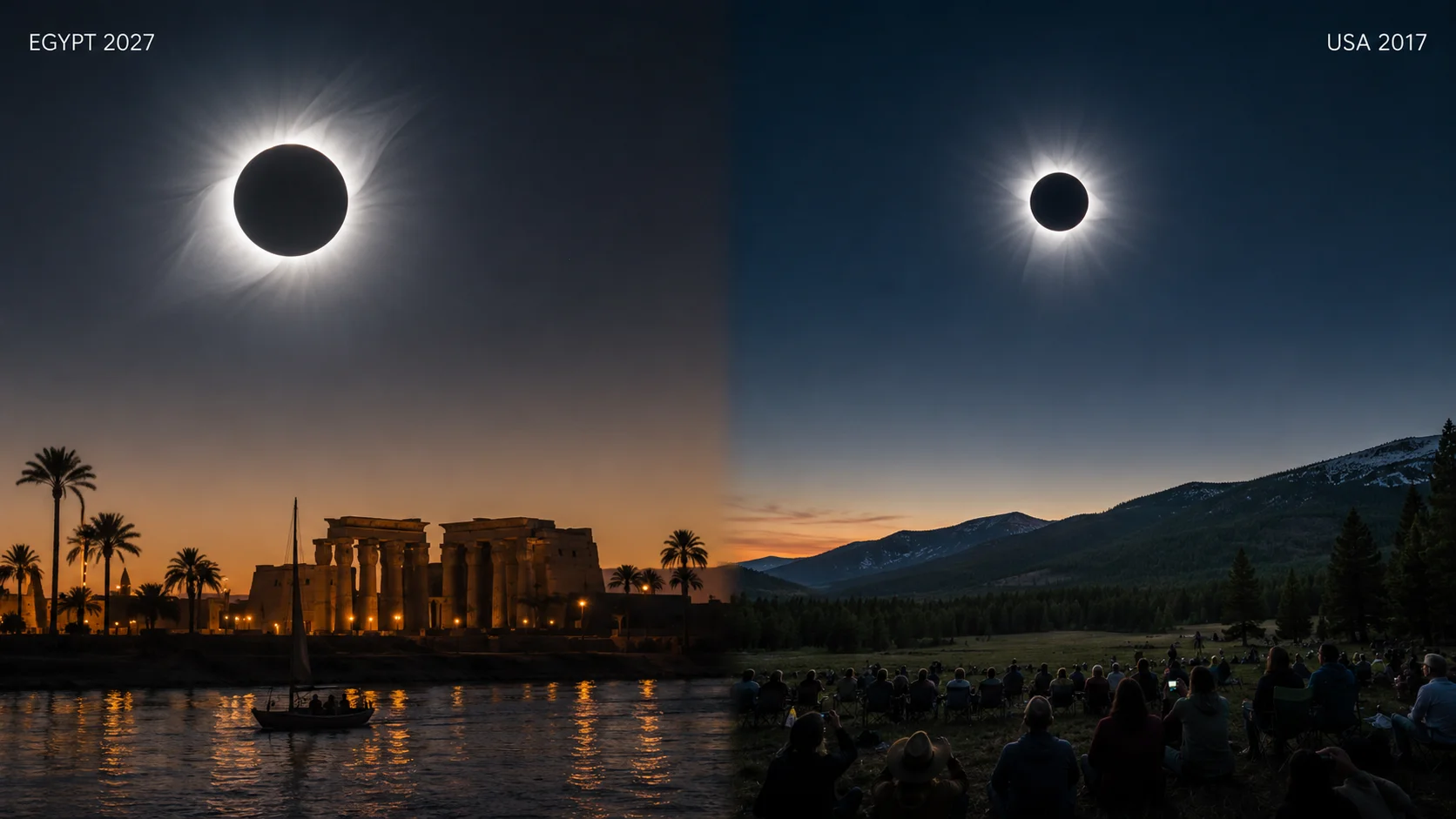
The 2027 eclipse vs 2017 eclipse comparison begins with one dramatic number. The total solar eclipse that crossed the United States on August 21, 2017 reached a maximum totality of about 2 minutes 40 seconds. The eclipse of August 2, 2027 can reach about 6 minutes 23 seconds at the point of greatest duration—more than twice as long.
Duration, however, is only one part of the story.
The 2017 event became a shared national experience across the United States. Its path crossed the country from the Pacific coast to the Atlantic coast, passed through 14 states and brought totality within a day’s drive of a large share of the population. Roads, parks, farms, stadiums, towns and private properties became viewing sites.
The 2027 eclipse will be geographically different. Its path crosses parts of Europe, North Africa, the Middle East and the Horn of Africa. In Egypt, it passes through regions that combine high solar altitude, long totality and landscapes ranging from the Nile Valley to the Western Desert. That creates extraordinary viewing potential, but it also demands more specialized planning for summer heat, remote-site access, transport, permits, shade, water, communications and medical support.
This article compares the two events honestly. It does not claim that one eclipse is “better” in every way. Instead, it explains how their astronomy, geography, atmosphere, logistics, photography and traveler experience differ—and what someone who experienced the Great American Eclipse in 2017 should expect from the 2027 total solar eclipse in Egypt.
2027 Eclipse vs 2017 Eclipse at a Glance
| Feature | 2017 USA Eclipse | 2027 Egypt Eclipse |
|---|---|---|
| Date | August 21, 2017 | August 2, 2027 |
| Global eclipse type | Total solar eclipse | Total solar eclipse |
| Maximum totality | About 2m 40.3s in standard NASA path tables | About 6m 23.2s at greatest duration |
| Path width near greatest eclipse | About 114.7 km | About 257.7 km |
| Sun altitude near greatest eclipse | About 63.9 degrees | About 81.7 degrees |
| Best-known setting | Coast-to-coast route across the contiguous United States | North African and Middle Eastern route with exceptionally long totality |
| Typical planning challenge | Traffic, weather variability and large public crowds | Heat, remote logistics, access, cooling and site operations |
| Egypt viewing experience | Not applicable | Nile Valley or Western Desert experience depending on exact site |
The figures above describe the events near their most favorable central-path locations. They are not promises for every city or viewing site. Local duration, altitude and path position must be calculated for exact coordinates.
Why the 2017 Eclipse Became a Cultural Event
The 2017 eclipse was widely known as the Great American Eclipse because its totality path crossed the contiguous United States from coast to coast. NASA notes that the path crossed 14 states and that approximately two-thirds of the U.S. population lived within a day’s drive of totality.
That accessibility mattered.
Many observers did not need international flights, visas or complex expedition logistics. They could drive to a park, a relative’s home, a campground or a temporary viewing event. Schools, universities, museums, astronomy clubs and local governments organized activities. NASA, media organizations and online platforms provided extensive live coverage.
The event also arrived during a period when social media and mobile photography could spread the experience instantly. NASA later described it as one of its largest online public-interest events, with tens of millions of views across its digital platforms.
For many people, 2017 was their first total solar eclipse. The event created a generation of new eclipse travelers who now understand that totality is fundamentally different from a partial eclipse.
The 2027 eclipse will inherit that audience. Many of the travelers comparing Egypt, Spain, Morocco, Libya, Saudi Arabia or other locations will be people who remember 2017 and want a longer, more immersive second experience.
The Biggest Difference: Totality Duration
The most obvious difference between the two events is duration.
NASA’s standard path table for August 21, 2017 gives a greatest-duration value of about 2 minutes 40.3 seconds. Detailed lunar-limb corrections can adjust contact timing slightly, but the event remained a roughly two-minute-and-forty-second maximum eclipse.
For August 2, 2027, NASA’s path data gives a greatest-duration value of about 6 minutes 23.2 seconds.
That means the 2027 maximum is approximately 3 minutes 43 seconds longer.
In percentage terms, the 2027 maximum is well over twice the 2017 maximum. For an eclipse observer, that is not a small improvement. It changes how totality can be experienced.
What Extra Time Means During Totality
A short totality can feel almost instantaneous. The observer may still be reacting to the darkness when the first sunlight returns. Photographers must work through a fast sequence. First-time viewers may spend too much time with equipment and too little time looking.
A six-minute totality provides more breathing room.
It may allow time to:
- Watch the final Baily’s beads and diamond-ring effect.
- Look at the corona without a camera.
- Notice its shape and streamers.
- Search for prominences along the solar limb.
- Observe the horizon and landscape.
- Identify bright planets or stars.
- Record several exposure sequences.
- Listen to environmental changes.
- Experience the return of light without feeling that the event disappeared immediately.
Long totality does not remove the need for rehearsal. Six minutes still pass quickly. However, it gives observers more opportunity to alternate between photography and unaided viewing.
Maximum Duration Is Not the Duration Everywhere
The 6-minute-23-second figure is the greatest duration anywhere along the 2027 global path under the standard prediction model. It does not describe every Egyptian site.
Duration changes with:
- Exact latitude and longitude.
- Distance from the centerline.
- Position along the global path.
- Earth’s curvature.
- Apparent sizes of the Sun and Moon.
- Shadow speed.
- Elevation and the detailed lunar limb.
A tour should therefore publish a local duration only after the viewing coordinates are finalized and checked against authoritative path data.
The same principle applied in 2017. A traveler in Oregon, Wyoming, Missouri or South Carolina did not automatically receive the maximum duration. The exact position within the path mattered.
The Path Width Difference
The 2017 path near greatest eclipse was about 114.7 kilometers wide according to NASA’s path table.
The 2027 path near greatest eclipse is about 257.7 kilometers wide.
The wider 2027 path creates a larger geographic corridor of totality. That can provide more flexibility in selecting a practical viewing area, but it does not eliminate site-selection challenges.
A wide path may offer:
- More possible towns and desert locations inside totality.
- More distance between the centerline and path limits.
- Greater opportunity to choose between landscapes.
- More options for avoiding a single crowded destination.
- More operational space for transport and accommodation planning.
However, not every point inside the path offers the same duration, weather prospects, access or safety. A broad path can cross mountains, cities, restricted areas, remote deserts, agricultural land and coastlines. The best mathematical coordinate may not be the best operational coordinate.
Sun Altitude: Why the 2027 Sun Will Be Higher
Near greatest eclipse, NASA’s path data places the Sun at an altitude of about 63.9 degrees for the 2017 event and about 81.7 degrees for the 2027 event.
The 2027 Sun will therefore be very high in the sky near the most favorable part of the path.
A high solar altitude has advantages:
- Distant horizon obstacles are less likely to block the Sun.
- Haze close to the horizon has less influence.
- Buildings, trees and low terrain are less likely to interfere.
- A broad open viewing field can provide a clean line of sight.
It also creates practical challenges:
- Photographers may need to point heavy lenses almost overhead.
- Tripod balance and camera access become more difficult.
- Guests must look upward for long periods.
- Shade structures must not block the Sun.
- Viewing areas need careful layout to avoid people standing in front of equipment.
- The midday heat can be severe in Egypt in August.
A successful 2027 viewing field should be designed around the Sun’s direction and altitude. Cooling areas can be placed beside the open field, but the observation zone itself must remain unobstructed.
Landscape: American Variety vs Egyptian Monumentality
The 2017 eclipse crossed a remarkable variety of American landscapes.
Observers watched from:
- Pacific coastal areas.
- Oregon high desert.
- Mountain regions.
- Plains and farmland.
- Small towns.
- National and state parks.
- River valleys.
- Southeastern landscapes near the Atlantic.
This variety allowed people to choose locations based on weather, travel distance, scenery and personal connections.
The 2027 eclipse in Egypt offers a different kind of visual identity.
Depending on the exact site, the event may be experienced against:
- The Nile Valley.
- Ancient temple landscapes.
- Oasis settlements.
- Black volcanic hills.
- Pale desert formations.
- Open Western Desert horizons.
- Red Sea environments.
- Remote camps.
The Egyptian landscape can add a powerful sense of history and scale. The event links a modern scientific experience with a country whose culture has been shaped by the Sun, seasonal cycles and astronomical observation for thousands of years.
That does not mean every ancient site is an appropriate viewing location. Heritage protection, access rules, crowd control and horizon conditions must come before visual symbolism. A remote desert view can be more practical than a famous monument if it provides safer movement and better operational control.
Accessibility: Domestic Road Trip vs International Expedition
For many Americans, 2017 was a domestic trip. Even when people traveled hundreds of miles, they remained within familiar systems of roads, language, payment, communications and emergency services.
The 2027 Egypt eclipse will be an international journey for most foreign visitors.
That introduces additional planning:
- Passport validity.
- Visa requirements.
- International flights.
- Airport arrival.
- Currency and payment.
- Travel insurance.
- Baggage limits for photography equipment.
- Hotel coordination.
- Domestic transfers.
- Desert road transport.
- Health preparation.
- Communication with the operator.
- Cancellation terms.
The trip can still be straightforward when organized well. Cairo is a major international gateway, and a structured package can connect airport reception, hotel nights, transfers and the viewing camp.
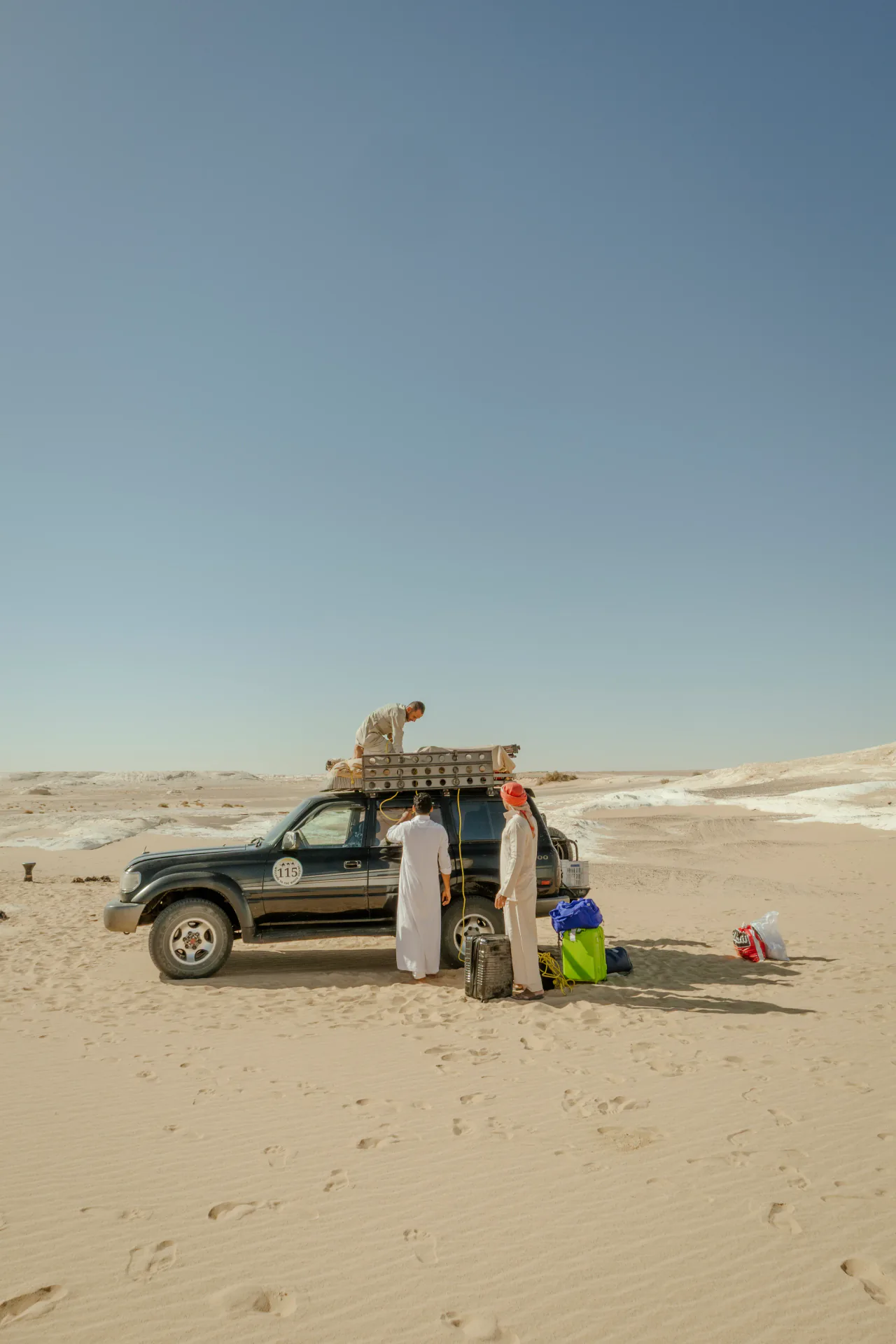
The difference is that guests cannot treat the event as a spontaneous drive to an open field. A remote Egyptian desert location requires verified vehicles, drivers, permits, route knowledge, water, fuel, communications and contingency planning.
Crowds and Traffic
The 2017 eclipse demonstrated how totality can create major temporary movement. Large numbers of people drove into the narrow path, and traffic after the event became a widely discussed part of the experience.
The lesson is not that every eclipse will produce identical congestion. It is that a brief event can concentrate visitors into a limited geographic corridor at the same time.
Egypt in 2027 may experience different crowd patterns.
Luxor and other established tourism centers may attract large organized groups because they already have hotels, airports, Nile cruises and famous attractions. Remote desert locations may have fewer casual visitors but face limited roads and service capacity.
A smaller crowd does not automatically mean easier operations. One narrow road, a fuel issue or poorly coordinated vehicles can create serious delays even with fewer people.
A managed camp should control:
- Arrival times.
- Vehicle assignments.
- Parking.
- Equipment unloading.
- Guest movement.
- Emergency lanes.
- Departure sequencing.
- Communication between drivers and camp staff.
One advantage of a multi-day camp is that guests can arrive before eclipse morning and avoid joining a same-day rush. Departures can also be staggered rather than sending every vehicle onto the road immediately after the partial phase ends.
Weather: A Comparison Without Guarantees
Weather is one of the largest uncertainties in eclipse travel.
The 2017 path crossed multiple climate regions. Some locations offered historically favorable conditions, while others had higher cloud risk. Actual weather on eclipse day varied locally, and some groups moved based on short-term forecasts.
The 2027 path across Egypt passes through regions known for dry summer conditions. That is encouraging, but “desert” does not mean “guaranteed clear.”
Potential issues include:
- High cloud.
- Local dust.
- Reduced transparency.
- Wind.
- Heat haze.
- Sand movement.
- Rare but possible weather changes.
- Smoke or local atmospheric pollution near populated areas.
No responsible eclipse plan should promise clear skies. Climate statistics describe long-term patterns, not the weather at one hour on one future date.
The operational advantage of the Western Desert may be the combination of open land, broad horizons and lower urban density. The operational disadvantage is remoteness and summer heat.
A good plan balances sky prospects with the ability to keep guests safe and comfortable.
Temperature and Human Comfort
The 2017 eclipse occurred during summer, but temperature conditions varied widely along its long U.S. path. Many visitors could choose cooler mountain or northern locations, while others experienced heat.
The 2027 Egyptian event occurs in early August, when desert heat is a central planning issue.
This affects the entire day, not only totality.
Guests may spend hours waiting through the partial phase. Photographers may arrive early to set up. Vehicles and equipment may remain in the Sun. Children and older travelers may become tired before the central phase begins.
The camp plan should address:
- Air-conditioned sleeping or rest areas.
- Shaded gathering areas.
- Cold drinking water.
- Electrolyte availability.
- Scheduled hydration reminders.
- Light meals.
- Sun-protective clothing.
- Medical screening and support.
- Cooling for vulnerable guests.
- Safe storage for batteries and electronics.
- Clear limits on unnecessary outdoor activity.
An air-conditioned base is most useful when it is next to an open viewing field. Guests can rest in a controlled environment and move outside for the important phases. The viewing area itself should not be described as enclosed if the sky must remain visible.
The Photography Difference
The 2017 eclipse produced some of the most widely shared eclipse photography of the modern era. Many photographers used it to learn the practical difficulty of totality.
The 2027 event offers more time but also different equipment challenges.
Longer Totality
More than six minutes can support:
- Wider exposure bracketing.
- Multiple corona sequences.
- Separate close and wide compositions.
- Time to check framing.
- A better balance between photographing and watching.
- A planned interval with hands away from the camera.
Higher Sun
The high Sun requires:
- Strong tripod stability.
- A head that can point steeply upward.
- Comfortable camera access.
- Careful cable management.
- Practice tracking the Sun.
- Awareness that guests may be looking almost overhead.
Heat
High temperatures can affect:
- Battery performance.
- Camera overheating.
- Laptop or tablet operation.
- Adhesive and filter security.
- Photographer concentration.
- The ability to remain under direct Sun.
Equipment should be shaded before the critical phase without blocking its line of sight. Photographers should avoid leaving lenses, batteries and computers inside closed hot vehicles.
Filters and Safety
Both events require the same basic optical safety.
A proper solar filter must cover the front of the camera lens during the partial phases. It may be removed only when the photosphere is completely hidden at the photographer’s exact location. It must be replaced before direct sunlight returns.
Eclipse glasses do not protect a person looking through an unfiltered optical viewfinder.
A managed viewing site should separate a photography zone, provide clear phase announcements and minimize movement in front of tripods.
Scientific Opportunity
Both eclipses offer scientific value.
In 2017, NASA and partner organizations used spacecraft, aircraft, ground instruments, balloons and citizen-science projects to observe the Sun, Moon and Earth. The event provided opportunities to study the corona, Earth’s atmosphere, ionospheric changes, animal behavior and public participation.
The long 2027 totality may support extended observations of the corona and related phenomena. However, the scientific importance of an eclipse does not depend only on duration. Instrument quality, location, calibration, coordination and research questions matter.
A travel camp can support amateur astronomy and educational observation without pretending to be a research institution. Useful additions may include:
- An astronomy briefing.
- A qualified eclipse adviser.
- Safe telescopes with proper solar filters.
- A pre-event lecture.
- Explanations of the corona and contact phases.
- Temperature logging.
- Shadow-band observation.
- Citizen-science instructions where appropriate.
Any formal scientific partnership should be named only after it is confirmed.
What a 2017 Eclipse Traveler May Notice in 2027
Someone who experienced 2017 may arrive with confidence. That is valuable, but 2027 will still require a different mindset.
The central phase will feel longer
The observer may have time to settle into totality rather than simply react to it.
The Sun will be higher
The visual attention shifts upward. Wide landscape compositions may require more creative framing.
The environment may be hotter
Heat management begins well before first contact.
The journey may feel more expedition-like
Airport reception, desert transport and camp operations become part of the experience.
The landscape may feel more isolated
A Western Desert site can create a quieter atmosphere than a public roadside event, provided the camp is carefully controlled.
The crowd may be more international
Guests may travel from several countries and share a multi-day program rather than arrive independently for a few hours.
The schedule must be more disciplined
Remote operations leave less room for spontaneous changes without planning. Guests need clear baggage, timing, health and equipment instructions.
The Social Experience
The 2017 eclipse often created short-lived communities. Strangers gathered in parking areas, fields and parks, shared eclipse glasses and celebrated together when totality arrived.
A camp-based 2027 experience can extend that community over several days.
Guests can meet before eclipse day, attend briefings, discuss equipment, share meals and understand the safety plan. That reduces confusion during the event and may produce a stronger group atmosphere.
The social experience should not interfere with observation. Music, white lights, vehicle movement and loud announcements should be controlled during the critical period. Communication must be clear but not distracting.
The best camp atmosphere combines hospitality with operational discipline.
2017 Lessons That Should Shape 2027 Planning
The Great American Eclipse produced practical lessons for future events.
Arrive early
Same-day travel introduces traffic and delay risk. A camp or hotel stay before eclipse day is safer.
Do not rely on one casual map
Use authoritative path data and exact coordinates.
Practice photography
Totality is not the time to learn camera menus.
Buy safe viewers early
Unverified products and last-minute shortages create risk.
Expect communications pressure
Mobile networks may become congested when crowds gather.
Control vehicle movement
Cars should not enter or leave the viewing field during critical phases.
Protect the experience
Visitors should spend at least part of totality looking directly rather than only at a screen.
Plan the departure
Traffic and fatigue after the event can be as important as arrival planning.
Communicate weather honestly
No operator can guarantee visibility.
These lessons are directly relevant to Egypt, even though the roads, climate and crowd distribution will be different.
Which Event Is Better for First-Time Eclipse Viewers?
The question has no universal answer.
The 2017 event was easier to access for many U.S. residents. Its shorter totality still delivered the full total-eclipse experience.
The 2027 event offers much longer maximum totality and a distinctive travel setting. It may be more rewarding for someone prepared for an international journey and summer desert conditions.
For first-time viewers, the quality of organization matters more than the prestige of the destination. A well-managed site with a verified path position, clear safety instructions and reliable logistics is better than a famous location with poor planning.
The traveler should evaluate:
- Exact viewing coordinates.
- Local totality duration.
- Heat plan.
- Transport.
- Accommodation.
- Group size.
- Toilets.
- Medical support.
- Eclipse glasses.
- Photography arrangements.
- Cancellation conditions.
- Weather policy.
- Operator licensing and identity.
Which Event Is Better for Experienced Eclipse Chasers?
Experienced eclipse chasers may value the 2027 event for several reasons:
- Exceptionally long totality.
- High solar altitude.
- Broad path.
- Multiple destination options.
- Potentially favorable summer climatology in parts of Egypt.
- The possibility of combining eclipse observation with a major cultural journey.
- Desert horizons and low urban obstruction.
They may also ask more demanding questions:
- How far is the site from the centerline?
- What lunar-limb model is being used?
- What is the Sun’s exact altitude and azimuth?
- Is there a mobility plan?
- What is the dust history?
- Can tripods remain assembled?
- Is electrical power stable?
- Are generators separated from the observation area?
- What are the lighting rules?
- How many vehicles and drivers are assigned?
- Is the site permitted?
- What is the emergency evacuation route?
A professional response should welcome these questions and distinguish confirmed details from planned details.
Egypt Location Choices Compared With the 2017 Route
The 2017 route offered many independently accessible options across one country. Travelers could move between states based on weather and preference.
Egypt’s path presents a different comparison.
Nile Valley Locations
Advantages may include:
- Established hotels.
- Airports or rail connections.
- Major attractions.
- More conventional tourism services.
Challenges may include:
- Greater concentration of tour groups.
- Urban or agricultural obstructions.
- Traffic.
- Limited control over public viewing spaces.
Western Desert Locations
Advantages may include:
- Open horizons.
- Lower urban density.
- A quieter setting.
- More control in a private camp.
- A distinctive desert experience.
Challenges may include:
- Remote access.
- Heat.
- Permits.
- Limited services.
- Greater dependence on local operational expertise.
Coastal Locations
Advantages may include resorts and accommodation. Challenges can include humidity, haze, site geometry and the need to verify whether the precise location lies inside totality.
The correct choice depends on exact coordinates and operations, not a broad destination name.
A Note About the White Desert Name
The phrase “White Desert eclipse” is widely used, but the geography must remain precise.
The White Desert region is broad, and the commonly understood tourist destinations around Farafra are not automatically equivalent to a verified totality coordinate. A tour may use a Western Desert viewing site near Bahariya and include White Desert excursions before or after the eclipse.
Travelers should distinguish clearly between the verified viewing site and the wider White Desert itinerary.
The viewing site should be advertised by its verified location and local circumstances. The White Desert can remain a major part of the journey without implying that every location carrying that name receives totality.
This level of transparency will appeal to experienced eclipse travelers.
How Much Longer Is the 2027 Eclipse Really?
Using the standard greatest-duration values:
- 2017: approximately 160.3 seconds.
- 2027: approximately 383.2 seconds.
The difference is approximately 222.9 seconds, or 3 minutes 42.9 seconds.
The 2027 maximum is about 2.39 times the 2017 maximum.
Those calculations help communicate scale, but they should not replace local-site data. A 2027 site away from greatest duration will receive less than 383.2 seconds. It may still be significantly longer than the 2017 maximum, but the exact result must be calculated.
Common Comparison Mistakes
“The 2027 eclipse is the longest ever”
Incorrect. Longer total eclipses exist in the historical and future catalogs.
“Every Egyptian site gets 6 minutes 23 seconds”
Incorrect. That is the greatest-duration value along the global path.
“The 2017 eclipse lasted only two minutes everywhere”
Incorrect. Local duration varied.
“The desert guarantees clear weather”
Incorrect. Desert climatology may be favorable, but no site can guarantee clear sky.
“A wider path means location no longer matters”
Incorrect. Duration and operations still vary across the path.
“Longer totality automatically means a better trip”
Not necessarily. Poor access, unsafe heat conditions or weak organization can outweigh extra seconds.
“2017 experience means no briefing is needed”
Incorrect. The 2027 altitude, heat, transport and camp environment will differ.
Frequently Asked Questions
How much longer is the 2027 eclipse than the 2017 eclipse?
At greatest duration, 2027 is about 3 minutes 43 seconds longer than the standard 2017 maximum.
Was 2017 visible across the entire United States?
A partial eclipse was visible across a much larger area, but totality was visible only inside the narrow path crossing 14 states.
Will all of Egypt see totality in 2027?
No. Only locations inside the path of totality will experience the total phase. Other Egyptian locations will see a partial eclipse.
Is the 2027 path wider?
Near greatest eclipse, NASA’s standard tables give a path width of about 257.7 km for 2027 versus about 114.7 km for 2017.
Will the Sun be higher in 2027?
Near greatest eclipse, yes. NASA lists about 81.7 degrees altitude for 2027 and about 63.9 degrees for 2017.
Does a higher Sun make viewing easier?
It reduces horizon obstruction but can make photography, shade placement and prolonged upward viewing more difficult.
Is Egypt likely to be clearer than the 2017 U.S. path?
Some Egyptian desert regions have dry summer climatology, but a specific day cannot be guaranteed. Local cloud, haze, dust and wind remain possible.
Can I photograph 2027 using my 2017 setup?
Possibly, but rehearse for a higher Sun, greater heat and longer totality. Inspect all solar filters and replace damaged or uncertain equipment.
Should I stay in Luxor or choose the Western Desert?
That depends on exact path position, weather strategy, crowd preference, accommodation and operations. Compare verified viewing plans rather than destination names alone.
Is the 2027 event suitable for children?
It can be, provided the program includes constant adult supervision, approved eclipse viewers, cooling, hydration, toilets and a realistic plan for the long day.
Can an operator guarantee the eclipse will be visible?
No. An operator can verify path location and prepare logistics, but cannot guarantee cloud-free weather.
Why choose a multi-day camp?
It reduces same-day transport risk, allows briefings and equipment setup, and gives guests a controlled base before and after the eclipse.
Final Takeaway
The 2017 USA eclipse and the 2027 Egypt eclipse belong to the same extraordinary category, but they create different travel experiences.
2017 was a coast-to-coast national event with exceptional domestic accessibility. Its maximum totality lasted about 2 minutes 40 seconds.
2027 offers more than six minutes at greatest duration, a path more than twice as wide near greatest eclipse and a very high Sun over Egypt. Its potential is enormous, but realizing that potential requires precise coordinates, honest weather communication and serious summer-desert operations.
For travelers who experienced 2017, Egypt can be more than a repeat. It can be a longer, more immersive eclipse journey—provided the viewing site, camp and logistics are verified carefully.
Explore the 2027 Egypt eclipse packages or check current camp availability.
Authoritative planning reference
Use NASA 2027 eclipse path data as a primary reference, then verify local circumstances for the exact location.