White Desert Egypt guide: quick answer
White Desert Egypt guide: This White Desert Egypt guide explains how to visit one of the country’s most unusual natural landscapes without confusing it with a simple roadside attraction. The White Desert Protected Area lies in Egypt’s Western Desert, within the wider Farafra region of New
This White Desert Egypt guide explains how to visit one of the country’s most unusual natural landscapes without confusing it with a simple roadside attraction.
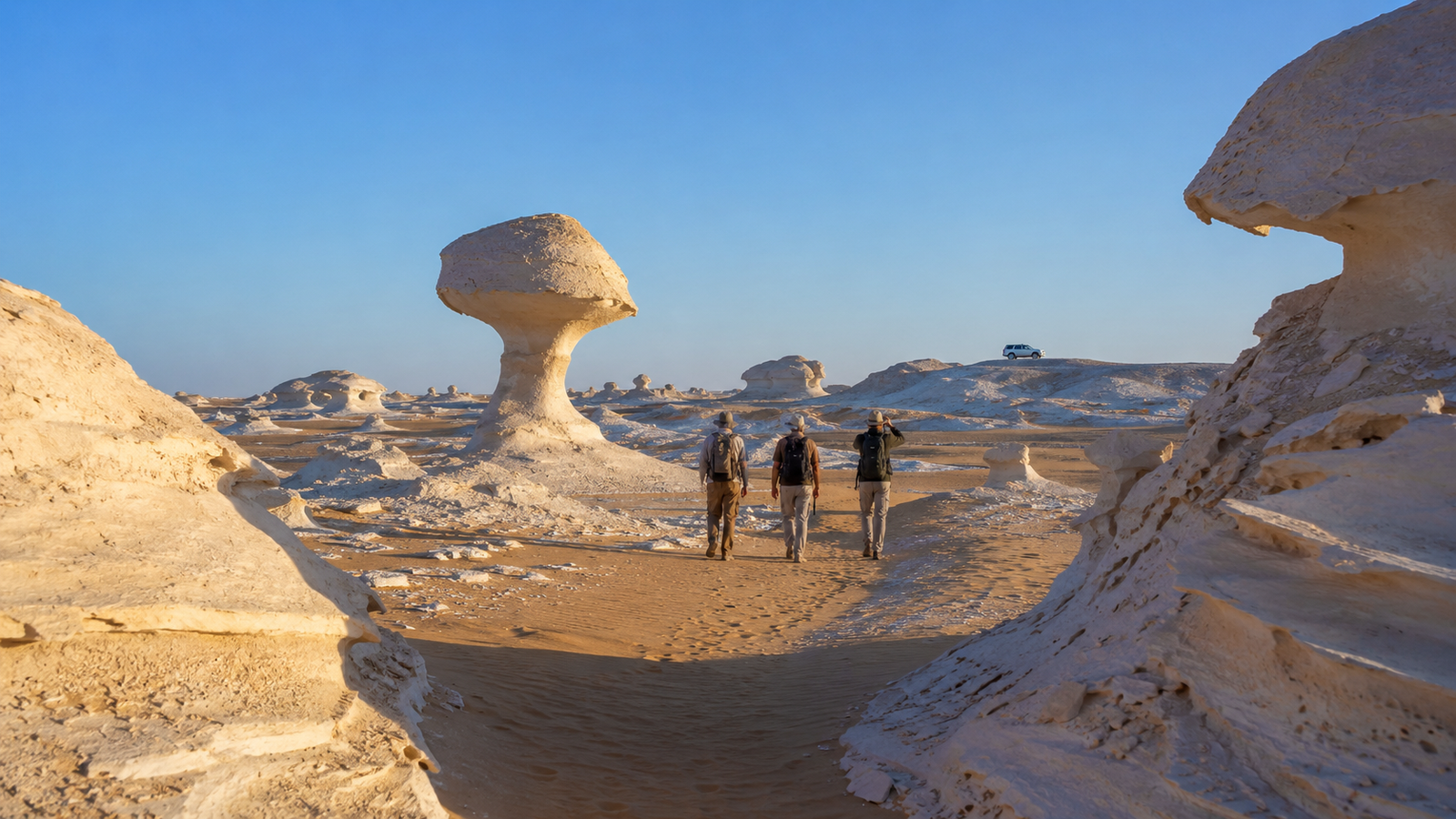
The White Desert Protected Area lies in Egypt’s Western Desert, within the wider Farafra region of New Valley Governorate. Official Egyptian information places the reserve roughly 38–40 kilometers from Farafra and describes an area of approximately 3,000 square kilometers. Its signature landscape is formed from pale chalk and chalky limestone sculpted into towers, domes, mushrooms, ridges and isolated white forms by weathering and erosion.
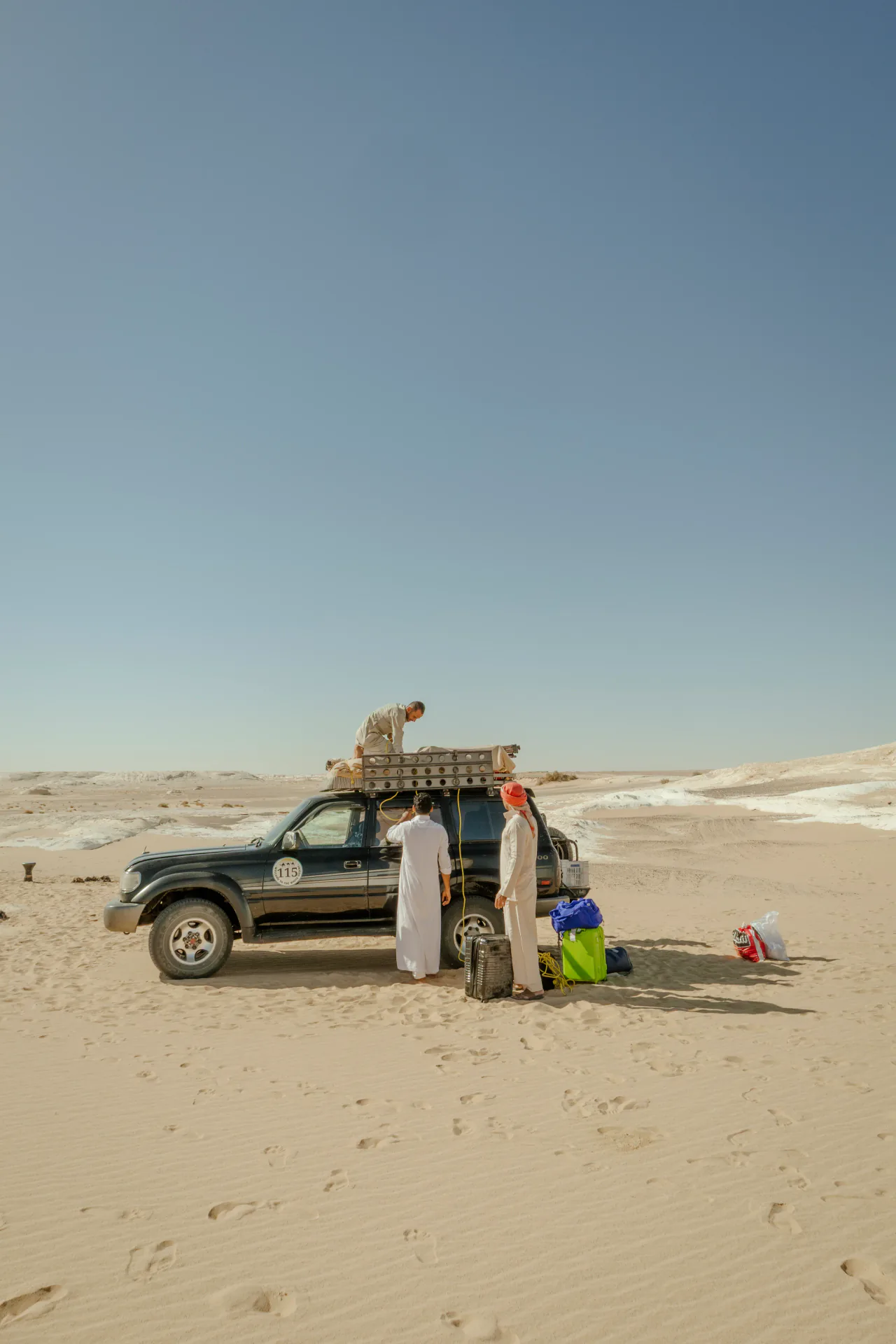
Most international travelers do not begin the journey in Farafra. They arrive through Cairo and travel to Bahariya Oasis, where local desert teams organize vehicles, permits, supplies and onward routes through the Black Desert, Crystal Mountain, Aqabat and the White Desert.
That is why two apparently conflicting statements can both be true:
- The protected White Desert is geographically associated with Farafra.
- Bahariya is one of the main practical gateways and operating bases for travelers coming from Cairo.
The White Desert is remote, protected and logistically demanding. Current official travel advice states that visitors to the Bahariya, Farafra, Black Desert and White Desert areas need advance permits and should use an official or licensed guide. Mobile reception and medical facilities can be limited. A normal city taxi, unsupported rental car or improvised overnight camp is not an equivalent alternative to a permitted local operation.
For travelers planning the August 2, 2027 total solar eclipse, the distinction becomes even more important. Standard White Desert landmarks should not automatically be described as inside totality. The eclipse product should use a separately verified viewing field near Bahariya, then combine it with White Desert experiences before or after the event.
Quick White Desert Egypt Guide
| Question | Practical answer |
|---|---|
| Where is the White Desert? | In Egypt’s Western Desert, associated with the Farafra Depression and New Valley Governorate. |
| Why do many tours start in Bahariya? | Bahariya is a practical road gateway from Cairo and a base for local desert drivers and operators. |
| Can you visit independently? | Do not treat it as an unsupported self-drive trip. Permits and an official or licensed guide are required under current guidance. |
| Best conventional season | Approximately October to April for milder days and cooler nights. |
| Can you visit in summer? | Only with a specialist plan for extreme heat, cooling, water, vehicles and medical response. August 2027 is exceptional because of the eclipse. |
| How many days are ideal? | Two days is the focused minimum; three or four days create a more comfortable route and more oasis time. |
| Main experiences | White chalk formations, Black Desert, Crystal Mountain, Aqabat, camping, stargazing, photography and oasis visits. |
| Is camping compulsory? | No. Some travelers can use an oasis hotel and take a long guided excursion, though overnight camping provides the fullest desert experience. |
| Is the White Desert the eclipse field? | Not automatically. The 2027 field must be verified separately by exact GPS coordinates. |
Where Is the White Desert in Egypt?
The White Desert is part of Egypt’s Western Desert, west of the Nile Valley.
Official Egyptian sources place the protected area about 38 kilometers northwest of Farafra, while the national tourism portal describes it as approximately 40 kilometers from Al-Farafra.
This does not mean every traveler must reach Farafra independently.
A common route from Cairo is:
- Cairo to Bahariya Oasis by paved road.
- Transfer into locally operated 4x4 vehicles.
- Travel through the Black Desert and other Western Desert landscapes.
- Continue toward Crystal Mountain, Aqabat and White Desert areas.
- Camp in an approved location or follow the operator’s confirmed route.
- Return through Bahariya or continue through the western oases, depending on the itinerary.
The exact route changes with permits, road conditions, protected-area rules, weather and the selected program.
Bahariya vs Farafra: Which Is the Gateway?
Farafra is geographically closer to the White Desert Protected Area.
Bahariya is operationally important because:
- It has a paved road connection with Cairo.
- It has hotels and local services.
- It supports experienced desert drivers and guides.
- Many short Cairo-based White Desert tours begin there.
- It connects naturally with the Black Desert and other route stops.
- It can serve as the base for the specialized 2027 eclipse operation.
The accurate answer is not “Bahariya or Farafra.” The two oases play different roles.
A traveler should ask the operator:
- Where does the road transfer end?
- Where do guests change into 4x4 vehicles?
- Which protected-area entrance or route is used?
- Is the night spent inside a permitted desert camp or at an oasis hotel?
- Does the itinerary reach the famous White Desert formations or only nearby Western Desert scenery?
- Which locations are confirmed under the current permit?
What Makes the White Desert White?
The landscape is built largely from pale chalk and chalky limestone.
Geological research identifies the Khoman Chalk Formation, dating to the Late Cretaceous, as an important part of the White Desert’s geology. The rock includes bright chalk and chalky limestone, with other layers and bands occurring within the formation.
Over long periods, weathering and erosion removed softer material and left more resistant forms standing above the surrounding surface.
The shaping processes include:
- Wind carrying abrasive sand.
- Temperature changes.
- Physical weathering.
- Chemical alteration.
- Differential erosion between softer and harder layers.
- Older landscape and water-related processes recorded in the wider Farafra region.
The result is not one uniform white plain. Visitors encounter:
- Pedestal rocks.
- Mushroom-like forms.
- Towers.
- Rounded boulders.
- Low white ridges.
- Broad chalk floors.
- Isolated forms that resemble animals or abstract sculptures.
- Contrasts between white rock, golden sand and dark surrounding hills.
Are the Formations Made of Snow or Salt?
No.
They are rock formations, mainly associated with chalk and chalky limestone, not permanent snow and not ordinary table salt.
The white color reflects the pale composition and surface of the rock.
Were They Formed Under an Ancient Sea?
The geological sequence records marine sediments, and the chalk formation developed in an ancient marine environment.
Travel articles often simplify this into “the White Desert was once the bottom of an ocean.” That is a useful visual introduction, but the full landscape seen today also depends on later uplift, exposure, weathering, erosion and regional geomorphological change.
The responsible explanation combines both stages:
- Marine sediment created the chalk-rich rock.
- Later landscape processes exposed and sculpted it.
Why the White Desert Is a Protected Area
Egypt formally created the White Desert protected area in 2002.
Protected status matters because the formations are natural heritage rather than props in an unrestricted playground.
Visitors should not:
- Climb fragile formations without permission.
- Break or collect chalk, crystals, fossils or rocks.
- Write on the formations.
- Drive outside authorized tracks.
- Leave food, plastic or waste.
- Disturb wildlife.
- Move stones to create photo arrangements.
- Build fires directly against sensitive formations.
- Use drones without checking current permission and security rules.
- Treat protected areas as unrestricted camping land.
A licensed local team should know the current routes, camping zones and permit process.
The best photographs and memories come from observing the landscape without damaging it.
Main Places and Landscapes on a White Desert Journey
A complete route usually includes more than the famous white formations.
Bahariya Oasis
Bahariya is the practical staging point for many trips from Cairo.
Travelers may find:
- Oasis hotels.
- Local restaurants.
- Palm gardens.
- Springs.
- Villages.
- Desert-driver networks.
- Fuel and supplies.
- Transfer points for 4x4 vehicles.
Bahariya also gives the journey local context. The desert is not an empty tourism backdrop; it is connected to communities whose drivers, cooks, hosts and guides make the trip possible.
Read the dedicated Bahariya Oasis guide for history, services and local planning.
The Black Desert
The Black Desert creates a dramatic visual contrast with the White Desert.
Dark stones and volcanic-looking hills cover parts of the landscape. The black surface material sits over lighter desert ground, producing slopes and cones that appear charred from a distance.
A stop may include:
- Short walks.
- Elevated viewpoints.
- Photography.
- Geological explanation.
- Sandboarding in suitable areas, when conditions and timing permit.
The Black Desert should not be described casually as one continuous volcanic field without context. The visual identity comes from dark material distributed across hills and ground surfaces.
Crystal Mountain
Crystal Mountain is one of the best-known stops on the Western Desert route.
Official tourism material describes it as a former underground cave or geological body exposed at the surface, with sparkling mineral features visible in the sunlight.
Visitors should treat it as a protected geological feature.
Do not remove crystals or strike the rock.
The site is generally a short interpretive and photography stop rather than a mountain climb.
Aqabat or Agabat Valley
Aqabat is known for broad desert views, white cliffs, dunes and a more expansive landscape than the isolated mushroom formations.
It can provide:
- Scenic driving.
- Landscape photography.
- Short walks.
- Sunset stops.
- Sandboarding in approved locations.
- A sense of transition between different desert terrains.
Exact access depends on permits, route conditions and the operator.
The White Desert Formations
The central visual experience is the field of pale sculpted rocks.
Popular descriptions compare them to:
- Mushrooms.
- Chickens.
- Rabbits.
- Camels.
- Icebergs.
- Towers.
- Faces.
These names are informal and depend on imagination. The formations continue to change as weathering acts on the rock.
The most responsible visit does not focus on reaching one famous shape at any cost. It allows time to move through the landscape, watch the light change and understand how multiple formations relate to the surrounding desert.
Camping in the White Desert
Overnight camping is one of the most memorable ways to experience the region.
At sunset, the white rock changes from bright cream to gold, pink and gray. After dark, the absence of nearby urban light can reveal a dense night sky when moon and atmospheric conditions are favorable.
A normal winter-style safari camp may include:
- Sleeping tents or screened shelters.
- Mattresses and blankets.
- Camp seating.
- Dinner.
- Breakfast.
- Basic toilet arrangements.
- Guide and driver support.
- Camp lighting.
- Water.
- Vehicle-based supplies.
Facilities vary significantly.
Do not assume that every camp includes:
- Private bathrooms.
- Hot showers.
- Continuous Wi-Fi.
- Mobile reception.
- Mains electricity.
- Air conditioning.
- Hotel-style beds.
- Medical staff.
- Accessible pathways.
Ask for the exact confirmed facilities.
Can You Visit Without Camping?
Yes, depending on the route and operator.
Options can include:
- Oasis hotel plus a long guided day excursion.
- Hotel night before or after one desert night.
- A shorter desert visit for travelers who cannot sleep outdoors.
- A private itinerary with more comfort stops.
- A multi-day route combining hotel and camp accommodation.
The day-trip format may involve many hours in vehicles and less time during sunset and sunrise, which are among the White Desert’s best periods.
A hybrid itinerary often provides the best balance: sleep in Bahariya before or after the desert and camp for one selected night.
How Many Days Do You Need?
One Day
A one-day visit from Bahariya may show selected landscapes, but it cannot deliver the full Cairo-to-desert experience comfortably.
Trying to travel from Cairo, explore deeply and return in one day creates a very long schedule.
Two Days
A focused two-day trip can include:
- Cairo pickup.
- Bahariya arrival.
- 4x4 transfer.
- Major route stops.
- One desert night.
- Sunrise.
- Return to Cairo.
This is the minimum format for many international visitors.
Three Days
Three days allow:
- More rest.
- Additional landscape stops.
- Better pacing.
- More photography time.
- A less rushed return.
- Greater flexibility around Bahariya.
Four Days
A four-day itinerary can combine:
- Bahariya hotel accommodation.
- Oasis touring.
- White Desert experiences.
- More recovery time.
- A stronger format for families or travelers who dislike compressed schedules.
For the 2027 eclipse, extra time is not wasted. Guests should reach the operating region before eclipse day, receive a safety briefing and avoid a same-day transfer to the viewing field.
Best Time to Visit the White Desert
For a conventional leisure trip, the most comfortable season is generally October through April.
October and November
Days become more manageable, while nights begin to cool.
These months can be attractive for:
- Camping.
- Short walks.
- Photography.
- Stargazing.
- Multi-day circuits.
December to February
Winter can produce pleasant daytime conditions and cold nights.
Travelers may underestimate how cold an exposed desert camp feels after sunset. Pack genuine warm layers, not only a light jacket.
March and April
Spring can provide good temperatures, though wind and dust should still be monitored.
May and September
These shoulder periods can be hot. The itinerary should reduce midday exposure.
June to August
Summer desert travel is demanding.
Ordinary camping recommendations do not apply safely without substantial adaptation.
Risks include:
- Heat exhaustion.
- Heatstroke.
- Dehydration.
- Hot vehicle interiors.
- Battery and equipment stress.
- Limited comfortable outdoor hours.
- Greater consequences if a vehicle fails.
- Difficulty sleeping without cooling.
- Increased risk for children, older travelers and people with health conditions.
The August 2, 2027 eclipse creates an exceptional reason to operate during a normally difficult period.
That does not make the heat disappear.
It means the product must be redesigned around:
- Air-conditioned sleeping and recovery spaces.
- Cold water.
- Shade.
- Medical response.
- Reliable power.
- Backup vehicles.
- Reduced midday activity.
- A verified viewing field close to the camp.
- A specialist local team.
Read the best time to visit the White Desert and the White Desert summer safety warning before booking an August itinerary.
White Desert Activities
The best trip combines observation with appropriate activity.
Scenic 4x4 Travel
A trained local driver manages tracks, soft ground, changing routes and vehicle conditions.
The journey is not simply transport. It is one of the main ways guests understand the scale and variety of the desert.
Short Walks
Walking between selected formations can provide:
- Better photography.
- A quieter experience.
- Geological observation.
- Time away from the vehicle.
Long unsupported hikes are not appropriate for most visitors because of heat, navigation and water requirements.
Sandboarding
Sandboarding may be offered on suitable dunes.
It should be timed outside the hottest period and matched to guest ability.
Photography
The White Desert is ideal for:
- Wide landscapes.
- Abstract formations.
- Sunrise and sunset.
- Night-sky images.
- Human scale within the landscape.
- Contrasts between white rock and Black Desert hills.
- 4x4 journey documentation.
Do not damage formations to create a better camera position.
Stargazing
Dark skies can be excellent, but visibility depends on:
- Moon phase.
- Dust.
- cloud.
- Atmospheric clarity.
- Camp lighting.
- The observer’s eyesight.
- Equipment.
Avoid guaranteeing the Milky Way on every date.
Camping and Campfire Evenings
A camp evening can include dinner, conversation and local hospitality.
Fire use should follow current protected-area rules and the operator’s environmental procedures.
Oasis Touring
Bahariya can add:
- Springs.
- Gardens.
- local villages.
- archaeological or historical stops where currently open.
- local meals.
- a hotel rest night.
See the White Desert activities guide and gallery for a fuller activity plan.
How to Reach the White Desert from Cairo
Most guests begin with an organized road transfer from Cairo to Bahariya.
The exact duration depends on:
- Cairo pickup location.
- Traffic.
- Security checks.
- Road conditions.
- Rest stops.
- Vehicle type.
- Weather.
- The final hotel or meeting point.
Avoid building a tight flight connection around an estimated road time.
A sensible sequence is:
- Arrive in Cairo.
- Rest overnight if arriving on a long international flight.
- Leave in the morning with the organized transfer.
- Reach Bahariya and meet the local team.
- Transfer to the appropriate 4x4 vehicles.
- Begin the desert route after permits, supplies and guest checks are complete.
The dedicated Cairo to Bahariya journey guide will cover transport and stops in detail.
Why a Local Guide Is Necessary
A local guide is not only someone who names rock formations.
The team coordinates:
- Permits.
- Route selection.
- Protected-area rules.
- Tourist-police procedures.
- 4x4 driving.
- Fuel.
- Water.
- Camp supplies.
- Food.
- Weather response.
- Communication.
- Vehicle recovery.
- Guest health.
- Waste removal.
- Emergency decisions.
Current UK travel advice says tourists entering Bahariya, Farafra, the White Desert and Black Desert must apply for permits in advance and use an official guide. Current U.S. guidance says travelers should visit the Black and White Deserts with a licensed tour company.
Rules can change, so the operator should recheck them for every departure.
Why Self-Driving Is a Poor Substitute
A standard rental vehicle may be unsuitable for:
- Soft sand.
- Track navigation.
- Remote recovery.
- Protected routes.
- Fuel planning.
- permit checkpoints.
- group communications.
- emergency evacuation.
Even a capable 4x4 does not replace local route knowledge and legal authorization.
Safety in the White Desert
The White Desert can be visited responsibly, but remoteness changes the consequences of small mistakes.
Heat and Dehydration
Drink before feeling thirsty and follow the guide’s activity schedule.
Vehicle Failure
The operation should have maintenance standards, communications and backup planning.
Navigation
Do not wander away from camp or formations without informing the guide.
Limited Medical Access
Disclose relevant health conditions and carry necessary medication.
Weak Mobile Reception
Do not rely on your personal phone as the only emergency system.
Cold Winter Nights
Pack layers, a hat and suitable sleep equipment.
Uneven Ground
Wear stable closed footwear and use a light after dark.
Sun Exposure
Use long sleeves, sunscreen, hat and shade.
Food and Water
Use the operator’s drinking-water supply and disclose dietary needs.
Wildlife
Observe animals from a distance and do not leave food accessible.
Security and Permits
Follow the approved route and instructions from guides and authorities.
What to Pack
Clothing
- Lightweight long-sleeve shirts.
- Breathable trousers.
- Sun hat.
- Warm layers for cool-season nights.
- Wind-resistant outer layer.
- Comfortable sleep clothing.
- Closed shoes.
- Spare socks.
Sun and Heat Protection
- Sunscreen.
- Sunglasses.
- Personal water bottle.
- Electrolytes if medically suitable.
- Lip balm.
- Light scarf.
Camp Comfort
- Small headlamp.
- Personal toiletries.
- Tissues and waste bags.
- Hand sanitizer.
- Earplugs.
- Power bank.
- Small towel.
- Prescription medication.
Photography
- Camera and lenses.
- Spare batteries.
- Dust protection.
- Lens cloth.
- Stable tripod.
- Memory cards.
- Red-light headlamp where appropriate.
Documents
- Passport copy.
- Travel insurance details.
- Booking confirmation.
- Emergency contacts.
- Health information needed by the operator.
Pack light enough for repeated vehicle loading.
Toilets, Showers, Wi-Fi and Charging
Facilities depend on the product.
Toilets
Basic safari trips may use portable or camp toilet systems.
Ask whether toilets are shared, enclosed and available throughout the night.
Showers
A conventional overnight desert camp may not include showers.
A longer program can use a Bahariya hotel before or after camping.
Wi-Fi and Mobile Service
Reception can be limited or absent.
Do not promise continuous Wi-Fi unless the final camp system is confirmed and tested.
Charging
Vehicle charging, generators, solar systems or battery stations may be used.
Guests with cameras or medical devices should confirm:
- Plug type.
- Wattage.
- charging schedule.
- backup capacity.
- whether power is continuous.
The eclipse camp facilities guide will provide the current confirmed details for the 2027 camp.
Families and Children
The White Desert can be memorable for children, but the itinerary must fit their age and heat tolerance.
Families should verify:
- Seat belts and child-seat arrangements.
- Walking distance.
- Toilet privacy.
- sleeping setup.
- food preferences.
- shade.
- water.
- medical response.
- supervision near formations and vehicles.
- summer cooling.
- the site’s child policy.
August eclipse travel requires stronger controls than a winter family safari.
Read the child policy before booking.
Older Travelers and Accessibility
A desert trip is not automatically unsuitable for older travelers, but it is not barrier-free.
Questions include:
- Can the guest enter a 4x4 safely?
- How high is the step?
- Is the ground soft or uneven?
- How far is the toilet?
- Is a chair available?
- Can the guest sleep comfortably?
- Is medication kept cool?
- Is air-conditioned rest available?
- How quickly can a vehicle reach medical care?
- Can the route be shortened?
A hotel-plus-excursion format may be better than an overnight camp for some travelers.
The operator needs honest medical and mobility information before confirmation.
Responsible and Sustainable Travel
The White Desert’s visual power depends on its natural condition.
Travelers and operators should:
- Follow designated routes.
- Use permitted camps.
- Remove all waste.
- Minimize single-use plastic.
- Avoid touching fragile surfaces unnecessarily.
- Keep noise low.
- Protect wildlife.
- Use existing fire procedures.
- Respect local communities.
- Employ local drivers and staff.
- Avoid misleading geotags that encourage unsupported access.
- Report damage or unsafe behavior to the guide.
A protected landscape should look unchanged after the group leaves.
White Desert and the 2027 Total Solar Eclipse
The White Desert is central to the site’s travel story, but astronomy requires exact language.
The August 2, 2027 path crosses the Western Desert. Representative Bahariya coordinates are inside totality and receive approximately 6 minutes 17 seconds.
Common Farafra and standard White Desert tourist coordinates may be outside totality.
Therefore, the correct product description is:
The confirmed Western Desert eclipse-camp region between the White Desert and the Black Desert, inside the path of totality, where the final astronomically verified viewing point will provide at least 6 minutes of totality at a separately verified totality field, combined with White Desert experiences.
It should not say:
Every White Desert landmark is inside totality.
The final operation should publish or internally document:
- Field coordinates.
- Local contact times.
- Totality duration.
- Distance from the path boundary.
- land permission.
- transport route.
- cooling capacity.
- medical support.
- guest capacity.
- date of last astronomical verification.
The viewing field and the excursion route may be different places.
That is not a weakness. It is the honest way to provide both a secure astronomical experience and a complete White Desert journey.
Why Choose a Bahariya-Based Local Team for the Eclipse?
A specialist Bahariya operation can coordinate the entire sequence:
- Cairo pickup.
- road transfer.
- oasis arrival.
- 4x4 logistics.
- desert excursions.
- camp.
- viewing field.
- contact-time briefing.
- solar-viewing safety.
- cooling.
- food.
- local permits.
- return transport.
A regular winter safari team may understand the desert but not the eclipse.
A generic eclipse organizer may understand contact times but not Bahariya’s roads, heat and desert operations.
The strongest product combines both specialties.
Learn more about Elzaghandi Group’s local operation and the fully air-conditioned eclipse camp.
Sample Two-Day White Desert Itinerary
Day 1
- Cairo pickup.
- Drive to Bahariya.
- Lunch and local-team meeting.
- Transfer to 4x4 vehicles.
- Black Desert stop.
- Crystal Mountain or approved route stops.
- Sunset in the White Desert.
- Camp dinner and overnight stay.
Day 2
- Sunrise.
- Breakfast.
- Additional formations or route stops.
- Return to Bahariya.
- Change to road vehicle.
- Return to Cairo.
This format is efficient but compressed.
Sample Three-Day Itinerary
Day 1
Cairo to Bahariya, oasis arrival and hotel or camp preparation.
Day 2
Full Western Desert route with Black Desert, Crystal Mountain, Aqabat and White Desert camping.
Day 3
Sunrise, additional landscape time, Bahariya return and Cairo transfer.
This format is more comfortable and gives the local team greater flexibility.
Sample Four-Day Itinerary
Day 1
Cairo to Bahariya and hotel rest.
Day 2
Oasis exploration and desert orientation.
Day 3
White Desert route and camp.
Day 4
Sunrise, return and Cairo transfer.
For the eclipse, the actual sequence will be arranged around August 2 and the verified viewing field.
How to Choose a White Desert Tour
Do not compare only the headline price.
Ask:
- Is the company licensed?
- Who is the local Bahariya operator?
- Are permits included?
- Which protected-area routes are confirmed?
- Which vehicle type is used?
- How many guests share each vehicle?
- Is there a backup vehicle?
- What drinking water is carried?
- What meals are included?
- What toilet system is provided?
- What sleeping equipment is included?
- Is a Bahariya hotel night included?
- How is waste removed?
- Is travel insurance required?
- What medical support exists?
- Is mobile service expected?
- What happens during dust or strong wind?
- Are children accepted?
- Can mobility needs be accommodated?
- What is the cancellation policy?
- For 2027, what are the eclipse-field coordinates?
- Which areas are air-conditioned?
- Are eclipse glasses included?
- Is the White Desert excursion separate from the viewing field?
- What details are confirmed in writing?
Read the booking and cancellation policy before paying.
Common Mistakes
Calling Bahariya and Farafra the Same Place
They are different oases with different geographic and operational roles.
Assuming Every White Formation Is Inside One Small Park
The wider Western Desert route covers multiple landscapes and jurisdictions.
Attempting Unsupported Self-Driving
Permits, local knowledge and recovery planning matter.
Booking Summer Camping Without Cooling
August requires a purpose-built system.
Assuming Wi-Fi and Showers
Facilities vary.
Packing Only Summer Clothing in Winter
Desert nights can be cold.
Removing Rocks or Crystals
The landscape is protected.
Choosing a One-Day Cairo Round Trip
The schedule can become exhausting and superficial.
Believing the White Desert Name Proves Eclipse Totality
Exact coordinates decide the eclipse type.
Booking Only from Social-Media Photos
Request written logistics, facilities and commercial terms.
Frequently Asked Questions
Where is the White Desert in Egypt?
It lies in Egypt’s Western Desert within the wider Farafra region of New Valley Governorate.
Is it near Bahariya or Farafra?
The protected area is closer to Farafra, while Bahariya is a major practical gateway from Cairo and an operating base for many tours.
How far is it from Cairo?
The total journey depends on the route. Travelers commonly drive from Cairo to Bahariya, then continue by organized 4x4 through the Western Desert.
Can I go without a tour?
Current official guidance requires advance permits and an official or licensed guide. Unsupported self-driving is not recommended.
Do I need a permit?
Yes under current guidance. The operator normally coordinates the process.
Why is the White Desert white?
Its landscape is dominated by pale chalk and chalky limestone exposed and sculpted by weathering and erosion.
What are the mushroom formations?
They are pedestal-like rocks shaped by differential erosion.
What is the best time to visit?
October through April is generally the most comfortable conventional season.
Is summer safe?
Summer requires specialist planning for extreme heat, cooling, water, vehicles and medical response.
Can I visit in August 2027?
Yes only through a purpose-designed eclipse operation that addresses heat and verifies the viewing field separately.
Is the White Desert inside the 2027 totality path?
Do not generalize. Representative Bahariya locations are total, while common Farafra and standard excursion coordinates may be partial.
How many days do I need?
Two days is a focused minimum; three or four days provide better pacing.
Do I have to camp?
No. A hotel-plus-excursion itinerary may be possible, though camping provides sunset, night-sky and sunrise experiences.
Are there toilets?
Camp toilet arrangements vary. Ask the operator for the exact system.
Is there Wi-Fi?
Reception can be weak or absent. Do not rely on continuous internet.
Is it suitable for children?
It can be, with suitable vehicles, supervision, toilets, water and temperature control.
Is it suitable for older travelers?
Potentially, but vehicle access, uneven ground, sleep arrangements, heat and medical needs must be assessed.
What should I wear?
Use sun-protective clothing and closed shoes. Bring warm layers during the cool season.
Can I collect a crystal or piece of chalk?
No. Leave natural material inside the protected area.
What is the best route for the eclipse?
Use Cairo as the arrival gateway, travel to Bahariya before the event, stay with a specialist local operation near a verified totality field, and include White Desert excursions around the eclipse.
Final Takeaway
The White Desert is not simply a collection of photogenic mushroom rocks.
It is a protected geological landscape connected to Farafra, commonly reached through Bahariya, and best experienced through a permitted local operation with suitable vehicles, supplies and route knowledge.
October through April remains the easiest season for a conventional camping trip. Summer—especially August—requires a completely different standard of preparation.
For the 2027 eclipse, the most accurate and comfortable product is a confirmed Western Desert eclipse-camp region between the White Desert and the Black Desert, inside the path of totality at a separately verified totality field, combined with White Desert experiences.
That structure gives travelers the astronomy they came for without making a false claim about every White Desert location, and it gives them a complete desert journey led by a team that works in the region.
Explore the White Desert eclipse camp, compare the 2027 eclipse packages, or check availability.
Authoritative planning reference
Use NASA 2027 eclipse path data as a primary reference, then verify local circumstances for the exact location.