White Desert activities: quick answer
White Desert activities: The best White Desert activities are not confined to one white-rock field. A complete Western Desert journey can combine the dark hills of the Black Desert, the mineral-rich outcrop known as Crystal Mountain, the golden dunes and cliffs of Agabat Valley, sandboarding,
The best White Desert activities are not confined to one white-rock field.
A complete Western Desert journey can combine the dark hills of the Black Desert, the mineral-rich outcrop known as Crystal Mountain, the golden dunes and cliffs of Agabat Valley, sandboarding, 4x4 travel, desert camping, stargazing, sunrise photography, oasis farms and natural springs.
The route is as important as the activity list.
The official White Desert Protected Area is geographically associated with the Farafra region. Bahariya Oasis is a practical gateway for many travelers arriving from Cairo and a base for locally experienced desert teams. The Black Desert, Crystal Mountain, Agabat and the famous white formations are separate stops along a broader journey rather than attractions inside one compact park.
A responsible itinerary therefore explains:
- Where each activity takes place.
- How much driving is required.
- Which activities need a suitable dune or marked area.
- Which sites are fragile and should only be observed.
- When heat makes an activity unsafe.
- Whether the activity is included or optional.
- How the route changes during the August 2027 eclipse program.
For eclipse travelers, the most accurate product is a confirmed Western Desert eclipse-camp region between the White Desert and the Black Desert, inside the path of totality at a separately verified totality field, combined with White Desert adventures before or after eclipse day. The famous formations should not automatically be marketed as the viewing field.
White Desert Activities at a Glance
| Activity | Best setting | Effort | Best time |
|---|---|---|---|
| White formation walk | Approved White Desert stops | Low to moderate | Early morning or late afternoon |
| Sandboarding | Suitable dunes near Agabat or another guide-selected area | Moderate | Morning or late afternoon |
| Crystal Mountain visit | Mineral-rich outcrop between major desert zones | Low | Morning or angled late-afternoon light |
| Black Desert viewpoint | Guide-selected hill or panoramic stop | Low to moderate | Morning or before sunset |
| 4x4 safari | Approved tracks and desert routes | Low physical effort | Daylight, outside severe heat when possible |
| Camping | Permitted camp location | Low to moderate | Overnight |
| Stargazing | Dark camp area away from vehicle lights | Low | After astronomical twilight |
| Sunrise and sunset photography | Camp, formations, dunes or viewpoints | Low | Golden hour |
| Oasis cycling or walking | Bahariya villages and farms | Moderate | Cool morning or late afternoon |
| Spring stop | Confirmed accessible spring near the route | Low | According to itinerary and local conditions |
The exact activity order depends on permits, weather, route conditions, guest ability and the package length.
1. Explore the White Chalk Formations
The White Desert is famous for pale chalk and chalky-limestone forms shaped by weathering and erosion.
Visitors often compare the formations with:
- Mushrooms.
- Animals.
- Towers.
- Domes.
- Faces.
- Abstract sculptures.
- Ships or buildings.
These comparisons are imaginative rather than official geological names.
The most rewarding experience is often a slow guided walk at a selected stop. From ground level, travelers notice details that are easy to miss from a vehicle:
- Thin layers within the rock.
- Wind-shaped surfaces.
- Contrasts between white stone and golden sand.
- Small shadows that change throughout the day.
- Fragile edges.
- Tracks of animals, vehicles and previous visitors.
- The scale of isolated formations against open space.
How to Visit Responsibly
The formations are not climbing walls.
Visitors should:
- Follow the guide’s route.
- Avoid standing on fragile ledges.
- Never carve names.
- Never break or collect pieces.
- Keep vehicles on approved tracks.
- Avoid moving rocks for photographs.
- Take all waste out.
- Respect restricted or restoration areas.
A photograph is a better souvenir than a piece of protected landscape.
Best Time for a Formation Walk
Early morning and late afternoon provide:
- Cooler temperatures.
- Softer light.
- Longer shadows.
- Better texture in photographs.
- More comfortable walking.
Midday light can flatten the formations visually and, in summer, expose visitors to unnecessary heat.
2. Sandboarding in the Western Desert
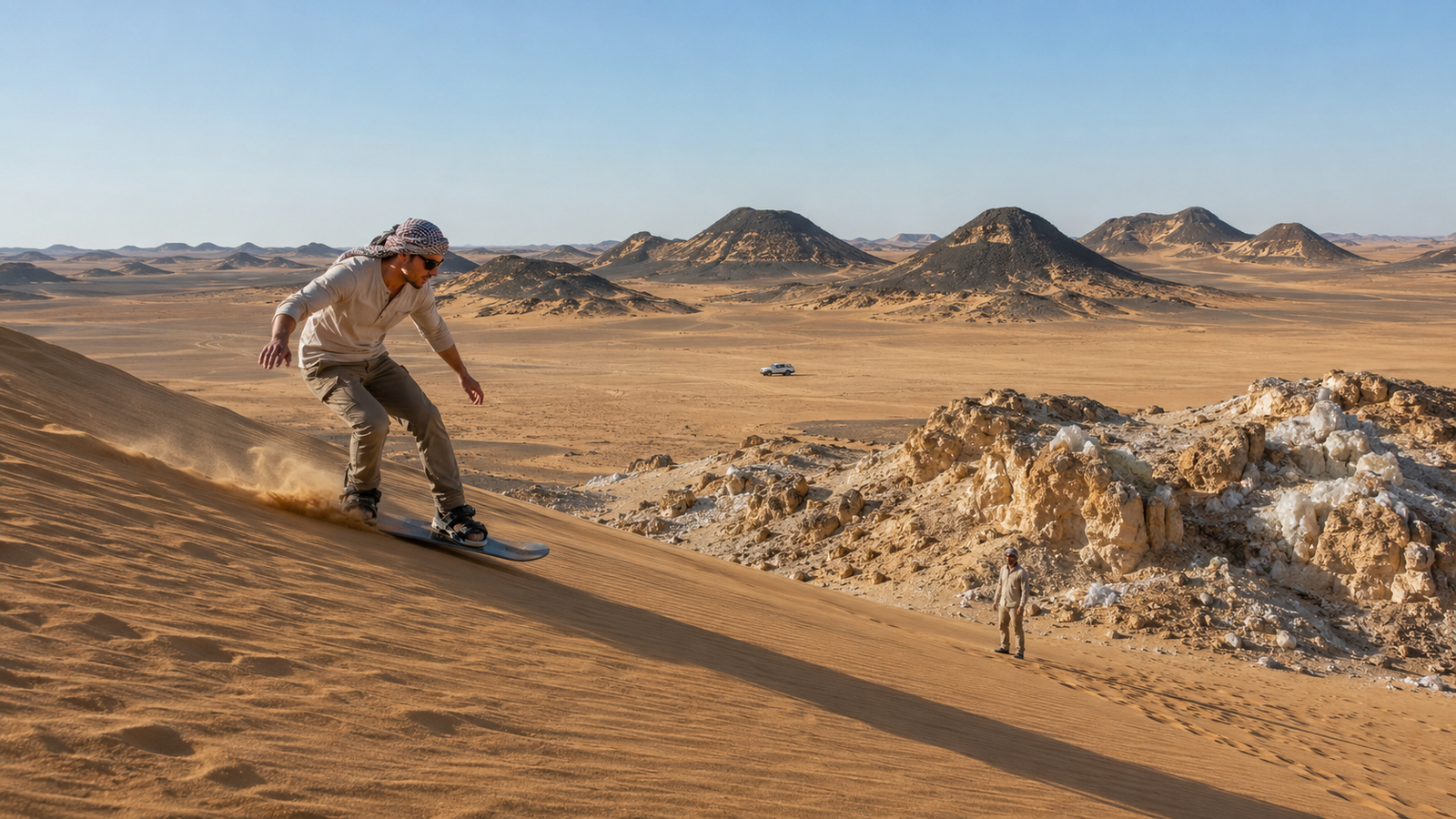
Sandboarding in the White Desert is one of the most searched activities, but the phrase needs geographic precision.
The White Desert’s signature attraction is its chalk landscape. Sandboarding should take place on a suitable dune selected by the local guide, often within the wider Western Desert route near Agabat or another approved sandy area. It should not damage chalk formations or protected features.
What Sandboarding Feels Like
The basic experience is similar to sledding or snowboarding on sand.
A beginner may:
- Sit on the board.
- Kneel.
- Stand with guidance.
- Start on a lower slope.
- Learn how to slow down and stop.
Sand produces more friction than snow. Speed depends on the dune, board, sand condition, slope and rider position.
Is Sandboarding Suitable for Beginners?
Many travelers can try it at an introductory level.
The guide should assess:
- The slope.
- Sand temperature.
- Wind.
- Visibility.
- The rider’s age.
- Balance.
- Joint or back problems.
- Footwear.
- The safe stopping area.
Standing rides require more balance and carry a greater fall risk than sitting.
Sandboarding Safety
Use:
- Closed footwear where practical.
- Sunglasses or protective eyewear.
- Sun protection.
- Gloves if the board design and sand temperature make them useful.
- A helmet when the operator’s risk assessment or activity standard requires one.
- A clear slope free of rocks, vehicles and other people.
Do not sandboard:
- During severe heat.
- In high wind or blowing sand.
- On a slope with rocks in the stopping zone.
- Near fragile formations.
- In a vehicle route.
- Without a guide checking the dune.
Children and Sandboarding
Children may be able to try a seated version on a gentle slope.
The operator should define:
- Minimum age.
- Adult supervision.
- Board type.
- Safe slope.
- Heat limits.
- Whether the activity is included under the child policy.
The child’s confidence and physical condition matter more than creating a dramatic photograph.
3. Visit Crystal Mountain Egypt
Crystal Mountain Egypt is a standard stop on many Western Desert routes.
Despite the name, it is better understood as a relatively small natural outcrop, ridge or arch containing visible mineral crystals rather than a high mountain requiring a major climb.
Official Egyptian tourism content describes it as a former underground cave pushed toward the surface, with an iconic arch and sparkling crystals visible in sunlight.
Other geological descriptions identify visible calcite and barite among the minerals associated with the formation. Online sources sometimes call every bright surface quartz, but that oversimplifies the geology; Crystal Mountain should not be reduced to a simple “quartz mountain” claim.
What Visitors Do at Crystal Mountain
A normal stop may include:
- Walking around the approved viewing area.
- Observing the arch and exposed crystals.
- Photographing reflections and textures.
- Listening to a geological explanation.
- Comparing the pale and dark landscapes around the site.
- Taking a short rest during the route.
Crystal Mountain is usually one stop in a larger itinerary rather than a full-day destination.
Can You Collect Crystals?
No responsible tour should encourage collecting crystals.
Visitors should not:
- Break rock.
- Remove loose mineral pieces.
- Scratch the formation.
- Climb fragile areas.
- Use crystals as props away from their original location.
Protected landscapes remain valuable only when each visitor leaves them intact.
Best Light for Crystal Mountain
Strong overhead light may create bright reflections but can flatten the shape in photographs.
Lower-angle light often improves:
- Texture.
- Shadow.
- Color contrast.
- Sparkle from selected surfaces.
- The appearance of the arch.
The itinerary should not promise a specific visual effect because cloud, dust and the route schedule can change the light.
4. Discover the Black Desert
The Black Desert creates one of the strongest visual contrasts in the Western Desert journey.
Its hills and ground are scattered or capped with dark stones. Basalt and other dark materials contribute to the black appearance seen across selected hills and slopes.
The landscape is not a single black sand field. Travelers encounter:
- Dark-topped hills.
- Brown and golden desert floor.
- Black stone fragments.
- Wide views across the oasis depression.
- Contrasting pale and dark geological zones.
Activities in the Black Desert
Depending on the approved stop, guests may:
- Take a short viewpoint walk.
- Climb a modest guide-selected hill.
- Photograph the dark slopes.
- Observe the transition between oasis vegetation and desert.
- Learn about the region’s geological history.
- Stop for tea, a meal or a scenic break.
Hiking Safety
A short viewpoint can still involve:
- Loose stones.
- Steep sections.
- Strong sunlight.
- Wind.
- No handrails.
- Uneven footing.
Travelers should wear stable footwear and turn back if the route exceeds their ability.
The best view is not worth a fall or heat illness.
5. Cross Agabat Valley
Agabat is one of the most cinematic sections of a White Desert circuit.
Its scenery can include:
- Soft golden sand.
- Large dunes.
- White cliffs.
- Isolated rock forms.
- Broad valley views.
- Strong contrasts at sunrise or sunset.
The official tourism portal highlights Agabat for its soft sand, dunes and distinctive white cliffs.
What to Do in Agabat
Activities may include:
- Scenic 4x4 travel.
- Sandboarding on a suitable dune.
- Short walks.
- Landscape photography.
- Sunset viewing.
- Tea or picnic stops.
- Geology interpretation.
The guide should choose the route based on current track conditions and permits.
Why Agabat Is Not an Uncontrolled Driving Playground
Dune driving requires experience.
A vehicle can:
- Become stuck.
- Overheat.
- Roll on a side slope.
- Damage sensitive terrain.
- Lose the route.
- Suffer tire or suspension problems.
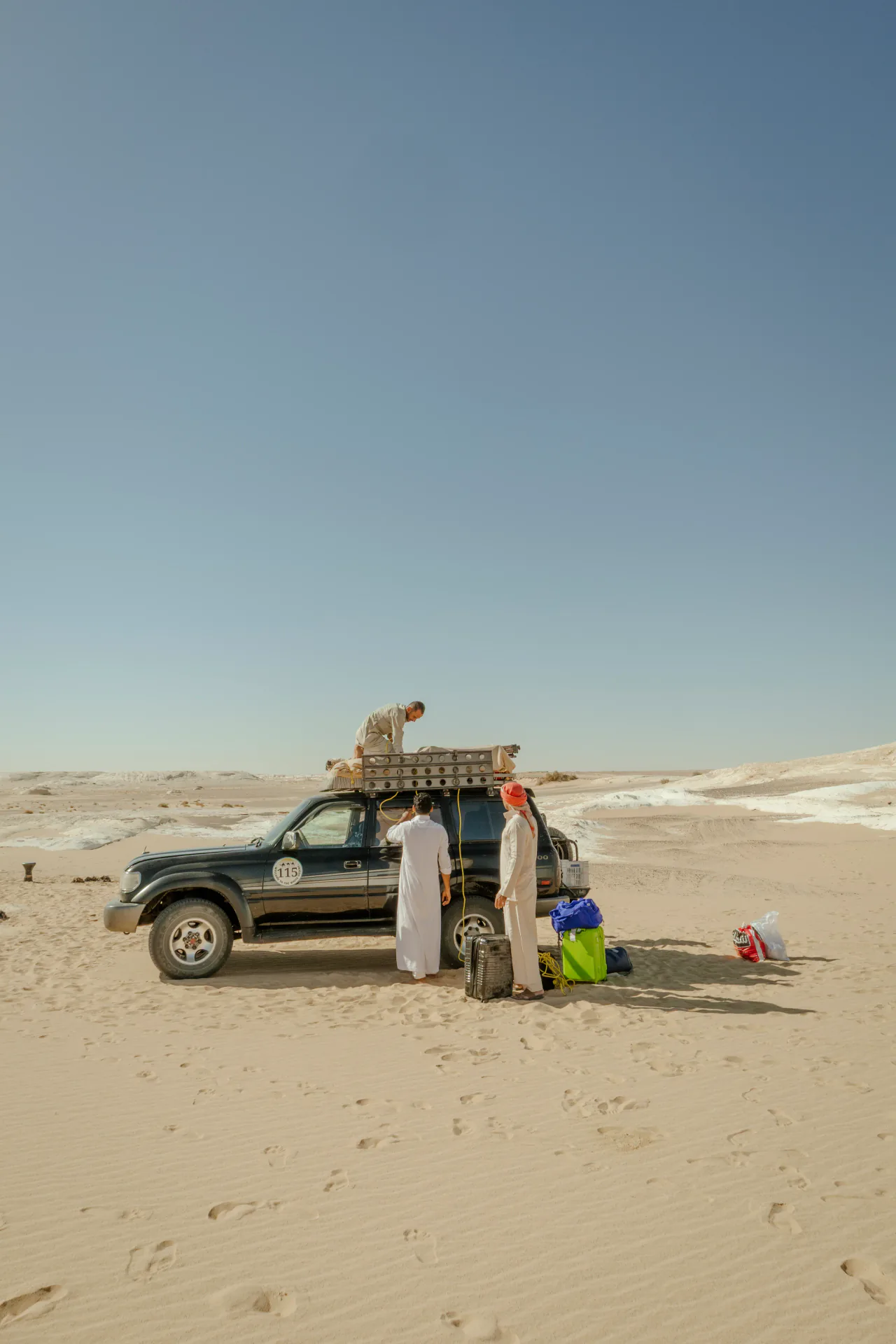
Passengers should use seat belts where fitted and follow the driver’s instructions. Standing through a roof opening while a vehicle moves creates unnecessary risk.
6. Experience a Guided 4x4 Desert Safari
A 4x4 is not merely an entertainment feature. It is a transport and safety tool.
Local vehicles connect stops where paved-road cars are unsuitable.
A professional 4x4 operation should address:
- Vehicle condition.
- Tires and spare tires.
- Recovery equipment.
- Fuel.
- Water.
- Driver experience.
- Communications.
- Guest seating.
- Luggage security.
- Backup support.
- Emergency route.
- Heat management.
What the Ride Is Like
Sections can be smooth, rough, sandy or rocky.
Guests may experience:
- Bouncing.
- Sudden changes in gradient.
- Tire-pressure adjustments.
- Stops to assess the track.
- Vehicle recovery.
- Dust.
- Long periods away from facilities.
Travelers with back, neck, hip or pregnancy-related concerns should discuss the route before booking.
A private or small-group vehicle can sometimes adjust pace more easily than a large convoy.
7. Camp Under the Desert Sky
Overnight camping is often the experience visitors remember most.
A normal camp may include:
- Tents.
- Mattresses.
- Sleeping bags or blankets.
- Dinner.
- Tea.
- A campfire where permitted.
- A quiet period for stargazing.
- Sunrise breakfast.
- Basic toilet arrangements.
Facilities vary dramatically.
A booking should state whether the camp is:
- A simple mobile desert camp.
- A fixed eco-camp.
- A private temporary camp.
- A climate-controlled event camp.
- Beside the vehicle route.
- Close to or separate from the viewing field.
Standard Winter Camping vs August 2027
A conventional winter desert camp is not automatically suitable for August.
The eclipse program requires specialist infrastructure such as:
- Climate-controlled sleeping or recovery spaces.
- Powerful shade.
- Cold water.
- Refrigeration.
- Reliable electricity.
- Backup power.
- Toilets matched to capacity.
- Medical support.
- Heat-illness procedures.
- Fire safety.
- Vehicle backup.
- A defined evacuation route.
The air-conditioned eclipse camp guide explains the difference.
Campfire Responsibility
A fire should only be used where legal and safe.
The team should control:
- Fuel source.
- Wind conditions.
- Distance from tents and vehicles.
- Extinguishing equipment.
- Ash and waste.
- Guest movement.
Collecting living wood or damaging vegetation is unacceptable.
8. Stargaze in the Western Desert
The Western Desert can provide strong night-sky conditions because many camp locations are far from major urban lighting.
Visitors may observe:
- The Milky Way during suitable seasons and lunar phases.
- Bright planets.
- Constellations.
- Satellites.
- Meteors.
- The changing Moon.
- The dark shape of desert formations against the sky.
No operator can guarantee a specific celestial object without considering the date, time, Moon phase, weather and horizon.
Better Stargazing Etiquette
At camp:
- Reduce white lights.
- Use a dim red light when possible.
- Allow eyes time to adapt.
- Keep phone screens low.
- Avoid shining lights toward other guests.
- Do not walk through tripod areas.
- Keep children close in darkness.
- Mark tent and toilet routes safely.
For August 2027, stargazing is an added benefit. Ordinary nighttime light pollution does not determine the quality of the midday eclipse in the same way.
9. Photograph Sunrise, Sunset and the Desert Landscape
The landscape changes dramatically with the angle of light.
Sunrise
Sunrise can provide:
- Cooler air.
- Soft light.
- Long shadows.
- Quiet camp scenes.
- Textured dunes.
- Strong contrast on white formations.
Sunset
Sunset can provide:
- Warm color on cliffs and dunes.
- Silhouettes.
- Layered horizons.
- Better conditions for portraits.
- A transition into blue-hour and night photography.
Midday
Midday is useful for:
- High-contrast documentation.
- Crystal reflections.
- Route photography.
- Eclipse observing.
It is usually less comfortable for walking and can flatten the landscape.
Photography Rules
Photographers should:
- Avoid climbing formations for a higher angle.
- Keep drones grounded unless permission is confirmed.
- Ask before photographing local residents.
- Protect equipment from sand.
- Use sealed bags during dusty sections.
- Keep batteries away from extreme heat.
- Secure tripods against wind.
- Label composites honestly.
The White Desert gallery can help travelers understand the route and landscape style before booking.
10. Visit Springs and Oasis Farms
A White Desert journey often includes time in or near Bahariya.
Possible experiences include:
- Palm groves.
- Olive farms.
- Village roads.
- Local food.
- Cold or warm springs.
- Short cycling routes.
- Scenic viewpoints.
- Archaeological stops.
Not every spring is suitable for bathing.
Before entering water, ask about:
- Temperature.
- Depth.
- Cleanliness.
- Access.
- Changing facilities.
- Local customs.
- Medical restrictions.
- Whether bathing is currently permitted.
A spring should not be marketed as medical treatment without appropriate evidence.
11. Cycle or Walk Around Bahariya Oasis
Official tourism content highlights cycling through Bahariya’s villages, springs, palm groves, orchards and historical areas.
This can add a human and agricultural dimension to a trip dominated by desert scenery.
Best Conditions
Cycle or walk:
- Early in the morning.
- Late in the afternoon.
- On a confirmed route.
- With water.
- With local guidance.
- Away from heavy traffic.
- At a pace suitable for the group.
In August, a long midday ride should not be added merely to fill an itinerary.
Read the complete Bahariya Oasis guide for cultural and historical planning.
12. Wildlife and Tracking
Travelers may see signs of desert wildlife, birds or small animals.
Wildlife observation should remain opportunistic.
Do not:
- Feed wild animals.
- Chase them for photographs.
- Approach dens.
- Leave food waste.
- Promise fox sightings.
- Handle snakes, scorpions or insects.
Footwear should be checked before putting it on, and tents should be closed according to the camp instructions.
Which Activities Belong in Each Package?
The exact commercial program should match the time available.
| Package length | Realistic activity focus |
|---|---|
| 2 days | Bahariya arrival, selected Black Desert and Crystal Mountain stops, camp orientation, eclipse viewing and a focused desert experience. |
| 3 days | Add a fuller White Desert or Agabat route, sandboarding when safe, sunset or sunrise photography and more recovery time. |
| 4 days | Add broader Bahariya and White Desert experiences, flexible photography, rest periods and stronger contingency space around eclipse day. |
The final package schedule may differ according to permits, camp design, guest arrival time and the position of the verified eclipse field.
How Activities Should Be Scheduled Around Eclipse Day
Eclipse day is not the right time to maximize every excursion.
The main priorities are:
- Guest health.
- Timely arrival at the viewing field.
- Equipment setup.
- Eye-safety briefing.
- Shade and hydration.
- A calm totality experience.
- Safe departure.
A strong schedule may use:
Day Before the Eclipse
- Bahariya sightseeing.
- A short Black Desert stop.
- Camp orientation.
- Photography rehearsal.
- Early dinner and rest.
Eclipse Morning
- Breakfast.
- Hydration.
- Equipment check.
- Limited low-effort activity only.
- Movement to the viewing field well before first contact.
During the Partial Phases
- Filtered observing.
- Shade.
- Rest.
- Educational announcements.
- Controlled photography.
After the Eclipse
- Lunch.
- Cooling and rest.
- Staged departure.
- No rushed long transfer unless operationally necessary.
Following Day
- White Desert excursion.
- Crystal Mountain.
- Agabat.
- Sandboarding in a cooler period.
- Oasis extension.
This structure protects the event rather than treating totality as one stop among many.
Best Time of Year for White Desert Activities
For conventional travel, the milder months from roughly October to April are generally more comfortable.
Autumn and Spring
Advantages:
- Moderate conditions.
- Good activity range.
- Cooler evenings than summer.
- Comfortable photography.
Winter
Advantages:
- Cooler days.
- Strong camping season.
- Better conditions for walking and sandboarding.
Challenges:
- Cold nights.
- Wind.
- Need for warm sleeping equipment.
Summer
Challenges:
- Severe midday heat.
- Hot sand and vehicle surfaces.
- Greater dehydration risk.
- Reduced safe activity window.
- Higher cooling and water requirements.
August 2027 is exceptional because the total solar eclipse creates a rare reason to operate under specialist conditions.
Read the best time to visit the White Desert and the White Desert summer safety warning before selecting activities.
White Desert Activities for Families
Families may enjoy:
- Short formation walks.
- Seated sandboarding on a gentle dune.
- Camp meals.
- Stargazing.
- Sunrise.
- Easy oasis visits.
- Age-appropriate geology stories.
The operator should define:
- Minimum ages.
- Child seats.
- Supervision.
- Heat limits.
- Camp toilet arrangements.
- Sleeping setup.
- Food.
- Emergency care.
- The child policy.
Children should never be allowed to wander around camp or formations alone.
Activities for Older Travelers and Limited Mobility
A good desert program can be adapted.
Possible adjustments include:
- Shorter walks.
- Vehicle-accessible viewpoints.
- Private vehicle.
- Stable seating.
- Lower dune activity.
- Avoiding hill climbs.
- Climate-controlled rest areas.
- Accessible toilet planning.
- Extra boarding time.
- A hotel-based night instead of simple camping.
The guest should disclose mobility, cardiac, respiratory and heat-sensitivity concerns before booking.
What to Wear and Carry
For daytime activities:
- Lightweight breathable clothing.
- Long sleeves.
- Wide-brimmed hat.
- UV-protective sunglasses.
- Comfortable closed shoes.
- Sunscreen.
- Personal medication.
- Refillable bottle.
- Small day bag.
- Dust protection.
For conventional cool-season nights:
- Warm layers.
- Socks.
- Light gloves where needed.
- Warm sleeping gear.
For August:
- Cooling strategy.
- Extra hydration.
- Electrolytes when appropriate.
- Heat-safe medication storage.
- Minimal exposure during midday.
- No unnecessary heavy backpack.
Why a Local Team Matters
A local team does more than drive.
It coordinates:
- Permits.
- Route choice.
- Drivers.
- Fuel.
- Water.
- Meals.
- Camp.
- Activity equipment.
- Heat response.
- Vehicle recovery.
- Cultural communication.
- Protected-area behavior.
- The transition between the oasis, desert route and eclipse field.
A generic Cairo itinerary can describe the attractions. A Bahariya-based team understands how the route works on the ground.
Questions to Ask Before Booking Activities
- Which exact activities are included?
- Which are optional?
- Where does sandboarding take place?
- Is the dune checked for rocks and vehicle traffic?
- Is equipment supplied?
- Is there an age limit?
- Is Crystal Mountain a walking stop or a climbing activity?
- What conservation rules apply?
- Is Black Desert hiking included?
- How difficult is the route?
- How long are the 4x4 sections?
- Are seat belts available?
- Where is the permitted camp?
- What toilets are provided?
- Is drinking water unlimited?
- What happens in high wind?
- Which activities are canceled during severe heat?
- Is there a medical professional or trained responder?
- What is the vehicle-backup plan?
- Are permits included?
- Is the eclipse field separate from the White Desert route?
- How far is the camp from the viewing field?
- Which activities happen before and after eclipse day?
- Are photography tripods accommodated?
- What are the cancellation and site-change terms?
Review the booking and cancellation policy before paying.
Common Mistakes
Treating the White Desert as One Activity Park
The attractions are spread across a route.
Sandboarding Anywhere
Only suitable dunes should be used.
Climbing Fragile Formations
The best photograph is not worth permanent damage.
Collecting Crystals
Leave Crystal Mountain intact.
Scheduling Every Activity at Midday
Heat should control the itinerary, especially in summer.
Expecting Luxury Facilities at a Simple Camp
Camp types differ greatly.
Assuming a 4x4 Removes All Risk
Vehicle condition, driver experience and backup still matter.
Promising Wildlife
Sightings are never guaranteed.
Driving Independently into Remote Areas
Permits, route knowledge and support are essential.
Using the Excursion Site as the Eclipse Field
The viewing coordinate must be verified separately.
Frequently Asked Questions
What are the best White Desert activities?
The main experiences are formation walks, sandboarding on suitable dunes, Crystal Mountain, the Black Desert, Agabat, 4x4 travel, camping, stargazing, sunrise, sunset and Bahariya oasis activities.
Is sandboarding included in every tour?
No. Confirm whether it is included, where it takes place and whether conditions are suitable.
Can beginners sandboard?
Many beginners can try a seated or gentle-slope version with supervision.
Can children sandboard?
Potentially, depending on age, slope, heat and the operator’s policy.
Is Crystal Mountain a large mountain?
No. It is better understood as a relatively small mineral-rich outcrop or ridge with an arch.
Can I take crystals home?
No responsible visitor should remove crystals or rock.
Why is the Black Desert black?
Dark stones and basalt-related material on selected hills and surfaces create its distinctive appearance.
Can I climb a Black Desert hill?
Some itineraries include a short guide-selected viewpoint, subject to ability and conditions.
Do I need a 4x4?
Most deeper desert routes require suitable locally operated 4x4 vehicles.
Can I camp overnight?
Yes, at a permitted location through an organized operation.
Are there toilets?
Facilities depend on the camp type. Ask for written details.
Is stargazing guaranteed?
Dark conditions can be excellent, but weather, Moon phase and camp lighting affect what is visible.
How many days do I need?
Two days is focused. Three or four days allow more activities, rest and flexibility.
Is summer suitable for these activities?
Conventional summer activity is demanding. August 2027 requires specialist cooling, water, timing and medical planning.
Will sandboarding happen on eclipse day?
It should only occur if the schedule, heat and guest condition make it safe. The eclipse itself remains the priority.
Is the eclipse viewed inside the famous White Desert formations?
Not automatically. The final viewing field should be separately verified inside totality.
Can older travelers join?
Yes when the itinerary, vehicle, walking, cooling and camp facilities suit their needs.
Do I need a permit and guide?
Current official tourism guidance says travelers should check permits and regulations with an authorized guide or travel agency.
Can I explore independently?
Unsupported travel is not recommended for remote protected routes.
How do I book?
Compare the 2027 eclipse packages or check availability.
Final Takeaway
The best White Desert adventure is not the longest activity checklist.
It is a carefully timed route through different landscapes.
A strong program can combine:
- White chalk formations.
- Sandboarding on a suitable dune.
- Crystal Mountain.
- The Black Desert.
- Agabat.
- 4x4 travel.
- Camping.
- Stargazing.
- Sunrise and sunset.
- Bahariya’s farms, villages and springs.
Each activity should match the location, weather, guest ability and conservation rules.
For August 2027, activities must be scheduled around the eclipse rather than competing with it. Sandboarding, long walks and hill climbs belong in cooler periods. Eclipse day should prioritize rest, shade, hydration, safe filtered viewing and calm access to the verified totality field.
The strongest commercial route is a confirmed Western Desert eclipse-camp region between the White Desert and the Black Desert, inside the path of totality at a separately verified totality field, combined with White Desert experiences before or after the event.
Explore the White Desert eclipse camp, compare the 2027 eclipse packages, or check availability.
Authoritative planning reference
Use NASA 2027 eclipse path data as a primary reference, then verify local circumstances for the exact location.