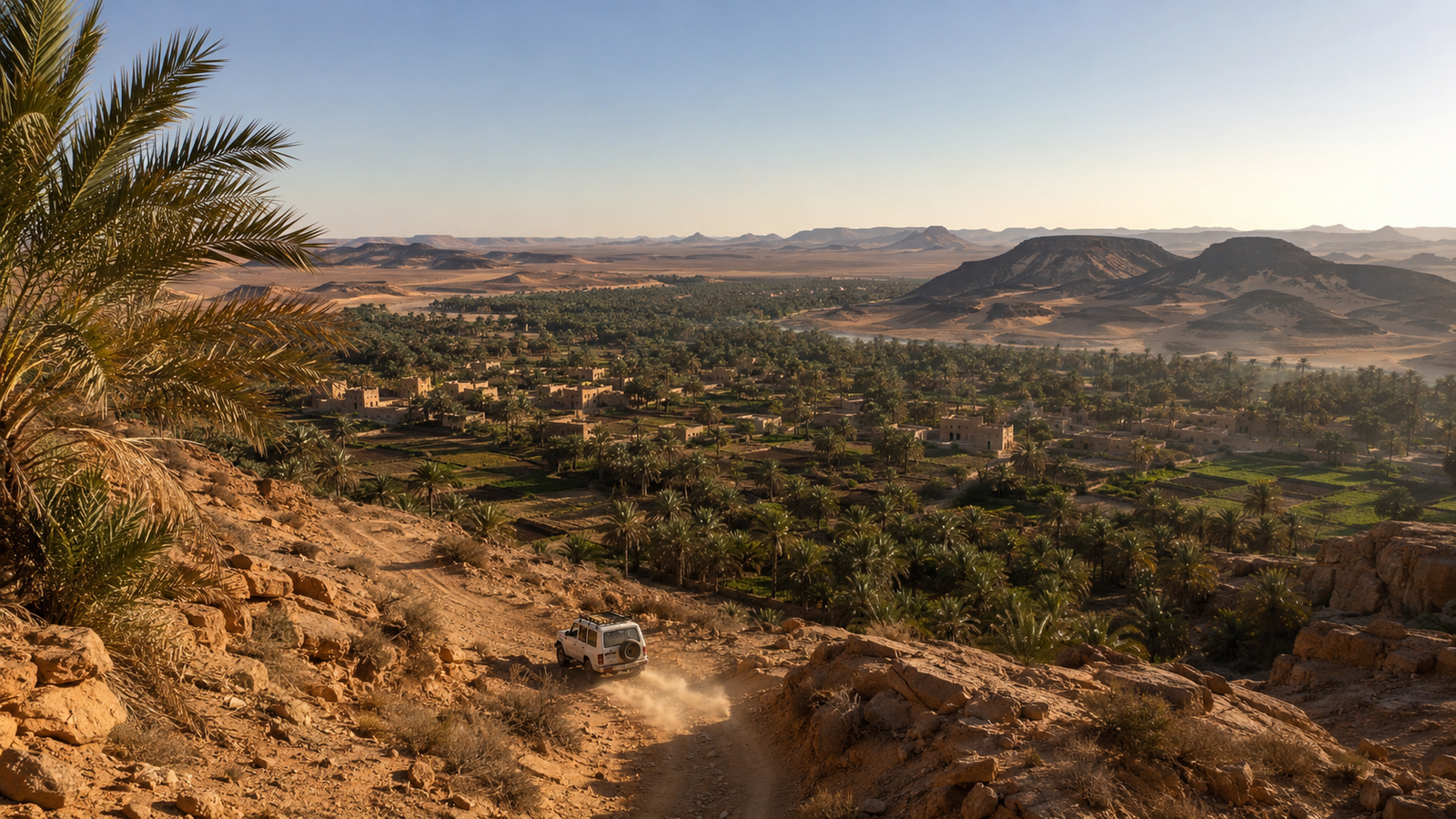
Bahariya Oasis is one of the best places in Egypt to watch the total solar eclipse of 2 August 2027. The oasis lies only about 20 kilometres from the centre line of the eclipse path. Totality in Bawiti, the main town, begins at about 12:50 local time (EEST, UTC+3) and lasts about 6 minutes 20 seconds, just a few seconds less than the maximum anywhere on Earth. The Sun will be almost overhead, and historical August cloud cover is close to zero.
This guide gives you the exact timings, a minute-by-minute plan, the best viewing areas around Bahariya, how it compares with Luxor and Siwa, and how to handle the August heat.
Bahariya Oasis eclipse 2027: key facts
| Item | Bawiti, Bahariya Oasis |
|---|---|
| Date | Monday, 2 August 2027 |
| Type | Total solar eclipse |
| Partial phase begins | About 11:29 EEST |
| Totality begins | About 12:50 EEST |
| Maximum eclipse | About 12:53 EEST |
| Totality ends | About 12:56 EEST |
| Partial phase ends | About 14:15 EEST |
| Duration of totality | About 6 min 19–21 s (published figures); about 6 min 18 s by our NASA-based estimate |
| Sun altitude at totality | About 77–79° |
| Historical August cloud cover | About 0% (Space.com, citing historical data) |
| Distance from centre line | About 19 km north |
| Distance from Cairo | About 370 km by road |
Is Bahariya Oasis in the path of totality?
Yes, and very centrally. NASA's path table shows the centre line crossing the Bahariya region at around 09:50–09:52 UT, when the path is about 256 kilometres wide. Bawiti lies about 19 kilometres north of that centre line, so it is more than 100 kilometres from either edge. Small changes in where you stand around the oasis make only a second or two of difference.
That central position is the main reason Bahariya is so attractive. It offers almost the same totality as Luxor, without the city crowds.
What time is the eclipse in Bahariya?
The full eclipse lasts about 2 hours 46 minutes. Here is a practical timeline for eclipse day.
| Local time (EEST) | What happens | What you do |
|---|---|---|
| 08:00–10:00 | Normal hot morning | Travel to your viewing site, set up shade and equipment, drink water |
| About 11:29 | First contact: the partial eclipse begins | Eclipse glasses on; start photos with solar filters |
| About 12:20–12:45 | Light dims and turns metallic; temperature starts to fall | Watch shadows sharpen; check cameras; rest in the shade |
| About 12:49 | Shadow bands may appear; the dark shadow approaches from the west | Final checks; look west |
| About 12:50 | Diamond ring and Baily's beads; totality begins | Glasses off only now |
| 12:50–12:56 | Totality: corona, dark sky, horizon glow, planets | Look, photograph, enjoy |
| About 12:56 | Third contact: diamond ring on the other side | Glasses back on immediately |
| About 14:15 | Last contact: eclipse over | Pack up, rest, rehydrate |
Exact times change by a few seconds depending on your exact GPS point. For all Egyptian cities, see 2027 eclipse times in Egypt by city.
How long is totality in Bahariya?
Published figures give Bawiti about 6 minutes 19–21 seconds of totality. Our own estimate from NASA's path table, for the town centre, is about 6 minutes 18 seconds. Whichever figure you use, Bahariya gets well over six minutes, and only a few seconds less than the maximum of 6 minutes 23.2 seconds listed by NASA.
For comparison:
| Location | Approx. totality | Notes |
|---|---|---|
| Point of greatest duration (New Valley/Asyut area) | 6 min 23 s | NASA maximum |
| Luxor | 6 min 22 s | Major city, very crowded |
| Black Desert, south of Bahariya | About 6 min 20 s | Open desert, near centre line |
| Bawiti, Bahariya Oasis | About 6 min 18–21 s | Oasis town with hotels |
| Asyut | 6 min 07 s | Nile Valley city |
| Siwa Oasis | 5 min 33 s | Remote oasis further west |
| White Desert formations | About 2 min or less | Near the southern edge |
| Cairo | Partial only (about 95%) | Outside the path |
Bahariya, Black Desert and White Desert estimates are ours; Luxor, Asyut, Siwa and Cairo figures are from Wikipedia's eclipse tables.
Where to watch the eclipse around Bahariya
In or near Bawiti
Watching from town is the easiest option. You have hotels, shade and services close by. The drawbacks are palm groves, buildings and some light and traffic around the viewing time. Look for an open rooftop or a clear area at the edge of town.
The desert just outside the oasis
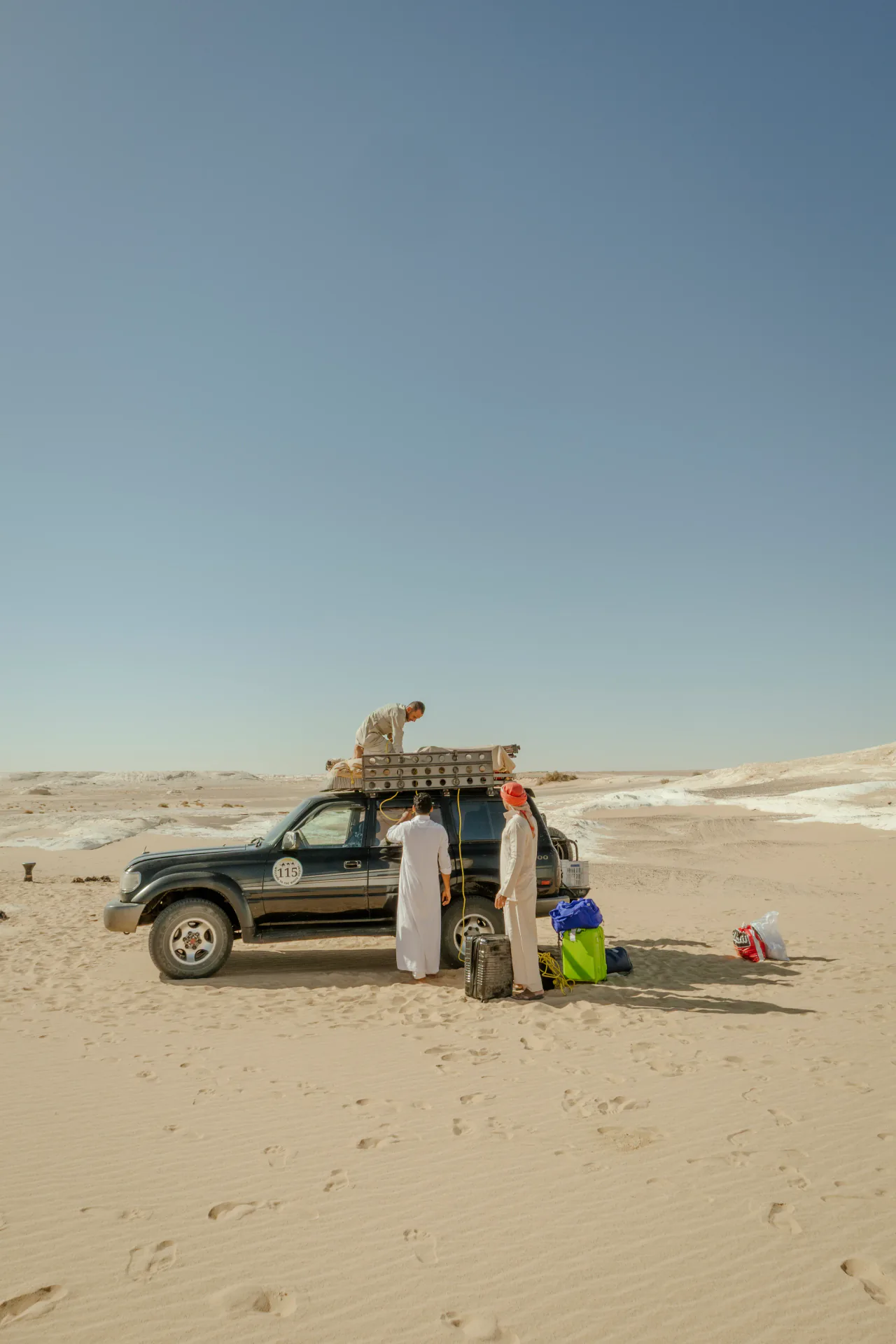
A short drive takes you to open desert with a clear horizon in every direction. This is where you see the full 360-degree sunset glow during totality, one of the most memorable parts of the eclipse.
The Black Desert
About 40–60 minutes south of Bawiti, the Black Desert lies even closer to the centre line. It combines long totality with dramatic dark hills. See our Black Desert solar eclipse 2027 guide.
Between the Black Desert and the White Desert
Further south, totality gets shorter as you approach the edge of the path. The zone between the Black Desert and Crystal Mountain still gets long totality, but the famous White Desert formations do not. Read Black Desert vs White Desert for the 2027 eclipse before choosing a site there.
Bahariya vs Luxor vs Siwa
| Factor | Bahariya | Luxor | Siwa |
|---|---|---|---|
| Totality | About 6:18–6:21 | 6:22 | 5:33 |
| Distance from Cairo | About 370 km | About 650 km (flight or train) | About 750 km |
| Crowds | Moderate in town, low in the desert | Very high | Moderate |
| Horizon | Open desert nearby | Urban and river valley | Open desert and lakes |
| Accommodation | Limited, books early | Large supply, high demand | Limited |
| Combine with | Black and White Desert safari | Temples, Nile cruise | Oasis culture, lakes |
Read more in Western Desert vs Nile Valley for the 2027 eclipse and Siwa Oasis and the 2027 eclipse.
Bahariya Oasis weather on eclipse day
Early August is one of the driest and sunniest times of year in the Western Desert. Space.com lists Bahariya's historical August cloud cover as 0%. Clouds are therefore unlikely. The real weather factors are:
- Heat: midday temperatures often reach the high 30s or low 40s Celsius.
- Dust and haze: wind can lift fine sand, which can reduce contrast. It rarely blocks the Sun completely.
- Strong sunlight: the Sun is almost overhead, so shade is scarce unless you bring it.
Plan for shade, cooling, at least 4–5 litres of water per person and a place to rest. See Egypt weather on 2 August 2027 and our desert heat safety guide.
How to get to Bahariya Oasis for the eclipse
Bahariya is about 370 kilometres south-west of Cairo. The road trip usually takes 4.5–5 hours including stops and police checkpoints. There are no scheduled flights to the oasis. Most visitors travel by private car, minibus or with an organised tour.
For the eclipse, arrive at least one day early. Traffic on the Cairo–Bahariya road will be heavier than usual on 1 August, and you do not want to be on the road at midday on 2 August. Read our Cairo to Bahariya Oasis journey guide.
Where to stay in Bahariya for the eclipse
Bahariya has a limited number of hotels, eco-lodges and camps. Demand for the eclipse night is expected to be far higher than usual, so book early. Options include:
- Hotels in or near Bawiti: rooms, air conditioning and showers.
- Eco-lodges: traditional style, often with hot springs nearby.
- Desert camps: close to the viewing site, but standard tents are very hot in August unless they are cooled.
Compare the options in where to stay for the 2027 eclipse and our Bahariya Oasis guide.
Things to do in Bahariya before and after the eclipse
- English Mountain for panoramic views over the palm groves.
- The El Dist and El Maghrafa hills, two striking pyramid-shaped hills.
- Hot and cold springs, including natural sulfur springs.
- The Black Desert, Crystal Mountain and Agabat Valley on a 4x4 safari.
- The White Desert at sunset.
- Dark-sky stargazing: the eclipse happens at new moon, so the nights around it are moonless.
For more ideas, see White Desert adventures and activities.
What you will see and feel in Bahariya during totality
A total eclipse is more than the black disc in the sky. In Bahariya, with the Sun nearly overhead and open desert all around, expect these effects:
- Fading light: from about 30 minutes before totality, the light becomes strange and silvery. Colours look flat and shadows become unusually sharp.
- Cooling air: the temperature can drop by several degrees Celsius in the last minutes before and during totality, a welcome break in the August heat.
- Tiny crescents: under palm trees, the gaps between leaves project dozens of small crescent Suns onto the ground.
- The approaching shadow: on a clear, open horizon you may see the dark shadow of the Moon sweeping in from the west.
- Shadow bands: faint, rippling lines of light and dark may move across light-coloured sand just before and after totality.
- The corona: the Sun's pearly outer atmosphere, with long streamers, visible only during totality.
- A 360-degree sunset: the horizon glows orange and pink in every direction, because those areas are outside the shadow.
- Stars and planets: bright stars and planets appear in the midday sky.
- Reactions: birds and animals often go quiet, and people around you usually cheer.
Town, rooftop or desert: which is best?
| Option | Pros | Cons | Best for |
|---|---|---|---|
| Hotel rooftop in Bawiti | Easy, close to air conditioning and toilets | Buildings and palms block part of the horizon; more people | Families, older travellers, limited mobility |
| Open ground at the edge of town | Better horizon; short drive | Little shade unless you bring it | Independent travellers with a car |
| Organised desert site | Full horizon, quiet, dark-sky night | Needs permits, 4x4 and a heat plan | Photographers, first-timers wanting the full experience |
A good compromise is an organised desert site with proper shade, cooling and toilets. You get the open horizon without exposing yourself to the full midday heat for hours.
Eclipse day checklist for Bahariya
- Eclipse glasses checked for scratches and holes, one pair per person plus a spare
- Solar filters fitted to cameras, binoculars and telescopes
- Water: at least 4–5 litres per person, plus electrolytes
- Hat, long sleeves, sunscreen and sunglasses for outside the eclipse
- Reclining chair or mat for looking almost straight up
- Fully charged phone and power bank
- Passport with you, in case of checkpoints
- A watch or app with countdown alarms for second and third contact
- Snacks and a light lunch for after the eclipse
- Calm: decide in advance what you want to do during the six minutes
Traffic and timing on eclipse day
Expect many more visitors than usual in Bahariya around 1–2 August 2027. The road from Cairo will be busier, and local roads near popular viewing areas may slow down. Practical tips:
- Arrive in Bahariya by 31 July or 1 August.
- Be at your viewing site by 10:00 on 2 August, well before first contact at about 11:29.
- Do not plan to drive during totality. Even a short drive can mean missing the most important minutes.
- After the eclipse, wait out the hottest hours before driving back to Cairo.
A little Bahariya history
Bahariya has been inhabited since ancient times. The oasis is famous for the Valley of the Golden Mummies, a large Greco-Roman cemetery discovered in the 1990s near Bawiti, and for ancient tombs and temples that show its importance as a trading and farming centre. Hot and cold springs have supported date palms, olives and crops for thousands of years.
On 2 August 2027 the oasis will add a new chapter: the longest total solar eclipse on easily accessible land this century, seen from almost the centre of its path.
Photographing the eclipse in Bahariya
- Use a solar filter on any lens or telescope during the partial phases.
- Remove the filter only at the diamond ring and replace it as soon as totality ends.
- Bracket exposures during totality to capture both the inner and outer corona.
- Use a very wide lens to include palms, dunes or hills with the high eclipsed Sun.
- Keep cameras shaded between shots; heat can cause overheating warnings.
- Rehearse your sequence the day before, so you do not miss the view while fiddling with settings.
Full settings are in our eclipse photography guide.
Bahariya eclipse with a local team
Solar Eclipse Tours is run by Elzaghandi Group, based in Bawiti. We have hosted travellers in Bahariya and the Western Desert for seven years. Our eclipse programmes include organised transport from Cairo, 4x4 desert transfers and a fully air-conditioned eclipse camp limited to 40 guests, set inside the path of totality between the Black Desert and the White Desert, with toilets, electricity, charging points and Wi-Fi.
- 2-day eclipse tour: a short, focused trip from Cairo.
- 3-day eclipse tour: adds a Bahariya hotel night and more desert time.
- 4-day Bahariya Oasis and White Desert tour: the most complete option, with two hotel nights.
Frequently asked questions
Is Bahariya Oasis in the path of totality for 2027?
Yes. Bahariya lies about 19 kilometres from the centre line of the 2 August 2027 eclipse, deep inside the path of totality.
What time is the solar eclipse in Bahariya Oasis?
The partial eclipse starts at about 11:29, totality begins at about 12:50 and ends at about 12:56, and the eclipse ends at about 14:15 local time (EEST, UTC+3).
How long will totality last in Bahariya?
About 6 minutes 20 seconds. Published figures for Bawiti are 6 minutes 19–21 seconds.
Is Bahariya better than Luxor for the eclipse?
Totality is almost the same. Bahariya offers open desert, fewer people and a safari. Luxor offers temples and a large city, but very heavy crowds and higher prices.
Will it be cloudy in Bahariya on 2 August?
Very unlikely. August cloud cover in Bahariya is historically close to zero. Heat and occasional dust are bigger concerns.
How hot will Bahariya be during the eclipse?
Expect high 30s to low 40s Celsius around midday. The temperature drops for a short time during totality, then rises again.
Can I drive from Cairo to Bahariya on eclipse morning?
It is possible, but risky. The drive takes 4.5–5 hours, and any delay could cost you totality. Arrive the day before.
Do I need a permit to watch from the desert near Bahariya?
Desert areas outside town require the right permits and are best visited with a licensed local operator. Carry your original passport.
Is Bahariya part of the White Desert?
No. Bahariya is a separate oasis about 100–150 kilometres north of the White Desert National Park. The Black Desert lies between them.
Is the Black Desert better than Bawiti for the eclipse?
Both are close to the centre line, so totality is almost the same. The Black Desert offers an open horizon and darker skies; Bawiti offers hotels and services nearby.
Sources and method
Path width, path limits and central durations come from NASA's path table for the total solar eclipse of 2 August 2027 (F. Espenak). Bawiti start of totality, published duration and historical cloud cover are from Space.com, which credits timeanddate.com. Luxor, Asyut, Siwa and Cairo values are from Wikipedia's eclipse article. Our own duration estimates are interpolated from NASA's path table and should be checked against an exact GPS point.