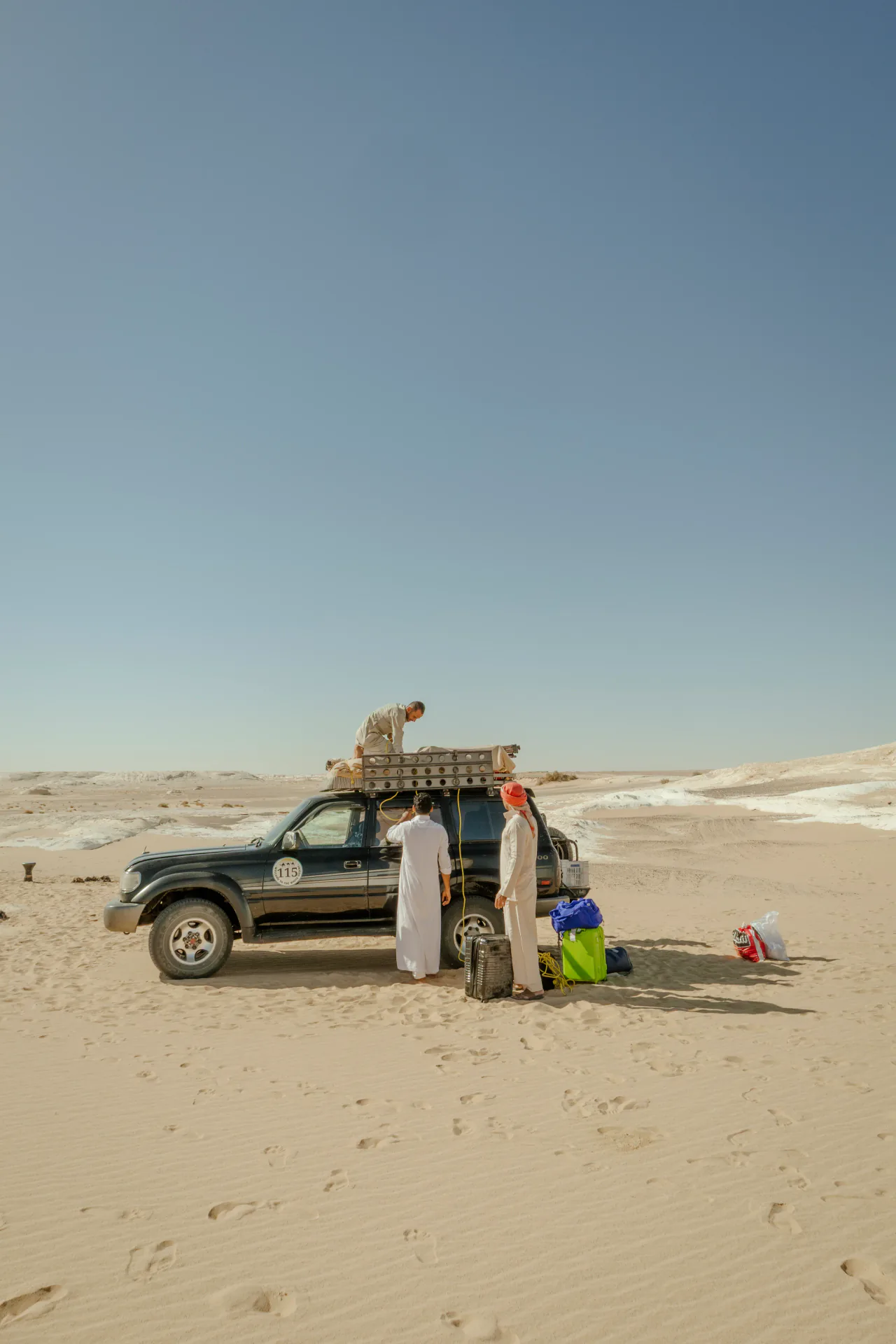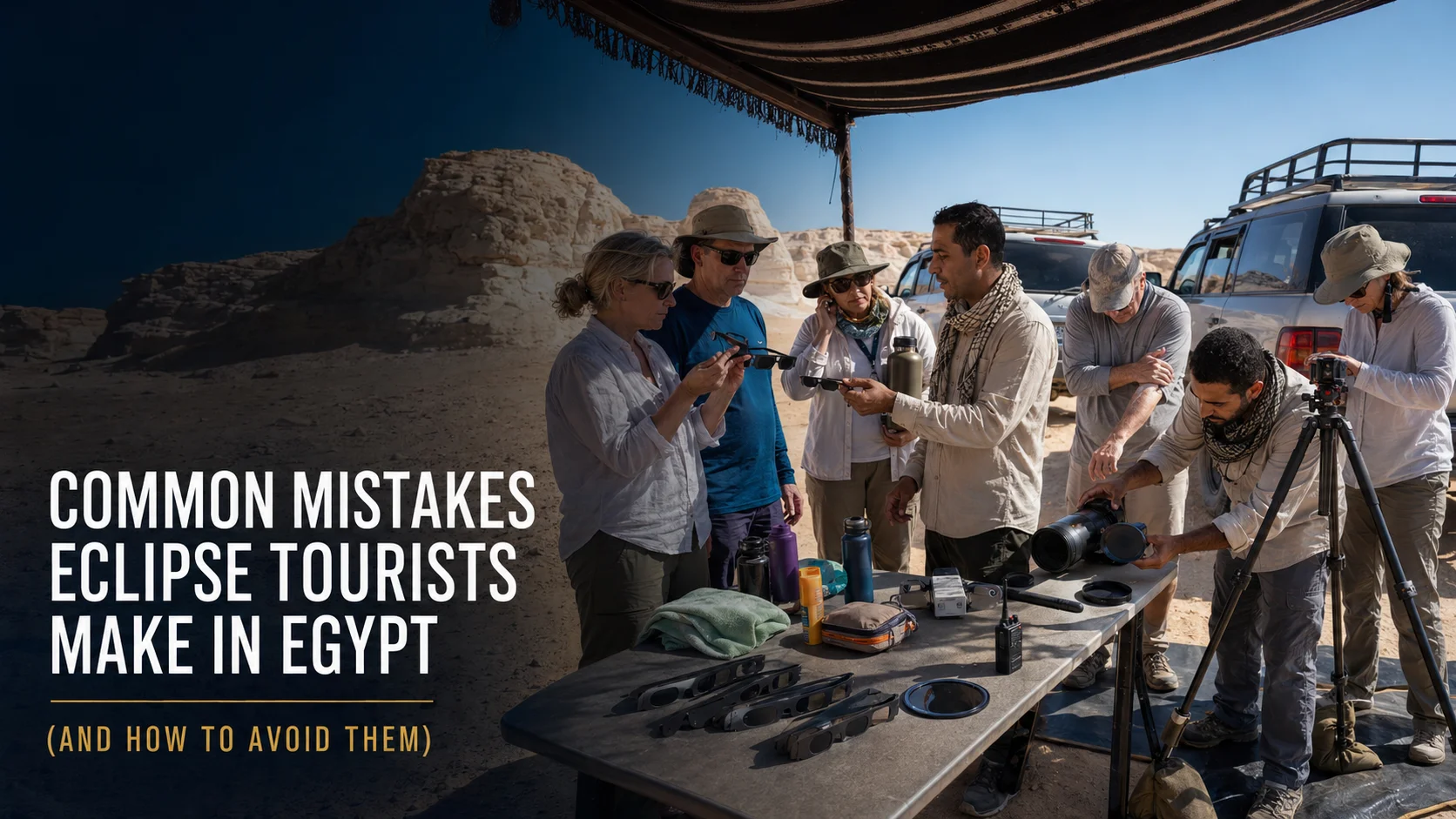
The most expensive eclipse tourist mistakes are rarely dramatic. They usually begin with one small assumption: choosing a hotel because the destination name sounds right, buying eclipse glasses from an unknown seller, treating August desert heat like a normal sightseeing day, or planning to leave Cairo on eclipse morning and “figure it out on the way.”
For the August 2, 2027 total solar eclipse in Egypt, those assumptions matter because totality is geographically precise, the event happens at a fixed time, the strongest Egyptian locations are hot in August, and some of the best viewing environments are far from normal city infrastructure.
This guide collects the most common planning errors a first-time eclipse traveler can make in Egypt — and explains how to avoid them before they become expensive, unsafe or impossible to fix.
Quick Checklist: Common Eclipse Mistakes and the Better Choice
| Mistake | Better approach |
|---|---|
| Booking by destination name only | Verify the exact viewing coordinates inside totality. |
| Assuming every White Desert landmark is total | Use a separately verified totality field and treat the White Desert as part of the wider trip. |
| Chasing maximum seconds at any cost | Balance duration with cloud climatology, access, safety, crowd control and facilities. |
| Treating August like winter safari season | Build the day around shade, cooling, water and reduced exposure. |
| Buying random eclipse glasses | Use a reputable supplier and inspect every viewer before use. |
| Using eclipse glasses with binoculars | Use a proper solar filter over the front of the optics. |
| Leaving Cairo on eclipse morning | Be near the viewing site well before eclipse day. |
| Overcomplicating photography | Practice one repeatable camera workflow in advance. |
| Ignoring children or senior-specific needs | Plan supervision, seating, cooling, mobility and medication before travel. |
| Assuming the sky is guaranteed clear | Use climatology to choose wisely, but keep realistic weather expectations. |
Mistake 1: Booking a Destination Without Verifying the Exact Eclipse Coordinates
This is the most fundamental error.
A total solar eclipse is not a country-wide event in the same way as a public holiday. Totality happens only inside a relatively narrow path.
NASA’s 2027 eclipse map states clearly that observers must be somewhere inside the central path to see the total phase.
That means a hotel listing that says “Luxor,” “Marsa Alam,” “Western Desert” or “White Desert” is not enough information.
You need the actual observation coordinates.
Two properties marketed under the same destination can have different circumstances. One may be comfortably inside totality while another may be closer to a boundary. Near the edge, small location changes can affect totality duration significantly.
The solution is simple:
- Obtain the exact intended viewing-field coordinates.
- Check them against a detailed eclipse map.
- Recheck the final location when higher-precision predictions become available.
- Do not assume a hotel, resort or landmark is safe simply because the city is discussed in eclipse articles.
Start with the 2027 eclipse path of totality in Egypt map guide.
Mistake 2: Assuming the Famous White Desert Formations Are Automatically Inside Totality
The phrase “White Desert eclipse” is attractive marketing language, but geography matters.
The protected White Desert and its famous formations are associated with the Farafra region. Representative locations in the standard tourist areas should not automatically be described as comfortably inside totality.
That does not make the Western Desert a poor eclipse option.
It means the product should be designed correctly.
A better structure is:
- Use a separate viewing area in the confirmed Western Desert eclipse-camp region between the White Desert and the Black Desert, inside the path of totality.
- Base operations near Bahariya where appropriate.
- Combine the eclipse with White Desert, Black Desert, Crystal Mountain and oasis experiences before or after the event.
This is a much stronger proposition than inventing a false claim that a famous mushroom-shaped rock is the exact totality site.
Read the complete White Desert Egypt guide for the geographic distinction.
Mistake 3: Chasing the Longest Possible Totality and Ignoring Everything Else
The August 2, 2027 eclipse is exceptionally long. NASA gives a global greatest duration of approximately 6 minutes 23.2 seconds.
That number can become psychologically dangerous for trip planning.
Travelers start thinking that six minutes 21 seconds is automatically inferior to six minutes 22 seconds, even if the shorter site has better logistics, lower crowd pressure, more shade, safer access or more flexible operations.
Duration matters.
It is not the only metric.
A strong viewing location should also be evaluated for:
- Historical cloud climatology.
- Horizon and sky access.
- Road access.
- Distance from accommodation.
- Heat management.
- Shade.
- Toilets.
- Medical response.
- Crowd control.
- Vehicle access.
- Power.
- Communications.
- Photography space.
- Security and permissions.
A site with excellent operational control and slightly shorter totality may deliver a better real experience than a theoretically perfect point that is overcrowded or difficult to access.
Compare the main options in Best Place in Egypt to Watch the 2027 Total Solar Eclipse.
Mistake 4: Treating Egypt’s August Heat Like a Normal Holiday Detail
Heat is not a footnote to this event.
WHO describes heat as a major health hazard and notes that heat stress can worsen heart, respiratory, kidney, diabetes and other conditions. Heatstroke is a medical emergency.
The eclipse occurs around midday in Egypt.
That means travelers may spend the hottest part of the day outside unless the program is designed intelligently.
The mistake is not traveling to Egypt in August.
The mistake is traveling with a winter-style operating plan.
A serious August program should include:
- Nearby cooled recovery areas.
- Shade.
- Seating.
- Continuous access to drinking water.
- Air-conditioned vehicles.
- Reduced unnecessary walking.
- Shorter outdoor exposure before totality.
- Medical-response planning.
- Staff rotation.
- A controlled post-eclipse departure.
Read How to Prepare for Egypt’s August Desert Heat before booking.
Mistake 5: Staying Outside for the Entire Partial Phase Because “The Eclipse Has Started”
The partial phase lasts much longer than totality.
A traveler can become excited at first contact and decide to remain beside the tripod or viewing chair continuously until totality.
In August, that may mean a long period of unnecessary direct sun exposure.
There is no astronomical requirement to do this.
A better schedule is:
- Observe the first partial phase briefly.
- Return to shade or cooling.
- Come out for selected intervals.
- Stay hydrated.
- Return to the field in good time before totality.
The strongest eclipse camp is one where the viewing area and the cooled rest space are close enough that guests can move between them easily.
Mistake 6: Buying Eclipse Glasses From an Unknown Seller Because “ISO 12312-2” Is Printed on Them
A printed standard number is not a magical guarantee.
NASA says safe solar viewers ought to comply with ISO 12312-2 and warns that normal sunglasses are not safe.
The American Astronomical Society also emphasizes buying from reputable sources because counterfeit or falsely labeled products exist.
The better process is:
- Buy early.
- Use a reputable supplier.
- Inspect the viewer before use.
- Discard torn, scratched or damaged viewers.
- Supervise children.
- Keep spare pairs.
The detailed buying checklist is in Safe Eclipse Glasses: How to Buy and Use Them.
Mistake 7: Thinking Dark Sunglasses Are “Almost as Good”
They are not.
NASA states that ordinary sunglasses, no matter how dark, are not safe for direct solar viewing.
This is one of the easiest mistakes to prevent.
Do not improvise.
Use proper eclipse viewers during every partial phase.
During true totality, when the bright photosphere is completely covered, the corona can be viewed directly. As soon as any bright Sun reappears, eye protection goes back on.
Mistake 8: Looking Through Binoculars, a Telescope or a Camera While Wearing Eclipse Glasses
This mistake is more serious than many first-time observers realize.
Eclipse glasses protect the eye from direct solar viewing.
They are not designed to sit between your eye and an unfiltered magnifying optical system.
NASA warns that concentrated sunlight through a camera lens, telescope or binocular can burn through the filter and cause severe eye injury.
The correct setup is a special-purpose solar filter secured over the front of the optics.
For photography, read How to Photograph the 2027 Total Solar Eclipse in Egypt.
Mistake 9: Assuming Cairo or Alexandria Will Experience Totality
They will not.
This is a major planning distinction.
Cairo and Alexandria experience a partial eclipse, not the total phase.
A deep partial eclipse can be impressive, but it does not create the same experience as totality. You will not see the full corona, the sudden darkness or the same dramatic environmental change.
If totality is the reason for the trip, the traveler must move to a verified location inside the path.
Read Cairo & Alexandria on Eclipse Day before building an itinerary around a Cairo hotel rooftop.
Mistake 10: Planning a Same-Day Cairo-to-Viewing-Site Transfer
The eclipse happens once.
Road delays do not care.
A same-day plan may be vulnerable to:
- Traffic.
- Vehicle trouble.
- Road restrictions.
- Security checks.
- Group delays.
- Wrong turns.
- Last-minute site changes.
- Heat-related stops.
- Unexpected congestion.
For a normal attraction, arriving two hours late is annoying.
For totality, arriving two minutes late can mean missing the main event completely.
The safer strategy is to be near or at the viewing operation well before eclipse morning.
A multi-day itinerary provides operational margin that a rushed day trip cannot.
Mistake 11: Assuming the Published City Time Is Exact for Your Field
Eclipse contact times depend on coordinates.
A city table is useful for planning, but the final viewing field should have its own local circumstances calculated.
This matters particularly for:
- Second contact.
- Third contact.
- Camera filter removal.
- Camera filter replacement.
- Safety announcements.
- Automated photography sequences.
Do not program your camera from a generic social-media graphic.
Use the 2027 solar eclipse times in Egypt by city as orientation, then verify the final coordinates.
Mistake 12: Waiting Until Eclipse Morning to Learn How to Use a Camera Filter
Photography failure often begins with too much equipment and too little practice.
A first-time eclipse photographer may arrive with:
- A new camera.
- A new 600mm lens.
- A tracker they have never aligned.
- A solar filter they have never mounted.
- A remote release still in the packaging.
This creates stress at the worst possible time.
Practice weeks or months before the eclipse.
Rehearse:
- Finding the Sun.
- Manual focus.
- Filter mounting.
- Filter removal.
- Filter replacement.
- Bracketing.
- High-angle tripod positioning.
- Battery changes.
- Memory-card behavior.
Your camera workflow should feel boring before eclipse day.
Mistake 13: Spending All of Totality Looking at a Camera Screen
Egypt’s long totality is a gift.
Do not use that gift to spend six minutes inside a menu.
Pre-program what you can.
Let the camera run a bracket or interval sequence.
Then look up.
The corona, horizon glow, changing light, temperature change and group reaction are not fully captured by a photograph.
The best eclipse photography plan deliberately includes time not photographing.
Mistake 14: Giving Children Eclipse Glasses and Assuming the Safety Job Is Finished
Children need supervision.
NASA explicitly recommends supervising children using solar viewers.
A child can remove the glasses, look around the edge, exchange them with another child, damage them, or point binoculars at the Sun without understanding the danger.
Parents should:
- Inspect the glasses.
- Check the fit.
- Demonstrate correct use.
- Stay close during direct viewing.
- Use indirect projection for children who cannot reliably follow instructions.
- Plan shade, cooling, toilets, water and rest.
Read the full Solar Eclipse Safety for Children.
Mistake 15: Assuming “Senior Friendly” Means Wheelchair Accessible
Those terms are not equivalent.
A desert program may be comfortable for an active older traveler but difficult for someone who requires step-free access.
Ask practical questions about:
- Sand and gravel.
- Vehicle step height.
- Walking distance.
- Toilets.
- Seating.
- Mobility aids.
- Cooling.
- Medication storage.
- Medical support.
Travelers with health conditions should review Eclipse Travel for Seniors and Travelers With Health Conditions.
Mistake 16: Treating a Remote Desert Trip Like a Normal Resort Excursion
The Western Desert is not a hotel garden.
Remote travel can involve limited mobile coverage, long distances, protected-area rules, vehicle dependence and fewer immediate medical services than a city.
A specialized operation should plan:
- Permits and access.
- Local drivers.
- Vehicle recovery.
- Fuel.
- Water.
- Backup power.
- Communications.
- Guest counts.
- Medical escalation.
- Waste management.
- Route control.
This is one reason a normal winter safari should not simply be expanded to a large August eclipse group without a dedicated operational plan.
Read Why You Should Never Visit the White Desert in Summer Without a Specialized Team.
Mistake 17: Assuming Mobile Internet and Power Will Work Exactly Like Cairo
Remote operations need redundancy.
Photographers may need battery charging. Travelers may rely on phones. Medical devices may require power. Families may expect to contact home.
Do not assume continuous strong mobile data.
Ask whether the program has:
- Generator power.
- Backup generation.
- Charging stations.
- Power-bank policies.
- Satellite or alternative communication.
- A plan for communications failure.
Then prepare personally:
- Charge devices in advance.
- Bring a power bank where appropriate.
- Store key documents offline.
- Screenshot essential booking information.
- Save contact numbers locally.
- Do not rely on cloud-only access to your passport copy or medical information.
Mistake 18: Believing “Desert = Guaranteed Clear Sky”
Egypt’s desert climatology is one of the strongest reasons to consider the country for the 2027 eclipse.
But climate statistics are not a weather guarantee.
A desert sky can still be affected by:
- Cloud.
- Dust.
- Haze.
- Wind.
- Local atmospheric conditions.
A good operator uses climatology to choose a strong region while still maintaining realistic expectations.
The wrong marketing promise is “100% clear sky guaranteed.”
The better promise is careful site selection and competent operations.
Mistake 19: Ignoring the Difference Between Cloud Risk and Heat Risk
A location can have excellent historical clear-sky prospects and still be physically demanding.
This is especially important when comparing Egypt with Spain or Tunisia.
Low historical cloudiness is a major advantage for the Western Desert, but the same dry summer environment creates serious heat-management requirements.
Do not evaluate weather with one number.
Think separately about:
- Cloud climatology.
- Temperature.
- Humidity.
- Wind.
- Dust.
- Shade.
- Cooling infrastructure.
The best eclipse location is the one whose astronomy, weather and logistics work together.
Mistake 20: Overpacking the Itinerary Before and After Eclipse Day
A traveler may think:
“If I am flying all the way to Egypt, I should see everything.”
That can turn into an exhausting itinerary of pyramids, museums, temples, flights, cruises, desert drives and early wake-ups immediately before totality.
The eclipse should be protected from itinerary fatigue.
Build recovery time around it.
A strong schedule gives travelers:
- A calm arrival.
- Time to recover from international flights.
- A stable night before totality.
- No unnecessary midday activity on eclipse morning.
- Time to rest after the event.
You can see more of Egypt before or after the eclipse without turning August 2 into the hardest day of the holiday.
Mistake 21: Booking Too Late
The 2027 eclipse is not a normal Tuesday in Egypt’s tourism calendar.
High-demand dates create pressure on:
- Hotels.
- Vehicles.
- Guides.
- Camps.
- Flights.
- Specialist equipment.
- Private viewing fields.
Waiting for a last-minute deal can reduce your choices dramatically.
The best reason to book early is not always price.
It is control.
Early booking gives more time to choose room type, itinerary, mobility support, photography requirements and cancellation terms.
Compare the 2027 eclipse tour packages and read the Booking & Cancellation Policy before paying.
Mistake 22: Buying a Package Without Reading the Cancellation Rules
A solar eclipse is a fixed-date event planned far in advance.
Personal circumstances can change.
Before paying a deposit, understand:
- Refund deadlines.
- Cancellation charges.
- Name-transfer rules.
- Payment deadlines.
- What happens if you miss the tour.
- What happens if the operator changes the viewing site.
- Weather limitations.
- Force-majeure terms.
Do not rely on a WhatsApp summary if the written policy says something different.
Keep copies of the confirmed terms.
Mistake 23: Skipping Travel Insurance Because “The Tour Is Already Paid For”
Payment makes insurance more important, not less.
A comprehensive policy may help with issues such as:
- Medical treatment.
- Emergency evacuation.
- Trip cancellation.
- Trip interruption.
- Delayed flights.
- Missed connections.
- Lost luggage.
- Medical equipment.
Travelers with pre-existing conditions should check the policy wording carefully and disclose information when required.
Insurance does not guarantee clear skies.
It protects against different kinds of financial and medical risk.
Mistake 24: Packing Only for the Eclipse and Forgetting the Desert
Eclipse glasses are important.
So are ordinary travel basics.
A practical August desert packing list can include:
- Lightweight loose clothing.
- Long sleeves.
- Hat.
- Sunscreen.
- Normal sunglasses.
- Comfortable closed shoes.
- Refillable water bottle.
- Personal medication.
- Backup medication documentation.
- Power bank.
- Phone cable.
- Dust protection.
- Eclipse glasses in a protective case.
- Camera filter if photographing.
- Spare batteries.
The operator should solve the infrastructure problem.
The traveler should solve the personal-equipment problem.
Mistake 25: Forgetting That Eye Safety Continues After Totality
Totality ends quickly.
At third contact, the bright photosphere returns.
That is when many observers are emotionally overwhelmed, looking at cameras, cheering or talking to companions.
NASA’s rule is simple: as soon as even a small part of the bright Sun reappears, put eclipse glasses back on for direct viewing.
Photographers must also replace the correct front solar filter on the optics.
The eclipse is not “over” for safety purposes just because the corona has disappeared.
Mistake 26: Leaving the Site in a Rush Immediately After Totality
Post-eclipse departure can become chaotic.
People pack tripods, enter vehicles, check phones, celebrate and try to leave simultaneously.
In August, the bright Sun and heat return while people are moving equipment.
A controlled event should use staged departure.
Guests should have time to:
- Replace eye protection.
- Return to shade or cooling.
- Hydrate.
- Pack slowly.
- Confirm belongings.
- Use toilets.
- Follow vehicle instructions.
The safest eclipse trip is not finished at third contact.
It is finished when everyone reaches the next safe destination.
Mistake 27: Choosing a Site Because It Looks Beautiful in a Photograph
An iconic image is not an operational plan.
A temple, pyramid, chalk formation or desert ridge may look perfect online but be unsuitable because of:
- Eclipse geometry.
- Access rules.
- Crowd capacity.
- Security.
- Tripod restrictions.
- Heat exposure.
- Lack of shade.
- Distance from vehicles.
Choose the site for the eclipse first.
Then choose the photograph.
Do not reverse that order.
Mistake 28: Assuming the Operator Can Solve an Undisclosed Medical or Mobility Need at the Last Minute
A tour company can only plan for a need it knows about.
If a traveler requires:
- Refrigerated medicine.
- Wheelchair transport.
- Special dietary timing.
- Oxygen.
- A specific room setup.
- Mobility assistance.
- Step-free access.
Discuss it before booking.
The operator should make reasonable efforts, but not every remote location can support every requirement.
Early disclosure gives both sides a chance to decide whether the program is suitable.
Mistake 29: Comparing Egypt, Spain and Tunisia on Duration Alone
The 2027 eclipse crosses several countries.
A serious comparison should include:
- Totality duration.
- Historical cloud climatology.
- Heat.
- Sun altitude.
- Airport access.
- Road access.
- Accommodation capacity.
- Crowd pressure.
- Mobility.
- Viewing-field control.
- Cultural itinerary.
Spain can offer excellent European access and good summer prospects in selected regions.
Tunisia offers totality in parts of the south.
Egypt combines exceptional duration with extremely strong desert cloud climatology in parts of the path, but demands more deliberate August heat management.
There is no value in winning a country comparison with inaccurate claims.
The better strategy is transparent, coordinate-based comparison.
Mistake 30: Forgetting Why You Traveled in the First Place
This is the final mistake because it is the easiest one to make after years of planning.
You can spend the entire event worrying about:
- Camera settings.
- Social media.
- Livestreaming.
- Messages.
- Contact times.
- Equipment.
- Other people’s photographs.
And then totality is over.
Prepare well enough that eclipse day becomes simple.
Follow the safety rules.
Trust the plan.
Then look up.
A Better Planning Sequence for the 2027 Eclipse in Egypt
Instead of solving everything at once, use this order.
1. Decide Whether You Want Totality or a Partial Eclipse
If you are traveling internationally for the event, totality is usually the goal.
2. Choose a Region
Compare Luxor, Western Desert, Siwa, Red Sea locations and other verified options.
3. Verify Exact Coordinates
Do not stop at the destination name.
4. Evaluate Heat and Facilities
Ask about cooling, shade, water, toilets and transport.
5. Choose the Package
Decide how much sightseeing, desert adventure and recovery time you want.
6. Book Early Enough to Preserve Choice
Do not wait until only the least suitable rooms or transport remain.
7. Buy Safe Eclipse Glasses
Do this early from a reputable source.
8. Plan Photography Separately
Practice before travel.
9. Review Health and Mobility
Speak with a clinician where relevant and disclose necessary support needs.
10. Reconfirm Everything Before Travel
Recheck contact times, viewing coordinates, travel documents, airline schedules and final operational instructions.
Frequently Asked Questions
What is the biggest mistake tourists make for the 2027 eclipse in Egypt?
Booking a destination without verifying the exact viewing coordinates is one of the biggest mistakes. Totality is limited to a defined path, so the exact field matters.
Is the White Desert inside the path of totality?
Do not treat the entire White Desert tourism area as one eclipse point. Standard tourist landmarks should be checked individually. The eclipse camp and open-sky viewing area will be inside the path of totality, in the zone between the White Desert and the Black Desert. The itinerary also includes White Desert excursions.
Can I watch totality from Cairo?
No. Cairo sees a partial eclipse. Travelers who want totality must travel to a verified site inside the path.
Can I watch totality from Alexandria?
No. Alexandria is also outside totality for this event.
Is Luxor the best place?
Luxor is one of the strongest choices because of its very long totality and mature tourism infrastructure. “Best” still depends on crowd tolerance, site control, weather strategy, heat management and itinerary goals.
Is Egypt too hot in August for the eclipse?
August is extremely hot in many Egyptian eclipse regions. That makes program design important. Shade, cooling, water, air-conditioned transport and reduced midday exposure are essential.
Are normal sunglasses safe for the eclipse?
No. NASA states that ordinary sunglasses are not safe for direct solar viewing.
Can I use eclipse glasses with binoculars?
No. Binoculars, telescopes and camera lenses require appropriate solar filters attached over the front of the optics.
Can I remove eclipse glasses during totality?
Yes, but only during true totality when the Sun’s bright face is completely covered. Put them back on immediately when bright sunlight returns.
Should I travel from Cairo on eclipse morning?
It is much safer operationally to be near the viewing site well before eclipse day. A fixed astronomical event leaves no margin for road delays.
Do I need travel insurance?
Comprehensive travel insurance is strongly recommended, especially for a high-value, fixed-date international event.
Should I bring my own eclipse glasses?
Yes. Even if an operator plans to provide them, carrying your own verified pair plus a spare is sensible.
Can children watch safely?
Yes, with correct eclipse viewers, direct adult supervision and a heat-safe environment.
Can seniors join a desert eclipse trip?
Many can. Suitability depends on health, mobility, heat tolerance and the exact itinerary. Review the program with a healthcare provider when appropriate.
Is clear weather guaranteed in Egypt?
No. Egypt has excellent historical cloud prospects in parts of the eclipse path, but no location can guarantee clear sky on a future date.
Do I need exact local eclipse times?
Yes. City times are useful for orientation, but final C1, C2, C3 and C4 times should be calculated for the viewing coordinates.
What should photographers practice most?
Practice safe solar-filter handling, manual focus, exposure bracketing and the transition into and out of totality.
How early should I book?
As early as needed to secure the accommodation, transport and viewing program that match your requirements. The eclipse period will not behave like an ordinary August travel date.
Final Takeaway
Most eclipse tourist mistakes are preventable months before the event.
The travelers most likely to have a smooth August 2, 2027 experience are not necessarily the people with the most expensive camera or the longest itinerary.
They are the people who verify the site, understand the heat, buy safe viewing equipment, arrive with time in reserve, choose an operator with a real logistics plan and keep the eclipse itself simple.
Start with the complete 2027 Total Solar Eclipse in Egypt guide. Check the path of totality, compare the best viewing locations in Egypt, review the Western Desert eclipse camp, then compare the current eclipse packages and check availability.
Sources
Core references used for the safety and eclipse framework include:
- NASA: Eclipse Viewing Safety
- NASA GSFC: Path of the Total Solar Eclipse of August 2, 2027
- NASA GSFC: Interactive 2027 Eclipse Map
- WHO: Heat and Health
- WHO: Health Advice for Hot Weather
Recheck exact eclipse circumstances, operational camp details, road conditions and travel requirements against current official and operator information before travel.