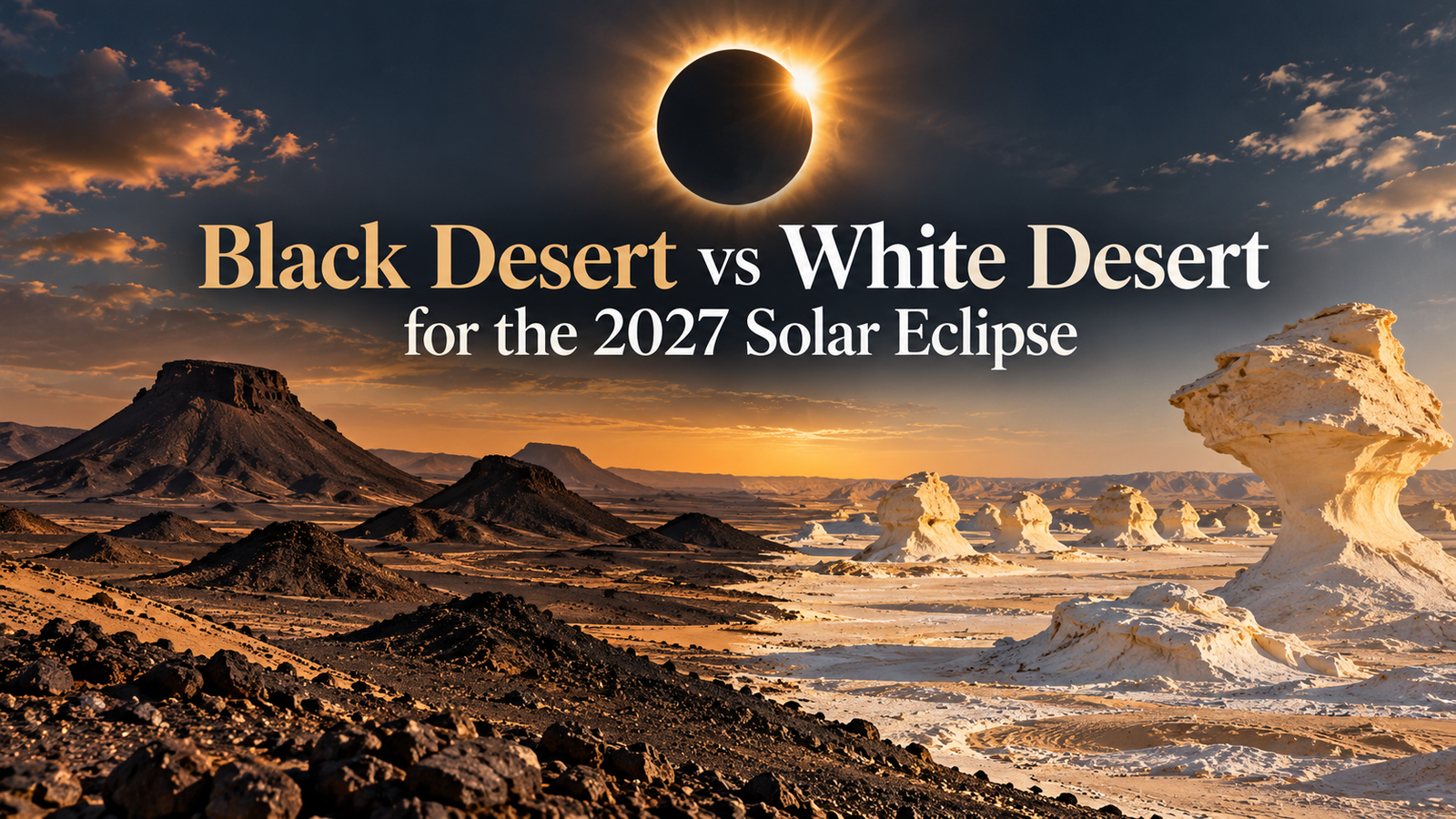
Black Desert vs White Desert for the 2027 solar eclipse: which should you choose? First, separate two questions that are often mixed together: Which landscape do you want to explore? and Where can you actually see the total eclipse on Monday, 2 August 2027? Egypt's Black Desert and White Desert make a memorable paired safari experience, but neither destination name guarantees that any particular campsite, viewpoint or famous rock formation is safely inside the path of totality.
The Black Desert is associated with dark rocky hills and the Bahariya travel corridor. The White Desert is famous for its brilliant chalk formations and is closely associated with Farafra. A tour can combine both while using a separately chosen, astronomically verified observation field. In fact, independently calculated eclipse circumstances distinguish representative Bahariya Oasis locations, which experience totality, from Farafra town, which sees a partial eclipse. That difference is the starting point for any meaningful comparison.
Black Desert vs White Desert: Quick Comparison
| Factor | Black Desert | White Desert |
|---|---|---|
| Signature scenery | Dark-topped hills, stone-strewn slopes and earthy desert contrasts | Pale chalk formations, sculpted rock features and bright desert vistas |
| Main travel association | Bahariya Oasis / Western Desert corridor | White Desert Protected Area and Farafra region |
| 2027 totality | Requires precise coordinates; suitable locations in the wider Bahariya region can be inside the path | Cannot be assumed across the whole region; Farafra town is partial |
| Best-known photography style | Dark hills, ridgelines and contrasting ground textures | White formations, sculpted silhouettes and expansive landscape frames |
| Access | Often visited as part of guided Bahariya safari programs | Typically reached through organized Western Desert excursions |
| Ideal use in an eclipse itinerary | Sightseeing and possible operational access subject to exact site checks | Landscape sightseeing before or after a separately verified eclipse session |
| Most important booking check | Actual observation-field GPS and facilities | Proof that the advertised observation point—not just a famous landmark—is inside totality |
This is a comparison of destinations and planning logic, not a promise that every attraction or visitor route will be open on eclipse day. The final viewing-field location, permissions, access, weather contingencies and camp design must be confirmed by the operator.
Where Are the Black and White Deserts in Egypt?
Both landscapes are part of Egypt's Western Desert travel experience, west of the Nile Valley. International travelers typically approach this corridor through Cairo or Giza, travel toward Bahariya Oasis, and then join organized desert excursions. The Black Desert is connected with the Bahariya-side landscapes, while the famous White Desert formations lie farther along the traditional safari circuit associated with Farafra.
This is why travel brochures so often put the two names together. A guided journey might start at an oasis town, pass through dark-hill scenery, continue past other geological landmarks and end among chalk formations. The route itself is interesting even without an astronomical event. But in August 2027, visiting a scenic landmark and observing a total eclipse are separate operational tasks; the shadow's geometry does not follow the tourist route.
The official Experience Egypt Bahariya guide establishes the oasis's importance as a regional gateway, while the Egyptian State Information Service provides protected-area context. For a broader explanation of towns, landscapes, springs and routes, see our Bahariya Oasis travel guide.
Why the Eclipse Path Matters More Than the Desert Name
The 2 August 2027 solar eclipse is total only within a specific strip of the Earth's surface. Observers outside this strip see a partial eclipse even if the Sun becomes dramatically covered. During totality, the Moon completely covers the Sun's bright photosphere, allowing a short view of the outer solar atmosphere under the relevant conditions. A site close to the path limit may have a much shorter period of totality than a site nearer the central zone.
NASA publishes the interactive map of the 2027 eclipse track, with boundaries and duration information. The widely quoted maximum duration—around six minutes and twenty-three seconds—is a property of the eclipse path at its maximum, not a universal guarantee for Bahariya, the Black Desert, the White Desert or a commercial campsite.
For example, location-specific calculations for a representative Bahariya Oasis point identify totality, while the corresponding Farafra town calculation identifies a partial eclipse. One place is not the other. A tourism-map label covering dozens of kilometers cannot reliably answer how many seconds of totality any individual will see.
A traveler should therefore make a simple distinction between an itinerary map, showing tourist stops, and an eclipse path map, showing astronomical boundaries. The best version of a tour uses both: the itinerary tells you where you will travel, while the astronomy map explains why the actual observing site was chosen.
Does the Black Desert Have Better Totality Than the White Desert?
It is tempting to give a sweeping answer, but a blanket ranking would be misleading. The correct comparison is between two precise locations, including their latitude, longitude, elevation if relevant, horizon and date. If a particular Black Desert field lies securely within the 2027 path and a famous White Desert stop lies outside it, the former is the obvious choice for someone whose priority is totality. But that does not establish a universal rule that every part of the Black Desert is better than every part of the White Desert.
Nor is the longest calculated duration automatically the best operational choice. A site with marginally longer totality can be less practical if it has an unsafe access road, restricted land access, poor parking space, inadequate drinking water, an obstructed horizon or weak emergency arrangements. An excellent observing location is both astronomically suitable and realistically manageable for the group.
For the geographic checks, explore our Egypt 2027 eclipse path map and the dedicated Bahariya totality guide. These explain why a town-center timing cannot automatically be reused for a remote campsite.
Landscape Comparison: Dark Hills or White Chalk Formations?
Black Desert: contrast, texture and rocky horizons
The Black Desert is defined visually by low dark hills, rocky surfaces and layers of contrasting tones. A travel photographer may enjoy the silhouettes of the ridges at different times of day, the relationship between shadow and texture and the way the terrain differs from sandy-dune stereotypes. The ground is not one homogeneous black plain; different stops have their own slopes, rock cover and line of sight.
This landscape can provide attractive context for an eclipse travel story. Visitors might photograph the area on the journey to or from the observation field and later create a composite travel gallery featuring both desert geology and the eclipse itself. But photographers should not select a totality position on visual appeal alone. An exposed hilltop can complicate wind protection, stability, group safety and equipment access.
White Desert: sculpted forms and pale rock
The White Desert is famous for formations created from pale geological material. Their shapes can look especially distinctive in the changing light and make memorable photographs on a dedicated sightseeing stop. Visitors may recognize surreal white rock silhouettes from Egyptian desert tourism imagery.
That visual drama is not proof of being inside totality. An especially photogenic formation may be an excellent place to visit on a normal safari yet unsuitable as the eclipse-observation field. The most responsible itinerary describes the sightseeing attraction accurately and identifies the separate eclipse location as its own element.
Which looks better in photos?
Neither is objectively superior. The Black Desert suits darker, rugged compositions; the White Desert suits pale sculptural landscapes. Photographers aiming for the solar corona will often prioritize solar filters, a clear and safe line of sight, camera stability, suitable focal length and an executable exposure sequence over the exact color of the ground. Visitors with mobile phones may value landscape photographs more than a tiny disk of the Sun in the frame. Think through the image you want before paying a premium for a particular route.
Which Desert Is Better for First-Time Visitors?
For a first-time traveler, the most rewarding itinerary may include both Black and White Desert highlights rather than treating them as mutually exclusive destinations. Many Western Desert safari programs are designed around the contrasts between geological areas, oasis landscapes, desert roads and overnight accommodation. For the eclipse, the decisive requirement is that the actual observation session occurs at a confirmed totality point if totality is what you are paying to experience.
If your main goal is a short totality-first trip, judge the package by how efficiently it gets you to the observing area before eclipse day and how clearly it explains the camp and transport. If your goal is a broader Egypt vacation, consider a longer route that includes Cairo attractions, more oasis sightseeing and perhaps other destinations after the eclipse. None of those additions changes the astronomical event, but they can transform the overall holiday.
Travelers comparing alternatives can consult our 7-, 10- and 14-day Egypt eclipse itinerary ideas and then see which parts are already included in the live Western Desert packages.
Transport: How Access Differs from an Ordinary Desert Safari
On a regular White Desert trip, the schedule can often be adjusted for scenery, rest stops and the preferences of the group. Eclipse day is different because its critical phase happens at a fixed time. Roads, pickup points, vehicle assignments and viewing-field arrival windows must be planned around the astronomical timetable, not the other way around.
The approach from Cairo typically involves a long air-conditioned road transfer toward Bahariya, followed by locally arranged desert travel where suitable vehicles are needed. A visitor booking a 4x4 safari should clarify whether the same vehicle handles every segment, whether luggage is transported separately and whether any sightseeing stops happen before or after the observing session.
Our standard eclipse tour structure includes organized transportation that may be shared within the group. Private road transfers and private desert 4x4 arrangements are optional paid upgrades, not automatically part of the basic package. If privacy matters, request a written quote specifying which vehicle stages are private, maximum occupancy and any additional charge. Review our Cairo–Bahariya journey guide for the practical travel corridor.
Can You Camp in the White Desert and Watch Totality in the Black Desert?
In principle, one could visit one destination and observe at another, but only if the operator provides an actual workable plan. On eclipse day, even what sounds like a modest road transfer can introduce risks: vehicle delays, difficult desert tracks, stops for permits or controls, and last-minute equipment setup. You should not assume two locations are interchangeable just because they appear close on a tourist map.
A robust trip specifies where guests sleep before the eclipse, when vehicles leave, what they carry, when the observation area must be ready, and how guests return afterward. Sleeping within the verified operational region beforehand can reduce the chance of missing the beginning of the observation program. When comparing packages, ask whether the advertised “White Desert camp” is itself the event base or simply a separate sightseeing campsite.
Likewise, if an operator advertises a “Black Desert eclipse camp,” ask whether its published coordinates refer to the camp, the venue entrance, an approximate oasis location or a separately designated observation platform. Precision matters because the Moon’s shadow is not impressed by branding.
Cooling and Comfort on 2 August 2027
Both landscapes share the challenge of August desert heat. An observation session near midday may involve prolonged outdoor exposure, carrying equipment and waiting through partial phases. Families, older travelers and guests with mobility needs may particularly value shade, toilets, drinking water, seating, and access to a cooled place to rest.
Our 2027 main eclipse camp concept is planned as a fully air-conditioned structure with a direct sky-view design so guests can observe from within the cooled camp environment, alongside an optional exterior viewing/seating area supported by high-capacity misting fans and suitable heat-management arrangements. The details of the structure, protected solar sightlines and final layout require operational confirmation; the outside air itself should never be described as air-conditioned.
For a buyer, the relevant questions include whether the structure is fully installed or still planned, how the sky-view system works without unsafe or obstructed sightlines, how many seats are available, how power and backup cooling are managed, whether all guests have access and whether the same configuration is actually included in the purchased package. A concept rendering should be labeled as a concept.
Read the current eclipse camp specification and our August desert heat safety guide before deciding. Air conditioning helps with comfort but cannot substitute for medical support, hydration and responsible heat planning.
Which Desert Is Better for Solar Eclipse Photography?
For some photographers, a Black Desert ridge makes a stronger sense-of-place image; for others, a pale White Desert sculpture is the unforgettable subject. Yet trying to place a famous rock directly under the eclipsed Sun in a single frame can be difficult because the Sun's elevation and direction are governed by time and location. A good site needs the correct solar sightline first.
Choose an observation position with stable ground and room for tripods. Have appropriate solar filters for any magnifying optics and know when they are required. Plan a sequence for the partial phase, diamond ring, totality and return of the bright Sun, and rehearse settings in advance. Heat can affect batteries, hands, focus and the operator, while wind and dust can complicate changing lenses.
Solar viewers for unaided eyes and full-aperture solar filters for cameras, telescopes or binoculars are different safety products. The American Astronomical Society's viewing guidance is a better source than informal tricks such as multiple sunglasses or improvised filters. For equipment, framing and exposure considerations, use our 2027 eclipse photography guide.
A separate travel photography session at the White Desert formations may be possible before or after the event, depending on the itinerary. This is often a more realistic goal than assuming you can freely move cameras and vehicles between distant scenic landmarks during totality.
Black Desert vs White Desert for Families and Older Guests
Choosing between locations should be less about the color of the scenery and more about the amount of walking, vehicle travel, heat exposure and reliability of facilities. Some travelers enjoy exploring uneven rocky hills; others prefer seated sightseeing and short walks. Neither destination automatically guarantees paved paths, step-free access, reliable phone coverage or a hotel-standard bathroom at every stop.
Parents should ask whether a young child can remain in shaded or cooled space during partial phases, whether an adult will supervise solar-viewing equipment and what happens if the child becomes tired. Older guests may care about how far the camp's cooled area is from the observation location, whether assistance is available and how quickly a medical response can be organized.
The right choice may be a smaller-scale managed observation event with an optional scenic drive rather than an exhausting all-day sightseeing schedule. Read our seniors and health considerations guide and solar safety guide for parents before confirming a booking.
How to Compare Real 2027 Desert Eclipse Tour Packages
Start by ensuring every package is offering the same fundamental event: a verified totality observation point on 2 August 2027. Then compare the length of the trip, the overnight arrangement, transfer details, included sightseeing and the quality of the guest-support plan. A 2-day, 3-day and 4-day package can share a viewing operation while offering different levels of comfort and time in Bahariya.
| Question | Why it matters |
|---|---|
| Is the observation GPS inside totality? | It distinguishes a genuinely total eclipse program from a partial-eclipse sightseeing stop. |
| Where do guests sleep before 2 August? | It affects the risk and length of event-day transfers. |
| Is transport organized or private? | It determines privacy, group size and cost. |
| What is the cooling and heat plan? | Midday desert conditions affect guests and equipment. |
| Are solar viewers or filters included? | Safety equipment is essential; verify actual inclusions. |
| Are hotel room categories and camp facilities confirmed? | Marketing words alone are not an accommodation specification. |
| What is the full price, deposit and remaining balance? | Deposits must not be confused with complete tour prices. |
| What is the cancellation policy? | The eclipse date cannot be moved, but travel circumstances can change. |
Our published 2027 eclipse tour packages set out 2-day, 3-day and 4-day options. For a side-by-side breakdown of actual advertised inclusions, use the package comparison guide. If you need a private transfer, extra hotel nights or an alternative pickup, the customization form lets you request a quote, rather than assuming the standard package contains a service it does not list.
What About Other Egyptian Eclipse Destinations?
It is also worth considering destinations outside the Bahariya-to-Farafra circuit. Luxor, for example, is a major historical destination with strong accommodation and airport infrastructure and a highly favorable totality position. Siwa offers a different oasis setting, while Red Sea destinations must be checked individually because towns and resorts can fall on different sides of the totality limits. Cairo and Alexandria are primarily gateways and partial-eclipse locations, rather than substitutes for a confirmed totality field.
The right answer depends on what you value: more established city tourism, remote landscape, a fixed hotel, a cooled event camp, a small group, ease of transport or the calculated duration at your specific coordinates. Our best places in Egypt for the 2027 eclipse compares destinations without assuming that one traveler profile fits everyone.
Frequently Asked Questions
Is the Black Desert the same as the White Desert?
No. They are different landscapes within Egypt's Western Desert tourism corridor. Their geological appearance and sightseeing experiences differ, although many guided trips combine both.
Which is closer to Bahariya Oasis?
The Black Desert is generally associated more closely with the Bahariya-side safari landscape, while the protected White Desert formations lie farther along the corridor associated with Farafra. Exact distances depend on the chosen stops; confirm the planned route rather than relying on a generic figure.
Will the Black Desert experience totality in August 2027?
Potentially, at appropriate coordinates within the wider Bahariya/Black Desert viewing region. A Black Desert name on a tour or map is not proof of totality at the exact observation point. Confirm latitude, longitude and circumstances with an astronomy map.
Is the White Desert outside the eclipse path?
Do not assign one eclipse circumstance to the entire broad White Desert landscape. Farafra town is calculated to see a partial eclipse, but every candidate site must be checked individually. The correct question is whether the exact field used for observing lies within the path.
Can we visit both deserts in one eclipse tour?
Many Western Desert safari routes can include attractions associated with both, but the actual included stops and available time depend on the specific itinerary. Do not assume all sightseeing is included in every 2-, 3- or 4-day package.
Is Black Desert better than Luxor for the eclipse?
Not for everyone. Luxor offers extraordinary archaeology, hotels and a favorable astronomical position. The Western Desert can offer a different controlled-event and landscape experience if its operational field and support systems are correctly planned. Choose based on the full itinerary and verified conditions.
Does a longer tour mean a longer eclipse?
No. A longer itinerary adds nights and travel experiences, not more minutes of totality at the same observation coordinate.
Will we be able to view totality from inside an air-conditioned camp?
Our 2027 main camp is planned with a cooled indoor direct-sky-view design and an optional outdoor area. Final line-of-sight design and operational specifications must be confirmed. Solar viewers and proper optical filters are still necessary whenever the uneclipsed bright solar disk is visible.
Is private 4x4 transportation included?
Not as the automatic standard. Organized transportation is included in our standard package structure, while private road transfers and private desert 4x4 arrangements may be requested as optional paid upgrades subject to availability.
What should I book first?
For a totality-first holiday, verify the operator's viewing-region plan and the published booking terms, then coordinate international flights and hotel stays around the fixed 2 August date. Allow time before eclipse day rather than depending on a long last-minute transfer.
Sources and Useful Planning References
- NASA: 2 August 2027 solar eclipse interactive path — official path boundaries and totality geography.
- NASA: 2027 eclipse path table — technical path reference.
- Timeanddate: Bahariya Oasis eclipse circumstances — representative location calculation.
- Timeanddate: Farafra eclipse circumstances — city-specific partial-eclipse calculation.
- Experience Egypt: Bahariya Oasis — destination context.
- Egyptian State Information Service: Bahariya protected landscape.
- American Astronomical Society: eclipse viewing safety.
Last editorial review: October 2026. Eclipse duration, local timings and the availability of event-camp facilities must be checked for the exact observation point and the operator's final published plan. No totality duration, clear sky or tour upgrade is guaranteed by a region name alone.
Prefer a managed 2027 Western Desert eclipse experience? Compare our current Egypt eclipse packages, or review how booking and deposits work.