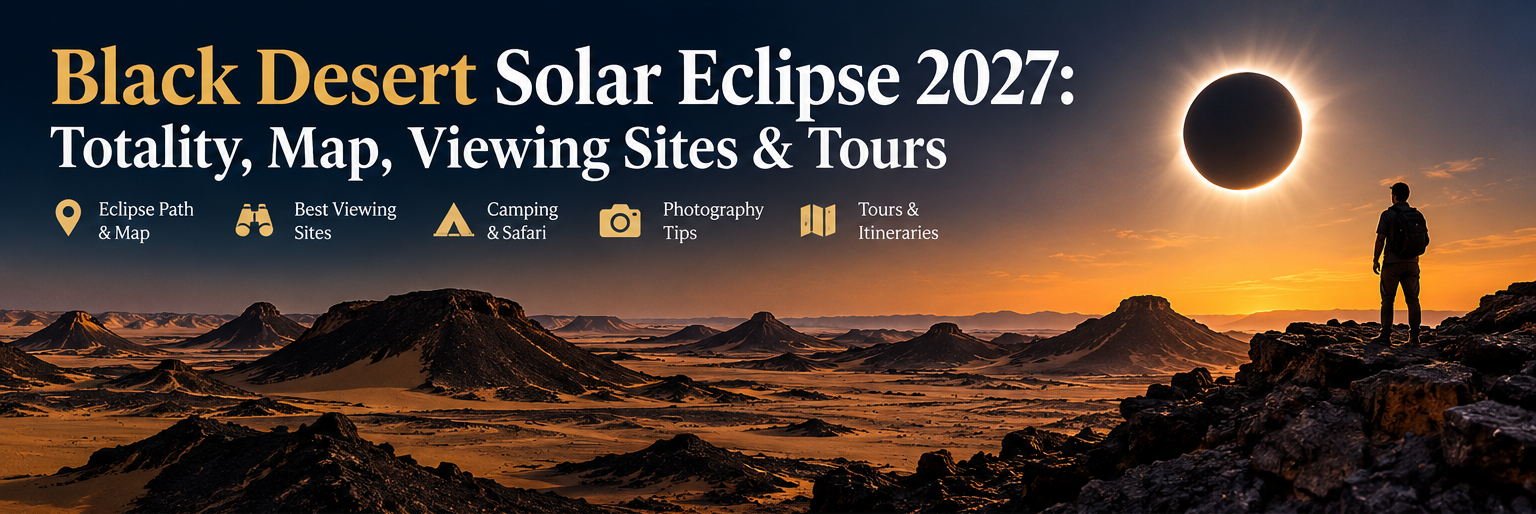
Can you see the 2027 total solar eclipse from Egypt's Black Desert? Yes, and our camp is one of the best places in Egypt to see it. On Monday, 2 August 2027, the centre line of the total solar eclipse crosses Egypt's Black Desert, south of Bahariya Oasis. Our eclipse camp and viewing site stand at 28.2067° N, 28.7245° E, only about 200 metres from that centre line, so totality there lasts 6 minutes 22 seconds: from 12:50:13 to 12:56:35 local time (EEST, UTC+3), with the Sun 79 degrees above the horizon. That is slightly longer than Luxor and roughly twice what the central White Desert formations receive. You sleep, eat and watch the eclipse in the same place, and the White Desert is included as an excursion in the programme. Compare the Black Desert eclipse packages.
Black Desert Eclipse 2027 at a Glance
| Item | Our Black Desert viewing site |
|---|---|
| Location | Black Desert eclipse camp, 28.2067° N, 28.7245° E |
| Date | Monday, 2 August 2027 |
| Eclipse type | Total |
| Partial phase begins | 11:29:28 EEST |
| Totality begins | 12:50:13 EEST |
| Maximum eclipse | 12:53:24 EEST |
| Totality ends | 12:56:35 EEST |
| Partial phase ends | 14:15:33 EEST |
| Duration of totality | 6 minutes 22 seconds |
| Distance from centre line | About 200 m |
| Sun altitude at totality | About 79° |
Times are calculated for our camp's coordinates from NASA's Besselian elements for the 2 August 2027 eclipse (Fred Espenak, NASA GSFC), updated with a current ΔT estimate of 69 s; NASA's original tables assumed 76 s, which shifts times by about 10 seconds. The Moon's uneven limb can shift contact times by one or two seconds. Other Black Desert stops a few kilometres away differ by only a few seconds.
This guide focuses on the Black Desert solar eclipse 2027 from a traveler’s perspective: geography, totality, what makes a workable viewing field, Cairo-to-Bahariya logistics, heat, safety, photography and how to compare real packages. It deliberately separates places you may visit on a safari from the exact place where the operator intends you to observe the eclipse.
2027 Black Desert Eclipse: Essential Facts
| Planning question | Practical answer |
|---|---|
| When is the eclipse? | Monday, 2 August 2027 |
| Is it total in Egypt? | Yes, within a defined path of totality; outside that path the eclipse is partial. |
| Is every Black Desert site total? | No assumption is safe without checking the exact latitude and longitude. |
| Is Farafra town total? | No. Published location-specific calculations show a partial eclipse there. |
| How long does totality last? | It varies by exact location. The event’s global maximum is about 6 minutes 23 seconds, not a universal promise for every stop. |
| When should I arrive? | Before eclipse day, with the selected observation site, transport and safety arrangements settled. |
| What is the most important question to ask? | Which GPS point will be used for observation, and what is the calculated duration of totality at that point? |
Where Is Egypt’s Black Desert?
The Black Desert is one of the characteristic landscapes on Western Desert journeys connected with Bahariya Oasis. Its low, dark hills and stone-strewn surfaces look strikingly different from the pale chalk formations further south. The dark appearance is associated with the region’s mineral-rich, iron-stained and volcanic-looking rock cover; it is not a single fenced attraction with one universal GPS point.
That geographical distinction becomes unusually important in August 2027. Travelers may hear “Black Desert,” “Bahariya,” “Al Haiz,” “White Desert” and “Farafra” used together because they are linked by a well-known safari route. Yet those labels describe different settlements, landscapes and sightseeing regions, not interchangeable eclipse observing stations. An itinerary can truthfully include a visit to the White Desert and still use a different, verified location for observing totality.
Egypt’s official tourism portal describes Bahariya as a gateway to both the White and Black Deserts, around 370 km southwest of Cairo. The Egyptian State Information Service also lists the Black Desert among the features of the Bahariya Oasis protected-area landscape. Both sources help establish the area’s travel identity; neither source substitutes for an eclipse-path calculation.
Why Is the Black Desert Black?
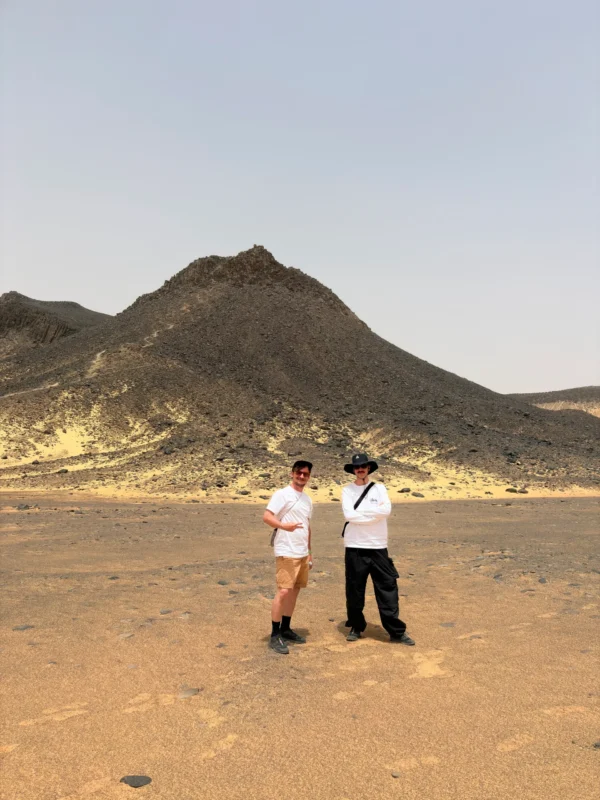
The Black Desert is a landscape of orange-brown sand and limestone hills capped and scattered with dark volcanic rock, mainly dolerite and iron-rich quartzite. Erosion has broken those dark caps into small stones that cover the slopes and plains, which gives the area its black, almost lunar look and makes it one of the few places in Egypt where you walk among volcanic-looking cones.
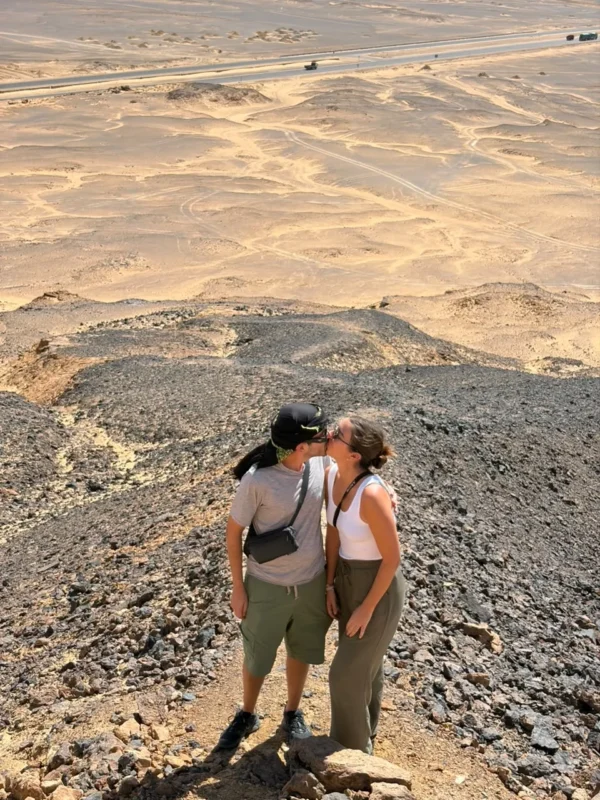
The best-known landmark of the Black Desert is Gebel el-Marsous, a black-capped hill whose dark stones lie so neatly that it looks as if they were stacked by hand (marsous means “stacked” in Arabic). A short climb to the top opens a wide view over the black-capped hills towards the Farafra road: the same open horizon that makes the area so good for watching the eclipse.
Is the Black Desert Inside the Path of Totality in 2027?
Yes. Our Black Desert viewing site is inside the path of totality, almost on the centre line. NASA's 2027 path shows a strip about 258 km wide between the northern and southern limits of the Moon's umbral shadow. At 28.2067° N, 28.7245° E, our camp sits only about 200 m from the centre line, the position that gives the longest totality at this longitude. Not every Western Desert stop is equal: totality shortens towards the edges of the path, so always ask an operator for the exact viewing coordinates.
| Location | Totality duration | Totality begins (EEST) |
|---|---|---|
| Our Black Desert camp (28.2067° N, 28.7245° E) | 6 min 22 s | 12:50:13 |
| Luxor | 6 min 20 s | 13:02:08 |
| Bawiti, Bahariya Oasis | 6 min 17 s | 12:50:21 |
| Central White Desert formations (approx. 27.33° N, 28.17° E) | About 3 min | 12:51:54 |
Values calculated from NASA/Espenak Besselian elements; lunar limb effects can change them by one or two seconds.
A useful warning comes from comparing two place-specific calculations. Timeanddate identifies a representative Bahariya Oasis location as total on 2 August 2027, while its Farafra location page identifies the same event as partial there. Those statements do not contradict one another: they refer to different coordinates. They demonstrate exactly why phrases such as “the whole White Desert is total” or “any desert camp will work” are unreliable.
For the official geometric framework, start with NASA’s interactive 2027 eclipse-path map, then explore our location-focused 2027 Egypt eclipse map guide. The purpose of a map is not to choose the prettiest screenshot: it is to determine whether a real, reachable location is securely inside the totality band.
What Does the Centerline Mean?
The centerline is the middle of the eclipse shadow’s path across the ground. Locations nearer it generally experience longer totality than locations near a path boundary, although the duration also changes as the shadow moves east. The 2027 event can reach approximately six minutes and twenty-three seconds at its maximum, but a commercial program should quote a site-specific figure, with a stated calculation source and location. Do not attach the global maximum to a random Black Desert photograph.
Even a mathematically favorable coordinate may not be a suitable guest site. Roads, ground conditions, safe parking, emergency access, legal permission, the horizon and dust exposure also matter. Eclipse planning is the combination of astronomy and real-world operations, not astronomy alone.
Black Desert, Al Haiz and Bawiti Are Not the Same Coordinate
Al Bawiti is an important settlement within the Bahariya area, and Al Haiz is associated with the oasis and desert corridor farther south. Their names are useful for understanding transport and accommodation, but they are not a guarantee that a certain hotel, palm grove or dune will have an uninterrupted view or the duration advertised for another location. Ask whether any published local duration refers to the actual hotel, a town-center reference point, a suggested field or the operator’s final observation site.
If an operator has not yet chosen its final field, that does not automatically make the offer invalid. It does mean the distinction must be made clearly: the broader operating region may be chosen, while the final field is still subject to terrain checks, permission and coordinate validation. An honest booking explanation is more useful than invented decimal-place precision.
How Long Is Totality in the Black Desert?
Totality in the central Black Desert lasts about 6 minutes 20 seconds, only a few seconds less than the eclipse maximum of 6 minutes 23.2 seconds listed by NASA. Duration falls slowly near the centre line and quickly near the edges, so moving south towards the White Desert costs minutes, not seconds.
| Location (north to south) | Approx. distance from centre line | Approx. totality |
|---|---|---|
| Bawiti, Bahariya Oasis | 19 km north | 6 min 18–21 s |
| Black Desert (central) | 15 km south | 6 min 20 s |
| Crystal Mountain area | About 68 km south | About 5 min 25 s |
| Agabat Valley | About 99 km south | About 4 min |
| White Desert formations (Mushroom area) | About 120 km south | About 2 min or less |
| Farafra town | About 148 km south | Partial only |
Bawiti matches published figures (timeanddate via Space.com). The other values are our estimates, interpolated from NASA's 2027 path table for approximate coordinates; confirm the exact viewing point before eclipse day.
How Does Black Desert Compare With the White Desert?
The Black and White Deserts are neighbors in a familiar Western Desert travel narrative, but their visitor experiences are different. Black Desert scenery emphasizes dark hills and rugged contrasts; the White Desert is known for sculpted, pale chalk formations. Visitors often combine them on a guided safari with Bahariya stops and other geological highlights. For the eclipse, however, the critical difference is not their color. It is the placement of a specific, accessible observation point within the narrow path of totality.
One especially important point: Farafra town sees a partial eclipse according to published calculations for 2 August 2027. The protected White Desert landscape is a broad area associated with Farafra, and it should not be treated as a single coordinate. That is why a tour can include famous White Desert rock formations for sightseeing without promising totality from every chalk formation.
We cover the geography of the wider region in our White Desert travel guide and explain the relationship between places and the eclipse in our Bahariya path guide.
How to Check a Black Desert Viewing Site Before Booking
A credible itinerary should be able to answer five progressively more detailed questions:
- Where is the intended viewing region? A regional answer is useful for planning the journey, but insufficient to promise a duration.
- Where is the proposed observation field? Request the precise coordinates once finalized, or the operator’s timeline for confirming them.
- What does the eclipse calculation show? Verify total versus partial, first and second contact, maximum, third and fourth contact, plus the applicable local time zone.
- Can guests safely reach and remain at the site? Consider road condition, permissions, shade, cooling, toilets, drinking water and emergency arrangements.
- Is there a documented contingency process? Know how the operator handles road restrictions, equipment failure, unexpectedly unfavorable local conditions and guest notifications.
NASA’s path calculation is an excellent starting point; it does not certify that any private business has legal access to a parcel of land or that a safari vehicle can reach a remote point safely. A good operator must verify both the sky and the ground.
What Time Will the 2027 Eclipse Happen Near Bahariya?
- About 11:29 – first contact; the partial eclipse begins (eclipse glasses on).
- About 12:50 – second contact; diamond ring, then totality (glasses off only now).
- About 12:53 – maximum eclipse.
- About 12:56 – third contact; totality ends (glasses back on immediately).
- About 14:15 – last contact; the eclipse is over.
These approximate local times (EEST, UTC+3) apply to the Bahariya and Black Desert area.
The eclipse takes place around midday in Egypt. The partial phases last much longer than totality. For most travelers, it is safer to treat exact contact times as information that will be delivered for the final observation coordinate than to copy a clock time from Luxor, Siwa or Farafra into a Black Desert itinerary. Egypt local time in August is typically Eastern European Summer Time (UTC+3), but your confirmation should state the local time and date explicitly.
Plan backwards from the viewing session. A comfortable day leaves time for breakfast, solar-filter checks, camera alignment, shade and hydration before the partial phase begins. Equipment setup is not something to postpone until the last five minutes before totality. Our city-by-city eclipse timeline explains why circumstances vary across Egypt, and the Egypt-wide reference page is a useful independent cross-check.
Getting From Cairo to the Black Desert Region
For most international visitors, Cairo or Giza is the practical gateway. The journey toward Bahariya crosses long stretches of desert road. The exact journey time depends on the pickup area, traffic leaving Greater Cairo, rest stops, vehicle type, weather, checkpoints and the final destination. An operator should quote a realistic transfer window rather than describe the journey as a short taxi ride.
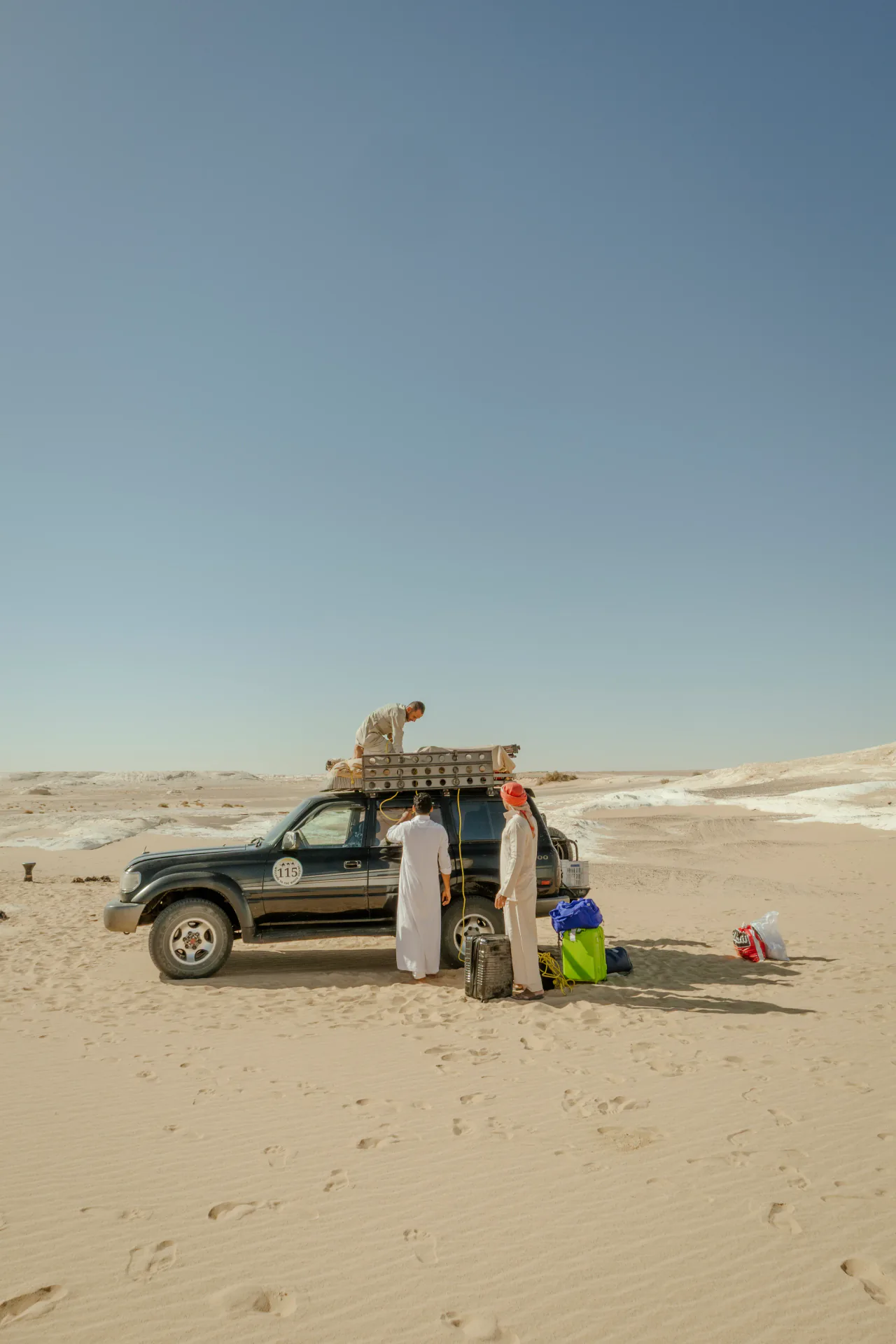
Beyond the main paved-road approach, desert sightseeing and final access may require locally suitable 4x4 vehicles. A road transfer from Cairo and the off-road portion of a trip are separate parts of the service. Ask how many people share each vehicle, where luggage is stored, and whether a quoted private option covers the Cairo road transfer, the desert 4x4 or both. For the logistics in greater depth, see our Cairo-to-Bahariya journey guide.
Arriving in Bahariya on eclipse morning without prearranged transport is a gamble. Access may be slower during a one-day astronomical event; a precise location might be difficult to find; and essential equipment may require hours to prepare. A more resilient itinerary reaches the operating area ahead of eclipse day and keeps the observation day focused on the eclipse itself.
Should You Sleep in Bahariya or at an Eclipse Camp?
There is no universal best answer. A conventional Bahariya hotel may provide familiar accommodation, whereas an event-specific desert camp places guests closer to the designated observation operation if that is how the itinerary is arranged. The correct comparison includes sleeping comfort, cooling, the distance to the actual viewing field, toilets, power, drinking water, transport and how early visitors must move on eclipse morning.
Our current 2027 Western Desert programs use a dedicated eclipse-camp night as a common part of their structure. The longer 3-day and 4-day options add Bahariya hotel nights. The planned main camp is designed around air-conditioned guest accommodation and a direct sky-view concept, with an optional outside observation area supported by heat-management equipment. Final construction, line-of-sight and site arrangements must be confirmed through the operator’s published specifications; do not assume the outdoor seating itself is air-conditioned.
For the up-to-date camp proposal and included facilities, consult the 2027 eclipse camp page. The most valuable pre-booking question is not “Is the camp luxurious?” but “What parts of the experience are confirmed, and what remains planned?”
August Heat: The Most Important Operational Difference
The 2027 total solar eclipse happens in early August. Even where historical cloud patterns look favorable, desert heat and solar exposure are serious concerns, particularly around midday. A clear sky is not the same as a comfortable or risk-free viewing session. Visitors should be able to spend time in a cooled or shaded setting, drink water regularly, reduce unnecessary walking and receive help if heat symptoms appear.
For families, older visitors and people carrying heavy photography gear, proximity between the observation location and cooling/support areas matters more than decorative promises about a tent. Ask for the actual shade arrangement, seating availability, water policy, accessible toilet details, medical-support plan and procedure for moving someone away from heat. A misting fan outdoors may improve comfort, but it is not equivalent to indoor air conditioning or a medical safety guarantee.
The right clothes can also help: light-colored breathable layers, sun protection, appropriate closed shoes for uneven ground and a hat for periods outside. Do not rely on an ordinary winter desert packing list. Read our August desert heat safety guide for a more complete preparation checklist.
Is Black Desert Good for Eclipse Photography?
The setting can be spectacular for landscape photography: dark ridges, desert horizons and opportunities to frame the changing light before and after totality. But a scenic background does not automatically make a safe solar observation site. Camera placement must account for ground stability, dust, heat, direct Sun exposure, a clear solar sightline and enough spacing to avoid tripods obstructing walkways.
Photographers should distinguish the goals of a wide-angle desert composition from a close-up image of the solar corona. A wide-angle lens may capture landscape context but make the Sun relatively small; a telephoto setup requires careful tracking, focusing and filters. Practice your sequence well before August 2027. Arrive with charged batteries, spare cards and equipment suited to dust and temperature rather than relying on unfamiliar last-minute settings.
Eye and camera safety are non-negotiable. During the partial phases, direct viewing requires genuine eclipse viewers that meet applicable solar safety requirements, and camera lenses or telescopes need appropriate front-mounted solar filters. Ordinary sunglasses do not protect your eyes. The American Astronomical Society explains the different requirements for unassisted eye viewing and magnifying optics. See our 2027 eclipse photography guide for a staged camera-preparation approach.
Black Desert Eclipse Tours: Which Trip Length Makes Sense?
A traveler interested in the Black Desert has several legitimate priorities: seeing totality, exploring more of the Western Desert, spending a night in an oasis hotel, minimizing road travel or allowing time for photography. These aims do not always point to the longest trip. An extended program generally changes the number of nights, sightseeing opportunities and pace—not the astronomical length of totality at the shared observation field.
Two-day option: an eclipse-first desert journey
A short format suits travelers who already have their broader Egypt itinerary organized and want a concentrated eclipse experience. It normally prioritizes reaching the event area, staying at the camp, observing on 2 August and returning after scheduled desert activities. It leaves less room for unplanned city sightseeing or recovery time.
Three-day option: extra Bahariya breathing room
A middle-length format can add a hotel night and spread some transport or sightseeing over a less compressed schedule. Travelers should still check the exact order of the days, as an attractive itinerary on paper may involve substantial road and 4x4 travel.
Four-day option: more oasis and desert time
The longer short-form option adds Bahariya time and hotel accommodation alongside the eclipse-camp night. It may suit guests who prefer a less hurried introduction to the area, but must not be mistaken for an automatically private-transport package. Under our standard package structure, organized transportation is included; private road transfers and private 4x4 arrangements are optional paid upgrades subject to availability.
Compare current inclusions, dates, room arrangements and prices on the 2027 eclipse tour packages and prices page. For detailed options, see the 2-day, 3-day and 4-day itineraries. These links are the live source for what is actually sold; this article is not a separate Black Desert-only package advertisement.
Is a Black Desert Viewing Experience Right for Families?
Families may appreciate a quieter setting and a structured group operation, but the decision should start with practical needs rather than attractive pictures. Check whether the camp can accommodate children’s sleeping arrangements, where shaded or cooled seating is located, how toilets work at night and whether children have suitable solar viewers and adult supervision. Ask whether the group has a defined meeting point and what happens if a child becomes tired during the partial phases.
A parent also needs to know how much of the program is a seated observation experience and how much involves walking on uneven desert ground, climbing hills or transferring between vehicles. Nothing about a remote desert observation day is automatically child-friendly merely because a package allows children. Our solar eclipse safety for children guide is a helpful companion to the live child policy and package details.
Black Desert vs Luxor: Which Is Better?
Luxor has established airport and hotel infrastructure, celebrated temples and a location close to exceptionally long totality in 2027. It is a natural choice for visitors who prioritize major historical sightseeing alongside the eclipse. By contrast, a managed Western Desert experience can appeal to visitors who want desert scenery, smaller-scale logistics and a deliberately selected observation site, provided its final coordinates and facilities are properly verified.
There is no evidence-based reason to tell every traveler that the Black Desert is automatically better than Luxor. A person seeking a conventional city hotel or a very specific astronomical duration may choose differently from a photographer seeking more open desert context. Compare actual travel times, access, accommodation, cost, heat management and viewing conditions—not only the number of seconds in totality. Our Western Desert vs Nile Valley comparison explains these trade-offs.
Common Planning Mistakes to Avoid
- Confusing a tour title with the viewing coordinate. “White Desert” or “Black Desert” can describe sightseeing rather than the final observation field.
- Assuming every site receives six minutes or more of totality. Durations change with position, and a location outside the band has no total phase.
- Driving out from Cairo on eclipse morning without a confirmed plan. Time, access and equipment setup matter more during a fixed event.
- Comparing deposit amounts instead of complete package prices. Check what you pay now, what remains due and when.
- Assuming shared safari transport is private. Confirm both the Cairo transfer and the 4x4 arrangement.
- Overlooking solar filters and midday heat. Excellent desert weather forecasts do not replace eye protection or hydration.
- Believing a concept image proves final facilities. Ask which parts of a future camp design are installed, planned or still being finalized.
- Adding a photography package without checking practical access. Tripods, charging, clear sightlines and space matter.
Frequently Asked Questions About the Black Desert Eclipse 2027
Will the Black Desert see a total solar eclipse on 2 August 2027?
Yes. The Black Desert lies on the centre line of the eclipse path. At our camp (28.2067° N, 28.7245° E), only about 200 m from the centre line, totality lasts 6 minutes 22 seconds. Areas further south, towards the White Desert formations and Farafra, get much less or none.
How long will totality last in the Black Desert?
6 minutes 22 seconds at our Black Desert camp, within about a second of the eclipse's maximum duration of 6 minutes 23 seconds.
What time does totality start in the Black Desert?
Totality begins at 12:50:13 and ends at 12:56:35 local time (EEST, UTC+3) at our camp. The partial eclipse starts at 11:29:28 and ends at 14:15:33.
Where exactly is your Black Desert eclipse camp?
Our camp and eclipse viewing site are in the Black Desert, south of Bawiti in Bahariya Oasis, at 28.2067° N, 28.7245° E. You stay and watch the eclipse at the same site; the White Desert is visited as an excursion within the programme. See the eclipse camp facilities and the tour packages.
Is the eclipse total in Bahariya Oasis?
Yes at representative locations shown in independent eclipse calculations. That does not make every hotel, settlement and excursion stop interchangeable. Use the actual observation coordinate for the exact time and duration.
Will Farafra see the total phase?
Published location-specific calculations identify Farafra town as partial on 2 August 2027. The town is not the same as every point within the much wider White Desert tourism landscape.
Is the White Desert inside the 2027 totality path?
Do not give the entire White Desert region a single total/partial label. Named formations, reserve boundaries, Farafra town and candidate observation sites must be distinguished. Check exact coordinates against the northern and southern path limits.
Do I need to stay in the Black Desert overnight?
Not necessarily, but reaching your designated operating area before eclipse day is a more resilient approach than beginning a long journey from Cairo the same morning. The right overnight arrangement depends on the itinerary and actual viewing-field access.
Can I watch the eclipse from inside an air-conditioned camp?
Our 2027 camp concept includes a fully air-conditioned main structure designed for direct sky viewing, plus a separate optional outdoor viewing area. Visibility from inside depends on the final viewing design and site approval. Use the current camp specification for what is planned and confirmed; observing the bright or partially eclipsed Sun still requires appropriate solar eye protection.
Are private 4x4 vehicles included in the standard tours?
No. Our standard tour transport is organized; private road transfers and private 4x4 arrangements are available as optional paid upgrades, subject to availability and written confirmation.
Where can I compare actual 2027 Western Desert eclipse packages?
Use the package comparison to review live dates, hotel nights, transport and inclusions. The booking page explains the reservation and deposit process.
Sources, Maps and Further Reading
- NASA GSFC: 2 August 2027 eclipse path and limits — use to verify the geometry of totality.
- NASA GSFC: eclipse path table — technical reference for path boundaries, central line and duration.
- Timeanddate: representative Bahariya Oasis eclipse circumstances.
- Timeanddate: Farafra partial eclipse circumstances.
- Experience Egypt: Bahariya regional tourism information.
- Egypt State Information Service: Bahariya protected-area landscape.
- American Astronomical Society: safe solar eclipse viewing.
Editorial note (October 2026): The final 2027 desert observation coordinate and camp configuration must be checked against the operator’s latest published plans and written booking details. This guide does not guarantee weather, a specific duration of totality at an unnamed site or availability of optional services.
Planning a Western Desert eclipse trip? Explore our 2-, 3- and 4-day Egypt solar eclipse tour packages, or request a tailored arrangement if you need an alternative pickup, room arrangement or optional private transfer.