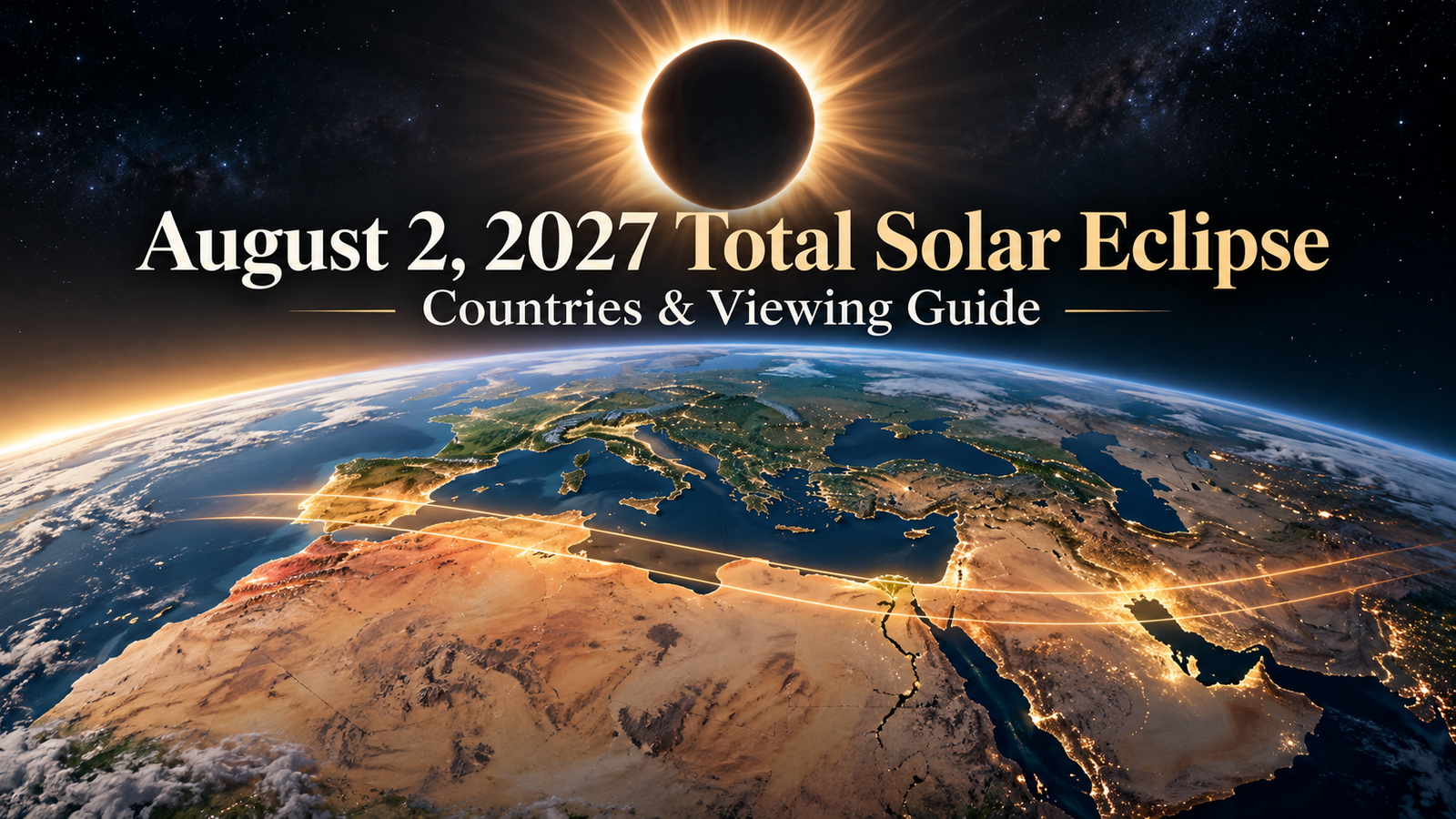
The upcoming total solar eclipse on August 2, 2027, will be one of the most remarkable astronomical events of the decade. On Monday, August 2, the Moon's shadow will travel from the Atlantic Ocean across southern Europe, North Africa, the Middle East and parts of the Indian Ocean, creating a narrow corridor where observers can experience a total solar eclipse.
At the most favorable location in Egypt, totality is predicted to last approximately 6 minutes and 23 seconds. That is an exceptionally long opportunity to see the Sun's corona, experience the strange darkness of midday totality and watch one of nature's most dramatic celestial events.
But the 2027 eclipse will not look the same everywhere. Some locations will experience several minutes of totality. Others will see only a partial eclipse, even if the Moon covers nearly all of the Sun.
This worldwide guide explains where the August 2, 2027 eclipse will be visible, which countries lie along the path of totality, when the event takes place, what first-time viewers should expect and how to plan a safe viewing experience.
August 2, 2027 Solar Eclipse: Quick Facts
| Question | Answer |
|---|---|
| When is the eclipse? | Monday, August 2, 2027 |
| What type of eclipse is it? | Total solar eclipse |
| Where will totality be visible? | Selected areas of southern Europe, North Africa, the Arabian Peninsula, northeastern Africa and the Indian Ocean |
| How long is the longest totality? | Approximately 6 minutes 23.2 seconds |
| Where is the maximum duration? | At a calculated location in Egypt |
| What time does the event happen? | Global eclipse activity runs roughly from 07:30 to 12:43 UTC; local timing depends on location |
| Will everyone see a total eclipse? | No. Totality is visible only inside the Moon's narrow central shadow |
| Is special eye protection required? | Yes, during every partial phase and whenever any bright part of the Sun remains visible |
The most important fact is that a total solar eclipse is location-specific. Being in a country crossed by the eclipse path does not guarantee that your town, hotel or viewing site will experience totality.
Use the NASA interactive eclipse map to check your intended observation point before arranging travel.
What Will Happen During the Total Solar Eclipse on August 2, 2027?
A total solar eclipse happens when the Moon passes directly between Earth and the Sun and blocks the Sun's bright visible surface for observers standing inside a particular region of the Moon's shadow.
The eclipse begins as a small dark curve appears along the edge of the Sun. Over the following hour or more, the Moon gradually covers a larger portion of the solar disk.
As totality approaches, the sunlight may develop an unusual quality. Shadows can become sharper, the landscape can appear strangely dim and the temperature may begin to change.
Then, for people standing inside the path of totality, the final visible sunlight disappears.
The Sun's bright surface is completely hidden behind the Moon. The surrounding sky darkens dramatically, and the normally invisible solar corona becomes visible around the black lunar disk.
The corona is the Sun's outer atmosphere. During totality, it can appear as a pearly white structure stretching outward into space.
Depending on observing conditions, viewers may also notice bright planets or stars, a glowing horizon, and changes in the behavior of birds or other animals.
These experiences are possible only during totality. In places outside the central shadow, the Sun remains partially visible, and the sky does not undergo the same complete transformation.
If you are unfamiliar with eclipse terminology, our guide to how a total solar eclipse happens explains the alignment of the Sun, Moon and Earth in greater detail.
Where Will the August 2, 2027 Solar Eclipse Be Visible?
The path of totality travels from west to east, crossing several regions and offering different observing conditions along the way.
It begins over the Atlantic Ocean, reaches the area around southern Spain and the Strait of Gibraltar, crosses northern Africa, continues through Egypt and the Arabian Peninsula, and eventually reaches northeastern Africa and the Indian Ocean.
Countries and territories in the path of totality
| Country or territory | Examples of viewing regions | Important consideration |
|---|---|---|
| Spain | Southern Spain, including parts of the Cádiz and Málaga areas | Verify the exact location within the southern path |
| Gibraltar | Gibraltar | Totality is possible within the territory |
| Morocco | Northern Morocco, including Tangier | Duration varies by viewing location |
| Algeria | Northern Algeria, including the Oran region | Summer conditions and local access require planning |
| Tunisia | Central and eastern regions, including Sfax | Not all Tunisian cities are inside totality |
| Libya | Selected areas including Benghazi | Check current travel advice and accessibility |
| Egypt | Siwa, parts of the Western Desert, Luxor and other locations | Contains the calculated maximum-duration area |
| Saudi Arabia | Western Saudi Arabia, including Jeddah and Makkah | Confirm local coordinates and observation arrangements |
| Yemen | Selected areas including Sana'a | Travel safety and accessibility must be considered |
| Somalia | Selected northern areas, including the Bosaso region | Remote access and travel conditions require careful assessment |
More detailed geographic eclipse listings also identify limited totality areas in Sudan and parts of the British Indian Ocean Territory. These should not be treated as practical visitor destinations without checking the precise eclipse path, local access restrictions and travel conditions. For example, Khartoum and Diego Garcia are listed as partial-eclipse locations, not totality viewing sites.
A city name is never a substitute for an exact eclipse calculation. Even two locations within the same region can experience different durations, and a site near the boundary may receive only a short period of totality.
Southern Spain and Gibraltar
For European travelers, southern Spain and Gibraltar are among the most geographically convenient areas along the early part of the eclipse path.
The Moon's central shadow reaches southern Spain in the morning, when the Sun is lower in the sky than it will be later in Egypt.
That creates a different viewing environment.
The lower solar altitude may produce dramatic landscape photographs, but it also makes a clear view toward the Sun more important. Buildings, hills, mountains and other obstructions can interfere with an otherwise suitable location.
Southern Spain also contains busy coastal destinations, which makes accommodation availability and eclipse-day traffic important considerations.
If you are planning to observe from Spain, do not assume that staying in a well-known city guarantees totality. Check the exact hotel or observation field against the path limits.
Morocco, Algeria and Tunisia
As the shadow moves across North Africa, totality becomes visible across selected areas of Morocco, Algeria and Tunisia.
The path includes locations around Tangier in northern Morocco, parts of northern Algeria and portions of Tunisia around Sfax and neighboring areas.
For international travelers, these destinations offer different possibilities for combining an eclipse observation with a wider cultural or coastal holiday.
However, summer weather conditions, local infrastructure, accommodation availability and transportation arrangements vary significantly.
One important distinction is that a country can appear prominently on a world eclipse map while its capital or most visited city remains outside the totality path.
For example, Casablanca and central Tunis are partial-eclipse locations. Travelers seeking totality must select their viewing point using the geographic predictions rather than the country name alone.
Libya and Egypt
The eclipse continues eastward through Libya and then enters Egypt.
Egypt receives particular attention because the geometry of the eclipse produces some of the longest predicted totality durations anywhere along the path.
The calculated maximum duration reaches approximately 6 minutes 23.2 seconds at a location in Egypt. Luxor, one of the best-known cities in the totality corridor, is expected to experience roughly 6 minutes 22 seconds at representative city coordinates.
Other Egyptian locations, including Siwa Oasis, Bahariya Oasis and selected parts of Upper Egypt and the Red Sea region, also lie inside the totality path.
By contrast, Cairo and Alexandria will experience a partial eclipse rather than totality.
Egypt combines an unusually long total phase with destinations that already attract international visitors. But heat, access to the viewing site, crowd management and local observing arrangements remain important.
For detailed coverage of Egyptian viewing locations, timings and planning, read our 2027 Total Solar Eclipse in Egypt: Complete Guide.
The purpose of this worldwide article is to explain the entire route, so detailed Egyptian city comparisons are covered separately.
Saudi Arabia, Yemen and Somalia
After crossing Egypt and the Red Sea, the eclipse's central shadow continues across parts of the Arabian Peninsula.
Selected locations in western Saudi Arabia, including Jeddah and Makkah, fall within the totality path.
The shadow then crosses areas of Yemen and northeastern Africa, including parts of northern Somalia.
At this stage, the Sun's position, surrounding landscape and timing differ from the earlier European and North African portions of the eclipse.
Not every destination offers the same practical conditions for visitors. Road access, accommodation, entry regulations, health considerations and government travel advisories should form part of any decision.
A destination appearing on an astronomical map should not automatically be considered suitable or accessible for a tourist trip.
The final part of the eclipse over the Indian Ocean
The totality corridor continues over the Indian Ocean before the eclipse ends.
Some remote islands and territories fall within the shadow, but their status on a scientific map does not imply public access.
A particular island may have a different eclipse result from a nearby island in the same territory.
For most first-time eclipse travelers, choosing a verified and accessible mainland observation site will be more practical than attempting to reach a remote island solely because it lies on the path.
Will the 2027 Solar Eclipse Be Visible Outside the Path of Totality?
Yes. The wider partial eclipse can be seen across a much larger geographical area than the narrow path of totality.
NASA identifies regions of partial-eclipse visibility across much of Europe, Africa, the Middle East and parts of Asia, with smaller visibility zones extending into eastern Canada and northern Maine in the United States.
This makes the event relevant to far more people than those who can travel into the central shadow.
However, a partial eclipse and a total eclipse are not interchangeable experiences.
During a partial eclipse, the Moon covers only part of the Sun. The remaining bright solar surface continues to illuminate the sky, and viewers must use appropriate solar eye protection throughout.
Will the August 2, 2027 eclipse be visible in the United States?
Only a very limited partial eclipse is expected in parts of northern Maine, close to sunrise.
The path of totality does not cross the United States, and the eclipse will not be visible from most American locations.
Someone planning to experience totality will need to travel to a destination within the global totality corridor.
For American eclipse enthusiasts familiar with the total solar eclipses of 2017 or 2024, the 2027 event offers an opportunity to experience a different geographical setting and, at some locations, a much longer total phase.
Will the eclipse be visible in the United Kingdom?
Parts of the United Kingdom, including London, are expected to see a partial solar eclipse.
The British mainland does not lie in the path of totality.
Gibraltar, a British Overseas Territory on the southern edge of the Iberian Peninsula, is a separate case: it lies within the totality corridor.
Travelers should distinguish between visibility from mainland Britain and visibility from Gibraltar.
Will the 2027 eclipse be visible in India?
Parts of India are expected to experience a partial solar eclipse, but India is not within the totality path.
Visibility and local circumstances vary significantly across such a large country. Exact times, eclipse magnitude and whether the Sun is above the horizon should be checked for each city.
The same principle applies to other countries across Asia: a national visibility listing does not mean every resident will see the same eclipse.
What Time Will the August 2, 2027 Solar Eclipse Happen?
There is no single local start time for the 2027 solar eclipse.
The Moon's shadow moves across Earth, so the eclipse begins, reaches maximum coverage and ends at different times depending on where an observer is standing.
For understanding the global event, Coordinated Universal Time (UTC) is useful.
Approximate global event stages are:
| Global eclipse stage | Approximate UTC time |
|---|---|
| First partial eclipse begins anywhere on Earth | 07:30 |
| First totality begins anywhere on Earth | 08:23 |
| Greatest eclipse | Around 10:07 |
| Last totality ends anywhere on Earth | 11:50 |
| Final partial eclipse ends anywhere on Earth | 12:43 |
These are worldwide event boundaries, not a schedule for one observing location. The beginning of the eclipse in Morocco, for example, cannot be compared directly with the time of maximum eclipse in Saudi Arabia without accounting for local time zones.
For a visitor, the relevant measurements are the circumstances at the exact viewing location:
- First contact, when the partial eclipse begins.
- Second contact, when totality begins.
- Maximum eclipse, the midpoint of the event locally.
- Third contact, when totality ends.
- Fourth contact, when the final partial phase ends.
A country may also use daylight-saving time, and legal time-zone rules can change between now and August 2027.
Before booking transfers or arranging photography, confirm the final local times for your selected coordinates.
For a detailed Egyptian city-by-city timetable, see 2027 Solar Eclipse Times in Egypt.
Why Is the August 2, 2027 Eclipse So Special?
The exceptional duration of totality is the reason this eclipse has attracted worldwide attention.
Many total solar eclipses provide only a few minutes of totality at a given location.
For the August 2027 event, the maximum calculated duration is approximately 6 minutes 23.2 seconds.
That gives observers at the most favorable site more time to study the corona, take photographs and experience the unfamiliar environment created by totality.
Why does this eclipse last so long?
The length of totality depends on several astronomical factors.
First, the Moon's apparent size changes as its distance from Earth varies. When the Moon appears larger in our sky, it can cover the Sun for a longer period.
Second, the Sun's apparent size also changes slightly during the year as Earth's distance from the Sun varies.
Third, the route of the Moon's shadow across Earth's surface matters. Earth's rotation, the shadow's speed and the geometry of the eclipse all influence how long an observer remains inside the umbra.
These factors combine favorably on August 2, 2027.
The longest duration does not apply to every location along the route. A place close to the edge of the central shadow may receive far less totality than a location nearer the centerline.
There is another useful distinction: the point of greatest eclipse is not necessarily identical to the point of greatest duration.
One describes where the shadow axis passes closest to Earth's center; the other identifies the calculated location where totality lasts longest.
For the astronomical explanation and historical comparisons, see Why the 2027 Eclipse Is So Rare.
How Can You Check Whether Your Location Is Inside the 2027 Eclipse Path?
An eclipse map is the most important planning tool for anyone hoping to see totality.
A world map helps identify which countries are crossed by the shadow. A more detailed local map can show whether a specific town, road, property or observation field lies inside the northern and southern path limits.
Start with the NASA interactive map for the August 2, 2027 eclipse.
NASA's map distinguishes the central line from the edges of the totality path and lets users explore eclipse circumstances at different coordinates.
For the best practical results, follow this process:
- Find the intended country and viewing region on the global map.
- Zoom into the actual destination rather than relying on its nearest large city.
- Check whether the viewing point is clearly inside the totality boundaries.
- Examine the predicted duration of totality.
- Confirm the Sun's position and whether the viewing area has an unobstructed line of sight.
- Recheck the prediction for your final coordinates before the event.
For observers near the path boundary, small differences in coordinates can determine whether totality occurs at all.
Detailed eclipse predictions also account for factors such as the irregular edge of the Moon, which can affect precise contact times and path boundaries.
A location near the centerline offers a larger margin than one near the outer edge, but it does not automatically guarantee the best overall viewing experience.
Weather, access and safety can be equally important.
How Should First-Time Viewers Choose a Country for the 2027 Eclipse?
The country offering the longest theoretical totality is not automatically the best choice for every traveler.
Some people prioritize ease of access. Others care most about photography, cultural experiences or the chance of a clear sky.
A useful starting point is to compare destinations by the kind of trip you want.
| Traveler priority | What to look for |
|---|---|
| Convenient European travel | Accessible totality locations in southern Spain or Gibraltar |
| North African cultural travel | Suitable locations in Morocco, Algeria or Tunisia |
| Long totality | Verified points in Egypt and other favorable areas along the central path |
| Landscape photography | An open horizon, clear solar sightline and a suitable foreground |
| First-time family viewing | Reliable transport, comfortable accommodation and experienced local arrangements |
| Scientific or specialist observation | Precisely verified coordinates, equipment access and contingency planning |
These are planning considerations, not a ranking of which country will have the best weather on eclipse day.
Historical cloud averages can be useful when comparing regions, but they do not predict the sky conditions on August 2, 2027.
The final decision should consider several factors together rather than selecting a destination solely because a map displays an impressive totality duration.
Clear skies matter more than a few extra seconds
A theoretical duration of six minutes is valuable only when the Sun can actually be observed.
An observer experiencing a slightly shorter total eclipse under clear skies may enjoy a better result than someone at the precise point of maximum duration beneath thick cloud.
That does not mean every viewing group should attempt long-distance relocation on eclipse morning.
An effective contingency plan must also consider roads, local restrictions, traffic, heat, permits, the availability of suitable alternative locations and how much movement is realistically possible.
When comparing eclipse tours, ask whether the observation point has been checked astronomically and what the organizer's realistic weather and access procedures are.
What Should You Expect on Eclipse Day?
A total solar eclipse develops through several stages, and knowing the sequence helps first-time viewers appreciate the event safely.
Before the partial eclipse begins
At the start of the viewing session, the Sun looks normal.
This is the time to check eclipse glasses, prepare cameras, identify shade and water supplies, and understand the expected contact times.
Do not wait until the eclipse starts to learn how to use your protective equipment.
During the partial phase
The Moon begins covering the Sun, slowly changing its shape from a bright circle to a progressively thinner crescent.
Through safe solar viewers, the changing solar outline becomes easy to follow.
It is not safe to look directly at the partially eclipsed Sun without proper protection.
As coverage increases, the landscape may take on an unusual color or brightness, but the remaining visible sunlight is still intense.
Immediately before totality
Observers inside the totality corridor may notice a rapid change in the quality of daylight.
For a few moments, features known as Baily's beads and the diamond-ring effect may appear as sunlight passes around the irregular edge of the Moon.
These transitions are brief and require careful attention to eye safety.
During totality
When the Sun's bright photosphere is completely covered, the corona becomes visible around the dark Moon.
At a location where totality has been confirmed, the Sun may be viewed directly without eclipse glasses only during this complete phase.
The sky becomes much darker, the horizon may glow and the ordinary appearance of the daytime environment is transformed.
For first-time observers, this is often the most memorable part of the experience.
As totality ends
The first returning point of direct sunlight marks the end of the safe unfiltered viewing period.
Put eclipse glasses back on before bright sunlight returns and keep appropriate solar filters on optical equipment whenever any part of the photosphere is visible.
The remaining partial phase then gradually ends as the Moon moves away from the Sun.
How to Watch the August 2, 2027 Eclipse Safely
Eye protection is essential for viewing a solar eclipse.
NASA advises using eclipse glasses or handheld solar viewers that comply with the ISO 12312-2 international safety standard during the partial phases.
Ordinary sunglasses are not suitable, regardless of how dark they appear.
Before using eclipse glasses, inspect them for scratches, holes, tears or other damage. Damaged viewers should not be used.
Children should be supervised when using solar viewing equipment.
Special precautions apply to cameras, binoculars and telescopes. These devices concentrate sunlight and require appropriate solar filters fitted over the front of the optics.
Wearing ordinary eclipse glasses while looking through an unfiltered telescope, binoculars or camera is dangerous.
The critical rule is simple:
Never look directly at any visible part of the Sun's bright surface without appropriate protection.
The only exception is the brief period of confirmed totality, when the Moon completely covers the bright solar disk for an observer inside the path.
As soon as the first bright sunlight returns, eye protection must be used again.
For practical guidance, read our Safe Eclipse Glasses Guide and NASA's Eclipse Viewing Safety Guidelines.
How Far in Advance Should You Plan for August 2, 2027?
The eclipse has a fixed date. Unlike a normal holiday attraction, totality cannot be moved to another day if travel arrangements fail.
That makes planning particularly important.
Choose the observation region before booking accommodation
Begin with the eclipse path.
Identify several feasible destinations and check the predicted eclipse type and duration at each location.
A hotel located in a country crossed by totality may still be outside the central shadow.
If you are booking specifically to see the total eclipse, confirm the viewing location before committing to accommodation that cannot be changed.
Check what your booking actually includes
A booking labeled as an eclipse tour may cover very different services depending on the operator.
Some arrangements may include only transportation to a viewing area. Others may combine accommodation, meals, guides, equipment support or wider sightseeing activities.
Ask for written clarification of the observation location, transport arrangements, included services, cancellation conditions and any optional upgrades.
Do not assume that eclipse glasses, professional photography support, private transport or a particular hotel category are included unless the booking description confirms them.
Arrive with enough time before eclipse day
Same-day travel from a distant city can introduce avoidable risk.
Road closures, traffic, long check-in queues, delayed flights or unexpected transport restrictions may interfere with reaching the observation site.
Allow enough time to reach the viewing region and understand the local arrangements before the eclipse begins.
This is especially important in locations where access depends on desert roads, specialist vehicles, permits or controlled observation fields.
Plan for the local climate
August temperatures can be high in parts of North Africa and the Middle East.
Even locations with favorable historical cloud conditions may present demanding temperatures during the day.
Carry appropriate water supplies, arrange shade, protect cameras from excessive heat and follow local advice about physical activity and sun exposure.
Heat management should be considered alongside eclipse safety rather than treated as an unrelated travel issue.
Understand weather uncertainty
No responsible eclipse organizer can guarantee clear skies on a specific date.
Climatological averages show what typically happens during a season, but actual cloud, dust and haze conditions become clearer only as the date approaches.
Review forecasts shortly before the event and understand the limitations of any alternative viewing arrangements.
A realistic plan is more useful than a promise of guaranteed visibility.
Have a backup communication plan
Mobile coverage, especially at remote observation locations, should not be assumed.
Keep important booking information accessible offline, agree on meeting points and know how to contact your local operator or traveling group.
For specialist photography or astronomy equipment, consider power requirements, spare batteries and safe equipment handling.
The goal is to spend eclipse day enjoying the event rather than resolving preventable logistical problems.
Can You Experience the 2027 Total Solar Eclipse in Egypt?
Yes. Egypt is one of the main countries crossed by the August 2027 totality path and contains the calculated maximum-duration region.
Travelers have several different geographical options within Egypt, but the most suitable location depends on exact eclipse coordinates, local conditions and the kind of trip they want.
For example, the eclipse experience in Luxor differs significantly from an organized Western Desert observation program, even though both can lie inside totality.
Cairo and Alexandria, on the other hand, remain outside the central shadow.
If Egypt is your preferred destination, the following guides provide information beyond the worldwide overview:
- 2027 Total Solar Eclipse in Egypt: Complete Guide — the main Egyptian planning reference.
- 2027 Solar Eclipse Egypt Map — detailed locations and path boundaries.
- 2027 Solar Eclipse Times in Egypt by City — approximate local contact times.
- Egypt Eclipse Tour Packages — available organized Western Desert itineraries.
The important distinction is that Egypt's geographical advantages do not eliminate the need for careful site selection, adequate safety arrangements and realistic weather planning.
Common Mistakes to Avoid When Planning the 2027 Solar Eclipse
Several planning mistakes can prevent travelers from experiencing the total phase even when they have arranged an expensive eclipse holiday.
Confusing a partial eclipse with totality. A location with extremely high solar coverage can still remain outside the Moon's umbra. Only observers within the path of totality will see the fully eclipsed Sun.
Choosing a hotel without checking its coordinates. A broad regional map may show the eclipse crossing a country, but that does not mean every hotel in that country is suitable.
Focusing only on maximum duration. The longest possible eclipse is valuable, but weather, safety and access are equally important.
Relying on one nationwide eclipse time. Eclipse contact times differ by location. A global maximum time is not the time of maximum eclipse at every city.
Assuming eclipse glasses are unnecessary during deep partial coverage. Direct solar viewing remains unsafe until the bright solar surface is completely covered during confirmed totality.
Booking transport too close to the event. Heavy demand or unexpected travel delays can make same-day movement unreliable.
Treating seasonal weather statistics as a guarantee. Historical sunshine patterns do not predict the exact weather on the day.
Avoiding these mistakes gives you a much better foundation for a successful eclipse trip.
Frequently Asked Questions About the August 2, 2027 Total Solar Eclipse
Is there really a total solar eclipse on August 2, 2027?
Yes. NASA's eclipse predictions confirm a total solar eclipse on Monday, August 2, 2027. The path crosses parts of southern Europe, North Africa, the Arabian Peninsula and northeastern Africa before continuing over the Indian Ocean.
Where will the August 2, 2027 eclipse be total?
Totality will be visible only from locations inside the narrow central shadow. Countries with totality regions include Spain, Morocco, Algeria, Tunisia, Libya, Egypt, Saudi Arabia, Yemen and Somalia, along with Gibraltar and certain limited additional areas identified on detailed eclipse maps.
Which country will have the longest total solar eclipse in 2027?
Egypt contains the calculated point of greatest duration for this eclipse. NASA's standard prediction gives a maximum of approximately 6 minutes 23.2 seconds. That does not mean every Egyptian destination experiences the same duration.
How many minutes will the 2027 eclipse last?
The maximum total phase lasts approximately 6 minutes 23 seconds, but totality duration changes along the path. A specific observation point may experience a shorter total eclipse or only a partial eclipse. The broader sequence of partial phases generally lasts much longer than totality.
What time is the August 2, 2027 solar eclipse?
The first partial phase begins anywhere on Earth at approximately 07:30 UTC, while the global greatest eclipse occurs around 10:07 UTC. Exact local contact times depend on the observation location and time zone.
Will the August 2, 2027 solar eclipse be visible in the USA?
A very limited partial eclipse is expected in parts of northern Maine around sunrise. Totality will not be visible from the United States, and most American locations will not see the event.
Will the 2027 solar eclipse be visible in London?
London is expected to experience a partial solar eclipse, not totality. Observers must use approved solar eye protection throughout the visible event. Gibraltar, unlike mainland Britain, falls inside the totality path.
Can I see the 2027 total solar eclipse in India?
No totality is expected in India. A partial eclipse will be visible from some areas, depending on location and the Sun's position. Check a city-specific prediction to determine the local circumstances.
Will Cairo experience a total solar eclipse in 2027?
No. Cairo will experience a deep partial solar eclipse on August 2, 2027. Travelers who want to experience totality must select a location inside the central shadow elsewhere in Egypt or along the international eclipse path.
Is the 2027 eclipse the longest solar eclipse of the century?
It is among the longest total solar eclipses of the 21st century, with a predicted maximum of approximately 6 minutes 23 seconds. However, calling it the longest eclipse of the entire century is incorrect because the total solar eclipse of July 22, 2009, had a longer maximum duration.
Is the August 2, 2027 eclipse the next solar eclipse?
As of October 2026, it is the next scheduled total solar eclipse. However, an annular solar eclipse occurs on February 6, 2027. Total and annular solar eclipses are different events.
Do I need solar eclipse glasses in 2027?
Yes. Safe eclipse glasses or suitable handheld solar viewers are required during the partial phases, including at locations inside the totality path. Direct unfiltered viewing is permissible only during the brief period of confirmed totality.
Can clouds ruin the eclipse experience?
Clouds can block the view of the Sun and corona, even when an observer is inside the path of totality. Some changes in daylight may still be noticeable under cloud cover, but clear skies provide the best opportunity to observe the solar corona and photograph the event.
Is the centerline always the best place to watch the eclipse?
Not necessarily. Locations closer to the centerline generally receive longer totality, but the best practical viewing point also depends on weather, accessibility, terrain, safety, permissions and visibility of the Sun.
Can I photograph the eclipse with a normal camera?
Yes, but photographing the Sun requires appropriate protection during all partial phases. Cameras with optical magnification need purpose-designed solar filters secured over the front of the lens. Direct unfiltered photography should be attempted only during confirmed totality, with safe equipment procedures established in advance.
Where can I find an accurate 2027 eclipse map?
NASA publishes the totality path and interactive viewing maps. Use its detailed eclipse map to identify the northern and southern limits, check the centerline and examine local eclipse predictions.
Final Thoughts: Make the Most of the August 2, 2027 Solar Eclipse
The total solar eclipse on August 2, 2027, will offer a rare combination of international visibility, dramatic landscapes and unusually long totality.
Its path will connect southern Europe, North Africa, the Arabian Peninsula and parts of the Indian Ocean, giving travelers several very different ways to experience the event.
The most important planning decision is not simply choosing a country. It is choosing a verified location inside the totality path, with suitable access, safe observing arrangements and a realistic understanding of local conditions.
Whether you plan to watch from southern Spain, Morocco, Egypt or another destination along the central shadow, the same principles apply: check the map, confirm local times, prepare appropriate eye protection and allow enough flexibility for the practical challenges of eclipse travel.
For travelers considering Egypt, begin with our complete Egypt 2027 eclipse guide before comparing locations or making a reservation.
The most memorable part of August 2, 2027, will last only a few minutes. Good preparation is what makes those minutes possible.
Sources and Further Reading
The astronomical facts and visibility information in this guide are based primarily on the following references. Predictions should be rechecked before August 2027, particularly for locations near the edge of totality.
- NASA — Future Solar Eclipses
- NASA GSFC — August 2, 2027 Total Solar Eclipse Path Table
- NASA GSFC — Interactive 2027 Total Solar Eclipse Map
- NASA — Eclipse Viewing Safety
- Timeanddate — August 2, 2027 Global Eclipse Visibility and Times
- National Solar Observatory — August 2, 2027 Eclipse Map
Astronomical and visibility information reviewed October 19, 2026. The eclipse calculations are location-dependent and should not be interpreted as confirmed weather conditions or final travel arrangements.