White Desert summer safety: quick answer
White Desert summer safety: A realistic guide to White Desert summer safety, explaining heat illness, dehydration, remote-route risks and why August travel requires a specialized local team.
White Desert summer safety is not a question of whether you are adventurous enough.
It is a question of whether the journey has been designed for severe heat, remote travel, limited communications and delayed access to medical care.
The White Desert is one of Egypt’s most remarkable landscapes. During the normal season from roughly October to April, a licensed local team can organize 4x4 transport, camping, meals, permits and route support under comparatively manageable conditions.
Summer changes the operating environment.
The same vehicle, tent, water calculation and daily schedule used in winter may be inadequate in August. A short mechanical delay can become a heat emergency. A mild headache can progress while the guest assumes it is ordinary fatigue. A phone with no signal cannot call a clinic. A camp generator problem affects cooling, refrigeration, charging and communication at the same time.
The August 2, 2027 total solar eclipse creates an exceptional reason to travel. It does not make the desert cooler before the event or easier after it.
The responsible product is not an ordinary summer safari. It is a managed Western Desert eclipse operation near Bahariya with a separately verified totality field, a controlled guest capacity, specialist heat planning and White Desert experiences scheduled outside the most demanding periods.
Quick White Desert Summer Safety Answer
| Question | Responsible answer |
|---|---|
| Is the White Desert safe in summer? | It can only be considered through a specialist operation designed for heat, remote logistics, permits, vehicles, cooling, water and medical response. |
| Is August a normal safari season? | No. October to April is the normal season. August 2027 is an exceptional eclipse operation. |
| Is drinking water enough? | No. Hydration is essential, but shade, cooling, activity timing, monitoring and emergency response also matter. |
| Is a 4x4 enough? | No. Vehicle preparation, recovery equipment, backup transport, fuel, experienced drivers and route communication are also required. |
| Can I self-drive? | Unsupported travel is inappropriate. Current guidance requires advance permits and an official or licensed guide for these areas. |
| Is mobile signal reliable? | No. Reception can be limited, so the operation needs a communication and emergency plan that does not depend on one phone. |
| Is a normal tent enough? | Not for a specialist August event. Guests need verified cooled recovery or sleeping areas, shade and backup power. |
| Can risk be eliminated? | No. A professional team reduces foreseeable risks and improves response; it cannot guarantee perfect weather, health or equipment performance. |
Why Summer Is Fundamentally Different
The desert does not become dangerous because the calendar says August.
Risk increases because several conditions change together:
- The body gains heat faster.
- Outdoor recovery becomes harder.
- Water demand rises.
- Equipment and vehicle temperatures rise.
- Food and medicine may need controlled storage.
- Safe walking and activity windows shrink.
- A delay exposes guests for longer.
- Air conditioning and power become safety systems rather than comfort extras.
- Medical evacuation takes time.
A winter itinerary can allow flexible photography stops and a leisurely lunch outside. An August itinerary must decide in advance when guests will be outdoors, where cooled recovery is available and what happens if one system fails.
That is why a summer trip cannot be made safe merely by adding more bottles of water to a normal safari.
Risk 1: Heat Exhaustion
Heat exhaustion generally develops when the body loses water and salt through prolonged heat exposure and sweating.
The CDC lists symptoms including:
- Headache.
- Nausea.
- Dizziness.
- Weakness.
- Irritability.
- Thirst.
- Heavy sweating.
- Elevated body temperature.
- Reduced urine output.
A traveler may mistake these signs for jet lag, motion sickness, excitement or an ordinary headache.
That delay matters.
What the Team Should Do
A specialist operation should have a written response plan that includes:
- Ending the activity immediately.
- Moving the person to a cool or shaded area.
- Cooling the head, face and neck.
- Providing frequent small amounts of fluid when the person is conscious and able to drink.
- Monitoring symptoms.
- Obtaining medical evaluation rather than simply returning the guest to the itinerary.
- Escalating when symptoms worsen or care is not readily available.
The exact medical decision belongs to trained professionals. Tour staff should not diagnose a serious condition through guesswork.
Risk 2: Heatstroke
Heatstroke is not “strong heat exhaustion.”
It is a medical emergency in which the body can no longer control its temperature effectively.
Warning signs can include:
- Confusion or altered mental state.
- Slurred speech.
- Fainting or loss of consciousness.
- Seizures.
- Very high body temperature.
- Hot skin that may be dry or accompanied by heavy sweating.
WHO guidance treats fainting, delirium or loss of consciousness during extreme heat as reasons to seek urgent medical help. The CDC also emphasizes immediate emergency treatment and rapid cooling.
Why Confusion Is Especially Dangerous in the Desert
A confused guest may:
- Insist they are fine.
- Walk away from shade.
- Remove necessary clothing incorrectly.
- Refuse water or assistance.
- Become separated from the group.
- Be mistaken for someone who is merely tired or emotional.
Staff must be trained to treat behavioral change as a potential medical warning, not a personality problem.
What Not to Do
Do not:
- Leave the person alone.
- Wait for the condition to “pass.”
- Continue the tour.
- Depend only on a phone call when transport can begin.
- Force fluids into an unconscious or confused person.
- Assume sweating rules out heatstroke.
The emergency procedure should be written before the group enters the desert.
Risk 3: Dehydration
Dehydration is not always obvious.
A guest may drink water but still fall behind because of:
- Continuous sweating.
- Caffeine or alcohol use.
- Vomiting or diarrhea.
- Medication effects.
- Long travel.
- Poor appetite.
- Reluctance to use basic toilets.
- Forgetting to drink while photographing.
- Sharing bottles rather than tracking personal intake.
Why “Drink When You Are Thirsty” Is Not Enough
Thirst is useful, but it is not a complete group-safety system.
A specialist team can support hydration through:
- Water issued per guest rather than one communal supply.
- Frequent scheduled drinking reminders.
- Cold-water points.
- Electrolyte options where medically appropriate.
- Monitoring of children and older guests.
- Backup water carried separately.
- Water reserved for vehicles, kitchen and emergencies.
- Clear rules against beginning activities without a bottle.
Guests with medical restrictions involving fluids, kidneys, heart conditions or medication should ask their clinician for personal guidance before travel.
Risk 4: The False Security of Shade
Shade reduces direct solar exposure but does not automatically create a cool environment.
A fabric canopy can still become extremely hot when:
- Airflow is poor.
- The ground radiates heat.
- Too many guests occupy the same space.
- The structure is positioned over a hot vehicle or surface.
- There is no cooled recovery area nearby.
Shade is one layer of protection.
A credible August setup needs a combination of:
- Strong shade.
- Air movement.
- Climate-controlled recovery areas.
- Cold water.
- Seating.
- Short walking distances.
- Reduced outdoor activity.
- Medical observation.
Risk 5: Vehicle Breakdown
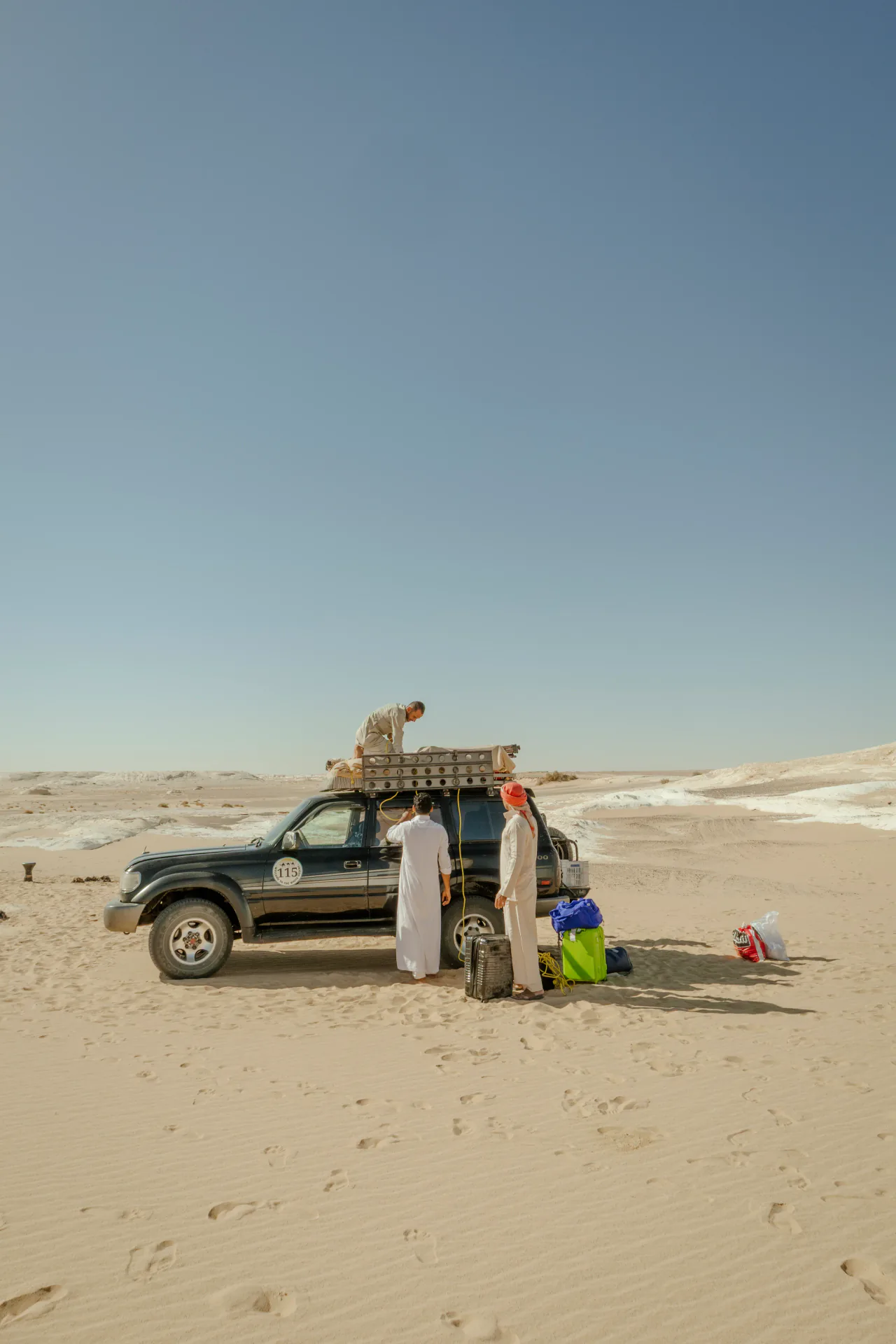
A 4x4 vehicle is essential for many desert routes, but it is not immune to failure.
Potential problems include:
- Tire damage.
- Overheating.
- Battery failure.
- Electrical faults.
- Suspension damage.
- Fuel problems.
- Getting stuck in sand.
- Air-conditioning failure.
In winter, a mechanical delay may be uncomfortable.
In August, it may expose passengers to dangerous heat while help is organized.
What a Specialist Vehicle Plan Includes
Ask whether the operation has:
- Vehicles inspected for the event.
- Suitable tires and more than one usable spare where appropriate.
- Recovery equipment.
- Tools and essential parts.
- Experienced local drivers.
- Backup fuel.
- Water distributed across more than one vehicle.
- A second vehicle or convoy support.
- An agreed route and check-in schedule.
- A plan for air-conditioning failure.
- A recovery and evacuation decision point.
“New car” is not an emergency plan.
Risk 6: Becoming Lost or Separated
The Western Desert can appear visually simple while offering few obvious reference points.
Tracks may:
- Divide.
- Disappear.
- Shift with sand.
- Be blocked or restricted.
- Lead toward different camps.
- Become difficult to recognize after dark or dust.
A guest who walks away for a photograph may lose sight of camp faster than expected.
Group-Control Measures
A specialist team should define:
- Guest boundaries.
- Head counts.
- Buddy rules.
- Toilet routes.
- Night lighting.
- Staff positions.
- Vehicle departure checks.
- Photographer zones.
- What happens if someone is missing.
Children should never move independently around a remote camp.
Risk 7: Limited Phone Reception
Current official travel advice notes limited phone reception and poor medical facilities in parts of Bahariya, Farafra and the White and Black Desert areas.
This means a plan cannot depend on:
- One guest’s mobile phone.
- Live map data.
- Continuous WhatsApp access.
- A hotel reception desk.
- Immediate ambulance arrival.
A specialist team should clarify:
- Which networks work at which stages.
- Whether radios or satellite communications are used.
- How vehicles report their position.
- Who contacts authorities.
- Where the nearest reliable communication point is.
- What happens if the primary device fails.
Internet access, when available, is a convenience. Emergency communication is a separate operational requirement.
Risk 8: Distance From Medical Care
A first-aid kit is important, but it does not replace medical care.
The operation should know:
- The nearest clinic or hospital from each major route segment.
- Expected travel time under realistic conditions.
- Which vehicle can leave immediately.
- Who remains with the group.
- How the camp coordinates with local authorities.
- What happens if more than one guest is unwell.
- Which cases require direct evacuation rather than camp observation.
A medical professional or trained responder on site can improve assessment and early care, but the operator should state the actual qualification rather than use vague language such as “medical support available.”
Risk 9: Medication and Chronic Conditions
Heat can affect both the traveler and the traveler’s medication.
CDC guidance notes that some medicines may increase dehydration or overheating risk, while some medicines and devices require temperature-controlled storage.
Travelers should discuss the trip with a clinician when they have:
- Heart disease.
- Respiratory disease.
- Kidney disease.
- Diabetes.
- Neurological conditions.
- A history of fainting or heat illness.
- Pregnancy.
- Medication requiring refrigeration.
- Electronic medical devices.
- Limited mobility.
Do not stop or change medication because of a general travel article.
The operator should ask about operational needs, but it should not provide medical clearance.
Read the dedicated guide for seniors and travelers with health conditions.
Risk 10: Food Storage and Hygiene
Summer heat increases the importance of:
- Refrigeration.
- Safe water.
- Clean food preparation.
- Handwashing.
- Waste control.
- Short serving times.
- Protection from insects and dust.
A stomach illness that causes vomiting or diarrhea can quickly worsen dehydration.
Ask:
- How cold food is transported.
- How refrigeration is powered.
- What happens during power failure.
- Where hands and utensils are washed.
- How drinking water is stored.
- Whether dietary needs are confirmed in advance.
Risk 11: Power Failure
In a winter camp, power may mainly support lighting and charging.
In an August eclipse camp, power can support:
- Climate-controlled rest or sleeping spaces.
- Refrigeration.
- Medical devices.
- Communications.
- Water pumping.
- Lighting.
- Charging.
That makes backup power a safety issue.
The operator should define:
- Primary generation.
- Backup generation.
- Fuel reserve.
- Maintenance.
- Critical-load priority.
- What remains cooled during a failure.
- How guests are moved if cooling cannot be restored.
Do not accept “generator available” as the complete answer.
Risk 12: Dust and Wind
Wind can affect:
- Visibility.
- Breathing comfort.
- Eye irritation.
- Tent stability.
- Cooking.
- Solar filters.
- Cameras and telescopes.
- Road speed.
- Emergency helicopter or vehicle operations.
A dust event can also hide tracks and increase mechanical wear.
The operation should monitor forecasts and local conditions, then shorten, delay or cancel activities when necessary.
Why Eclipse Day Is Harder Than an Ordinary Safari Day
The eclipse creates unusual pressure.
The Event Has a Fixed Time
A sunset can be watched tomorrow.
Totality cannot be delayed because a vehicle is late or a guest becomes unwell.
The Partial Phases Last for Hours
Guests may be outdoors or moving between observation and cooled areas for a long period. The most visually dramatic minutes occur near midday, when heat planning is critical.
People Ignore Their Bodies
Excitement can cause travelers to:
- Skip water.
- Refuse shade.
- Stand for too long.
- Carry heavy equipment.
- Delay reporting symptoms.
- Remain in the field to protect a tripod or camera.
Equipment Creates Extra Work
Photographers may carry:
- Telephoto lenses.
- Tripods.
- Tracking mounts.
- Batteries.
- Filters.
- Computers.
The field needs safe transport, marked zones, charging and staff who understand that equipment should never take priority over health.
Road Congestion May Increase
Other groups may use the same regional roads. Guests should arrive in Bahariya before eclipse day and stay near the verified field rather than depend on a long same-day transfer from Cairo.
Ordinary Safari vs Specialized August Eclipse Operation
| System | Ordinary cool-season safari | Specialized August eclipse operation |
|---|---|---|
| Activity schedule | Long outdoor windows | Short controlled windows with cooled recovery |
| Camp | Basic tents may be appropriate | Verified climate-controlled recovery or sleeping spaces required |
| Power | Lighting and charging | Cooling, refrigeration, communications and critical backup |
| Water | Normal route provision | Guest supply plus separately distributed emergency reserve |
| Vehicles | Standard local 4x4 plan | Heat-prepared vehicles, recovery and backup transport |
| Medical planning | First aid and route support | Heat monitoring, trained response and defined evacuation route |
| Capacity | May vary by departure | Must be limited by cooling, toilets, vehicles, water and medical capacity |
| Eclipse field | Not applicable | Separately verified coordinates inside totality |
The specialized operation should be built around the weakest critical system. A camp cannot safely accept more guests than its cooling, water, toilets, transport or medical response can support.
What a Specialized Local Team Actually Changes
The value of a local team is not a guide wearing a company shirt.
It is integrated control of:
- Permits.
- Route selection.
- Local authorities and checkpoints.
- Drivers.
- Vehicles.
- Fuel.
- Recovery.
- Water.
- Food.
- Camp layout.
- Cooling.
- Power.
- Toilets.
- Waste.
- Medical response.
- Guest movement.
- Eclipse-field timing.
- White Desert excursions.
A team based in or closely connected with Bahariya can react to local road, service and weather changes faster than an itinerary designed only from Cairo.
Read why an eclipse trip needs a specialized local team rather than a regular safari.
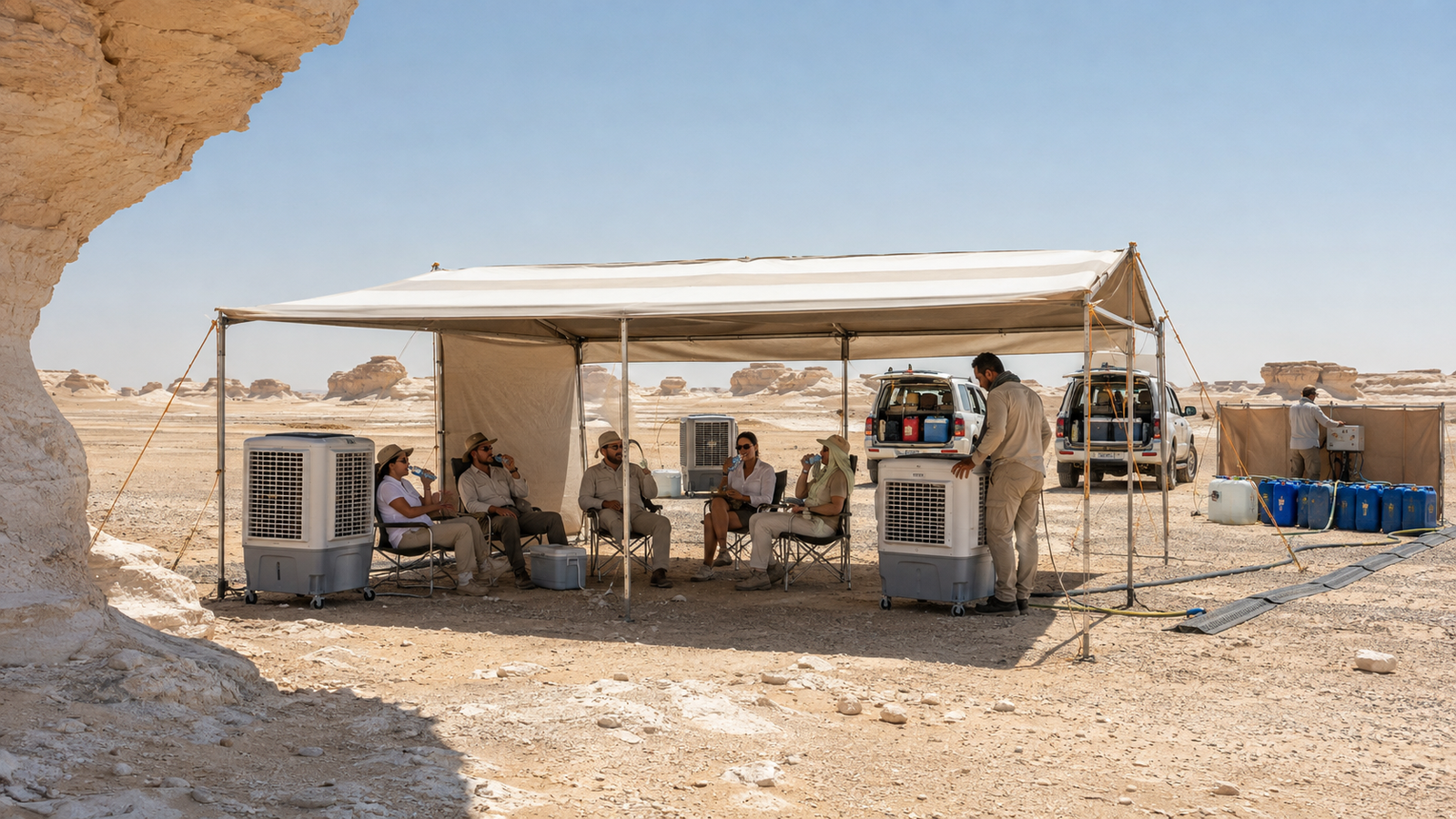
The Role of the Air-Conditioned Camp
A climate-controlled camp does not make unlimited outdoor activity safe.
Its value is to create a controlled recovery system.
Guests can use cooled areas to:
- Sleep.
- Rest before the partial phases.
- Recover between observation periods.
- Store selected medication correctly.
- Reduce cumulative heat load.
- Eat and hydrate comfortably.
- Wait during operational delays.
The field itself must remain open to the sky. Shade and cooled areas should be close enough for practical use without obstructing observation.
Before booking, verify:
- Which spaces are cooled.
- Cooling method.
- Guest capacity per space.
- Backup power.
- Fuel reserve.
- Temperature monitoring.
- Distance to the field.
- Policy if cooling fails.
Explore the detailed air-conditioned eclipse camp guide and the main White Desert eclipse camp page.
Who Should Not Book Without Medical Advice
Seek personal medical advice before committing if you:
- Have significant heart or lung disease.
- Have kidney disease or fluid restrictions.
- Use medication affected by heat.
- Need refrigerated medication.
- Have a history of heatstroke.
- Have poorly controlled diabetes.
- Have mobility limitations affecting fast evacuation.
- Are pregnant.
- Are responsible for a very young child.
- Recently had major surgery or serious illness.
The operator should be willing to say that a trip may not suit everyone.
That is a sign of professionalism, not poor sales.
Children and Summer Desert Travel
Children may become dehydrated or overheated without communicating clearly.
Parents need:
- Constant supervision.
- Age-appropriate eclipse glasses.
- Short outdoor periods.
- Immediate cooled rest.
- Familiar food and fluids.
- Child-safe transport.
- Reliable toilet access.
- A plan for boredom during long partial phases.
- Clear rules preventing independent movement around camp.
Read the eclipse safety rules for children and families and the child policy.
Older Travelers
Age alone does not prevent desert travel.
The relevant questions are:
- Heat tolerance.
- Walking ability.
- Medication.
- Heart and respiratory health.
- Ability to enter vehicles.
- Need for accessible toilets.
- Distance from cooled areas to the field.
- Emergency evacuation needs.
A strong program allows a guest to experience totality without completing every desert activity.
What Travelers Must Do
A specialized team cannot compensate for every personal decision.
Guests should:
- Disclose relevant health and mobility information.
- Follow the activity schedule.
- Drink regularly.
- Use shade and cooling before symptoms appear.
- Report headache, dizziness, nausea, weakness or unusual behavior early.
- Avoid alcohol before and during demanding heat exposure.
- Wear light, loose clothing, a wide-brimmed hat and suitable footwear.
- Keep medication protected according to professional advice.
- Never leave the marked camp or field area alone.
- Prioritize health over photography.
The practical preparation steps are explained in How to Prepare for Egypt’s Desert Heat in August.
What Not to Do
Do not:
- Leave Cairo for Bahariya on eclipse morning.
- Book a summer trip with no written cooling details.
- Depend on one vehicle.
- Depend on one generator.
- Depend on one mobile phone.
- Enter remote tracks without permits and an official guide.
- Walk away from camp for a private photograph.
- Assume water alone prevents heatstroke.
- Ignore confusion or slurred speech.
- Store medication in a hot vehicle without checking requirements.
- Let a child use eclipse glasses unsupervised.
- Use a camera or telescope without a front-mounted solar filter during partial phases.
- Continue an activity because it is listed in the itinerary when conditions are unsafe.
For solar-viewing protection, use the eclipse-glasses buying guide and eclipse photography safety guide.
Questions to Ask the Operator
- Are you licensed for this route?
- Are permits included?
- Where is the final or representative eclipse field?
- How far is it from the path boundary?
- Is the field separate from standard White Desert excursion sites?
- Where will guests sleep?
- Which areas are air-conditioned or climate controlled?
- How many guests can each cooled space support?
- What is the backup-power plan?
- How much fuel reserve is held?
- How is drinking water distributed?
- Is emergency water stored in more than one vehicle?
- How many vehicles support the group?
- What recovery equipment is carried?
- What happens if vehicle air conditioning fails?
- Which communication systems work without mobile signal?
- Who is responsible for first aid?
- What are their qualifications?
- Where is the nearest clinic or hospital?
- What is the evacuation route?
- How are children supervised?
- What accommodations exist for older or mobility-limited guests?
- How are medicines and food refrigerated?
- What is the maximum guest capacity?
- Which activities are canceled in severe heat or wind?
- When do guests arrive in Bahariya?
- How close is accommodation to the viewing field?
- Are ISO-compliant eclipse glasses supplied?
- What happens if the field or route must change?
- What are the booking and cancellation terms?
A professional operator should answer in practical terms rather than responding only with “do not worry.”
Common Marketing Claims to Question
“The Desert Is Dry, So the Heat Is Easy”
Dry air can make sweat evaporate, but that does not remove heat risk. It can make fluid loss less noticeable.
“We Have a 4x4”
Ask about maintenance, backups, recovery and air-conditioning failure.
“The Camp Is Air-Conditioned”
Ask which areas, what capacity and what backup power.
“Our Guides Know the Desert”
Ask who holds permits, who drives, who handles medical response and where the team is based.
“Mobile Internet Is Available”
Internet access is not an emergency communication plan.
“Clear Sky Is Guaranteed”
No operator can guarantee clear sky.
“The White Desert Is Inside Totality”
The tourism region covers many coordinates. The eclipse field must be verified separately.
Frequently Asked Questions
Is the White Desert safe in summer?
A normal summer safari is not recommended. August travel should only be considered through a specialist operation designed for heat, permits, remote logistics, cooling, backup vehicles and medical response.
Why is August 2027 different?
The total solar eclipse creates a rare reason to travel, but the operation must be designed specifically around summer conditions.
Is drinking plenty of water enough?
No. Hydration is one part of a system that includes cooling, shade, activity timing, monitoring and emergency response.
What is the difference between heat exhaustion and heatstroke?
Heat exhaustion may include headache, nausea, dizziness, weakness, thirst and heavy sweating. Heatstroke can include confusion, slurred speech, seizures, fainting and loss of temperature control and requires emergency treatment.
Should I give water to someone with heatstroke?
Do not force fluids into an unconscious or confused person. Seek emergency medical help and begin rapid cooling according to trained guidance.
Can heatstroke happen while someone is sweating?
Yes. Sweating does not reliably exclude heatstroke.
Can I drive a rental car to the White Desert?
Unsupported self-driving is inappropriate. Current guidance requires advance permits and an official or licensed guide for the Bahariya, Farafra, White Desert and Black Desert areas.
Is a single 4x4 safe?
A vehicle can fail. Ask for recovery, communication and backup-transport arrangements.
Is mobile reception available?
Reception can be limited. The operation should not depend on one mobile phone.
Are medical facilities close?
Medical access can be limited. The team should define the nearest appropriate facility and evacuation route.
Is a normal camping tent enough in August?
No. A specialist event requires verified cooled recovery or sleeping areas, shade, water, sanitation and backup power.
Does an air-conditioned camp eliminate the risk?
No. It reduces cumulative heat exposure when it is properly engineered and used within a controlled schedule.
Can children join?
Potentially, but only with strict supervision, short outdoor periods, cooled recovery, appropriate transport and a clear family-safety plan.
Can seniors join?
Potentially. Suitability depends on health, medication, mobility, cooling access and medical advice.
Should I consult a doctor?
Travelers with chronic conditions, pregnancy, heat-sensitive medication, mobility concerns or previous heat illness should seek personal medical advice.
Is the eclipse viewed in the famous White Desert formations?
Not automatically. The final viewing field should be a separately verified coordinate inside totality.
Should I arrive on eclipse morning?
No. Arrive in the Bahariya region before the event and stay close to the field.
What if the weather changes?
The operator should have a site and schedule decision process, but no plan can guarantee clear sky.
How do I choose a reliable team?
Ask for permits, local experience, field coordinates, vehicle backups, cooling specifications, power redundancy, water, communications, medical response and written terms.
How do I book?
Compare the 2027 eclipse packages or check current availability.
Final Takeaway
The White Desert is not an inherently reckless destination.
Improvised summer travel is the problem.
Risk increases when severe heat, remote routes, weak communications, vehicle dependence and limited medical access are managed as separate inconveniences rather than one connected system.
A specialized local team reduces those risks by controlling permits, routes, vehicles, backup transport, water, cooling, power, guest capacity, communication and emergency response.
The August 2, 2027 eclipse is exceptional enough to justify a specialist operation. It does not justify using a normal winter safari model in summer.
The strongest plan is to arrive in Bahariya before eclipse day, stay with a managed Western Desert eclipse camp near a separately verified totality field, use cooled recovery areas and controlled observation zones, and schedule White Desert experiences during safer periods.
Explore the air-conditioned camp plan, compare the 2027 eclipse packages, or check availability.
Authoritative planning reference
Use CDC heat guidance as a primary reference, then verify local circumstances for the exact location.