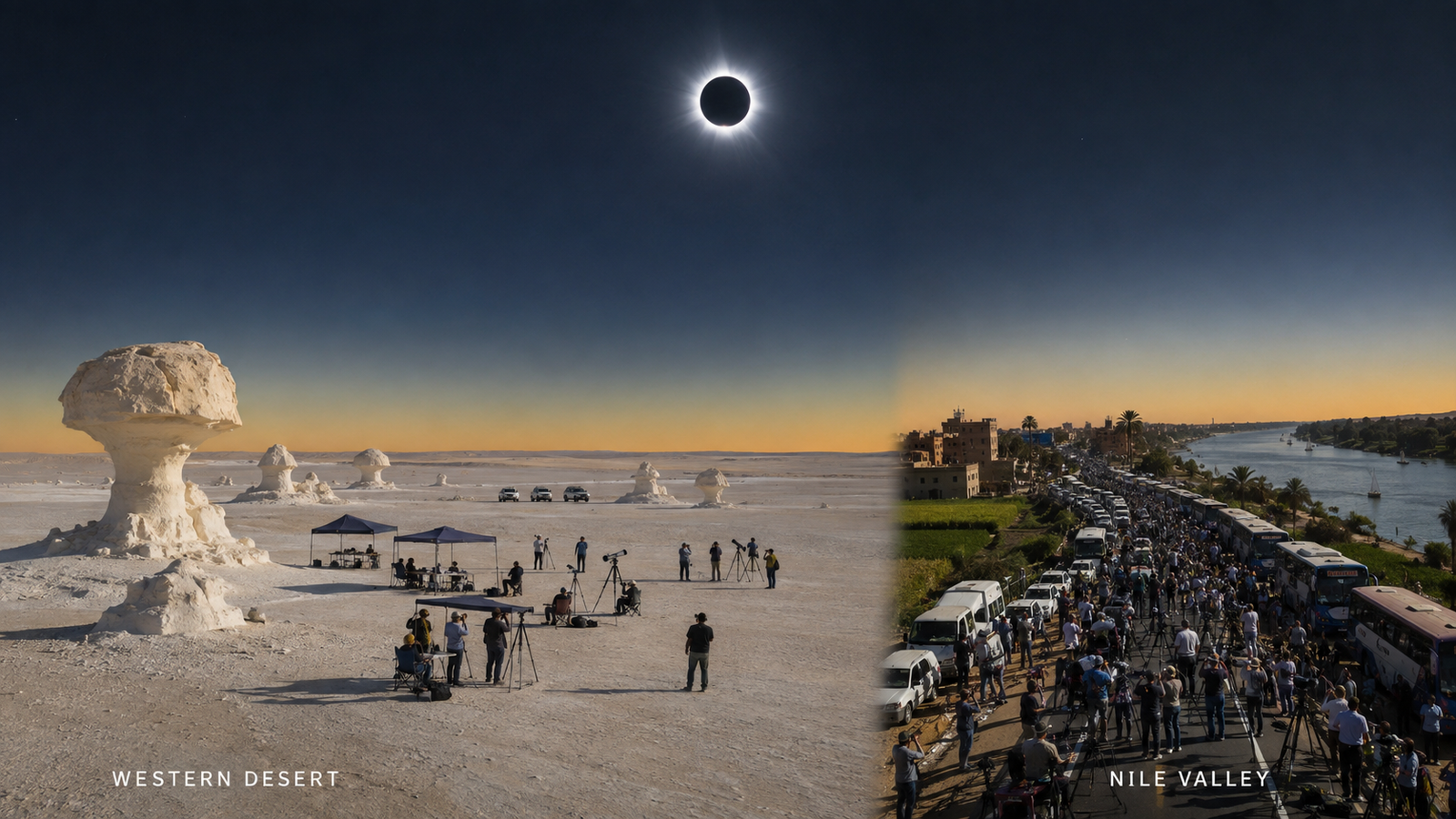
Western Desert vs Nile Valley eclipse: quick answer
Western Desert vs Nile Valley eclipse: The Western Desert vs Nile Valley eclipse decision is not as simple as comparing five seconds on a timing table. Luxor is one of the strongest city-based locations anywhere along the August 2, 2027 total solar eclipse path. Representative coordinates receive approximately
The Western Desert vs Nile Valley eclipse decision is not as simple as comparing five seconds on a timing table.
Luxor is one of the strongest city-based locations anywhere along the August 2, 2027 total solar eclipse path. Representative coordinates receive approximately 6 minutes 22 seconds of totality. The city has hotels, an airport, Nile cruises, established guides and some of the world’s most important archaeological sites.
Representative Bahariya Oasis coordinates receive approximately 6 minutes 17 seconds. That is only about five seconds shorter than Luxor, yet a purpose-planned Western Desert program can offer something a major city may struggle to provide: a private viewing field, controlled capacity, open space, separation between vehicles and tripods, dedicated cooling, local desert operations and accommodation close to the observation site before eclipse day.
For a traveler whose priority is ancient monuments, established hotels and the longest practical city totality, Luxor may remain the better choice.
For a traveler whose priority is a controlled, low-distraction and immersive eclipse experience, the confirmed Western Desert eclipse-camp region between the White Desert and the Black Desert, inside the path of totality can be the stronger overall product.
This article explains where the Western Desert genuinely wins, where the Nile Valley remains stronger, and what must be verified before either option is booked.
For the broader destination ranking, read the best place in Egypt for the 2027 eclipse.
Quick Answer
| Question | Western Desert near Bahariya | Nile Valley / Luxor |
|---|---|---|
| Representative totality | About 6m17s near Bahariya | About 6m22s in Luxor |
| Main strength | Controlled private-field potential | Near-maximum duration and established tourism |
| Crowd environment | Potentially lower public density at a capped private camp | Expected to be Egypt’s main eclipse hub |
| Accommodation style | Hotel plus purpose-built camp or camp-based program | Hotels, cruises, apartments and conventional tourism services |
| Viewing-site control | Potentially high if land, permits and camp are confirmed | Depends on private field, hotel, cruise or public event |
| Photography space | Potential for marked tripod zones and open sky | Excellent astronomy but more competition for space |
| Cultural program | Bahariya, Black Desert and White Desert landscapes | Temples, tombs, museums and Nile experiences |
| Access | Organized road journey from Cairo | Airport, rail, road and cruise access |
| Best for | Totality-first travelers, controlled groups and desert enthusiasts | First-time Egypt visitors and culture-focused travelers |
The correct conclusion is not that the Western Desert is universally better. It is better for a specific type of eclipse traveler and only when the camp is professionally designed.
What “Western Desert” and “Nile Valley” Mean in This Comparison
The Western Desert covers a vast area. It includes multiple oases, protected regions, roads, settlements and tourism circuits.
In this article, the commercial Western Desert option means:
- Arrival through Cairo.
- Organized transfer to Bahariya Oasis.
- A viewing field separately verified inside the path of totality.
- A purpose-planned eclipse camp or nearby accommodation.
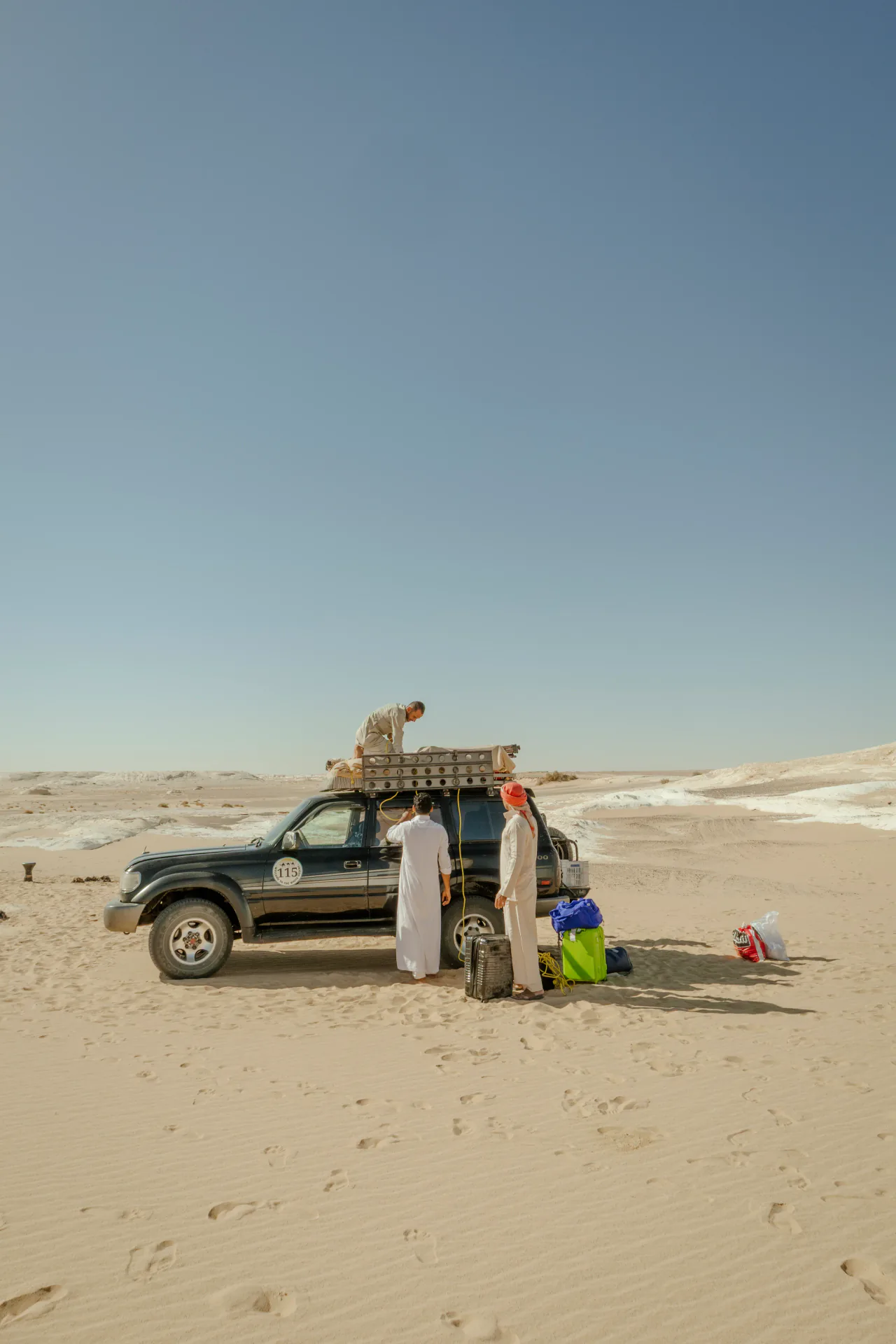
- Local desert drivers and guides.
- Optional Black Desert and White Desert experiences before or after the central event.
It does not mean that every standard White Desert or Farafra tourist location is inside totality.
The Nile Valley option mainly refers to:
- Luxor.
- Qena.
- Sohag.
- Asyut.
- Edfu and selected Upper Egyptian locations.
- Hotels, Nile cruises and land-based viewing fields.
Luxor receives most international attention because it combines long totality with famous attractions and established services.
Astronomy: Luxor Wins by Seconds, Not by a Different Eclipse
NASA’s standard path calculations place the maximum duration in Egypt at approximately 6 minutes 23.2 seconds.
Representative local values include:
- Luxor: about 6m22s.
- Bahariya: about 6m17s.
- Asyut: about 6m07s.
- Siwa: about 5m33s.
- Marsa Alam: about 5m28s.
Luxor’s approximate advantage over Bahariya is therefore around five seconds.
Five seconds matter to some dedicated eclipse chasers. They do not automatically outweigh:
- A long or uncertain transfer.
- A crowded public field.
- Unverified monument access.
- Inadequate shade.
- Poor toilet provision.
- Vehicle movement around tripods.
- Limited medical support.
- Difficulty reaching the field early.
- A hotel located far from the actual viewing point.
Once a site already provides more than six minutes of totality, operational quality becomes extremely important.
Where Luxor Is Stronger
A fair comparison should begin by recognizing Luxor’s genuine advantages.
Established International Destination
Luxor already supports international tourism with hotels, guides, restaurants, transport companies, hospitals and tourism services.
Airport Access
Guests may reach the city by air rather than depending entirely on a long overland transfer from Cairo.
Near-Maximum Totality
Approximately 6 minutes 22 seconds is extraordinary. It is only about one second below the global maximum.
Cultural Importance
The city offers temples, tombs, museums, the Nile and one of the world’s most concentrated archaeological landscapes.
Accommodation Choice
Luxor has conventional hotels, resorts, apartments, cruise vessels and other established lodging types, although eclipse-period availability may be constrained.
Strong Value Beyond the Eclipse
If weather interferes, travelers still have a major cultural trip.
Easier Fit for Conventional Tourism
Visitors who prefer a standard hotel, city restaurants and familiar tourism infrastructure may feel more comfortable in Luxor than in a remote camp.
Read the complete Luxor eclipse guide for local timing and operational planning.
Where Luxor Becomes More Difficult
The same popularity that makes Luxor attractive can create pressure.
Concentrated Demand
Luxor is widely promoted as one of Egypt’s main eclipse hubs. Some specialist sites claim that large blocks of hotel capacity are already contracted or unavailable.
Exact visitor totals cannot be predicted responsibly. It is still reasonable to expect demand to concentrate around the city because it dominates international coverage.
Road Pressure
Hotels, cruise vessels, public events and private fields may all move guests during similar periods. The eclipse cannot wait for traffic.
Protected-Site Restrictions
Karnak, Luxor Temple, the Valley of the Kings and other heritage sites should not be advertised as viewing venues without written authorization.
Public-Space Control
A famous city cannot automatically prevent:
- Walk-in crowds.
- Vehicle noise.
- Artificial lights.
- People crossing tripod lines.
- Last-minute road closures.
- Inconsistent announcements.
- Overcrowded rooftops.
Price and Inventory Pressure
High demand may affect hotels, vehicles, guides and cruises. Travelers should verify that inventory is contracted rather than merely requested.
Midday Heat
The partial phase begins before noon and ends in mid-afternoon. Shade and cooling are essential even in a city with established infrastructure.
Where the Western Desert Can Win
The Western Desert does not win because it is empty. It wins when emptiness is turned into a professionally managed viewing environment.
1. A Private Viewing Field
A private permitted field can control entry and capacity.
This can reduce:
- Public crowd pressure.
- Vehicle movement.
- Tripod interference.
- Artificial lighting.
- Uncontrolled announcements.
- Last-minute changes caused by unrelated visitors.
The field still needs written permission, exact coordinates and a defined emergency route.
2. Accommodation Close to the Eclipse Site
The camp can be designed around the viewing field rather than added to a distant city itinerary.
Guests can:
- Arrive before eclipse day.
- Sleep near the field.
- Attend a safety briefing.
- Test filters and tripods.
- Rest before the event.
- Reach the observation zone through a short controlled movement.
- Remain after totality until departure is safe.
This is a major advantage over a long eclipse-morning transfer.
3. Controlled Capacity
A camp can cap attendance according to:
- Land area.
- Toilet capacity.
- Shade.
- water supply.
- Cooling capacity.
- Vehicles.
- Medical support.
- Kitchen service.
- Power.
- Emergency planning.
A sold-out camp can stop taking bookings. A public city cannot stop independent travelers from arriving.
4. Open Observation Space
A broad field can separate:
- General observers.
- Family zones.
- Long-lens photographers.
- Telescopes.
- Media teams.
- Medical and staff areas.
- Vehicles.
- Food service.
- Shade structures.
The Sun will stand very high, so the field does not need a dramatic horizon. It does need clear overhead space and shade positioned so it does not obstruct the view.
5. Lower Urban Distraction
A desert field can reduce:
- Traffic noise.
- Buildings.
- Rooftop antennas.
- Uncontrolled music.
- Street lighting.
- Crowded sidewalks.
- Cruise schedules.
- Public access conflicts.
Totality lasts minutes. A calmer environment can help guests experience it rather than manage distractions.
6. A Locally Integrated Operation
Bahariya-based teams understand the local roads, drivers, fuel, water, settlements, desert tracks and support network.
That continuity matters more than importing a city itinerary and adding a temporary field at the last moment.
7. A Complete Western Desert Journey
The package can include:
- Bahariya Oasis.
- The Black Desert.
- Crystal Mountain.
- Agabat.
- White Desert formations.
- Local springs and oasis landscapes.
- Desert sunsets and night skies.
- The managed eclipse camp.
The central viewing field should remain separately verified. The White Desert excursions add travel value without being used as a false path claim.
The Western Desert’s Real Challenges
A responsible comparison must not romanticize remote desert travel.
Heat
August conditions are demanding. Ordinary winter camping procedures are not enough.
Power
Air conditioning, refrigeration, lighting, charging, communications and medical equipment require reliable power and backup systems.
Water
The camp needs sufficient drinking, kitchen, cleaning and emergency water.
Toilets and Waste
Dedicated sanitation and waste removal must match guest capacity.
Medical Response
The operator should define:
- On-site first aid.
- Heat-illness response.
- Nearest clinic or hospital.
- Evacuation route.
- Vehicle availability.
- Communication procedure.
- Medication storage.
Land Permission
An attractive satellite location is not automatically legal or available.
Road and Vehicle Reliability
The route from Cairo and local desert movement need suitable vehicles, drivers, fuel and backup plans.
Communications
Mobile coverage may be weak. The operator should not promise continuous internet unless verified.
Dust and Wind
Open space can be affected by dust. Equipment and guest comfort plans should address it.
Facilities Must Be Real
“Air-conditioned camp” should mean a confirmed technical solution, not a marketing phrase. The final product should state exactly which spaces are cooled and how capacity is supported.
Read the White Desert summer safety warning and the air-conditioned eclipse camp guide.
Crowd Comparison Without Invented Numbers
No trustworthy source can currently state exactly how many people will be present in Luxor or at every Western Desert event.
The responsible comparison is qualitative.
Luxor has:
- Global name recognition.
- Very long totality.
- Major monuments.
- Airport access.
- Extensive media attention.
- Many announced packages.
- Independent travelers and organized groups using the same city.
A private Bahariya camp can:
- Set a fixed capacity.
- Admit registered guests only.
- Control buses and 4x4 vehicles.
- Close sales when operational limits are reached.
- Separate staff and guest zones.
- Prevent public vehicles from entering the field.
That does not mean the entire Western Desert will be empty. Multiple operators may establish camps, and main roads or oasis services may become busy.
The advantage is local control inside one defined operation, not a guarantee of regional solitude.
Viewing-Field Control: The Most Underrated Factor
The best destination article often asks, “How long is totality?”
A better operational question is, “What happens in the final ten minutes before totality?”
At a controlled field:
- Guests are already in position.
- Vehicles are stopped.
- Filters are checked.
- Children are supervised.
- Announcements are clear.
- Lights are off.
- Staff know the contact schedule.
- Photographers have marked space.
- Medical staff can reach guests.
- No one is still searching for parking.
The quality of those ten minutes may matter more than five additional seconds of totality.
Heat Management: City Infrastructure vs Purpose-Built Camp
Luxor
Luxor hotels and buses can provide air conditioning. The main challenge is the viewing field itself.
Guests may still need:
- Shade.
- Cold water.
- Toilets.
- Seating.
- Cooling.
- Medical support.
- A short route back to air conditioning.
Western Desert
The camp must create these systems from the ground up.
A strong design can place:
- Climate-controlled sleeping or rest areas.
- Shaded lounges.
- Cold-water stations.
- Toilets.
- Medical point.
- Open viewing field.
The field remains open to the sky, while guests use cooled areas during selected partial phases.
The desert is not automatically safer than Luxor. It becomes competitive only when the infrastructure is designed specifically for August.
Weather and Sky Quality
Egypt’s dry summer climate is a major advantage along much of the path.
Historical cloud averages can help compare regions, but they cannot guarantee one specific afternoon.
Both Luxor and the Western Desert can face:
- High cloud.
- Dust.
- Haze.
- Wind.
- Heat shimmer.
- Local smoke.
- Unexpected weather changes.
The Western Desert may offer lower urban light and pollution, but totality occurs around midday, so ordinary nighttime light pollution is not the decisive factor. Open space, dust and local atmospheric clarity matter more.
An operator should never guarantee clear sky.
Photography: Why the Desert Can Be Easier
The eclipse Sun will be very high.
Photographers in both regions need to rehearse near-vertical tracking.
A private desert field can offer:
- Marked tripod positions.
- Separation between long lenses and casual observers.
- Vehicle exclusion.
- Controlled artificial lights.
- Clear walkways.
- Equipment tables.
- Charging.
- Staff announcements.
- Open overhead space.
Luxor can offer powerful cultural imagery, but famous monument compositions may require permission, distance, planning and honest labeling.
A wide-angle image that appears to place totality directly above a temple may be a composite. Composites should be disclosed.
For detailed preparation, read the 2027 eclipse photography guide.
Families and Older Travelers
Luxor may be easier for travelers who need conventional hotel facilities, elevators, hospitals and familiar services.
A desert camp can work for families and older guests only when it provides:
- Short walking distances.
- Stable surfaces.
- Seating.
- Accessible toilets.
- Cooling.
- Water.
- Child supervision.
- Medical support.
- Vehicle access.
- Medication storage.
- Clear emergency response.
The operator should not assume every traveler can walk across sand or tolerate heat.
The correct choice depends on the actual facilities, not the destination label.
Nile Cruise vs Desert Camp
A Nile cruise offers:
- Cabins.
- Dining.
- Air conditioning.
- Nile scenery.
- Access to major sites.
- A familiar organized-tour structure.
Its eclipse limitations may include:
- Uncertain vessel position.
- Navigation schedules.
- Docking rules.
- Limited deck capacity.
- Masts, roofs or shade structures.
- Restricted tripod space.
- River traffic.
- Dependence on the captain’s approved plan.
A desert camp offers:
- A fixed land coordinate.
- A purpose-planned observation field.
- Larger potential tripod zones.
- Controlled vehicle access.
- Flexible field layout.
Its limitations are the need to build almost all support systems temporarily.
A cruise is not automatically safer, and a camp is not automatically better. The operational documents decide.
Access from Cairo
For many international travelers, Cairo is the arrival gateway.
The Bahariya route can be designed as one organized road journey with pickup, support vehicles and a planned camp arrival.
A Luxor plan may use:
- Domestic flight.
- Overnight train.
- Long road transfer.
- Nile cruise.
- Combination itinerary.
Luxor’s airport is a major advantage. Bahariya’s road connection is an advantage for operators already based in the oasis and for travelers who want to avoid another flight.
The key rule is the same: guests should be in the viewing region before eclipse day.
Read the Cairo to Bahariya Oasis journey guide.
Cultural Experience: Monuments vs Landscape
Luxor offers an unmatched concentration of ancient sites.
The Western Desert offers:
- Geological formations.
- Oasis life.
- Black volcanic hills.
- White chalk landscapes.
- Desert camps.
- Night skies.
- A sense of expedition.
Neither experience is objectively better.
Travelers choosing Luxor usually want the eclipse integrated into a major ancient-Egypt itinerary.
Travelers choosing Bahariya usually want the eclipse to be the center of a desert journey.
Who Should Choose Luxor?
Luxor is a strong choice for:
- First-time visitors to Egypt.
- Travelers prioritizing temples and tombs.
- Guests who prefer established hotels.
- People who want near-maximum totality.
- Travelers who value airport access.
- Nile cruise guests.
- Visitors uncomfortable with remote camps.
- Travelers needing extensive conventional medical or accessibility infrastructure.
Who Should Choose the Western Desert?
The Bahariya-based program is a strong choice for:
- Travelers prioritizing a controlled totality field.
- Photographers needing organized tripod space.
- Guests arriving through Cairo.
- People who want lower urban density.
- Travelers seeking a private group atmosphere.
- Visitors who want White Desert experiences.
- Guests who prefer staying close to the field.
- People who value local desert operations.
- Repeat Egypt visitors looking for a different journey.
Choose the Western Desert Package That Fits Your Trip
Instead of treating the Western Desert as one generic itinerary, compare the live 2-, 3- and 4-day options according to time, comfort and transport style:
- 2 days / 1 night: one eclipse-camp night for the shortest focused experience.
- 3 days / 2 nights: one Bahariya hotel night plus one eclipse-camp night for a stronger balance of comfort and desert time.
- 4 days / 3 nights: two five-star Bahariya hotel nights plus one premium eclipse-camp night, with private transport available as an optional upgrade.
See the current Bahariya / Western Desert eclipse packages for live pricing, dates and inclusions before booking flights.
Sample Luxor Eclipse Itinerary
Day 1 — Arrival in Luxor
Hotel transfer and rest.
Day 2 — Cultural Touring
Selected east-bank or west-bank visits.
Day 3 — Field Rehearsal
Equipment and safety briefing.
Day 4 — Eclipse Day
Early transfer to a private permitted field, observation, rest and staged return.
Day 5 — Nile or Archaeological Extension
Continue the cultural itinerary.
Luxor still requires a dedicated viewing-field plan. A hotel booking alone is not enough.
What to Verify Before Booking Either Option
Ask for:
- Exact or representative viewing coordinates.
- Local totality duration.
- Distance from the path boundary.
- Land permission.
- Final accommodation category.
- Distance from accommodation to field.
- Transport schedule.
- Guest capacity.
- Shade and cooling.
- Drinking-water plan.
- Toilets.
- Medical support.
- Emergency route.
- Eclipse glasses.
- Photography rules.
- Power and charging.
- Backup vehicles.
- Policy for site changes.
- Cancellation terms.
- Honest weather language.
For the commercial terms, read the booking and cancellation policy.
Common Mistakes
Choosing Only by Seconds
A five-second advantage does not repair a weak field.
Assuming Every Desert Site Is Quiet
A public or poorly managed desert location can still become chaotic.
Assuming Every Luxor Monument Is Available
Protected-site access must be confirmed.
Believing a Hotel Is the Viewing Site
The hotel and field may be separate.
Treating “White Desert” as One Coordinate
The tourism region is geographically broad.
Ignoring Heat
The partial phases occur around midday.
Trusting Exact Crowd Forecasts
Demand is high, but precise future visitor counts are not established.
Believing Weather Is Guaranteed
It is not.
Arriving on Eclipse Morning
This creates avoidable risk.
Booking Without Written Coordinates
A destination name is not sufficient.
Frequently Asked Questions
Is the Western Desert better than Luxor for the 2027 eclipse?
It can be better for travelers who prioritize a controlled private field, lower urban density and a desert journey. Luxor remains stronger for near-maximum city totality and ancient-Egypt tourism.
How much totality does Bahariya receive?
Representative Bahariya coordinates receive approximately 6 minutes 17 seconds. The final camp must be calculated separately.
How much totality does Luxor receive?
Approximately 6 minutes 22 seconds at representative coordinates.
Is five seconds a major difference?
For most travelers, site quality and safety matter more once both options exceed six minutes.
Will Luxor be crowded?
Luxor is expected to attract strong demand because it dominates international coverage. Exact crowd numbers are not yet reliably known.
Is Bahariya guaranteed to be quiet?
No. A managed private camp can control its own capacity, but the wider oasis and roads may still be busy.
Is the White Desert inside totality?
Some Western Desert areas are inside, while common Farafra and White Desert tourist coordinates can be outside. The viewing field must be verified separately.
Is a desert camp safe in August?
Only when it is purpose-designed for heat, water, sanitation, power, medical support and emergency access.
Will the camp be air-conditioned?
The package must state exactly which sleeping and rest spaces are climate controlled. Do not rely on a general marketing phrase.
Is a Nile cruise a good viewing platform?
It can be, but the exact vessel position, deck capacity, obstructions and navigation plan must be confirmed.
Which location is better for photography?
A private desert field may provide stronger tripod control. Luxor provides richer cultural context but more complex permissions and crowd management.
Which option is better for families?
Luxor may offer stronger conventional facilities. A professionally designed camp can work well if cooling, toilets, medical support and child supervision are confirmed.
Which is easier from Cairo?
Bahariya can be reached through an organized road transfer. Luxor offers domestic air access.
Can clear weather be guaranteed?
No.
Should I book independently?
Independent travel is possible, but eclipse-day transport, field permission, cooling and crowd management make a verified package attractive.
Final Takeaway
Luxor is one of the best city-based eclipse destinations on Earth. It offers approximately 6 minutes 22 seconds of totality, established tourism and a cultural program that is difficult to match.
The Western Desert near Bahariya offers a different kind of advantage.
It can place guests close to a verified private field, cap attendance, control vehicles and tripods, design cooling around the event, reduce urban distraction and combine the eclipse with a locally managed Bahariya, Black Desert and White Desert journey.
The representative duration difference is only a few seconds.
For culture-first travelers, Luxor may remain the stronger choice.
For totality-first travelers seeking a controlled private experience, the confirmed Western Desert eclipse-camp region between the White Desert and the Black Desert, inside the path of totality can be the better overall product.
Explore the White Desert eclipse camp, compare the 2027 eclipse packages, or check availability.
Authoritative planning reference
Use NASA 2027 eclipse path data as a primary reference, then verify local circumstances for the exact location.