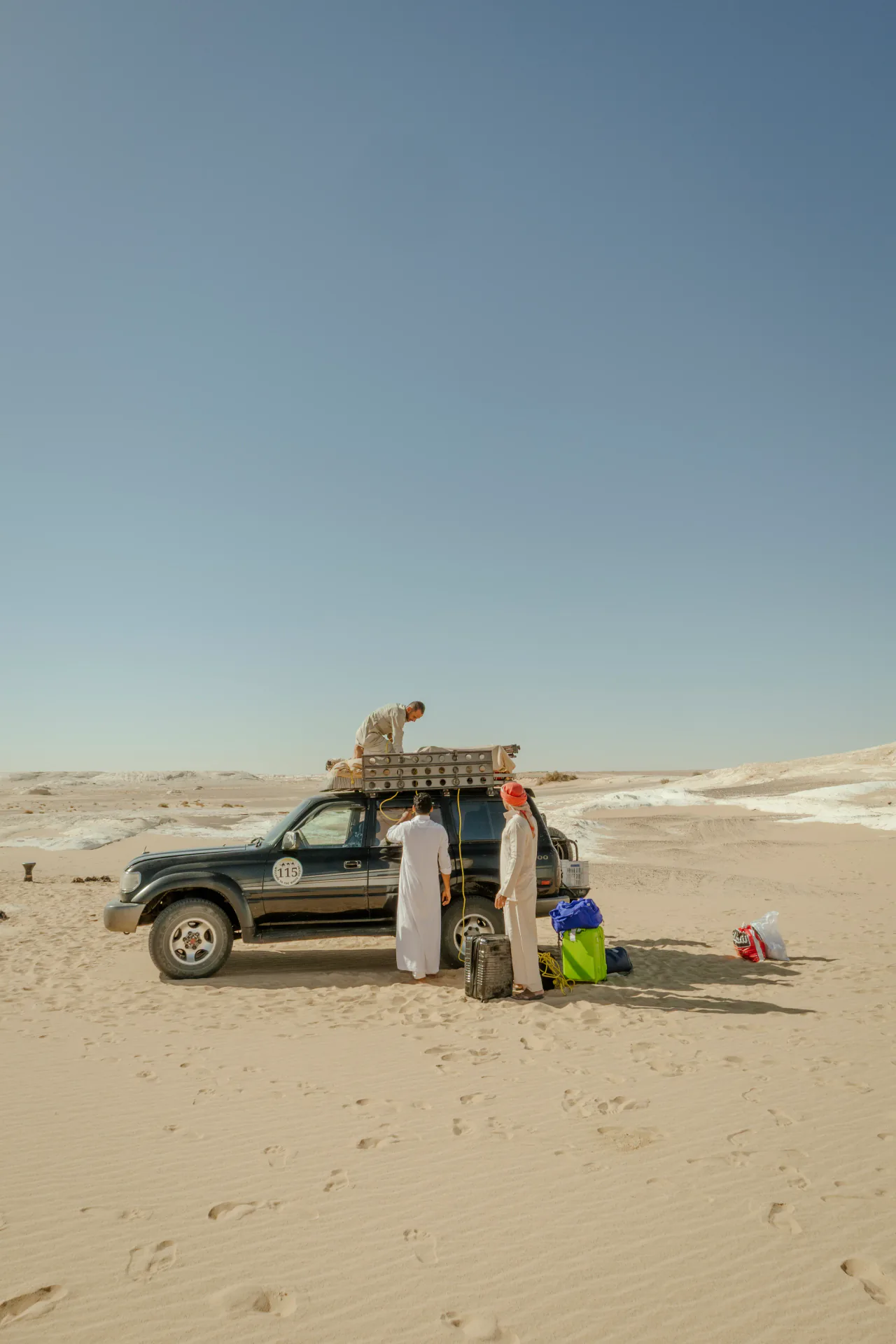
Can you combine the 2 August 2027 total solar eclipse with the Pyramids of Giza and the Grand Egyptian Museum on a seven-day Egypt trip? Yes. A carefully structured week can include Cairo's most important archaeological experiences and a separately booked Western Desert eclipse program. The essential condition is protecting the fixed eclipse date: Monday, 2 August 2027. Unlike a museum appointment or an ordinary sightseeing day, totality cannot be moved when a traveler is late.
This Egypt solar eclipse 2027 with Pyramids itinerary explains how an international visitor can combine Giza, the Grand Egyptian Museum (GEM), Bahariya Oasis and the Western Desert in seven calendar days. It also explains a crucial booking distinction: Solar Eclipse Tours currently sells 2-, 3- and 4-day Western Desert eclipse packages, not one automatically inclusive seven-day Cairo-and-desert package. The sample seven-day programs below are planning frameworks. Cairo hotels, Cairo sightseeing, GEM admission, flights and extra transfers should be booked or separately confirmed; do not infer they are included in the advertised eclipse package.
Egypt's 2027 Solar Eclipse: What Makes the Dates Non-Negotiable?
On 2 August 2027, a narrow path of totality crosses parts of northern Africa and the Middle East, including Egypt. NASA's published circumstances place the global maximum total phase at approximately 6 minutes 23 seconds. That figure belongs to a specific part of the track and is not a guarantee for every Egyptian town, hotel or desert camp. The selected observation field must be checked at its actual latitude and longitude, and the sky still needs to cooperate on the day.
One of the most important facts for a Cairo-based visitor is that Cairo and the Giza Pyramids will see a partial eclipse, not totality. You can have an excellent sightseeing experience in Cairo, but watching the Sun from the Pyramids on eclipse day is not a substitute for visiting a verified location inside the totality corridor. That is why this itinerary separates the Cairo sightseeing days from the Western Desert event.
For the geography, consult the Egypt eclipse path map and 2027 city-by-city eclipse timing guide. For technical boundaries, use NASA's 2 August 2027 eclipse map. The astronomical distinction should guide your accommodation decisions and day-by-day route.
Seven-Day Egypt Eclipse Itinerary: At a Glance
This baseline plan uses the 3-day Western Desert eclipse package, which currently runs 1–3 August 2027. Times are illustrative; international flight schedules, ticket availability, pickup arrangements and confirmed tour operating details control the final trip.
| Date in 2027 | Suggested plan | What to confirm |
|---|---|---|
| Thursday, 29 July | Arrive at Cairo International Airport, transfer to Cairo or Giza hotel, rest | Airport arrival time, separate hotel, transfer arrangement |
| Friday, 30 July | Giza Plateau: Pyramids and Great Sphinx, with a conservative summer schedule | Entry reservations, transport, site rules, heat management |
| Saturday, 31 July | Grand Egyptian Museum and a quiet preparation evening | Official timed museum ticket, operating hours, luggage preparation |
| Sunday, 1 August | Depart Cairo/Giza for Bahariya Oasis and join the Western Desert eclipse program | Included pickup zone, group transport, camp accommodation |
| Monday, 2 August | Observe the eclipse at the designated totality site, then follow the tour itinerary | Final observation coordinates, solar safety, cooling and logistics |
| Tuesday, 3 August | Continue desert itinerary and return to Cairo/Giza | Realistic return window and hotel reservation |
| Wednesday, 4 August | Airport transfer and departure | Flight time, traffic allowance, checkout time |
If you are departing Cairo before the tour can return on 3 August, this arrangement is not suitable. Similarly, do not promise a museum visit on 31 July if you have chosen the 4-day eclipse tour: that option starts on 31 July. Read the individual 2027 tour dates and package descriptions before paying for non-refundable Cairo activities.
Day 1: Arrive in Cairo and Protect Your Recovery Time
Make arrival day a buffer rather than a list of rushed excursions. Flights into Cairo may involve long overnight journeys, connections, different time zones and baggage collection. A traveler who wants to enjoy both Giza and the eclipse should avoid beginning with an exhausting museum sprint after a late landing. Reserve enough time for passport control, airport transfer, check-in, water, food and sleep.
Staying in Giza can be convenient for an early Pyramids visit and for some Western Desert pickup areas, while central Cairo may appeal to travelers adding other city experiences. Location matters more than a generic star-rating label. Consider your airport transfer time, access to the Giza Plateau, arrival hour, room air conditioning, flexible cancellation and the actual pickup zone for your chosen eclipse package.
Ask the hotel to confirm check-in arrangements if your international flight arrives in the early morning. A hotel booking beginning on the same calendar day does not necessarily guarantee access to a room before the property's standard check-in time. A paid early check-in or an extra hotel night may be worthwhile after a long-haul flight, particularly for parents traveling with children.
Before bedtime, inspect your passport and travel documents, confirm that you have the necessary visa or entry permission and save offline copies of all bookings. Store the Western Desert tour contact and pickup address in your phone. A good first day is intentionally uneventful: you arrive, recover and make the week predictable.
Day 2: Pyramids of Giza and the Great Sphinx
Begin sightseeing early rather than using the hottest part of the day for long exposed walks. The Giza Plateau contains the Great Pyramid, other royal pyramids, associated monuments and the Great Sphinx. For many first-time visitors, this is one of the reasons to spend a full week in Egypt rather than taking a very short eclipse-only visit.
Decide in advance whether you mainly want panoramic views and exterior exploration or whether you also wish to visit accessible interiors, where separate tickets and physical constraints can apply. Some interiors involve narrow passages, steps or confined conditions. A family with younger children, a visitor with mobility needs or someone sensitive to heat may prefer a slower outdoor-oriented program with transport between designated areas.
Allocate time for security procedures, travel between viewpoints and unhurried photography. A practical day may begin with a guided or self-arranged visit to the pyramids, continue to the Sphinx and then leave the afternoon for lunch or recovery. Do not assume all monuments, special access areas or interiors are covered by one basic entrance ticket. Rules and opening times must be checked for the actual visit date.
Summer at Giza is not a trivial warmup for the desert. Carry water, use sun protection and take regular breaks. August desert eclipse viewing brings its own heat-management requirements, so treat these Cairo days as part of acclimatization rather than a challenge to maximize walking distance.
Do you need a guide at the Pyramids?
Some travelers value a licensed Egyptology guide for archaeological context, on-site coordination and efficient movement. Others explore independently with advance reading. If you want guiding or a private vehicle, arrange it separately unless the written eclipse itinerary expressly includes Cairo sightseeing and its associated charges. A local desert guide is not automatically an Egyptologist, and an Egyptologist is not automatically a solar-eclipse educator. These are different professional roles.
Day 3: Grand Egyptian Museum and Final Eclipse Preparation
The Grand Egyptian Museum (GEM) provides a substantial cultural counterpart to a Western Desert eclipse journey. Its official visitor information describes major galleries, the Grand Hall, the Grand Stairs, the Tutankhamun Galleries and Khufu's Boats Museum among the attractions accessible under relevant admission arrangements. Visiting on 31 July in this baseline seven-day plan keeps the museum separate from the fixed eclipse date.
Check the museum's official plan-your-visit information for the current gallery schedule and requirements. Its official ticketing channel is managed through the museum. Do not rely on last year's opening times, informal resellers or an assumption that every exhibition is accessible with every ticket type. Book a suitable entry slot and make room for security, visitor flow and any additional experiences you specifically want.
GEM can easily occupy several hours. Families or first-time travelers should choose a few priority areas rather than rushing every gallery. Leave adequate time for a break and to reach your hotel before a comparatively early Western Desert departure the following morning. A full museum day followed by late-night shopping and packing is a poor preparation strategy.
In the evening, confirm the transport pickup point and window for 1 August, review what luggage belongs in the road vehicle versus the desert 4x4, charge devices, pack your approved solar viewers and check your camera filters. Download the eclipse tour FAQ and the safe eclipse-viewing guide for offline reference. A calm evening now is more useful than squeezing one more attraction into the schedule.
Day 4: Cairo to Bahariya Oasis, Then the Eclipse Camp
What the 3-day package does on 1 August: hotel pickup in Cairo or Giza between 7:00 and 9:00 AM; about 4–5 hours by air-conditioned vehicle to Bahariya Oasis; lunch in Bahariya; then by 4x4 through the Black Desert, El Hez village and its natural sulfur springs, and Crystal Mountain; and finally the fully air-conditioned eclipse camp, with time to set up cameras and tripods and dinner at camp.
The published 3-day Western Desert program starts on Sunday, 1 August 2027. Its broad sequence involves pickup in the advertised Cairo or Giza zones, an organized road transfer to Bahariya Oasis and locally operated desert 4x4 travel before reaching the planned eclipse-camp region. The usual paved-road transfer is measured in hours, not minutes. Vehicle allocations, checkpoints, stops and off-road segments all influence the real schedule.
Before departure, confirm that your hotel lies within an included pickup zone. An airport hotel or a distant suburb should not automatically be treated as a free pickup location. Private road transport and private 4x4 vehicles are separate optional paid upgrades under the current package rules; an ordinary booking does not make both segments exclusive to your party.
Travelers may pass Western Desert scenery associated with Bahariya, Black Desert landscapes and other features listed in their actual itinerary. Which stops are visited depends on the purchased program and operational conditions. Do not build a separate sightseeing promise around a stop that is not written into the specific package. The priority on 1 August is arriving at the correct operating area safely and with time to settle before eclipse day.
The 2027 main camp concept is built around a fully air-conditioned event structure designed for direct sky viewing, together with an optional outside observation and seating area. Facilities and the final observing setup are still subject to the operator's written confirmation and actual implementation. Review the live eclipse camp page for what is proposed and what is confirmed. A design visualization should not be interpreted as a completed site photograph.
Day 5: Monday, 2 August 2027 — Total Solar Eclipse
What the 3-day package does on 2 August: breakfast at the camp; the eclipse watched from the camp's air-conditioned, direct sky-view setting, with refreshments and lunch during the eclipse programme; departure at about 4:00 PM by 4x4 to Agabat Valley; sunset among the White Desert formations; then back to Bahariya Oasis for hotel check-in, dinner and the night.
This is the anchor of the entire trip. The observation program should begin well before totality, with guests already at the selected site and prepared to observe the partial phase safely. A representative Bahariya reference point lies within the path of totality, but the precise contact times and duration at the commercial observation field depend on the final verified GPS location. Your program should explain that distinction clearly rather than applying a single clock time or the event's global maximum to every traveler.
During the partial phases, approved solar viewers are needed for direct eye observation. Cameras, telescopes and binoculars require appropriately designed front-mounted solar filters; eclipse glasses alone are not adequate protection when looking through magnifying optics. Only during the brief fully total phase can direct, unfiltered eye observation of the obscured Sun be safe. As soon as any bright solar surface reappears, protection must go back on. Refer to NASA's eclipse-viewing safety instructions.
Because the eclipse occurs around midday, shade, water, cooling and rest areas deserve the same attention as the astronomy. The planned camp's cooled direct-sky-view design is an important proposed feature, and outside viewing remains optional; neither feature removes the need to confirm actual sightlines, operational readiness, power and backup arrangements. Guests who wish to photograph the corona should plan tripod positions and safe filters in advance, not improvise with untested equipment during the final minute.
The 3-day itinerary continues after the event according to its booked routing and includes a Bahariya hotel night. Do not schedule a Cairo city tour or an international departure for the same evening. If your priority is spending several minutes watching totality rather than operating a complicated camera, designate one simple photography method or leave the camera aside entirely.
Day 6: Western Desert Return and Cairo Recovery
On 3 August, the 3-day package ends with breakfast at the Bahariya hotel and an air-conditioned drive of about 4–5 hours back to Cairo or Giza, with drop-off at your hotel. The desert sightseeing is completed the day before, so this is mainly a travel day. Road time can vary with traffic, checkpoints and stops.
Assume the return to Cairo/Giza may take much of the day. Rather than reserve another major museum tour on arrival, use the evening for a comfortable meal, sorting luggage, backing up eclipse photos and checking the next day's flight. International guests often underestimate how tiring repeated desert transfers can be even when the individual activity level is low.
Book the Cairo hotel for the correct night. The eclipse package's Bahariya hotel night is not the same as a post-tour Cairo hotel night. If you are traveling with children, ask for clear room occupancy and bedding arrangements throughout the week; a child's reduced desert-package price does not automatically mean an extra bed in every independently booked hotel.
Day 7: Leave Cairo Without a Last-Minute Rush
On 4 August, plan your departure based on the international flight's check-in rules, the airport and the traffic conditions at that hour. Cairo and Giza traffic can be variable, especially during busy travel periods. Avoid adding a non-refundable morning excursion unless there is ample time for the airport transfer, security and flight check-in.
Save digital copies of your museum, tour, hotel and transport receipts. If you photographed the eclipse, back up your files to at least two separate locations rather than trusting a single camera card in checked luggage. If the trip inspired you to return for more Egyptian archaeology, that can be a future holiday; the seven-day plan has already fulfilled its main purpose by protecting the fixed astronomical event.
Daily Heat Plan for the Seven Days
Late July and early August are among the hottest weeks of the year in Egypt. The itinerary works best if the hottest hours, roughly 12:00–16:00, are spent indoors, in a vehicle or in cooled shade.
| Day | Hot-hours plan (about 12:00–16:00) |
|---|---|
| Day 1 | Rest at the hotel after arrival |
| Day 2 | Pyramids at opening time; back indoors before midday |
| Day 3 | Inside the air-conditioned Grand Egyptian Museum |
| Day 4 | Air-conditioned vehicle to Bahariya, lunch indoors, short 4x4 stops, then the air-conditioned eclipse camp |
| Day 5 | Totality at about 12:50, then rest in the air-conditioned eclipse camp |
| Day 6 | In the air-conditioned vehicle back to Cairo or Giza |
| Day 7 | Indoor museum, café or hotel before the airport |
Cairo itself lies outside the path of totality and sees a deep partial eclipse of about 95%, so the desert days are what give you the full experience. See our August desert heat safety guide and the partial eclipse in Cairo and Alexandria.
Alternative: Seven Days Around the 4-Day Luxury Eclipse Package
Travelers who prefer two Bahariya hotel nights and the longer 4-day Western Desert itinerary can still aim for 29 July–4 August, but must rearrange their sightseeing. The published 4-day package begins on 31 July and ends on 3 August. A sensible framework therefore uses 29 July for arrival, 30 July for carefully selected Giza and GEM highlights or a longer combined day, 31 July–3 August for the eclipse package and 4 August for departure.
However, combining the Giza Plateau and a meaningful GEM visit on one day is a compromise, especially in summer. A stronger option for travelers who want an unhurried museum experience is to arrive a day or two earlier or extend the trip beyond seven days. Do not pretend that every 7-day itinerary has room for every major Cairo attraction alongside four full Western Desert days.
Under the current standard offer, the 4-day package includes organized transport, two five-star Bahariya hotel nights and one premium event-camp night. Its name may include luxury language, but private road transport and private 4x4 vehicles are optional paid upgrades unless a separate written upgrade is confirmed. Compare the full 4-day itinerary, not the package name alone.
Alternative: Seven Days Around the 2-Day Eclipse Package
The 2-day package runs 1–2 August, using one eclipse-camp night and returning toward Cairo/Giza after the event and scheduled sightseeing. It may suit travelers who want more flexibility in Cairo after the eclipse or who prefer to limit their Western Desert travel nights. Within the same seven-day country window, 3 August then becomes a rest day or an opportunity for independently arranged cultural activities.
The trade-off is that the 2-day format has a more concentrated schedule. A visitor who needs recovery time, enjoys a slower desert experience or travels with young children may prefer the 3- or 4-day route even if the full adult package price is higher. In every case, the eclipse location and final safety plan—not simply the number of nights—must remain central to your decision.
How Much Does a Seven-Day Egypt Eclipse Vacation Cost?
The total price of an international week is not the same as the quoted eclipse-ground-package price. The current advertised adult package prices are US$1,800 for 2 days, US$2,800 for 3 days and US$3,950 for 4 days. These are full starting adult prices for the desert program, not all-inclusive weeklong packages with flights, Giza, GEM and Cairo hotel stays.
| Cost component | Included in standard eclipse package? | Planning method |
|---|---|---|
| Western Desert eclipse program | Yes, for the purchased 2-, 3- or 4-day itinerary | Use the current full adult or child package rate |
| International flights | No automatic inclusion | Compare actual arrival and return fares |
| Cairo hotel outside package dates | No automatic inclusion | Quote the exact number of extra nights |
| Giza Plateau visit and special entries | No automatic inclusion | Check official admissions and separate guiding |
| Grand Egyptian Museum tickets | No automatic inclusion | Reserve based on the official available date and ticket type |
| Cairo sightseeing vehicle and Egyptologist | Not automatically included | Request a separate written sightseeing quote |
| Egypt visa and travel insurance | Not automatically included | Check nationality-specific rules and insurer conditions |
| Private transfer or private desert 4x4 | Optional paid upgrades | Request exact routes, capacity and extra price |
| Tips, personal items and contingency | Not necessarily included | Set aside a reasonable personal allowance |
The current standard adult booking deposit is US$500, credited toward the complete package price. Children aged 7–15 are currently charged 50% of the adult package rate with a US$250 deposit, while children aged 0–6 are listed as free with no deposit, subject to available space and the child policy. For any family, the final rooming, child restraints, vehicle allocation and complete written price take precedence over a simplified table.
A deposit is never the complete price of a US$2,800 or US$3,950 tour. The booking page states that the remaining balance is payable on arrival before the tour begins, subject to the applicable confirmed conditions. Read the booking and cancellation policy before payment, and review our full eclipse trip budget guide for methods to estimate independent costs.
Where Should You Stay in Cairo or Giza?
There is no single ideal hotel district. Giza-facing accommodation can help with an early plateau visit; central Cairo may make sense if you plan more city activities; airport-area accommodation is sometimes attractive for a late arrival or early departure but may be less convenient for sightseeing or a designated Giza pickup. Compare real journey times rather than hotel marketing maps.
Examples of established names visitors might encounter when researching the Giza and West Cairo area include Marriott Mena House, Cairo, Steigenberger Pyramids Cairo and Hyatt Regency Cairo West. These are names only, not booking links, recommended partners, endorsements or confirmation of availability. Check the actual distance from your hotel's entrance to your selected pickup point, air-conditioning, room type, refund rules and number of nights required.
Ask whether your accommodation can provide breakfast or a packed breakfast before an early departure. If pickup takes place outside your hotel's covered zone, agree on the meeting point and any additional transfer charge in advance. A hotel name on a booking receipt does not prove that a desert driver will automatically collect guests from that location.
Should You Book Your Cairo Sightseeing Through the Eclipse Operator?
It can be convenient to ask for a tailored arrangement combining the Giza Plateau, GEM and a standard Western Desert eclipse package, but convenience must be distinguished from a published inclusion. Use the custom eclipse tour inquiry form to describe your exact arrival date, preferred desert package, number of travelers, rooming needs and optional Cairo sightseeing. Request a written response stating which arrangements can be made and what each costs.
Do not assume a Cairo sightseeing request has been approved simply because an inquiry form was submitted. A confirmed desert place, museum admission, private vehicle and licensed city guide may all require separate confirmation. If you choose to book Cairo independently, keep the operator informed of your hotel address and movement dates so the fixed eclipse departure stays clear.
Photography Tips for a Pyramids Plus Eclipse Vacation
Photographing the Giza Plateau and photographing a midday total solar eclipse are distinct challenges. Archaeological photography often depends on angles, changing ground-level light and site access. Eclipse photography depends on appropriate solar filters, a predictable sequence, equipment stability and how high the Sun will be above the horizon. Do not assume that a scenic pyramid composition can contain the totally eclipsed Sun; Cairo itself is outside totality.
If you bring a long telephoto lens, tripod and backup camera, ask whether your vehicle allocation allows safe storage and transport. Pack cameras to withstand dust and heat and practice with solar filters before flying. Travelers who mainly want an unforgettable experience may prefer to take a few landscape photos at Giza and observe totality directly rather than spending the most extraordinary minutes looking at a camera screen.
See the 2027 eclipse camera settings guide for technical shooting steps. Specialist photography instruction is not automatically included with every standard guided desert package; request a written clarification if workshop teaching is essential to your booking.
Traveling With Children, Seniors or Limited Mobility
A week combining major archaeological sites with remote desert travel can be rewarding, but it is not equally suitable for every traveler. Giza involves exposed areas, uneven ground and optional confined pyramid interiors. GEM may require several hours of indoor walking. Western Desert travel includes long drives, vehicle changes and August heat. The best itinerary reduces strain where possible instead of describing every stop as effortless.
For families, identify acceptable travel hours, sleeping needs, medication storage and child-restraint requirements before selecting a package. Children must be supervised during all solar observation. A free package price for a young child does not mean a car seat, cot or private room is automatically provided. For older guests, confirm access between the vehicle, accommodation, toilets, cooled rest spaces and observation position. Some remote sites cannot guarantee full step-free access.
Read our solar viewing guidance for children, senior travel planning guide and Egypt August heat safety guide. Independent medical advice may be appropriate for guests with significant health conditions.
International Arrivals, Visas and Booking Deadlines
Check current passport-validity, entry and visa rules for your citizenship, even if another member of your group traveled to Egypt in the past. Visa eligibility and procedures can change. Use official government channels and ensure every traveler, including children, has the required documents. The Egypt eclipse visa guide explains the planning questions, but it is not a substitute for immigration authorities or airline requirements.
Book the scarce, fixed-date components early enough that you can coordinate the rest of the journey around them. This generally means selecting the correct 2-, 3- or 4-day eclipse package first, then obtaining appropriate international flights and Cairo hotel rooms that leave enough buffer before departure. Confirm any material cancellation restrictions before making non-refundable commitments; separate services can have different change and refund rules.
Frequently Asked Questions
Can I watch the total solar eclipse from the Pyramids of Giza in 2027?
No. The Giza/Cairo area experiences a partial eclipse on 2 August 2027. You need a location within the verified path of totality to see the total phase.
Does Solar Eclipse Tours offer a complete seven-day Pyramids and GEM package?
The currently published standard products are 2-, 3- and 4-day Western Desert eclipse tours. This article is a sample seven-day overall Egypt itinerary. Cairo sightseeing, international flights and additional hotel nights require separate booking or an individually confirmed customized quote.
Which published eclipse tour is easiest to combine with a seven-day Egypt holiday?
The 3-day tour from 1–3 August can fit between two Cairo sightseeing days and a 4 August flight if you arrive on 29 July. The 2-day tour allows additional post-eclipse Cairo time; the 4-day tour leaves less room for Giza and GEM within the same week.
Can I visit GEM on 31 July if I book the 4-day eclipse trip?
Not under the standard 4-day departure schedule, which begins on 31 July. Move the museum visit earlier, arrive earlier or extend your stay.
Are the Pyramids and GEM tickets included in the Western Desert eclipse package price?
Not automatically. Verify separate Cairo tickets, guiding and transport arrangements in writing.
Does a US$500 deposit cover the entire seven-day vacation?
No. The US$500 is the current adult deposit toward a selected 2-, 3- or 4-day eclipse package. The full adult prices are higher, and the additional Cairo vacation components are separate.
Are private vehicles included in the 4-day luxury eclipse itinerary?
The current standard package includes organized transport; private road transfers and private 4x4 services are optional paid upgrades, subject to written confirmation.
Will the final totality location be published before I travel?
The operator's current plan is to provide the final observation details after astronomy, ground access, horizon, permission and safety checks. Ask when the coordinates will be provided and how they are verified.
Are museum hours and gallery access guaranteed for summer 2027?
No. Check the Grand Egyptian Museum's official visitor information and ticket availability close to booking and before the visit.
Can children participate in this itinerary?
Children may be booked under the published child policy, but suitability, seating, accommodation and supervision must be confirmed for each age and household. Desert heat and solar eye safety need particular attention.
Authoritative Sources and Further Planning
- NASA: 2 August 2027 path of totality — identifies the band in which totality is visible.
- NASA: solar eclipse safety — eye and optical-filter guidance.
- Grand Egyptian Museum: official visitor information — museum access and planning rules.
- Timeanddate: Cairo eclipse circumstances — Cairo is partial, not total.
Editorial review: October 2026. Every detailed schedule is subject to flight times, confirmed tours, ticket availability, immigration rules, weather, authorized desert access and the operator's current published terms. No museum visit, specific Cairo hotel, expert educator or private transfer is included merely because it appears as an optional idea in this guide.
Ready to organize your week around totality? Begin with the 2027 eclipse packages and booking page, or request a tailored quote for the Cairo additions you actually need.