solar eclipse safety for children: quick answer
solar eclipse safety for children: The most important rule for solar eclipse safety for children is simple: during every partial phase, a child must never look directly at the Sun without safe solar viewing protection. During a total solar eclipse, direct viewing without eclipse glasses is safe
The most important rule for solar eclipse safety for children is simple: during every partial phase, a child must never look directly at the Sun without safe solar viewing protection. During a total solar eclipse, direct viewing without eclipse glasses is safe only during the brief period of complete totality, when the Sun’s bright face is entirely covered—and only for observers who are actually inside the path of totality.
That rule sounds straightforward. In practice, parents have more to manage than a pair of glasses.
Children move quickly. They become excited. They may remove a viewer, look around its edge, borrow a sibling’s pair, aim binoculars at the Sun, forget instructions, become tired in the heat or refuse to stay outside for a long partial phase. Younger children may not understand why the Sun suddenly becomes an object they are told not to look at directly.
For families planning the August 2, 2027 total solar eclipse in Egypt, there is another layer: midday desert heat. Eye safety and heat safety must be planned together.
This guide explains how parents can prepare children for the eclipse, choose and use safe viewers, practice the routine before eclipse day, manage totality correctly, avoid dangerous optical-device mistakes, use indirect viewing methods, plan for toddlers and older children, and reduce heat exposure in Egypt’s August conditions.
Quick Answer: How Can Children Watch a Solar Eclipse Safely?
Children can safely experience a solar eclipse when adults organize the viewing rather than simply handing out glasses and hoping everyone remembers the rules.
For direct viewing during the partial phases:
- Use safe eclipse glasses or a safe handheld solar viewer from a trustworthy source.
- Use products intended for direct solar viewing and conforming to the ISO 12312-2 standard.
- Inspect every viewer before use.
- Discard torn, punctured, scratched or damaged filters.
- Make sure the viewer fits well enough that the child cannot casually look around it while facing the Sun.
- Put the viewer in place before the child looks up.
- Have the child turn away from the Sun before removing the viewer.
- Supervise every direct look.
- Do not combine eclipse glasses with unfiltered binoculars, telescopes or cameras.
For a total eclipse, children inside the path of totality may look directly at the completely covered Sun only during confirmed totality. As soon as even a small bright part of the Sun returns, safe viewers must be back in place.
If a child is too young, too impulsive or uncomfortable using direct viewers reliably, use an indirect method such as a pinhole projector instead. A child does not need to stare directly at the Sun to enjoy the eclipse.
Why Children Need Active Supervision
NASA and the American Astronomical Society both specifically tell adults to supervise children using solar viewers.
That wording matters.
Supervision is not the same as standing somewhere nearby.
A child may understand the rule at breakfast and forget it when everyone around them starts shouting that the eclipse has begun. A sibling may drop a pair of glasses. A young child may lift the glasses away from the face to get a better look. A teenager may decide to point a phone, binoculars or a camera at the Sun without understanding the difference between eye filters and optical-device filters.
A safe family system reduces the number of decisions the child must make.
The adult can say:
- “Keep your head down.”
- “Glasses on.”
- “Now look up.”
- “Look for a few moments.”
- “Look down again.”
- “Now remove the glasses.”
That sequence follows the basic AAS approach of putting protection in place before facing the Sun and turning away before removing it.
For younger children, repeat the exact same sequence every time.
Consistency is safer than changing instructions during the event.
What Makes Ordinary Sunglasses Unsafe?
Eclipse glasses are not dark sunglasses.
NASA explains that safe solar viewers are thousands of times darker than normal sunglasses. Regular sunglasses, even very dark ones, are not safe for direct solar viewing.
This can be confusing for children because the two products may look similar.
Make the distinction obvious before the event:
- Normal sunglasses are for walking around in bright daylight.
- Eclipse glasses are for direct looks at the Sun during partial phases.
- Eclipse glasses are so dark that a child should not use them for walking.
- A child should never substitute one for the other.
Keep normal sunglasses and eclipse viewers in different cases or labeled bags.
If several children are traveling together, consider labeling each safe viewer with the child’s name so that people do not scramble when the partial phase starts.
Read the detailed Safe Eclipse Glasses ISO 12312-2 Guide before buying viewers for the family.
How to Choose Eclipse Glasses for a Child
The first priority is safety and traceability.
The second is fit.
A viewer that is technically safe but constantly slips away from the child’s eyes creates a supervision problem.
Buy From a Trustworthy Source
Do not assume that an online product is safe because “ISO 12312-2” is printed on it.
The AAS warns that markings alone are not enough to prove a product genuinely meets the standard. Buy from a supplier with a reliable chain of manufacture and distribution.
NASA does not approve specific commercial brands.
Avoid advertising language such as “NASA-approved glasses.”
Check the Filter Before Use
Inspect the viewer in good light.
Discard it if the filter is:
- Torn.
- Scratched.
- Punctured.
- Separating from the frame.
- Creased in a way that damages the filter.
- Otherwise visibly compromised.
Children can damage paper-frame viewers more easily than adults because they fold, twist and play with them.
Store spare pairs flat and protected.
Check the Fit
Have the child put the viewer on indoors.
The glasses should remain positioned over both eyes without constant adjustment.
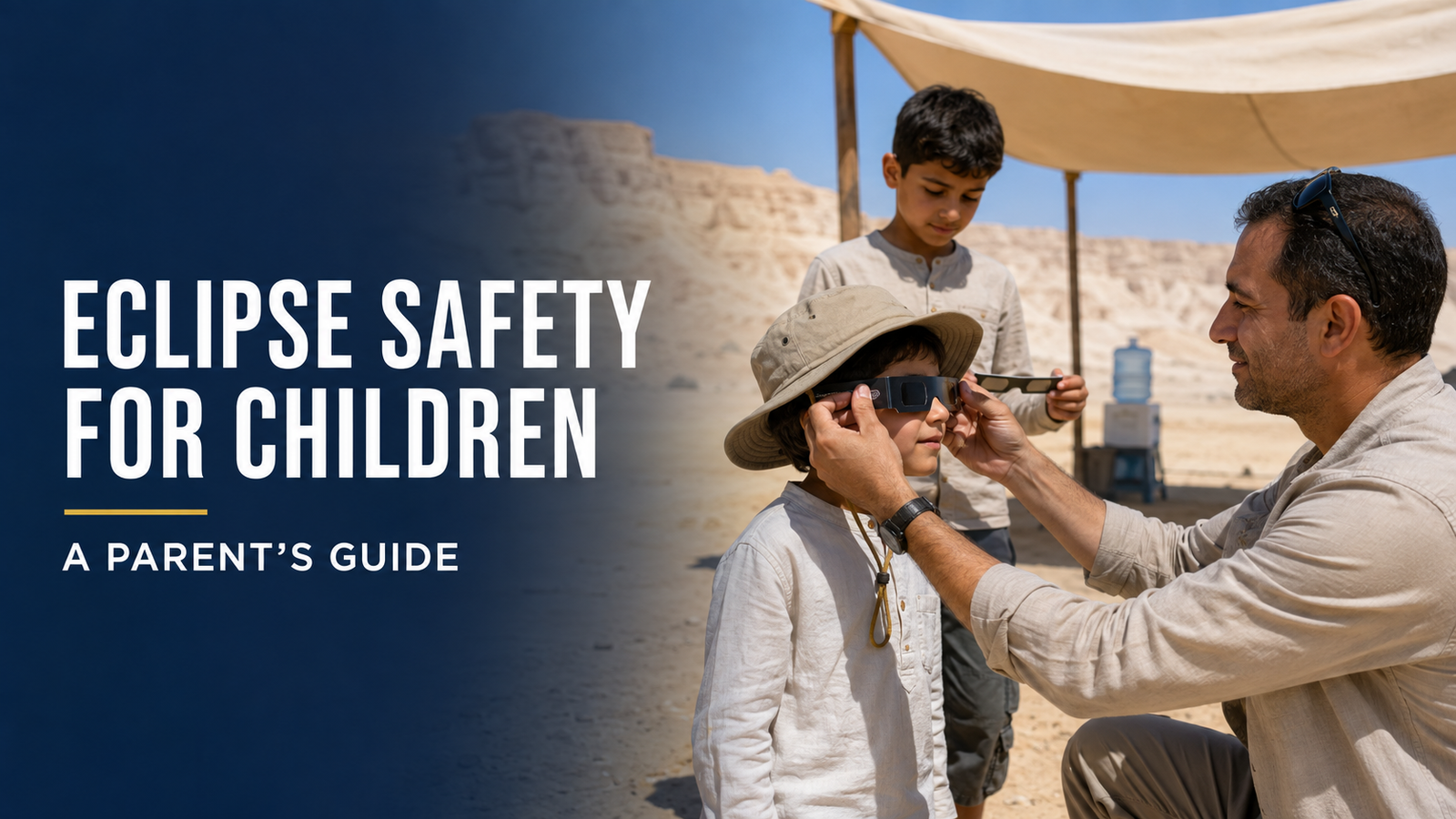
If an adult-size paper frame is too loose, a handheld viewer may be easier to control because the adult can physically position it in front of the child’s face during a short direct look.
The goal is not fashion or comfort for an hour. The goal is reliable coverage for supervised viewing moments.
Practice Before Eclipse Day
Do not make eclipse day the child’s first time using solar viewers.
Practice the movement sequence before travel.
Start indoors without looking at the Sun:
- Head down.
- Viewer in place.
- Look forward.
- Turn away.
- Remove viewer.
Then practice outdoors on an ordinary sunny day using the same procedure.
The AAS recommends that viewers be in place before looking up at the bright Sun and that observers turn away before taking the filter off.
Keep the practice short and calm.
The objective is not to train the child to stare at the Sun for long periods. It is to make the physical sequence automatic.
Make One Rule Easy to Remember
For younger children, use one short family rule:
“Glasses first, Sun second.”
Then add:
“Look away before glasses come off.”
A short rule works better under excitement than a long lecture.
How Long Should a Child Look at the Sun Through Safe Eclipse Glasses?
Modern compliant eclipse viewers do not require children to stare continuously at the Sun.
There is no educational benefit to forcing long direct viewing.
A safer family rhythm is usually:
- Short supervised direct looks.
- Breaks in shade or cooling.
- Indirect viewing.
- Watching shadows and changing light.
- Returning to direct viewing at selected moments.
For the 2027 Egypt eclipse, the partial phase will last much longer than totality. A child does not need to spend that entire period facing the Sun.
This is especially important in August, when reducing unnecessary outdoor exposure also helps with heat safety.
Totality: The Rule Parents Must Understand Before the Trip
A total solar eclipse has one unique phase.
During totality, the Moon completely covers the Sun’s bright photosphere. NASA states that direct viewing is safe during that brief period of complete coverage.
Before totality, viewers stay on for direct solar viewing.
During confirmed totality, observers inside the path may remove them.
As soon as direct sunlight begins to reappear, viewers must go back on immediately.
Why This Is Harder With Children
Adults may be watching the sky, taking photographs, listening to countdowns and reacting emotionally.
That is exactly when a child can be forgotten for a few seconds.
Assign responsibility before the event.
One adult should be the child-safety adult, even if other adults are photographing.
That person’s job is to:
- Confirm the child has viewers on before second contact.
- Listen for the site’s totality announcement.
- Help remove viewers only after totality is confirmed.
- Watch the child during totality.
- Put viewers back on before direct sunlight returns.
Do not assume that the child will copy the crowd correctly.
What If You Are Outside the Path of Totality?
This distinction is critical for Egypt in 2027.
Many places will see a very deep partial eclipse but not totality.
If your location is outside the totality path, there is no safe naked-eye phase.
Children must use safe solar viewing protection every time they look directly at the Sun.
A 99% partial eclipse is not totality.
The remaining uncovered part of the Sun is still dangerously bright.
This is why families should verify the exact viewing coordinates rather than relying on a city, governorate or tourism-region name.
Read the 2027 Total Solar Eclipse in Egypt Complete Guide and the Total vs Partial vs Annular Eclipse Guide if you need to explain the difference to older children.
Indirect Viewing Is Excellent for Children
Direct viewing is only one way to experience a solar eclipse.
NASA recommends indirect methods such as pinhole projection.
These methods can be especially useful for:
- Toddlers.
- Preschool children.
- Children who dislike wearing eclipse glasses.
- Large family groups.
- Schools.
- Children who repeatedly remove glasses.
- Anyone who wants a second activity during the long partial phase.
Simple Pinhole Projection
A small hole can project an image of the Sun onto another surface.
The important rule is that the child looks at the projected image, not through the hole toward the Sun.
Keep the Sun behind the child while observing the projection.
As the eclipse progresses, the projected solar image changes shape.
Use Natural Pinhole Effects
Leaves can produce many small projected solar crescents on the ground.
Children often enjoy this because it turns the eclipse into a pattern they can photograph or draw without staring upward.
Why Indirect Viewing Is More Than a Backup
It teaches the geometry of the eclipse.
A child can compare:
- The actual safe direct view through glasses.
- The projected crescent on a card.
- Crescent shadows under trees.
- Changes in ambient light.
- Temperature changes.
That creates a richer experience than repeated direct looking.
Never Use Eclipse Glasses With Unfiltered Binoculars or Telescopes
This is one of the most important safety rules for older children and teenagers.
Eclipse glasses protect the eyes from ordinary direct viewing.
They are not a substitute for a proper filter on binoculars, telescopes or camera lenses.
NASA warns that concentrated sunlight through unfiltered optics can damage the solar viewer and cause severe eye injury.
A solar filter for optical equipment must be designed for that equipment and mounted securely at the front, on the Sun-facing side of the optics.
A child should never be allowed to experiment with:
- Unfiltered binoculars.
- An unfiltered telescope.
- A magnifying glass aimed at the Sun.
- A camera viewfinder connected to unfiltered optics.
- Homemade filters attached behind the lens.
If a family brings a telescope or binoculars, one experienced adult should control them.
Do not leave solar-pointing equipment unattended where a child can use it.
What About Phone Cameras?
Children and teenagers may want to film the event.
The eye-safety rule remains the same: holding a phone does not make direct naked-eye viewing safe during partial phases.
A child can accidentally look over or around the phone at the Sun while framing a shot.
For specialized solar photography, follow equipment-specific guidance and use the correct filter where required.
The 2027 Total Solar Eclipse Photography Guide should be read by any family planning serious photography.
For younger children, the safest approach is often to let an adult manage the camera while the child concentrates on the experience.
Children Who Wear Prescription Glasses
The AAS recommends keeping normal eyeglasses on and placing eclipse glasses over them, or holding a safe handheld viewer in front.
Do not remove a child’s necessary prescription glasses simply to make eclipse glasses fit unless that is comfortable and appropriate for the child.
Practice the arrangement before the event.
If the eclipse glasses sit poorly over the prescription frames, a handheld viewer may be easier.
Again, the adult should supervise the viewing movement.
Contact Lenses
Contact lenses do not protect against solar viewing.
A child or teenager who normally wears contact lenses still needs safe eclipse glasses or a handheld solar viewer during partial phases.
The same direct-viewing rules apply.
Toddlers and Very Young Children
Parents sometimes ask whether a toddler should view the eclipse directly at all.
There is no requirement that they do.
If a young child cannot reliably follow the viewing routine, use indirect viewing and let them experience the changing environment.
They can still notice:
- Unusual light.
- Projected crescents.
- Cooler air near totality.
- Reactions of other people.
- The darkened sky during totality if inside the path.
During totality itself, a child inside the totality path can experience the darkened environment without needing to understand complex eye-safety timing.
The key is that the supervising adult controls the transitions before and after totality.
Do Not Force a Toddler to Wear Viewers
If the child keeps pulling them off, direct partial-phase viewing may not be appropriate.
Use a pinhole projector instead.
A safe eclipse does not require every child to look directly at the Sun.
Preschool and Primary-School Children
Children in this age group can often follow a simple viewing routine if it has been practiced.
Keep instructions concrete.
Instead of explaining retinal radiation in the moment, say:
- “We only look at the Sun with these special glasses.”
- “Put them on before you look up.”
- “Look down before taking them off.”
- “Do not touch the telescope unless an adult says it is ready.”
Give them activities during breaks:
- Draw the shape seen through the viewer.
- Record changes in light.
- Look for crescent shadows.
- Make a simple eclipse timeline.
- Compare the temperature feeling before and near totality.
Activity reduces the temptation to stare continuously.
Teenagers
Teenagers may understand the science but take more independent risks.
Common risks include:
- Trusting an unverified pair of glasses bought online.
- Using a phone while looking around the device.
- Trying binoculars.
- Removing glasses early because others do.
- Photographing through equipment without correct filtering.
- Separating from the family viewing zone.
Treat teenagers as participants in the safety plan.
Explain the reason for each rule and give them responsibility for something safe, such as monitoring the family’s indirect projector or keeping spare viewers protected.
Children With Sensory or Developmental Needs
Some children may dislike the feel of paper eclipse glasses, become anxious in a crowd, react strongly to sudden darkness or struggle with verbal instructions during excitement.
Parents know their child best.
Practice is especially valuable.
Possible adaptations include:
- Using a handheld viewer rather than a frame on the face.
- Watching indirect projection instead of direct viewing.
- Choosing a quieter area away from loud crowds.
- Preparing the child for cheering and sudden darkness.
- Using visual instructions.
- Keeping a familiar adult physically close.
- Providing hearing protection if crowd noise is a concern, while ensuring the child can still receive safety instructions.
- Having an air-conditioned quiet space nearby.
Do not make totality a performance the child must complete correctly.
The objective is a safe and positive experience.
Solar Eclipse Safety for Children in Egypt: Heat Changes the Plan
The August 2, 2027 eclipse occurs during one of the hottest times of year in Egypt.
CDC guidance notes that infants and young children depend on adults to keep them cool and hydrated in hot weather.
That means a family eclipse plan needs more than glasses.
A child may be outdoors during the partial phase for a long period, and the Sun will be high in the sky across the strongest Egyptian viewing areas.
The safest family setup provides:
- Reliable shade.
- Air-conditioned recovery space.
- Drinking water.
- Toilets.
- Seating.
- Short walking distances.
- Adult supervision.
- A medical response plan.
- An easy route back to the vehicle or cooled space.
Read How to Prepare for Egypt’s August Desert Heat before planning a family trip.
Keep Children Cool and Hydrated
CDC recommends keeping children cool and hydrated on hot days.
For a desert eclipse event:
- Offer fluids regularly.
- Do not wait for a young child to request water.
- Use lightweight, loose-fitting clothing.
- Use shade whenever the child is not actively viewing.
- Take cooling breaks.
- Avoid unnecessary physical activity near midday.
- Keep meals and snacks available according to the child’s normal needs.
- Watch behavior as well as verbal complaints.
A tired, unusually quiet, irritable or confused child should not be pushed to remain outside for the eclipse schedule.
Seek medical care promptly if a child develops symptoms of heat-related illness.
Never Leave a Child in a Parked Vehicle
This deserves its own section because families may be moving between hotels, 4x4s, buses and camp areas.
CDC specifically warns never to leave infants or children in a parked car, even if windows are open or cracked.
A desert vehicle can become dangerously hot very quickly.
Before every departure and stop:
- Count the children.
- Check every row of seats.
- Confirm sleeping children have been removed.
- Make one adult responsible for the final vehicle check.
Do not use a parked, non-running vehicle as a waiting room.
Sun and Skin Protection
NASA also reminds eclipse observers that they may be outside for hours and should protect skin from the Sun.
For children this can include:
- Appropriate sunscreen.
- A wide-brimmed hat.
- Lightweight protective clothing.
- Shade.
- Avoiding unnecessary direct sunlight during long waiting periods.
Eclipse glasses protect the eyes for direct solar viewing. They do not protect the rest of the child from heat or ultraviolet exposure.
The Best Family Eclipse Camp Is Not the One With the Most Seconds
Parents should evaluate the entire environment.
A viewing field offering a few extra seconds of totality is not automatically better if it lacks:
- Cooling.
- Toilets.
- Shade.
- Medical support.
- Reliable transport.
- Controlled capacity.
- Easy access for children.
For families, a well-managed site slightly away from the mathematical maximum may produce a much better experience.
The current plan for Solar Eclipse Tours centers on a confirmed Western Desert eclipse-camp region between the White Desert and the Black Desert, inside the path of totality, with the actual viewing field verified separately inside totality.
The value for families is not simply the desert scenery. It is the ability to organize capacity, vehicles, shade, cooling, toilets, water and supervision around one controlled viewing program.
Review the Western Desert Eclipse Camp, compare the 2027 Eclipse Tour Packages and check availability based on your family size and children’s ages.
A Family Safety Briefing the Night Before
Do not wait until eclipse morning.
The night before, gather everyone for a short briefing.
For children, show rather than lecture.
Show the Eclipse Glasses
Let each child identify their own viewer.
Inspect it with them.
Explain that it is not a toy and should stay in its protective envelope or case when not being used.
Practice the Movement
Head down.
Glasses on.
Look up.
Look down.
Glasses off.
Repeat it a few times.
Explain Totality
For older children:
“Tomorrow we keep the glasses on whenever we look directly at the bright Sun. If we are at our confirmed total viewing site, the guide will tell us when the Sun is completely covered. Only then can we remove them. When bright sunlight comes back, glasses go on immediately.”
Explain the Heat Plan
Tell children where the cooled area is, where water is, where toilets are and which adult they should stay with.
Make the Buddy Assignments
Each child should know their named adult.
Avoid vague responsibility such as “we’re all watching them.”
Eclipse Morning Checklist for Parents
Before leaving the hotel, camp or room:
- Inspect each eclipse viewer.
- Pack spare safe viewers.
- Pack normal sunglasses separately.
- Confirm hats and sun-protective clothing.
- Confirm sunscreen.
- Fill water bottles.
- Pack necessary medication.
- Charge phones.
- Confirm the viewing-site location.
- Confirm totality timing from the event briefing.
- Confirm who is supervising each child.
- Confirm where the cooled area and toilets are.
- Keep children’s essential items in an accessible bag rather than buried under luggage.
During the Partial Phase
The partial phase is long.
Do not turn it into a test of patience.
A good family rhythm is:
- Short safe look through eclipse glasses.
- Look down and remove viewers.
- Return to shade.
- Check a pinhole projection.
- Drink water.
- Draw or photograph the changing environment.
- Repeat later.
The child stays engaged without hours of continuous upward viewing.
Ten Minutes Before Totality
This is when the family should become more organized.
- Bring children back from the cooled area.
- Visit toilets earlier if needed.
- Make sure every child is with the assigned adult.
- Confirm glasses are undamaged and on correctly.
- Stop unnecessary photography experiments.
- Listen to official countdowns or instructions.
- Keep the child calm and stationary.
Do not move through crowded tripod zones at the last moment.
During Totality
At a confirmed total location, once the Sun’s bright face is completely covered, the family can experience the extraordinary part of the eclipse.
Children may see:
- A dark disk where the Sun was.
- The solar corona.
- A much darker sky.
- Bright planets or stars.
- A twilight-like horizon.
- Changes in temperature and light.
Some children may be amazed.
Others may be frightened by sudden darkness or crowd noise.
Both responses are normal.
Keep the child close.
Do not pressure them to stare upward.
Totality is an environment to experience, not an exam.
Before Totality Ends
The supervising adult should be ready before direct sunlight returns.
Do not wait to react after the first bright flash if you can avoid it.
Follow the event’s verified contact timing and visual safety instructions.
As soon as the bright photosphere begins to reappear, viewers are required again for direct viewing.
For families, it can be sensible to have children put their viewers back on slightly early rather than competing for the very last unfiltered instant.
After Totality
The eclipse is not finished.
The partial phase continues.
Children may believe that because everyone has cheered, the safety rules are over.
Remind them:
“The bright Sun is back. Glasses again.”
Then return to shade or cooling.
Hydrate.
Pack slowly.
Avoid rushing children through a hot departure immediately after totality.
What If a Child’s Eclipse Glasses Fall Off While Looking Up?
The first action is simple:
Tell the child to look away from the Sun immediately.
Do not ask them to continue looking while you adjust the glasses.
Move into shade, inspect or replace the viewer and reset the routine.
If there is concern that the child looked directly at the Sun without proper protection, do not try to diagnose eye damage at the viewing site.
Solar retinal injury may not be painful at the moment of exposure, and visual symptoms can develop later.
If the child develops blurred or distorted central vision, a central dark or blind spot, abnormal color vision or another significant visual change after solar exposure, seek prompt evaluation by an eye-care professional.
What If a Child Refuses to Wear Eclipse Glasses?
Do not force direct viewing.
Use indirect projection.
A child who dislikes the glasses can still enjoy almost everything around the eclipse.
Parents sometimes feel pressure because the event is rare.
The rare nature of the eclipse does not justify compromising safety.
Can a Baby Experience the Eclipse?
Yes, as part of the family environment, but there is no reason to intentionally direct a baby’s gaze toward the Sun.
Keep the baby shaded and cool.
Protect the baby from heat and ordinary sun exposure.
During totality at a confirmed total location, the environment will darken naturally.
For infants, the major practical concerns are comfort, cooling, hydration or feeding needs, shade, transportation and the parent’s ability to supervise without distraction.
Can Children Use Welding Glass Instead?
Parents may encounter online advice about welding filters.
The AAS discusses certain welding filters as a specialized option under specific conditions, but this is not the simplest choice for a family trip.
Do not improvise with unknown welding glass, smoked glass, exposed film or homemade dark materials.
For most families, the simplest direct-viewing option is a trustworthy, purpose-made eclipse viewer.
Can Children Share Eclipse Glasses?
Sharing creates unnecessary risk.
It can lead to hurried handoffs, dropped glasses, damaged filters and a child looking up before the viewer reaches their face.
Bring at least one safe viewer per person plus spares for damage or loss.
A managed event should also have contingency viewers available, but parents should not depend on finding a spare at the last minute.
Do Eclipse Glasses Expire?
The AAS explains that modern compliant viewers in excellent condition can often be reused, provided they are not damaged and come from a manufacturer whose product was properly tested.
Some old warnings about discarding viewers after three years or limiting every look to a few minutes are outdated for properly manufactured modern viewers.
For children, physical condition matters more than the printed age alone because paper frames can be damaged through handling.
Inspect before every use.
Frequently Asked Questions
Is it safe for children to watch a solar eclipse?
Yes, when they use safe solar viewers correctly during partial phases and are actively supervised by an adult. Direct unfiltered viewing is safe only during complete totality at a confirmed location inside the path of totality.
Are children’s eyes more vulnerable during an eclipse?
The practical safety message is that children require active supervision because they may not reliably follow viewing rules. All viewers, adults and children, need proper protection during partial phases.
Can a child use normal sunglasses during an eclipse?
No. Ordinary sunglasses are not safe for direct solar viewing.
Are darker sunglasses safer?
No. Darkness alone does not make ordinary sunglasses suitable for viewing the Sun.
Should a toddler wear eclipse glasses?
Only if the child can use them reliably under direct adult supervision. Indirect projection is an excellent alternative for toddlers who repeatedly remove glasses.
Can a child look at the eclipse through a phone?
Holding a phone does not protect the child’s eyes. They still must avoid direct naked-eye solar viewing during partial phases.
Can children use binoculars with eclipse glasses?
No. Eclipse glasses are not a substitute for a proper front-mounted solar filter on binoculars. Unfiltered optical devices are dangerous.
Can children use a telescope during the eclipse?
Only when the telescope has an appropriate solar filter correctly secured at the front and is managed by a knowledgeable adult. Do not allow unsupervised use.
What is the safest alternative to direct viewing?
Indirect projection, such as a pinhole projector, lets children see the changing solar shape without looking directly at the Sun.
Can children remove glasses during totality?
Yes, but only during complete totality at a location inside the path of totality. The glasses must go back on as soon as direct sunlight returns.
What if our location gets 99% eclipse coverage?
That is still a partial eclipse. There is no safe naked-eye phase.
What if my child accidentally looks at the Sun?
Tell them to look away immediately. If there is concern about unprotected solar viewing or they develop visual symptoms afterward, seek prompt evaluation from an eye-care professional.
Can children with prescription glasses watch safely?
Yes. Keep prescription glasses on and place eclipse glasses over them, or use a handheld solar viewer in front, following AAS guidance.
Do contact lenses protect the eyes?
No. A child wearing contact lenses still needs proper solar viewing protection.
How many eclipse glasses should a family bring?
At minimum, one safe pair or viewer per person, plus spares for damage or loss.
How do I know the glasses are genuine?
Buy from a trustworthy source and check current AAS supplier guidance. Do not rely only on an ISO number printed on the frame.
Does NASA approve eclipse glasses brands?
No. NASA does not approve individual commercial brands.
Is heat a serious issue for children during Egypt’s 2027 eclipse?
Yes. The event occurs around midday in August. Families need shade, hydration, cooling and reduced unnecessary outdoor exposure in addition to eye protection.
Can my child stay in air conditioning until close to totality?
A well-designed viewing site should allow breaks in a cooled space during the long partial phase. Children do not need continuous direct solar viewing.
Is a Western Desert eclipse camp suitable for children?
It can be when the operation is specifically designed for August with cooling, water, shade, toilets, safe transport, controlled capacity and medical planning. Parents should confirm actual facilities before booking.
Parent’s Final Eclipse-Day Rules
If you remember nothing else, use these rules:
- Glasses first, Sun second.
- Look away before glasses come off.
- Partial eclipse means protection every time.
- 99% is still partial.
- Only complete totality allows direct viewing without eclipse glasses.
- Bright Sun returning means glasses on immediately.
- Never use eclipse glasses with unfiltered binoculars, telescopes or cameras.
- Indirect viewing is a full eclipse experience, not a second-rate option.
- One adult is responsible for each child.
- Heat safety matters as much as eye safety in Egypt in August.
Final Takeaway
A total solar eclipse can be one of the most memorable science experiences a child ever has.
The safest approach is not to make the child memorize every astronomical detail. It is to design the environment so that safe behavior is easy.
Buy trustworthy eclipse viewers in advance. Inspect them. Practice before the event. Use short supervised viewing sessions. Add pinhole projection and other indirect activities. Assign a specific adult to each child. Understand exactly when totality starts and ends. Keep optical equipment controlled. Build shade, cooling and hydration into the day.
For the August 2, 2027 eclipse in Egypt, families should choose a viewing program based on more than duration alone. A controlled site with open sky, safe coordinates, reliable transport, cooled recovery areas, water, toilets and organized supervision can be far more valuable than chasing a few additional seconds at an improvised location.
For a managed option, review the Western Desert Eclipse Camp near Bahariya, compare the 2027 Eclipse Packages, read the Child Policy and Booking & Cancellation Policy, then check availability for your family.
Sources and Safety References
Safety guidance can change. Before the 2027 event, recheck the latest official guidance from: