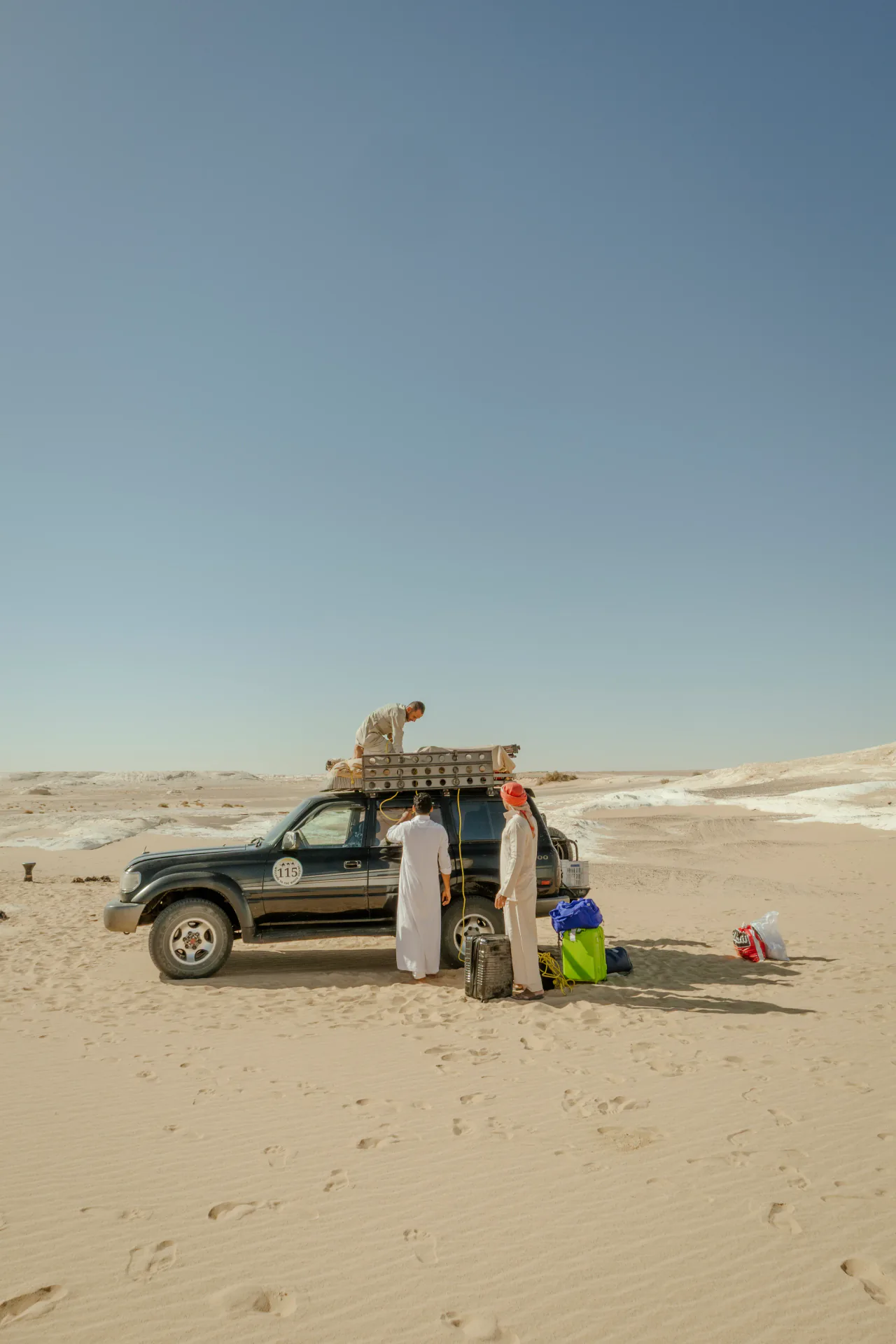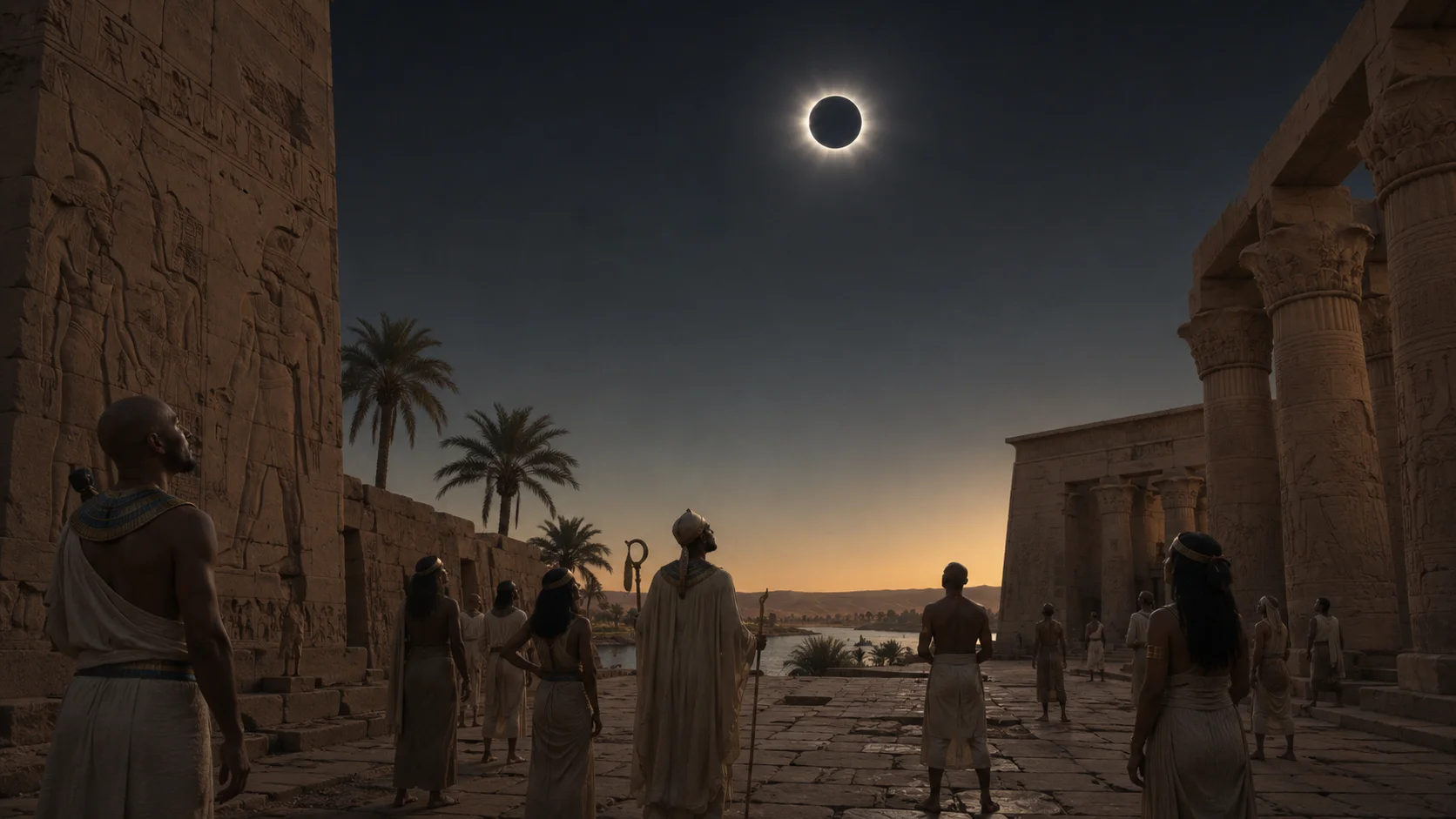
ancient Egypt solar eclipse: quick answer
ancient Egypt solar eclipse: 🏺 Historical accuracy notice: Ancient Egyptians unquestionably lived through solar eclipses, but surviving Egyptian evidence does not give historians a universally accepted, precisely dated eyewitness account of a total solar eclipse. This article separates astronomical possibility, archaeological evidence, scholarly interpretation and modern
An ancient Egypt solar eclipse is easy to imagine. A dark disk covers the Sun above temples aligned with the sky. Daylight fades over the Nile Valley. Priests, farmers, soldiers and royal officials stop what they are doing as the familiar order of the day changes without warning.
Ancient Egyptians certainly witnessed solar eclipses during the thousands of years in which their civilization developed. The Moon’s shadow crossed North Africa many times, and modern astronomical calculations can identify ancient eclipses that were potentially visible in or near Egypt.
The harder question is whether any surviving Egyptian text, inscription or object gives us a secure eyewitness record of a specific total solar eclipse.
The responsible answer is cautious: there is no single ancient Egyptian eclipse account that scholars universally accept as an unambiguous, precisely dated observation of totality.
That does not mean Egyptians ignored the sky. They developed sophisticated calendars, timekeeping systems, stellar observations and religious traditions centered on the Sun. It means the evidence must be interpreted carefully. Religious poetry about the hidden Sun is not automatically an eclipse report. A modern calculation showing that an eclipse could have crossed Egypt is not proof that a particular inscription describes it. A historical crisis occurring near an eclipse date does not prove that the eclipse caused the crisis.
This guide examines what modern astronomy can reconstruct, what ancient Egyptian sources actually tell us, why the evidence remains uncertain and how to discuss the connection between ancient Egypt and the 2027 total solar eclipse in Egypt without turning an intriguing possibility into a false historical claim.
Quick Answer: Did Ancient Egyptians See Solar Eclipses?
Yes. Ancient Egyptians lived through multiple solar eclipses, including some that may have been total or nearly total in parts of Egypt.
However, three different statements must not be confused:
- An eclipse occurred during an ancient Egyptian period.
- The eclipse may have been visible from a particular Egyptian region.
- A surviving Egyptian source clearly records that eclipse.
The first can often be established through astronomical calculation. The second may be estimated with varying uncertainty. The third requires credible historical evidence and is much harder to prove.
A proposed ancient eclipse should therefore be described using language such as:
- “Modern calculations suggest that an eclipse may have been visible.”
- “Some researchers have proposed a connection.”
- “The interpretation is debated.”
- “The surviving text is not universally accepted as an eclipse record.”
It should not be described as a confirmed pharaonic observation unless the evidence supports that level of certainty.
Why Ancient Eclipse Research Is Difficult
Modern eclipses can be predicted with extraordinary precision. For August 2, 2027, astronomers can calculate the Moon’s path, local contact times, solar altitude and expected duration for exact coordinates.
Ancient eclipses are different because reconstructing the shadow path requires knowing how Earth rotated thousands of years ago.
Earth Does Not Rotate Like a Perfect Clock
The length of the day changes slightly over long periods. Tidal interactions with the Moon, changes in Earth’s interior, oceans and atmosphere affect rotation.
Astronomers use a quantity called Delta T to relate uniform astronomical time to time based on Earth’s rotation. For recent centuries, observations constrain Delta T well. For remote antiquity, uncertainty becomes much larger.
NASA’s eclipse-prediction material explains that uncertainties in Earth’s rotation can shift reconstructed ancient eclipse paths significantly in longitude. Before about 1500 BCE, reliable path placement becomes especially difficult, and before roughly 2000 BCE the geographical uncertainty can become so large that precise claims may lose meaning.
This matters for Egypt because a totality path is narrow. A shift of several degrees can move totality far from a proposed city, temple or battlefield.
The Moon’s Edge Is Irregular
The lunar limb contains mountains and valleys. During a modern eclipse, detailed lunar topography can change the exact contact times by seconds and shift the effective path boundary slightly.
For ancient research, this is usually a smaller problem than uncertainty in Earth’s rotation, but it reminds us that a simple smooth-circle model is not the entire story.
Ancient Calendars Require Conversion
An inscription may use a regnal year, lunar date, festival date or civil calendar rather than the modern Gregorian system.
To connect it with an eclipse, historians must determine:
- Which ruler is named.
- How that reign is dated.
- Which calendar is being used.
- Whether the calendar date was fixed or seasonal.
- How missing or damaged text should be reconstructed.
- Whether the modern conversion is disputed.
A small chronological change can lead researchers to a different eclipse candidate.
Symbolic Language Is Not a Scientific Log
Ancient texts frequently describe the Sun, darkness, divine anger, chaos or cosmic danger in metaphorical language.
A phrase such as “the Sun was hidden” might describe:
- Sunset.
- Storm clouds.
- Ritual symbolism.
- A mythological journey.
- Political disorder.
- Death or mourning.
- A solar eclipse.
Context determines which interpretation is plausible. One dramatic sentence is rarely enough.
A Four-Level Evidence Test for Ancient Eclipse Claims
A useful way to evaluate claims is to place them on four levels.
| Evidence level | Meaning | Responsible wording |
|---|---|---|
| Astronomically possible | A calculated eclipse occurred during the period and may have been visible in the region | “An eclipse may have been visible” |
| Historically plausible | A source describes unusual darkness or solar disturbance near a compatible date | “Some researchers propose a connection” |
| Strongly supported | The text, date, location and astronomical reconstruction fit with limited ambiguity | “The evidence strongly suggests an eclipse” |
| Securely documented | The record clearly identifies an eclipse and its historical context | “The source records an eclipse” |
Many viral ancient Egypt claims stop at the first or second level but are presented online as if they reached the fourth.
The Sun in Ancient Egyptian Religion
The Sun was not simply a bright object in the sky. It was connected with creation, kingship, renewal, death and rebirth.
Ra and the Daily Solar Journey
Ra became one of ancient Egypt’s most important solar deities. He was associated with the Sun’s daily movement across the sky and its nighttime journey through the underworld.
The rising Sun represented renewal. Sunset was not an ending but part of a cycle in which the solar god passed through darkness and returned.
This daily pattern gave religious meaning to changes in light, but it also creates an interpretive problem. A text about the Sun disappearing may describe the ordinary sunset cycle rather than an eclipse.
Ra-Horakhty
Ra-Horakhty combined solar and Horus traditions and was associated with the rising Sun, light and renewal. Images often show a falcon-headed figure wearing a solar disk.
The British Museum’s educational material emphasizes the role of Ra and Ra-Horakhty as solar gods connected with Heliopolis and the Sun’s creative and renewing power.
Amun-Ra
As religious traditions developed, Amun became linked with Ra, creating Amun-Ra. This combined divine power with solar authority and became central to royal religion during major periods of Egyptian history.
Aten
The Aten was represented as the visible solar disk, especially during the reign of Akhenaten. Rays extending from the disk ended in hands that offered life.
It can be tempting to connect any event involving the solar disk with Akhenaten’s religious transformation. Yet a modern eclipse calculation does not prove that an eclipse caused the Aten-focused reforms.
Khepri and the Rising Sun
Khepri represented the morning Sun and renewal. The scarab became associated with transformation and the cycle of rebirth.
Solar Religion Does Not Equal Eclipse Documentation
The importance of solar gods tells us that unusual solar phenomena may have carried meaning. It does not tell us exactly how Egyptians interpreted a particular eclipse.
Historians need direct or contextual evidence before reconstructing a ritual response, political meaning or theological explanation.
Egyptian Astronomy Was Practical and Sophisticated
Ancient Egyptian astronomical knowledge served practical, religious and administrative purposes.
Calendar and Agriculture
The annual Nile cycle shaped life. Egyptians developed a civil calendar of 365 days, divided into twelve 30-day months plus five additional days.
Seasonal observation helped organize agriculture, taxation, festivals and state administration.
Sirius and the Year
The heliacal rising of Sirius became connected with seasonal timing and the approach of the Nile inundation. The relationship between stellar observation, calendars and ritual demonstrates careful long-term sky watching.
Decans and Nighttime Timekeeping
Egyptian observers used groups of stars called decans to mark portions of the night. These appeared in coffin decoration, astronomical ceilings and timekeeping traditions.
Monument Orientation
Temples and monuments were often oriented with attention to cardinal directions, solar positions, stellar alignments or local landscape relationships.
Scholars debate the exact methods and intentions for individual structures, but there is no doubt that direction and celestial cycles mattered.
Water Clocks and Shadow Clocks
Egyptians used devices such as water clocks and shadow clocks to divide time.
What This Knowledge Does Not Prove
Sophisticated observation does not automatically prove that Egyptians could predict total solar eclipses mathematically.
Babylonian astronomers later developed systematic eclipse cycles and predictive methods. Greek thinkers developed geometrical explanations. Egyptian knowledge interacted with wider Mediterranean traditions, but claims about exact eclipse prediction require evidence from the relevant period.
Did Egyptians Understand What Caused a Solar Eclipse?
The surviving evidence does not provide one simple answer across three millennia of Egyptian history.
Knowledge changed over time. Priests, administrators, foreign scholars and communities had different traditions. Egypt also interacted with Mesopotamia, Greece, Rome and other cultures.
A person in Ptolemaic Egypt may have had access to astronomical concepts unavailable to someone in the Old Kingdom.
It is therefore misleading to ask what “the ancient Egyptians” believed as if one explanation remained unchanged for thousands of years.
At a religious level, an eclipse could potentially be understood as a disturbance in solar order. At a learned astronomical level in later periods, some observers may have known geometric explanations based on the Moon passing before the Sun.
The evidence should be discussed period by period.
Ma’at, Isfet and Cosmic Order
Ancient Egyptian thought placed strong emphasis on ma’at—order, balance, justice and the proper structure of the world.
Its opposite, often described through the idea of isfet, represented disorder, injustice and disruption.
A sudden daytime darkening could fit a broad theme of threatened cosmic order. The Sun’s reliable daily return was part of the stability of the world.
However, this remains a conceptual interpretation. It should not be converted into an invented statement such as “Egyptian priests performed a specific eclipse ritual” unless a source documents that ritual.
The Mythic Enemy of the Sun
In Egyptian mythology, the solar journey faced danger during the night. The serpent Apophis, or Apep, represented chaos and threatened the solar god.
Priestly texts and rituals opposed this threat and supported the restoration of order.
Modern writers sometimes describe an eclipse as Egyptians believing that Apep swallowed the Sun. This is possible as a comparative interpretation, but direct evidence linking a specific Egyptian eclipse observation to that exact explanation is limited.
The myth should therefore be presented as part of the broader solar worldview, not as a confirmed eyewitness report.
Are There Confirmed Ancient Egyptian Eclipse Records?
Researchers have proposed several texts and historical episodes as possible eclipse references, but agreement is limited.
A secure eclipse record normally needs:
- A text close to the event.
- A clear description of unusual daytime solar disappearance.
- A date or historical setting.
- A location.
- An astronomical eclipse compatible with that date and place.
- Limited alternative explanations.
Egyptian evidence often lacks one or more of these elements.
Why Neighboring Cultures Sometimes Offer Clearer Records
Mesopotamian, Chinese and some Near Eastern sources contain eclipse observations that are easier to recognize and date.
A famous scholarly study connected a Ugaritic text with a total solar eclipse, using both literary and astronomical evidence. The example demonstrates the method historians want: a surviving text, a chronological framework and a reconstructed eclipse path.
Ugarit was not ancient Egypt, but the case shows why a clear textual tradition matters.
Egyptian Silence Is Not Proof of No Observation
Surviving records are incomplete.
Documents decay. Papyrus is fragile. Texts were copied selectively. Religious and administrative records preserved some subjects more often than others.
An eclipse may have been witnessed, discussed and remembered without leaving an identifiable surviving document.
The Proposed Eclipse Around the Early Reign of Akhenaten
Popular articles sometimes connect solar eclipses with Akhenaten, the Aten religion or political change.
The attraction is obvious. Akhenaten elevated the solar disk in royal religion, changed artistic conventions and founded a new capital at Akhetaten.
But chronology alone does not establish causation.
To argue that an eclipse influenced the reforms, researchers would need evidence such as:
- A compatible eclipse visible from the relevant region.
- A secure date relative to the reforms.
- A text connecting the event with royal action.
- Evidence that the eclipse was interpreted in the proposed way.
Without those elements, the connection remains speculative.
The correct phrase is not “an eclipse caused Akhenaten’s revolution.” It is “some modern writers have explored possible astronomical contexts, but there is no widely accepted proof that an eclipse caused the Aten reforms.”
The 2471 BCE Eclipse Hypothesis
Another widely repeated claim associates a solar eclipse around 2471 BCE with Egypt’s Old Kingdom or with a specific historical interpretation.
This type of claim requires exceptional caution.
NASA’s discussions of ancient eclipse-path uncertainty show why. At dates earlier than 2000 BCE, uncertainty in Delta T can correspond to enormous shifts in the calculated longitude of totality.
For approximately 2500 BCE, NASA’s uncertainty table illustrates that the geographical error can reach tens of degrees. A calculated central line on a modern map should not be treated like a precise 2027 path.
A researcher may identify an eclipse that astronomically occurred on that date, but confidently placing totality over one Egyptian monument may not be justified.
This is the distinction between the date of an eclipse and the exact ground track of the eclipse.
Can Pyramids or Temples Prove Eclipse Knowledge?
Claims that pyramid dimensions, temple axes or reliefs encode eclipse cycles should be evaluated skeptically.
A convincing argument needs:
- A clear ancient design intention.
- Measurements taken consistently.
- A relationship that is not produced by selecting convenient numbers.
- Historical evidence that the builders used the proposed eclipse cycle.
- Independent scholarly review.
Monuments can show advanced geometry and celestial orientation without encoding eclipses.
Solar Alignments Are Not Eclipse Alignments
A building aligned with sunrise at a solstice, a feast date or a local horizon feature does not imply knowledge of a future eclipse.
Solar alignments repeat predictably each year. Total eclipse paths do not repeat at one place on a simple annual cycle.
What Would Totality Have Looked Like in Ancient Egypt?
Although we cannot reconstruct the reaction of one specific community, the physical event would have followed the same sequence experienced today.
The Partial Phase
The Moon would gradually cover the Sun. Without solar filters, observers may not have noticed the earliest phase by looking directly because the remaining Sun stayed bright.
Indirect crescent projections may have appeared beneath trees or through small openings.
The Approach of Totality
The light would become strange. Shadows would sharpen. The temperature might fall. Animals might change behavior.
Baily’s Beads and the Diamond Ring
Sunlight passing through lunar valleys would create bright points close to totality.
The Corona
Once the photosphere was fully hidden, the corona would surround the black Moon.
This appearance could have been interpreted within religious ideas of the solar disk, divine radiance or cosmic danger.
The Horizon
Distant regions outside the Moon’s shadow could produce a twilight glow around the horizon.
The Return of Sunlight
The first returning point of light would rapidly restore daylight.
For an observer without modern astronomical preparation, the event would be overwhelming even if it lasted only a few minutes.
Eye Safety in Antiquity
Ancient observers did not have ISO-certified eclipse glasses.
A partial solar eclipse is dangerous to view directly. The eye contains no pain receptors that immediately warn of retinal injury, and damage may not become obvious until later.
We do not know which indirect methods ancient Egyptians used during eclipses. Viewing reflections in water or observing projected light could reduce direct exposure in some circumstances, but it would be irresponsible to recreate ancient viewing practices today.
Modern visitors should follow current eclipse viewing safety guidance and use approved solar viewers during every partial phase.
How Historians Use Astronomy Without Letting It Control the Evidence
Archaeoastronomy can be powerful, but it works best when astronomy and historical evidence support each other.
A strong study usually follows this order:
- Identify a credible text, object or alignment.
- Establish its archaeological and chronological context.
- Define the astronomical question.
- Calculate possible celestial events.
- Account for uncertainty.
- Test alternative explanations.
- Publish a conclusion proportional to the evidence.
A weak study often reverses the process:
- Find an interesting eclipse date.
- Search for any historical event near it.
- Assume a connection.
- Present the coincidence as causation.
The second method creates dramatic stories but weak history.
How Modern Eclipse Calculations Work
Astronomers calculate the positions of the Sun and Moon using mathematical ephemerides. They then model how the Moon’s shadow intersects Earth.
For modern eclipses, several inputs are well constrained:
- Earth orientation.
- Lunar orbit.
- Solar position.
- Observer coordinates.
- Elevation.
- Lunar topography.
For ancient eclipses, the Moon and Sun can still be calculated, but Earth’s rotational position introduces larger uncertainty.
NASA’s Five Millennium Canon provides a valuable reference from 2000 BCE to 3000 CE, yet the existence of a catalog entry does not imply that every ancient path line is geographically exact.
Why Ancient Eclipse Records Help Modern Science
Historical eclipse observations are scientifically valuable because they help researchers estimate changes in Earth’s rotation.
If a text gives a reliable date, time and place for an eclipse, astronomers can compare the historical observation with orbital calculations.
The difference helps constrain Delta T.
This creates an interesting feedback relationship:
- Astronomers use historical records to study Earth’s rotation.
- Historians use astronomical calculations to test dates and interpretations.
The method is strongest when the historical source is clear.
Ancient Egypt, the Sun and the 2027 Eclipse
The safest historical connection to 2027 is experiential rather than sensational.
On August 2, 2027, travelers in a verified Egyptian totality location will experience a phenomenon that inhabitants of ancient Egypt could also have witnessed during their long history.
Modern observers will know the cause. They will use precise maps, clocks, solar filters, cameras and scientific language.
Ancient observers may have understood the event through different religious, political or astronomical frameworks.
The shared element is the physical transformation of the landscape:
- The Sun becoming a crescent.
- Daylight fading.
- The temperature changing.
- The corona appearing.
- The horizon glowing.
- Sunlight returning.
This connection is powerful without claiming that a particular pharaoh stood at the same place or recorded the same event.
Travelers can explore the modern science in how a total solar eclipse happens, compare the types of solar eclipse and understand the exact 2027 eclipse path across Egypt.
Can the Eclipse Be Viewed from an Ancient Temple?
A temple may provide a dramatic setting, but astronomy is only one part of the decision.
The operator must confirm:
- Whether the temple lies inside totality.
- Whether the Sun is visible from the site.
- Visitor capacity.
- Opening hours.
- Heritage permissions.
- Tripod rules.
- Security.
- Emergency movement.
- Shade and hydration.
No tour should promise private or special eclipse access to an archaeological site without written confirmation from the relevant authorities.
A dedicated viewing field may offer better safety, visibility and crowd control, while temple visits can be scheduled before or after the eclipse.
The Western Desert as a Historical Landscape
The Western Desert offers a different historical connection.
Oases served as routes, settlements, agricultural centers and frontier regions across Egyptian history. Desert landscapes preserve archaeological sites, geological formations and a sense of distance from modern urban life.
A Western Desert eclipse journey can combine:
- Verified totality coordinates.
- Bahariya Oasis.
- White Desert excursions.
- Black Desert landscapes.
- Local communities.
- Geological interpretation.
- Night-sky observation.
The White Desert eclipse camp should still distinguish the excursion landscape from the precise totality site. Historical atmosphere must not replace geographic accuracy.
Common Myths About Ancient Egypt and Solar Eclipses
“Ancient Egyptians Never Saw a Solar Eclipse”
False. Eclipses occurred during the civilization’s long history. The uncertainty concerns surviving documentation and exact path reconstruction.
“Every Text About Darkness Describes an Eclipse”
False. Darkness can be metaphorical, meteorological, ritual or literary.
“An Eclipse Caused Akhenaten to Worship the Aten”
Unproven. It is an interesting hypothesis, not an established historical fact.
“The Pyramids Predict Solar Eclipses”
There is no generally accepted evidence that pyramid dimensions were designed as an eclipse-prediction system.
“NASA Can Tell Us the Exact Ancient Path”
Not for very remote antiquity with the same confidence as a modern eclipse. Uncertainty in Earth’s rotation can shift the reconstructed path.
“Egyptian Priests Used a Specific Eclipse Ritual”
Do not state this without a credible source identifying the ritual and its context.
“Ra Was Swallowed During Every Eclipse”
This is a modern simplification. Solar mythology involving danger and chaos may provide context, but direct eclipse-specific evidence is limited.
Frequently Asked Questions
Did ancient Egyptians witness total solar eclipses?
Almost certainly. Their civilization lasted for thousands of years, during which multiple eclipses crossed or approached Egypt.
Did they write about them?
Possible references have been proposed, but there is no universally accepted Egyptian text that securely documents a precisely dated total eclipse in the same way as some records from other ancient cultures.
Why are ancient eclipse paths uncertain?
Because Earth’s rotation changes over time. Uncertainty in Delta T can shift reconstructed paths significantly.
Did Egyptians believe a serpent swallowed the Sun?
Egyptian mythology included Apep, a serpent associated with chaos and the solar god’s danger. Directly applying this myth to every eclipse is an interpretation rather than a confirmed historical record.
Was Ra the Egyptian Sun god?
Ra was one of the most important solar deities. Egyptian religion also included solar forms and combinations such as Ra-Horakhty, Amun-Ra, Aten and Khepri.
Did Akhenaten’s religion begin because of an eclipse?
There is no widely accepted proof. The connection remains speculative.
Could Egyptians predict eclipses?
The evidence supports sophisticated astronomical observation and timekeeping, but claims of systematic eclipse prediction depend on period and source. They should not be assumed for all ancient Egyptian history.
Is the 2471 BCE eclipse over Egypt confirmed?
An eclipse can be calculated for that era, but locating its exact path over a specific Egyptian place is highly uncertain because of ancient Earth-rotation uncertainty.
Were pyramids aligned with eclipses?
Pyramids show precise orientation, but that is not evidence of eclipse alignment or prediction.
Can I watch the 2027 eclipse from Luxor temples?
Only if the site, access, heritage permission and viewing conditions are confirmed. Luxor lies in a favorable totality region, but a temple visit and an eclipse viewing field are separate operational questions.
Is the White Desert historically connected to pharaohs?
The Western Desert and its oases were part of Egypt’s historical landscape. The modern White Desert tourism region is primarily known for geology and desert travel. Specific historical claims require archaeological evidence.
Is it safe to look at a solar eclipse?
Only during confirmed totality when the bright photosphere is completely covered. Approved solar protection is required during every partial phase.
Final Takeaway
Ancient Egyptians certainly lived through solar eclipses, but the historical record does not justify confident stories about a specific pharaoh witnessing totality, an eclipse causing a religious revolution or one inscription proving a precise eclipse date without scholarly support.
Modern astronomy can show which eclipses occurred and estimate where they may have been visible. Archaeology and textual scholarship determine whether an ancient source actually records them. For very early periods, uncertainty in Earth’s rotation makes exact path claims especially difficult.
The strongest connection between ancient Egypt and 2027 is therefore honest and human: modern visitors will stand beneath the same sky and experience the same physical transformation of daylight that ancient inhabitants could also have witnessed, while understanding it with today’s science and observing it with modern safety equipment.
Explore the complete 2027 Egypt eclipse guide, compare Egypt eclipse tour packages or check current availability.
Related Destination Guide
The symbolic connection between Egypt’s ancient solar traditions and the 2027 event becomes part of a wider journey through the country’s natural landscapes. Read the complete White Desert Egypt travel guide for the geology, protected-area rules, routes through Bahariya and Farafra, camping guidance and the accurate distinction between White Desert excursions and the viewing area in confirmed Western Desert eclipse-camp region between the White Desert and the Black Desert, inside the path of totality.
Authoritative planning reference
Use NASA 2027 eclipse path data as a primary reference, then verify local circumstances for the exact location.