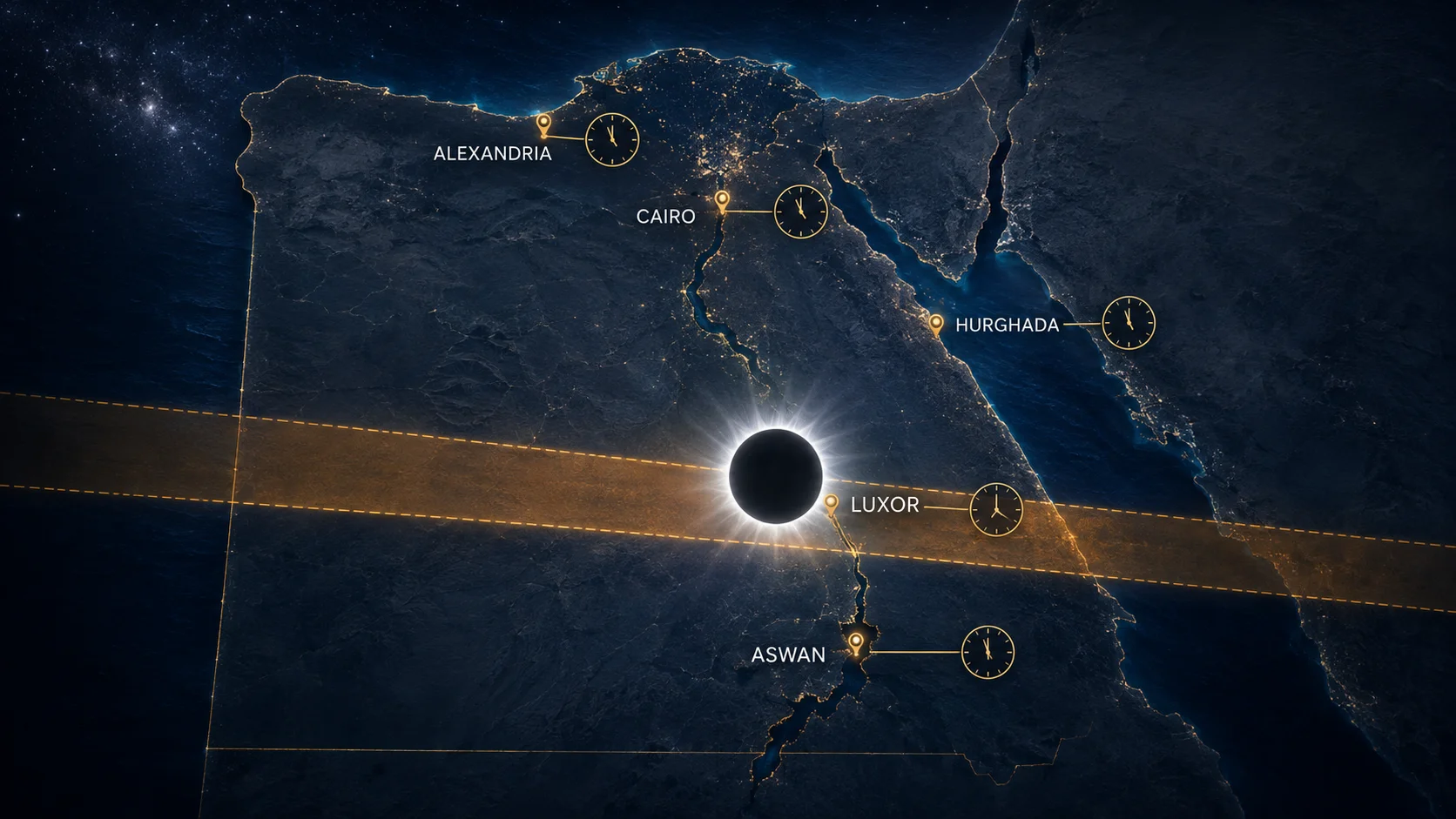
solar eclipse 2027 time in Egypt: quick answer
solar eclipse 2027 time in Egypt: 🕒 Planning accuracy notice: The table below uses representative city-center coordinates and rounds times to the nearest minute. It is suitable for trip planning, not as the final operational timetable for a viewing camp. Exact seconds, totality duration and path status must
The solar eclipse 2027 time in Egypt is not one single nationwide moment. The total solar eclipse occurs on Monday, August 2, 2027, but each Egyptian city experiences first contact, maximum eclipse and final contact at slightly different times as the Moon’s shadow moves eastward across the country.
The most important difference is not only the clock time. Some Egyptian locations are inside the path of totality and will see the Sun completely covered for several minutes. Other locations—including Cairo, Alexandria, central Aswan city, Hurghada and Farafra—are expected to see a deep partial eclipse rather than totality at their representative city-center coordinates.
Under Egypt’s current daylight-saving law, August 2 falls during summer time, so the expected civil time is EEST, UTC+3. The legal time rule should still be checked again before tickets, transfers and final guest briefings are issued, because governments can amend clock regulations.
For a quick answer, the eclipse begins across the selected Egyptian locations between approximately 11:22 am and 11:46 am local time. Maximum eclipse occurs from about 12:45 pm to 1:11 pm, depending on longitude and latitude. The final partial phase ends between approximately 2:08 pm and 2:31 pm.
The exact experience changes sharply by location. Siwa, Bahariya, Asyut, Luxor, Qena and Marsa Alam are examples of locations where representative coordinates fall inside totality. Cairo and Alexandria remain partial. Aswan city is extremely close to totality but is still partial at the city-center reference coordinate, demonstrating why a governorate name or tourism destination is not precise enough for eclipse planning.
Quick 2027 Egypt Eclipse Timing Table
All times below are expected local Egyptian summer time, UTC+3, rounded to the nearest minute. “Total begins” and “Total ends” apply only to locations inside the path of totality.
| Location | Local type at reference coordinate | Partial begins | Total begins | Maximum | Total ends | Partial ends | Approx. totality |
|---|---|---|---|---|---|---|---|
| Siwa Oasis | Total | 11:22 am | 12:43 pm | 12:45 pm | 12:48 pm | 2:08 pm | About 5m 31s |
| Bahariya Oasis / Bawiti reference | Total | 11:30 am | 12:50 pm | 12:53 pm | 12:57 pm | 2:16 pm | About 6m 17s |
| Alexandria | Partial | 11:30 am | — | 12:52 pm | — | 2:12 pm | None |
| Cairo | Partial | 11:33 am | — | 12:56 pm | — | 2:16 pm | None |
| Asyut | Total | 11:36 am | 12:57 pm | 1:00 pm | 1:03 pm | 2:22 pm | About 6m 05s |
| Luxor | Total | 11:40 am | 1:02 pm | 1:05 pm | 1:08 pm | 2:27 pm | About 6m 21s |
| Qena | Total | 11:40 am | 1:02 pm | 1:05 pm | 1:08 pm | 2:26 pm | About 6m 10s |
| Hurghada | Partial | 11:41 am | — | 1:05 pm | — | 2:25 pm | None |
| Aswan city | Deep partial | 11:43 am | — | 1:08 pm | — | 2:30 pm | None at city-center reference |
| Marsa Alam | Total | 11:46 am | 1:08 pm | 1:11 pm | 1:14 pm | 2:31 pm | About 5m 27s |
These values are intentionally rounded for trip planning. Exact seconds and totality duration should be confirmed again for the final viewing GPS coordinate, elevation and calculation model before the event.
What Time Zone Will Egypt Use on August 2, 2027?
Egypt’s standard clock is Eastern European Time, UTC+2. Under Law No. 24 of 2023, the legal clock is advanced by one hour from the final Friday of April through the end of the final Thursday of October.
If that law remains in force without amendment, Egypt will use Eastern European Summer Time, UTC+3, on August 2, 2027.
That means a NASA time shown in Universal Time must currently be converted by adding three hours.
For example:
- 9:45 UTC becomes 12:45 pm in Egypt.
- 10:05 UTC becomes 1:05 pm in Egypt.
- 11:16 UTC becomes 2:16 pm in Egypt.
This sounds simple, but time-zone mistakes are common in event planning. Some older eclipse pages and software tools assume Egypt is permanently UTC+2. Others ask the user to add daylight saving manually. A schedule can therefore be wrong by one hour even when the astronomical calculation is correct.
When comparing published eclipse times, look for:
- The local time in Egypt.
- The UTC time in a technical note.
- The time-zone abbreviation and offset.
- A “last verified” date.
- A reminder that legal time should be checked again before the event.
A final guest itinerary should never rely on an old screenshot or copied table without verifying its UTC conversion.
The Five Main Eclipse Contacts
A solar-eclipse timeline uses contact points to describe the event.
First Contact — C1
First contact is the moment the Moon’s edge first touches the Sun’s edge from the observer’s viewpoint. The partial eclipse begins.
The change is subtle at first. A small dark indentation appears on the solar disk through approved eclipse glasses or a properly filtered instrument.
Guests should already be at the viewing field before C1. Camera filters, tripods, shade, hydration and safety instructions should be ready. C1 is not the correct arrival time; it is the beginning of the observation program.
Second Contact — C2
Second contact occurs only at locations inside the path of totality. It marks the beginning of totality.
The final bright points of the photosphere disappear. Baily’s beads and the diamond-ring effect may be visible close to this moment. Once the photosphere is fully covered and the site leader confirms totality, ordinary eclipse glasses may be removed for naked-eye viewing.
This transition happens rapidly. A clear announcement system is essential at an organized camp.
Maximum Eclipse
Maximum eclipse is the moment when the Moon is most centrally positioned over the Sun for that exact location.
It does not always fall exactly halfway between the beginning and end of the entire partial eclipse. For a total location, it falls near the middle of totality.
Maximum eclipse is useful for tables and photography plans, but the entire total phase matters. Guests should not wait for maximum to look up.
Third Contact — C3
Third contact marks the end of totality.
The first direct point of photospheric sunlight returns. Eclipse glasses must be replaced immediately before or at this moment. Camera solar filters must also be restored before the photosphere reappears.
A professionally managed site should issue a countdown or clear warning before C3 so that guests are not surprised by the returning sunlight.
Fourth Contact — C4
Fourth contact is when the Moon completely leaves the solar disk and the partial eclipse ends.
By this time, guests may already feel that the main event is over, but the post-totality partial phase lasts for more than an hour in many Egyptian locations. Photographers may continue recording the changing solar crescent.
Operationally, the period after C3 should be planned carefully. Immediate mass departure can create traffic, dust and unsafe vehicle movement. A camp may keep guests for lunch, rest or a post-eclipse briefing until the field can be cleared in stages.
Solar Eclipse 2027 Time in Cairo
Cairo is expected to see a deep partial solar eclipse rather than totality.
At a representative central-Cairo coordinate, the partial phase begins at approximately 11:33 am, reaches maximum at about 12:56 pm, and ends near 2:16 pm local summer time.
The exact minute can vary slightly across Greater Cairo because the metropolitan area is large. Different sources may show 11:33 or 11:34 for first contact and 2:16 or 2:17 for final contact depending on the selected coordinate and rounding method.
The important conclusion is stable: Cairo is outside the path of totality.
Observers in Cairo will see the Sun become a thin crescent, but some photospheric sunlight remains visible throughout. There is no safe naked-eye phase. Eclipse glasses or an indirect projection method are required whenever looking at the Sun.
Cairo can serve as the international arrival gateway for eclipse travelers. It should not be marketed as the location of the total phase.
A good travel schedule may include:
- International arrival in Cairo.
- Hotel rest.
- Equipment and safety check.
- Transfer to the selected totality region before eclipse day.
- Return to Cairo after the event or after an extension.
Travelers who remain in Cairo can still experience an impressive partial eclipse, but they should understand that it is not equivalent to totality. Read the full Cairo and Alexandria partial-eclipse guide to compare city viewing with the confirmed Western Desert eclipse-camp region between the White Desert and the Black Desert, inside the path of totality, where the final astronomically verified viewing point will provide at least 6 minutes of totality.
Solar Eclipse 2027 Time in Alexandria
Alexandria is also outside the path of totality at the representative city coordinate.
The partial eclipse begins at about 11:30 am, reaches maximum near 12:52 pm, and ends around 2:12 pm local time.
Alexandria’s maximum occurs several minutes earlier than Cairo because of its position farther west. The event ends earlier for the same reason.
The city may offer an attractive Mediterranean setting for partial-eclipse photography, but the Sun is never completely covered. The corona will not become visible as it does during totality, and solar protection must remain in use throughout.
Travelers should not choose Alexandria on the assumption that a high coverage percentage is “close enough” to totality. The final exposed part of the photosphere remains extremely bright and changes the entire experience.
Solar Eclipse 2027 Time in Siwa Oasis
Siwa Oasis lies inside the path of totality at the representative oasis coordinate.
The partial eclipse begins at approximately 11:22 am. Totality begins around 12:42:34 pm, maximum occurs near 12:45:19 pm, and totality ends around 12:48:05 pm. The final partial phase ends near 2:08 pm.
This gives roughly 5 minutes 31 seconds of totality at the chosen reference point. Other published calculations may round the duration to about 5 minutes 33 seconds depending on the coordinate and model.
Siwa is one of the earliest major Egyptian destinations to experience the eclipse because it lies in the western part of the country.
Its advantages may include:
- A verified total location.
- Open desert landscapes.
- A distinctive oasis setting.
- A total phase much longer than most modern eclipses.
Its planning considerations include:
- Long overland transport.
- Accommodation capacity.
- Road congestion near the event.
- Summer heat.
- Medical and vehicle support.
- The distance between a hotel or camp and the final viewing coordinate.
A listing that says only “Siwa” is not a complete viewing plan. The exact site still determines duration, horizon, access and crowd control.
Read the complete Siwa Oasis eclipse guide and compare it with the managed White Desert eclipse camp near Bahariya, which offers longer representative totality, easier access from Cairo and White Desert experiences.
Solar Eclipse 2027 Time in Bahariya Oasis
At a representative Bawiti/Bahariya coordinate, the partial phase begins at approximately 11:30 am. Totality begins around 12:50:19 pm, maximum occurs near 12:53:28 pm, and totality ends around 12:56:36 pm. The partial eclipse ends around 2:16 pm.
The reference totality duration is approximately 6 minutes 17 seconds.
This is a major strategic advantage for a Western Desert eclipse product. Bahariya can offer a long total phase while remaining reachable by organized road transfer from Cairo.
However, the representative Bawiti calculation is not automatically the camp calculation.
The final camp may be placed at another coordinate for reasons such as:
- Greater totality duration.
- Better road access.
- Legal permission.
- A wider horizon.
- Safer terrain.
- More space for tents and vehicles.
- Lower local obstruction.
- Better emergency access.
- Separation from public traffic.
The site coordinates must be checked before the website publishes an exact duration.
The tour can include excursions to the White Desert, Black Desert, Crystal Mountain or oasis attractions, but the eclipse-viewing site should be described by its verified Western Desert coordinate rather than assuming that every destination in the wider White Desert region is inside totality.
Solar Eclipse 2027 Time in Asyut
Asyut lies inside the path of totality at the representative city coordinate.
The partial eclipse begins around 11:36 am. Totality starts at approximately 12:56:55 pm, maximum occurs close to 1:00 pm, and totality ends around 1:03 pm. The final partial phase ends near 2:22 pm.
The resulting totality is about 6 minutes 5 seconds.
Asyut demonstrates how the path crosses Upper Egypt well north of Luxor. It may attract observers seeking a long total phase without traveling as far south.
A city location still requires local evaluation. Buildings, trees, public access, traffic and security can make an urban coordinate less suitable than an open site outside the center.
Solar Eclipse 2027 Time in Luxor
Luxor is one of the most discussed viewing destinations for the 2027 eclipse because it lies close to the most favorable section of the path.
At the representative city coordinate, the partial eclipse begins around 11:40 am. Totality starts at approximately 1:02:06 pm, maximum occurs near 1:05:17 pm, and totality ends around 1:08:27 pm. The partial phase ends close to 2:27 pm.
The calculated totality is approximately 6 minutes 21 seconds, only slightly below the global maximum.
Luxor’s advantages include:
- Exceptionally long totality.
- Established hotels.
- An international tourism infrastructure.
- Ancient temples and Nile attractions.
- Airport access.
- A very high Sun near maximum eclipse.
Potential challenges include:
- Concentration of international groups.
- Traffic.
- Competition for hotels and transport.
- Restrictions around archaeological sites.
- Urban or agricultural obstructions.
- Heat exposure during the midday event.
A famous monument should not be assumed to be the viewing field. Permissions, visitor safety and an unobstructed sky must be confirmed.
Solar Eclipse 2027 Time in Qena
Qena also lies inside totality at the representative coordinate.
The partial eclipse begins around 11:40 am. Totality begins near 1:01:37 pm, maximum occurs around 1:04:42 pm, and totality ends around 1:07:47 pm. The partial phase ends close to 2:26 pm.
The central phase lasts approximately 6 minutes 10 seconds.
Qena can be strategically relevant because it lies within the long-totality region while offering a different logistical environment from central Luxor. It may also be used in wider destination comparisons involving Dendera, road access and accommodation.
The same rules apply: calculate exact coordinates, confirm land access and do not transfer a city-center duration to a different viewing field without recalculation.
Solar Eclipse 2027 Time in Hurghada
Hurghada is expected to see a deep partial eclipse at its representative city coordinate.
The event begins around 11:41 am, reaches maximum at about 1:05 pm, and ends near 2:25 pm.
The eclipse magnitude is high, but the photosphere does not disappear completely at the city-center coordinate. There is no total phase and no safe naked-eye interval.
This is an important correction because “the Red Sea” is a broad region. Hurghada and Marsa Alam do not share the same path status.
Read the complete Hurghada vs Marsa Alam eclipse comparison for the coast-by-coast path, resort-coordinate checks, transfer risks and comparison with the Bahariya and White Desert eclipse camp.
A resort’s marketing page should therefore avoid saying that all Red Sea destinations will experience totality. The exact hotel or viewing area must be checked.
Guests based in Hurghada who want totality would need an organized transfer to a verified location inside the path. The road, departure time, heat and return plan would be major parts of the product.
Solar Eclipse 2027 Time in Marsa Alam
Marsa Alam lies inside the path of totality at the representative coordinate used for this table.
The partial eclipse begins at approximately 11:46 am. Totality starts around 1:08:06 pm, maximum occurs near 1:10:50 pm, and totality ends around 1:13:33 pm. The partial phase ends close to 2:31 pm.
The reference totality lasts about 5 minutes 27 seconds.
Marsa Alam therefore differs fundamentally from Hurghada for the 2027 event.
Potential advantages include:
- A verified total phase at suitable coordinates.
- Resort accommodation.
- Red Sea scenery.
- Airport access.
- A later maximum that may allow a different event schedule.
Challenges may include:
- Exact resort location.
- Coastal haze or humidity.
- Transfer distances.
- Viewing-field access.
- Heat.
- The need for an unobstructed high-sky view.
The label “Marsa Alam” covers a long coastal area. A resort north or south of the reference point can have different eclipse circumstances.
Solar Eclipse 2027 Time in Aswan
Aswan requires especially careful wording.
At a representative central-Aswan coordinate, the partial eclipse begins at approximately 11:43 am, reaches maximum around 1:08 pm, and ends near 2:30 pm.
The eclipse is extremely deep—close to full coverage—but remains partial at the selected city-center coordinate. There is no second or third contact and no totality.
Parts of the wider Aswan Governorate may have different circumstances because the governorate covers a large area. A statement such as “Aswan is inside totality” or “Aswan is outside totality” is too broad unless it identifies the exact point.
For a travel product, the correct method is:
- Identify the hotel or embarkation point.
- Identify the proposed viewing field.
- Calculate each coordinate separately.
- Confirm road access between them.
- Publish the viewing-site result rather than the governorate result.
This distinction protects the site from misleading claims and helps travelers understand why a short transfer can change the experience from deep partial to total.
What About Farafra and the White Desert?
At a representative Farafra coordinate, calculations place the event extremely close to totality but still partial.
The partial phase begins around 11:29 am, reaches maximum near 12:53 pm, and ends around 2:16 pm. The magnitude is approximately 0.994 at the reference coordinate.
That means almost all of the Sun’s diameter is covered, but the city-center reference does not experience totality.
The phrase “White Desert” can refer to a broad tourism region, park area or collection of excursion sites. Some proposed Western Desert viewing coordinates may be inside totality, while familiar Farafra-area sites may be outside.
The eclipse product should therefore separate:
- The verified eclipse camp location.
- Bahariya Oasis.
- White Desert excursions.
- Farafra.
- The broader Western Desert brand.
This is not a minor technical detail. It determines whether guests see the corona and whether eclipse glasses may be removed during a central phase.
Why Do Published Eclipse Times Differ by a Minute?
Travelers may compare two reputable calculators and notice that one shows 11:33 while another shows 11:34.
Several factors can cause small differences:
Different coordinates
“Cairo” may refer to the city center, Cairo Governorate, New Cairo, Giza or another point in the metropolitan area.
Rounding
A contact at 11:33:31 may be displayed as 11:33 or 11:34 depending on the rounding rule.
Different ephemerides or Delta T assumptions
Calculation systems may use slightly different astronomical models or predicted Earth-rotation values.
Lunar-limb profile
The Moon’s edge contains mountains and valleys. Center-of-mass predictions treat the limb more smoothly. Detailed limb calculations can alter totality contact times by a few seconds and shift the effective path edge by a small distance.
Elevation
Observer elevation can make a small difference, especially near a path boundary.
Time-zone handling
An outdated UTC+2 conversion can create a full one-hour error, much larger than normal astronomical differences.
For public-facing content, minute-level rounded times are usually clearer. For camp operations and photography, use seconds from a documented calculation for the final GPS point.
Why the Eclipse Does Not Peak at the Same Time Everywhere
The Moon’s umbral and penumbral shadows move across Earth while Earth rotates underneath them.
Western Egyptian locations encounter the event earlier. Eastern and southeastern locations encounter it later.
This is visible in the table:
- Siwa maximum: about 12:45 pm.
- Bahariya maximum: about 12:53 pm.
- Cairo maximum: about 12:56 pm.
- Asyut maximum: about 1:00 pm.
- Luxor and Hurghada maximum: about 1:05 pm.
- Aswan maximum: about 1:08 pm.
- Marsa Alam maximum: about 1:11 pm.
The sequence is not determined by longitude alone. The shape and direction of the shadow path also matter.
How Early Should Guests Arrive at the Viewing Field?
Guests should be settled well before first contact.
For a camp where C1 occurs around 11:30 am, a reasonable operational schedule might place guests at the open viewing field by 10:00 or 10:30 am, depending on walking distance and equipment needs.
The pre-eclipse period should include:
- Breakfast and hydration.
- Medical check-in where appropriate.
- Distribution and inspection of eclipse glasses.
- Camera-filter inspection.
- Tripod setup.
- Assignment of viewing zones.
- Explanation of C1, C2, maximum, C3 and C4.
- Emergency and toilet instructions.
- Confirmation of white-light restrictions.
- A practice countdown for removing and replacing glasses.
- Weather and dust update.
- Final communication check.
Guests should not be transferred to a remote field only minutes before totality.
Suggested Eclipse-Day Schedule for a Bahariya Reference Site
The following is a planning example, not the final itinerary.
7:00–8:00 am — Breakfast and hydration
Guests eat early and begin drinking water before outdoor exposure.
8:00–9:00 am — Astronomy and safety briefing
The team explains eclipse phases, glasses, camera filters and emergency procedures.
9:00–10:00 am — Equipment movement
Tripods and approved equipment are transferred to assigned zones.
10:00–10:30 am — Guests enter the viewing field
The field should already be controlled, shaded rest areas operating and medical support available.
Around 11:30 am — Partial eclipse begins
Glasses remain on for direct viewing.
Around 12:50 pm — Totality approaches
The viewing leader begins contact announcements. Movement, vehicles and distracting activity stop.
Around 12:50–12:57 pm — Total phase
Exact C2 and C3 depend on the final operational GPS coordinate. Glasses may be removed only after full coverage is confirmed and must be replaced before sunlight returns.
12:57–2:16 pm — Post-totality partial phase
Guests rest, eat and continue filtered observation.
After 2:16 pm — Eclipse complete
Equipment is packed in stages. Departure is controlled to avoid dust and traffic.
Safety Rules Linked to the Timeline
Before C2
Approved eclipse glasses or safe indirect projection are required.
During confirmed totality
At a total location only, glasses may be removed after the photosphere is fully covered.
Before C3
The leader warns guests to prepare to replace glasses.
At C3
Glasses and front-mounted camera filters must be back in place.
Partial-only locations
Glasses remain on whenever looking directly at the Sun. There is no removal phase.
Ordinary sunglasses are never sufficient. Cameras, binoculars and telescopes require suitable solar filters over the front aperture during partial phases.
Photography Timing Checklist
A photographer should create a local contact sheet for the exact viewing coordinate.
It should include:
- C1.
- Ten-minute intervals before C2.
- Five minutes before C2.
- One minute before C2.
- C2.
- Mid-totality.
- One minute before C3.
- C3.
- C4.
- Solar altitude and azimuth.
- Filter-on and filter-off actions.
- Camera exposure sequence.
- A planned period for unaided viewing.
Because the Sun is very high during the Egyptian eclipse, tripod movement should be rehearsed. A camera may need to point close to overhead, and the photographer should confirm that the tripod head, cables and lens hood do not collide.
Frequently Asked Questions
What time does the eclipse start in Egypt?
In the selected cities, the partial eclipse begins between approximately 11:22 am and 11:46 am local summer time. The exact start depends on location.
What time is maximum eclipse in Luxor?
Maximum eclipse is approximately 1:05 pm local time at the representative Luxor coordinate.
What time does totality begin in Luxor?
It begins at approximately 1:02 pm and ends around 1:08 pm at the representative city coordinate.
What time is maximum eclipse in Siwa?
Approximately 12:45 pm local time.
What time is the eclipse in Cairo?
The partial phase begins at about 11:33 am, reaches maximum near 12:56 pm and ends around 2:16 pm.
Will Cairo see totality?
No. Cairo is outside the path of totality and sees a partial eclipse.
Will Alexandria see totality?
No. Alexandria sees a partial eclipse at the representative city coordinate.
Will Aswan see totality?
Central Aswan city is expected to see a very deep partial eclipse. Other coordinates within the wider governorate must be checked individually.
Will Hurghada see totality?
Hurghada city is expected to see a deep partial eclipse rather than totality.
Will Marsa Alam see totality?
Representative Marsa Alam coordinates lie inside totality, but the exact resort or viewing field must be calculated.
Is Bahariya inside the path of totality?
Representative Bahariya/Bawiti coordinates are inside totality. The eclipse camp and open-sky viewing area will be inside the path of totality, in the zone between the White Desert and the Black Desert. The exact operational point and coordinates will be shared later with confirmed guests after final terrain, access, safety, horizon and viewing-condition checks. These checks are designed to choose the best practical terrain, horizon and viewing conditions. The selected point will be astronomically verified to provide at least 6 minutes of totality.
Is the White Desert inside totality?
The term describes a broad region. Some locations may be outside totality. Do not rely on the name alone; use exact coordinates.
Why are the times shown in EEST?
Egypt’s current summer-time law would place August 2, 2027 at UTC+3. The legal rule should be checked again before the event.
Can eclipse times change?
The broad timing is highly predictable. Refined lunar-limb models, coordinates, elevation and time-zone rules can change published local seconds or clock conversion slightly.
Should I arrive at maximum eclipse time?
No. Arrive well before first contact. Totality lasts only minutes and the equipment and safety briefing must be completed beforehand.
When can eclipse glasses be removed?
Only at a location inside totality, and only after the Sun’s photosphere is completely covered. Replace them before direct sunlight returns.
Final Takeaway
The 2027 solar eclipse does not occur at one identical time or with one identical eclipse type across Egypt.
Western destinations such as Siwa encounter maximum eclipse first. Bahariya follows, then Cairo and Upper Egypt, with Marsa Alam reaching maximum later. Some locations receive more than six minutes of totality, while Cairo, Alexandria, Hurghada, Farafra and central Aswan remain partial at representative coordinates.
The planning table is useful for understanding the day. The final viewing plan must be based on the exact camp GPS point.
Explore the 2027 Egypt eclipse packages or check availability for the Western Desert eclipse camp.
Related Map Guide
Compare these city timings with the 2027 eclipse path of totality in Egypt map to see which locations are total, partial or close to the path boundary.
Location Guide Update
For travelers considering Upper Egypt, the complete Luxor eclipse guide explains the local timing, approximately 6 minutes 22 seconds of totality, high-Sun photography, heat management, viewing-field requirements and how Luxor compares with a Western Desert camp.
Related Aswan Path Guide
Aswan city and Aswan Governorate do not share one eclipse result. Read Is Aswan Inside the 2027 Eclipse Path? for the city-versus-governorate distinction, Edfu totality and transfer-planning implications.
Authoritative planning reference
Use NASA 2027 eclipse path data as a primary reference, then verify local circumstances for the exact location.