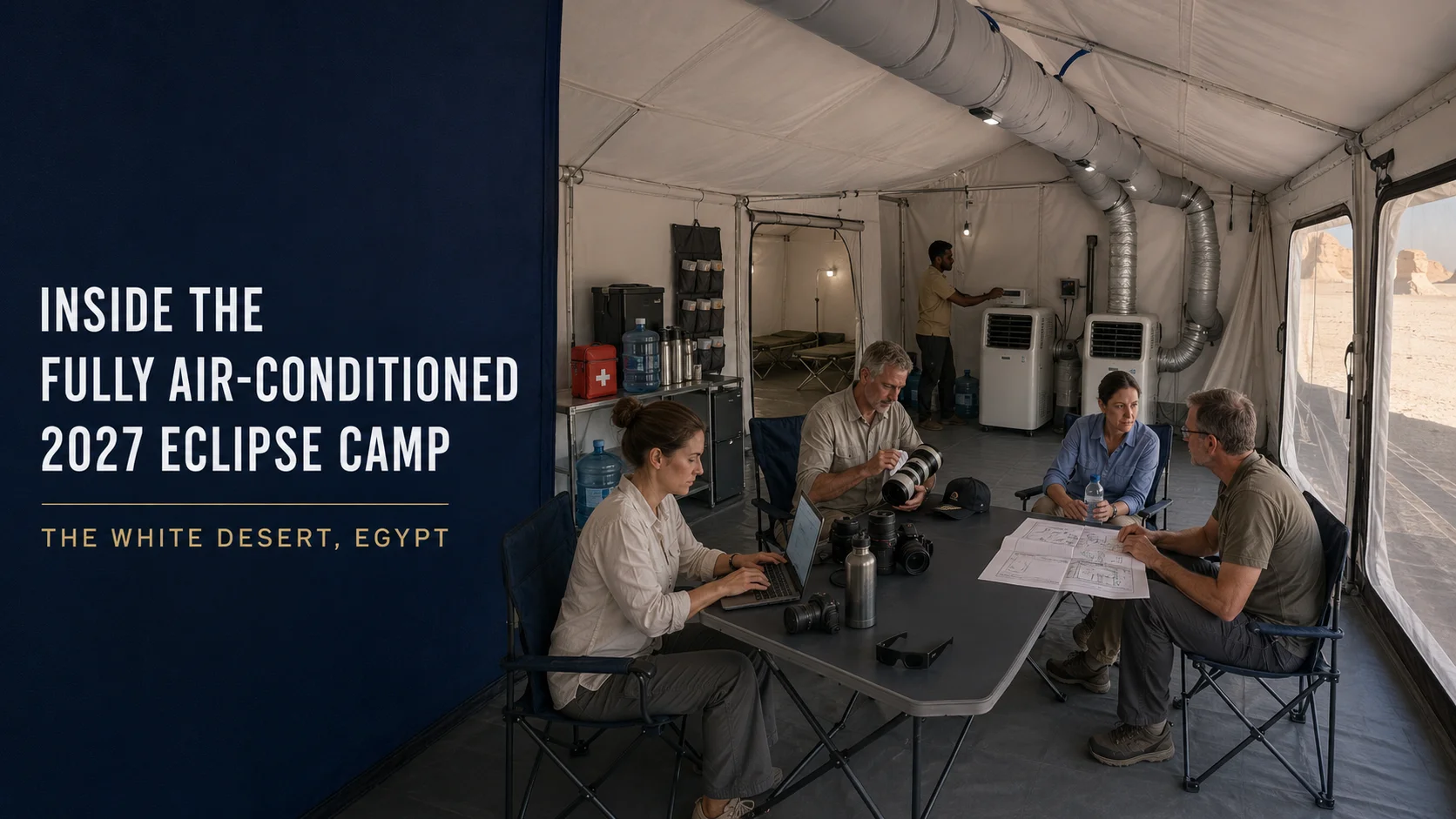
For most of the year, camping in Egypt’s Western Desert is about simplicity: canvas, stars, a fire, basic meals and an extraordinary landscape. The air-conditioned eclipse camp in the White Desert region for 2027 is being designed for a very different challenge.
The total solar eclipse of August 2, 2027 takes place in midsummer, around the hottest part of the day. Travelers may spend hours at the event base before and after totality. Photographers may arrive early to prepare equipment. Older guests, families and travelers with health conditions may need regular access to cooling. The camp therefore cannot be planned like a minimalist winter safari.
The published 2027 concept from Solar Eclipse Tours is a fully serviced event base in Egypt’s Western Desert, operated through Bahariya Oasis and combined with White Desert experiences. The current operating dossier specifies air-conditioning at the Observatory Camp, cooling planned across sleeping tents, seating lounges, dining areas and dedicated eclipse-viewing spaces, camp-wide Wi-Fi, distributed charging points, toilets, first aid and an on-site medical professional during the main event. The standard published capacity is capped at a maximum of 40 travelers.
That does not mean every operational detail is frozen more than a year before the eclipse. Exact field coordinates, final layouts, permits, equipment quantities and some infrastructure details remain subject to final written confirmation. But the philosophy is already clear: the eclipse camp is being built around August heat and event-day operations, not adapted from a normal desert safari at the last minute.
What Does “Fully Air-Conditioned Eclipse Camp” Actually Mean?
The phrase can easily be misunderstood.
Nobody is suggesting that the actual Sun should be observed through the roof of an enclosed hotel room. A total solar eclipse requires an open view of the sky. The observation field itself must remain open and unobstructed.
The purpose of the climate-controlled camp is different.
It gives guests a network of cooled spaces close to the viewing area so they do not need to remain exposed to August heat for hours simply because the eclipse is underway.
The current event-base concept divides the experience into several functions:
- Sleeping accommodation.
- Seating and lounge areas.
- Dining.
- Eclipse preparation.
- Open-sky observation.
- Photography preparation.
- Water and food service.
- Toilets and sanitation.
- Charging and electricity.
- Wi-Fi and communications.
- First aid and medical support.
- Vehicle staging and controlled departures.
Air-conditioning and cooling are used where they improve comfort and reduce unnecessary heat exposure, while the actual moment of observation takes place outside under the open desert sky.
This is a very different model from standing beside a parked 4x4 in an empty field for several hours.
Why Air Conditioning Matters So Much on August 2, 2027
The eclipse date cannot be moved to a cooler month.
Egypt in August can be extremely hot, especially in inland desert environments. The central eclipse period also happens around midday.
WHO identifies heat as a significant environmental and occupational health hazard. Prolonged exposure can contribute to heat exhaustion and heatstroke and can worsen cardiovascular, respiratory, kidney, metabolic and other health conditions.
For a 2027 eclipse event, heat management therefore becomes part of the site design.
A cooled camp can reduce several avoidable problems:
- Guests arriving already overheated before totality.
- Photographers staying in direct sun because they are afraid to leave equipment.
- Children becoming tired or irritable during the long partial phase.
- Older travelers standing outside longer than is comfortable.
- Staff working continuously without recovery areas.
- Guests relying only on moving air from fans.
- Visitors waiting in hot vehicles.
- Meals and beverages being served from an improvised setup.
Cooling does not eliminate heat risk, but it gives the operation a practical tool to control exposure.
Read the full Egypt August desert heat safety guide for the wider preparation plan.
The Observatory Camp: The Core of the Event Base
The current Solar Eclipse Tours B2B operating dossier describes the main event base as the Observatory Camp.
The published concept includes:
- Air-conditioning available at the Observatory Camp.
- Cooling planned across sleeping tents.
- Cooled seating lounges.
- Cooled dining areas.
- Dedicated eclipse-viewing support spaces.
- Camp-wide Wi-Fi.
- Distributed charging points.
- Dedicated toilets.
- First-aid support.
- An on-site medical professional during the main event.
- A standard maximum capacity of 40 travelers.
The purpose of that capacity limit is important.
A camp designed for 40 people is not automatically capable of serving 300 or 500 guests just because more land is available. Larger groups require additional vehicles, generators, cooling capacity, toilets, catering, staff, water, waste management, permits and medical planning.
That is why requests above the published standard capacity require a separate operational feasibility review before they can be confirmed.
Why a 40-Guest Cap Changes the Experience
Eclipse events can become crowded very quickly.
Major cities and famous tourism locations may attract large numbers of independent travelers, buses, tour groups and media teams. A controlled desert base allows the operation to design for a known number of guests instead.
A maximum published capacity of 40 can support:
- Better spacing between observers.
- More predictable cooling demand.
- Better toilet-to-guest ratios.
- Controlled catering quantities.
- Structured vehicle manifests.
- Easier head counts.
- Defined photography zones.
- More reliable charging demand planning.
- Clearer medical oversight.
- A more controlled departure after totality.
Capacity alone does not guarantee quality. The final layout and staffing still matter.
But it is much easier to design a serious event around a known maximum than around an unlimited crowd.
Where Is the Eclipse Camp?
The operation is based through Bahariya Oasis and the Western Desert, with White Desert experiences incorporated into the broader itinerary.
This geographic distinction matters.
The famous White Desert formations should not automatically be described as the exact totality field. The standard tourist areas and iconic formations are part of the wider desert journey, while the eclipse observation site uses a separately managed open desert location inside the path of totality.
The current operating documents describe the viewing plan as an open desert viewing area inside totality, with exact operational coordinates managed with the relevant authorities.
That is a more accurate model than publishing one permanent GPS point too early.
Final coordinates can be affected by permits, road access, site preparation, safety, operational requirements and refined eclipse-path calculations.
For the larger geography, read The White Desert, Egypt: The Complete Traveler’s Guide.
What Guests See When They Arrive
The arrival experience should feel like an event base, not an improvised roadside stop.
Guests arrive through organized transport from Cairo or Giza to Bahariya, then continue into the desert using locally operated 4x4 vehicles according to the selected package.
The main camp needs to perform several roles simultaneously:
- Accommodation base.
- Dining venue.
- Rest area.
- Cooling station.
- Eclipse briefing area.
- Equipment charging point.
- Communication hub.
- Medical-support location.
- Observation staging area.
A guest should be able to understand where to sleep, where to sit, where to eat, where to charge a phone, where to obtain water, where to find a toilet and where to go if they feel unwell.
That sounds basic, but those are exactly the details that become difficult in a remote desert environment when a group is large and the temperature is high.
Air-Conditioned Sleeping Areas
The current camp concept plans cooling across sleeping tents at the main eclipse event base.
This is particularly important because poor sleep the night before totality can affect the entire experience.
Guests may already have experienced:
- An international flight.
- Jet lag.
- A Cairo hotel stay.
- A several-hour road transfer.
- A 4x4 desert route.
- August heat.
- Excitement about the eclipse.
A cooled sleeping environment gives the body a better chance to recover before the fixed astronomical event the next day.
Sleeping arrangements are planned in solo, twin and triple formats depending on booking and package.
Final bedding type, tent model and rooming allocation should be confirmed in the traveler’s written booking documents.
Cooled Seating Lounges
The seating lounge may be one of the most valuable areas in the entire camp.
Why?
Because most guests do not need to spend every minute outside during the partial phase.
A traveler can observe the first bite of the Moon, return to a cooled lounge, come outside at selected intervals, then return to the observation field before totality.
This reduces unnecessary heat exposure without reducing the eclipse experience.
The lounge can also support:
- Older guests.
- Families.
- Guests recovering from the road transfer.
- Photographers waiting after setup.
- People who need medication or rest.
- Staff rotation.
- Guests who simply prefer not to sit in direct sunlight.
The goal is not to hide from the desert.
The goal is to choose when you are exposed to it.
Cooled Dining Areas
Meal service at a large desert event is a logistical operation in its own right.
The current published plan includes freshly prepared meals, vegetarian options, mineral water and cold drinks.
A cooled or climate-managed dining environment helps guests eat properly and recover from outdoor exposure.
This matters because eclipse excitement can make people neglect basic routines.
A traveler who skips dinner, sleeps poorly, misses breakfast and then stands outside in August heat is creating avoidable risk.
The main camp is intended to support structured meals rather than leave guests dependent on snacks from a vehicle.
Guests with allergies, dietary restrictions or medically important meal requirements should communicate those needs before travel.
Dedicated Eclipse-Viewing Support Areas
The actual observation of totality requires open sky.
The camp design therefore needs a transition between climate-controlled support spaces and the open viewing field.
The ideal setup allows a guest to move from:
cooling → shade → observation → cooling
without a long walk.
That proximity is particularly useful in the final hour before totality.
Guests can rest close to the field, then move outside with enough time to settle before second contact.
After totality, they can return to shade and cooling rather than immediately pack bags under the returning midday Sun.
Wi-Fi in a Remote Desert Camp
The current event concept includes camp-wide Wi-Fi.
That can be valuable for:
- Family communication.
- Messaging.
- Operational announcements.
- Checking itinerary updates.
- Sharing selected images.
- Accessing eclipse timing tools.
- Some work-related needs.
However, guests should not treat desert Wi-Fi as equivalent to fiber internet in a city hotel.
Remote connectivity can depend on backhaul systems, power, network congestion and the number of users.
On eclipse day, 40 people attempting to upload large RAW photo files simultaneously can overwhelm any reasonable shared connection.
The sensible expectation is useful event connectivity, not guaranteed unlimited high-speed production bandwidth.
Critical information such as contact times, safety instructions and essential documents should also be available offline.
Distributed Charging Points
Charging is another feature that sounds small until everyone needs it at once.
An eclipse group may carry:
- Smartphones.
- Cameras.
- Spare batteries.
- Power banks.
- Tablets.
- Laptops.
- Telescope controllers.
- Tracking mounts.
- Hearing devices.
- Medical equipment.
The current camp concept includes distributed charging points rather than one single outlet for the entire group.
Travelers should still arrive with charged devices and personal backup power.
Do not make eclipse morning dependent on finding an empty socket.
Photographers should prepare their batteries the night before and read the 2027 eclipse photography guide.
Power Is the Hidden Backbone of the Camp
Air-conditioning, Wi-Fi, charging, lighting and some medical-support systems all depend on electricity.
That means power planning is not simply an amenity issue.
It is part of operational resilience.
A properly prepared event base needs sufficient generation for the planned loads and an appropriate backup strategy.
Exact generator specifications and redundancy arrangements should be treated as operational details to be confirmed before the event rather than guessed in marketing copy.
Travelers with medically essential powered equipment should disclose that requirement before booking and obtain written confirmation that the required support can be provided.
Toilets and Sanitation
The published camp concept includes dedicated toilets at the event base.
This is a major difference from a minimalist small-group safari camp.
For a 40-person eclipse operation, sanitation affects:
- Comfort.
- Hygiene.
- Queue length.
- Older travelers.
- Families with children.
- Guests taking medications.
- The length of time people can remain at the site comfortably.
Shower access is associated with Bahariya hotel accommodation according to itinerary rather than being automatically promised at every remote desert camp.
That distinction should remain clear in public descriptions.
First Aid and an On-Site Medical Professional
The current published event concept includes first-aid support and an on-site medical professional during the main eclipse event.
This is particularly relevant in August.
A medical professional does not turn a remote camp into a hospital.
But on-site capability can improve early assessment, first response and decisions about evacuation.
The larger operational plan should also include:
- Communication.
- Vehicle access.
- Defined evacuation routes.
- Awareness of the nearest appropriate medical facility.
- Staff who know how to escalate a problem.
Travelers with significant health conditions should still discuss the itinerary with their own clinician before travel.
Read Eclipse Travel for Seniors and Travelers With Health Conditions for the detailed planning framework.
Drinking Water and Cold Beverages
Water cannot be treated as an optional extra at an August desert event.
The current dossier includes mineral water and cold drinks as part of the food-and-beverage operation.
The important operational principle is continuous availability.
Guests should be able to access drinking water without waiting for a scheduled meal.
Travelers should also carry a personal bottle so they are not dependent on being physically beside the central beverage point.
People who have medical fluid restrictions should follow their clinician’s advice rather than generic hydration targets.
Food at the Eclipse Camp
The published program includes freshly prepared meals and vegetarian options.
Food service is integrated into the camp operation because guests may be at the event base for a substantial period rather than arriving only for totality.
Depending on package, the itinerary can include breakfast, lunch and dinner across multiple days.
The precise meal count depends on the selected 2-day, 3-day or 4-day program.
Guests should disclose dietary requirements early, particularly for:
- Allergies.
- Diabetes-related meal planning.
- Vegetarian diets.
- Religious dietary requirements.
- Food intolerances.
Remote kitchens can make reasonable preparations, but last-minute complex requests are harder to manage than advance planning.
What the Camp Is Not
The Observatory Camp should not be confused with several other types of accommodation.
It is not a conventional city hotel.
It is not a normal winter safari camp.
It is not an unrestricted public festival ground.
It is not the same as the smaller second-night camp used in some longer packages.
And it is not a guarantee that every single space remains at one exact temperature regardless of outdoor conditions.
It is a purpose-built, serviced eclipse event base with planned cooling and support infrastructure designed around the August event.
That distinction creates realistic expectations.
Main Eclipse Camp vs a Standard White Desert Safari Camp
| Feature | 2027 Observatory Camp | Typical Minimalist Desert Camp |
|---|---|---|
| Primary purpose | Special-event eclipse base | Small-group desert overnight |
| Seasonal design | Built around August heat | Usually more suited to cooler desert months |
| Cooling | Air-conditioning available; cooling planned across key guest areas | Often none or limited |
| Capacity | Published maximum 40 travelers | Often small groups |
| Wi-Fi | Camp-wide Wi-Fi planned | Often unavailable |
| Charging | Distributed charging points | Limited or vehicle-based |
| Toilets | Dedicated camp toilets | Varies widely |
| Medical support | First aid + on-site medical professional during main event | Normally basic first aid only |
| Observation planning | Dedicated open-sky eclipse field inside totality | No eclipse-specific requirement |
The table is a conceptual comparison rather than a claim about every desert camp in Egypt. Some private camps may provide more facilities and others less.
The 2-Day Package: Fastest Way to Use the Main Camp
The shortest published program runs August 1–2, 2027.
Guests travel from Cairo or Giza to Bahariya, continue through the Western Desert and arrive at the eclipse event camp before the evening program.
The next morning includes eclipse preparation and totality viewing, followed by further White Desert experiences and the return to Cairo/Giza.
This option is best for travelers who want the shortest complete desert eclipse program.
The trade-off is pace.
There is less recovery time than in the longer package formats.
The 3-Day Package: Eclipse Plus a Smaller Second Camp
The 3-day program uses the main event camp for eclipse night, then continues after totality to a quieter small-group camp.
That second camp is a different experience.
The published itinerary describes it as a small-group camp with a maximum of 10 guests.
Travelers should not assume that every facility at the main Observatory Camp automatically follows them to the smaller second camp.
The benefit is a fuller White Desert experience, including additional desert activities after the eclipse.
The 4-Day Package: Comfort-First Arrival
The 4-day program adds a Bahariya lodge night before entering the desert.
This can be especially attractive for travelers who do not want to travel from Cairo and enter the desert immediately.
The lodge night provides:
- Air-conditioned room.
- Private bathroom facilities.
- Dinner and breakfast.
- Time to rest.
- Bahariya sightseeing before the eclipse camp.
Then guests continue to the main event base and later to the smaller White Desert camp.
For older travelers or guests who want more acclimatization time, this structure may be easier than the shortest program.
Why the Camp Is Useful for Photographers
Eclipse photography requires more time on site than casual viewing.
Photographers may need to:
- Assemble tripods.
- Test solar filters.
- Check focus.
- Align tracking mounts.
- Charge batteries.
- Protect equipment from dust.
- Confirm contact times.
A camp with charging, Wi-Fi, nearby shade and cooling lets photographers prepare without remaining beside the camera continuously in direct sun.
A designated photography zone can also reduce tripod conflicts with general guests.
The exact field layout will depend on final operations, but controlled capacity makes zoning much more practical.
Why the Camp Works for Families
Families face a different challenge.
Children may not want to remain outside for the entire partial phase, and they may need frequent toilet, food and hydration breaks.
A managed base lets parents move between the observation area and the camp infrastructure.
Parents still remain responsible for supervising children and ensuring correct solar-viewing behavior.
Read Solar Eclipse Safety for Children before the event.
Why the Camp Can Be Better for Seniors
Older adults are not one uniform group.
Some are highly active; others need seating, shorter walking distances, medication storage or more regular cooling.
A climate-controlled base can make those differences easier to accommodate.
Useful features include:
- Seating.
- Reduced continuous heat exposure.
- Nearby toilets.
- Water.
- Medical support.
- Vehicle access.
- Charging for devices.
- A place to rest before and after totality.
Accessibility still depends on actual ground surface, vehicle steps, toilet layout and final camp construction.
Travelers with mobility requirements should request specific written information rather than relying only on the phrase “senior friendly.”
Eclipse Glasses Are Not Automatically Included
One important operational detail in the current package dossier is that eclipse glasses are listed separately from the package inclusions.
Do not assume that every booking automatically includes personal solar viewers unless your final package confirmation says so.
Guests should plan to obtain safe viewers from a reputable source and carry spares.
During all partial phases, proper eye protection is required for direct viewing.
Read the full ISO 12312-2 eclipse glasses guide.
The Camp Does Not Guarantee Clear Skies
No operator can guarantee eclipse visibility.
The Western Desert is attractive partly because of its extremely dry climate and strong historical clear-sky prospects, but weather is never guaranteed.
Possible issues can include:
- Cloud.
- Dust.
- Haze.
- Wind.
- Local atmospheric conditions.
The role of a specialist operator is to choose a strong region, prepare a suitable site and manage logistics professionally.
It cannot control the atmosphere.
Why the Western Desert Is Different From Luxor on Eclipse Day
Luxor offers extraordinary totality duration and mature tourism infrastructure.
The Western Desert offers a different type of experience.
Potential advantages include:
- A quieter environment.
- Broad desert sightlines.
- Controlled event capacity.
- Dedicated observation space.
- Lower urban obstruction.
- Easier separation of general guests and photographers.
- A purpose-built climate-managed event base.
- A White Desert journey around the eclipse.
Neither option is automatically “best” for every traveler.
A traveler who prioritizes temples and city hotels may prefer Luxor.
A traveler who prioritizes a controlled desert event and smaller crowd may prefer the Western Desert.
A Typical Eclipse Morning at the Camp
The exact schedule will depend on final contact times and coordinates, but the operational rhythm should look something like this.
Breakfast
Guests eat before the most intense part of the day.
Safety Briefing
The team confirms eye-safety rules, event timing, viewing zones, medical location and movement procedures.
Photography Setup
Photographers prepare equipment early while avoiding last-minute rushing.
Partial Eclipse Begins
Guests can observe the early phase, then return to cooled or shaded areas.
Pre-Totality Return
Everyone returns to the open viewing field in good time before second contact.
Totality
During the true total phase, approved viewers are removed for direct observation of the corona according to the safety briefing.
Third Contact
Eye protection goes back on when the bright photosphere returns.
Recovery
Guests return to shade, cooling, water and food rather than immediately rushing to vehicles.
Controlled Departure or Continued Program
The group either continues deeper into the desert or begins the return route depending on package.
What Happens if the Power Fails?
This is exactly the kind of question a serious traveler should ask.
Because cooling and communications depend on electricity, the final operation needs resilience.
Specific generator counts, fuel reserves and backup architecture should be confirmed in the final operational plan rather than invented in advance.
For travelers, the useful booking question is:
What backup is planned for critical power-dependent services?
If you have a medically essential device, make that requirement explicit before payment.
What Happens if Wi-Fi Fails?
The eclipse does not depend on Wi-Fi.
Critical safety procedures should not depend on internet access either.
The camp should still be able to operate through local staff communication, printed or offline timing information and direct briefings.
Guests should download essential documents and eclipse timing tools before leaving Cairo or Bahariya.
Wi-Fi is valuable infrastructure, but it should remain a convenience rather than a single point of failure.
What Should You Bring Even to a Fully Serviced Camp?
A serviced camp does not mean you should arrive empty-handed.
Bring:
- Passport and documents.
- Safe eclipse glasses.
- Personal medication.
- Sunscreen.
- Hat.
- Lightweight clothing.
- Comfortable footwear.
- Personal water bottle.
- Phone charger.
- Power bank.
- Camera equipment if required.
- Dust protection for electronics.
- Personal hygiene items.
- Small day bag.
- Travel insurance details.
Photographers should carry additional batteries and memory cards.
Questions to Ask Before Booking the Eclipse Camp
Ask for specific answers to these questions:
- Which parts of the Observatory Camp are air-conditioned?
- How is cooling distributed among sleeping, lounge and dining areas?
- How far is the open viewing field from the cooled camp area?
- What is the final guest capacity for my departure?
- Is Wi-Fi included?
- What charging is available?
- What type of toilets are provided?
- What meals are included in my package?
- Can dietary requirements be accommodated?
- Is a medical professional scheduled for the main event?
- What first-aid support is available?
- What is the emergency transport plan?
- Are eclipse glasses included or should I bring my own?
- What sleeping arrangement is confirmed?
- Which night is at the main event camp and which night, if any, is at the smaller camp?
- How much walking is required?
- Can mobility requirements be accommodated?
- What happens if the viewing field has to change?
- What is the cancellation policy?
- Which facilities are guaranteed in writing rather than still planned?
A professional operator should prefer these questions to vague assumptions.
Frequently Asked Questions
Is the 2027 White Desert eclipse camp really air-conditioned?
The current published operating concept states that air-conditioning is available at the Observatory Camp and that cooling is planned across sleeping tents, seating lounges, dining areas and dedicated eclipse-viewing support spaces. Final facility configuration should be confirmed in the written booking documents before travel.
Is the actual observation field indoors?
No. Totality must be viewed from an open-sky observation area. Cooling is provided in nearby camp and support areas so guests can reduce unnecessary heat exposure before and after the critical viewing period.
How many guests will be at the main camp?
The standard published event-base capacity is a maximum of 40 travelers. Larger private or trade groups require a separate feasibility review.
Is Wi-Fi available?
Camp-wide Wi-Fi is part of the published event-base concept. Remote bandwidth should not be treated like guaranteed city fiber speeds.
Can I charge my camera and phone?
Distributed charging points are part of the published plan. Guests should still arrive with charged devices and personal backup power.
Are there toilets?
Yes, dedicated toilets are part of the main event-camp concept. Final accessibility details should be confirmed for travelers with mobility needs.
Are showers available?
Shower access is associated with Bahariya hotel stays according to itinerary. Do not assume that every remote camp night includes hotel-style shower facilities.
Is there medical support?
The published event concept includes first-aid support and an on-site medical professional during the main event. This does not replace hospital care or personal medical planning.
Are meals included?
Yes, meals are included according to the selected package, with freshly prepared food, vegetarian options, mineral water and cold drinks in the current concept.
Are eclipse glasses included?
The current package dossier lists eclipse glasses as not included. Travelers should bring safe viewers unless their final written confirmation states otherwise.
Is the camp located at the famous mushroom rocks?
Do not assume so. The eclipse field is separately managed inside the path of totality. White Desert icons are included in the wider route, but famous formations should not be marketed as the observation point without exact coordinate verification.
Is the camp suitable for children?
Families can benefit from cooling, toilets, food and seating, but parents remain responsible for supervision and solar-viewing safety.
Is the camp suitable for seniors?
It can be more comfortable than an unsupported desert field because of cooling, seating and medical support, but individual mobility and health needs should be confirmed before booking.
What if the viewing location changes?
The final field may change for operational, access, permit, safety or viewing reasons. The important requirement is that the replacement field remain appropriately planned and verified for the eclipse.
Can you guarantee clear weather?
No. No eclipse operator can guarantee visibility.
Is this a luxury glamping resort?
It is better understood as a fully serviced specialist eclipse event base. The purpose is operational comfort, cooling and support in a remote desert setting rather than copying a permanent resort hotel.
Final Takeaway
The most important feature of the 2027 Western Desert eclipse camp is not a decorative tent or a luxury label.
It is the operating philosophy.
August 2, 2027 requires a desert base designed around heat, power, communications, sanitation, crowd control, medical readiness and a fixed astronomical schedule.
The current Observatory Camp concept brings those pieces together through air-conditioning, planned cooling across key guest areas, Wi-Fi, charging, toilets, meals, water, first aid, an on-site medical professional and a controlled maximum published capacity of 40 travelers.
The actual eclipse still happens outside.
Guests still need safe solar viewers.
Weather is still outside anyone’s control.
The Western Desert is still remote.
But the difference between an improvised desert stop and a managed event base is exactly what happens around those few minutes of totality.
Explore the dedicated 2027 Western Desert eclipse camp, compare the eclipse tour packages and check availability.
For August preparation, also read Why You Should Never Visit the White Desert in Summer Without a Specialized Team and How to Prepare for Egypt’s August Desert Heat.
Sources and Operational Basis
This article is based on the current Solar Eclipse Tours 2027 B2B Trade Dossier v3 and the wider 2027 operational plan. Facility details, exact coordinates, permits and final event configuration should be reconfirmed before publication and again before travel.
Safety context should also be checked against: