Red Sea solar eclipse 2027: quick answer
Red Sea solar eclipse 2027: Hurghada is partial while Marsa Alam is total for the 2 August 2027 eclipse. Compare local timings, totality duration, resort coordinates, transfers and Red Sea viewing plans.
The Red Sea solar eclipse 2027 will not look the same along Egypt’s entire coast.
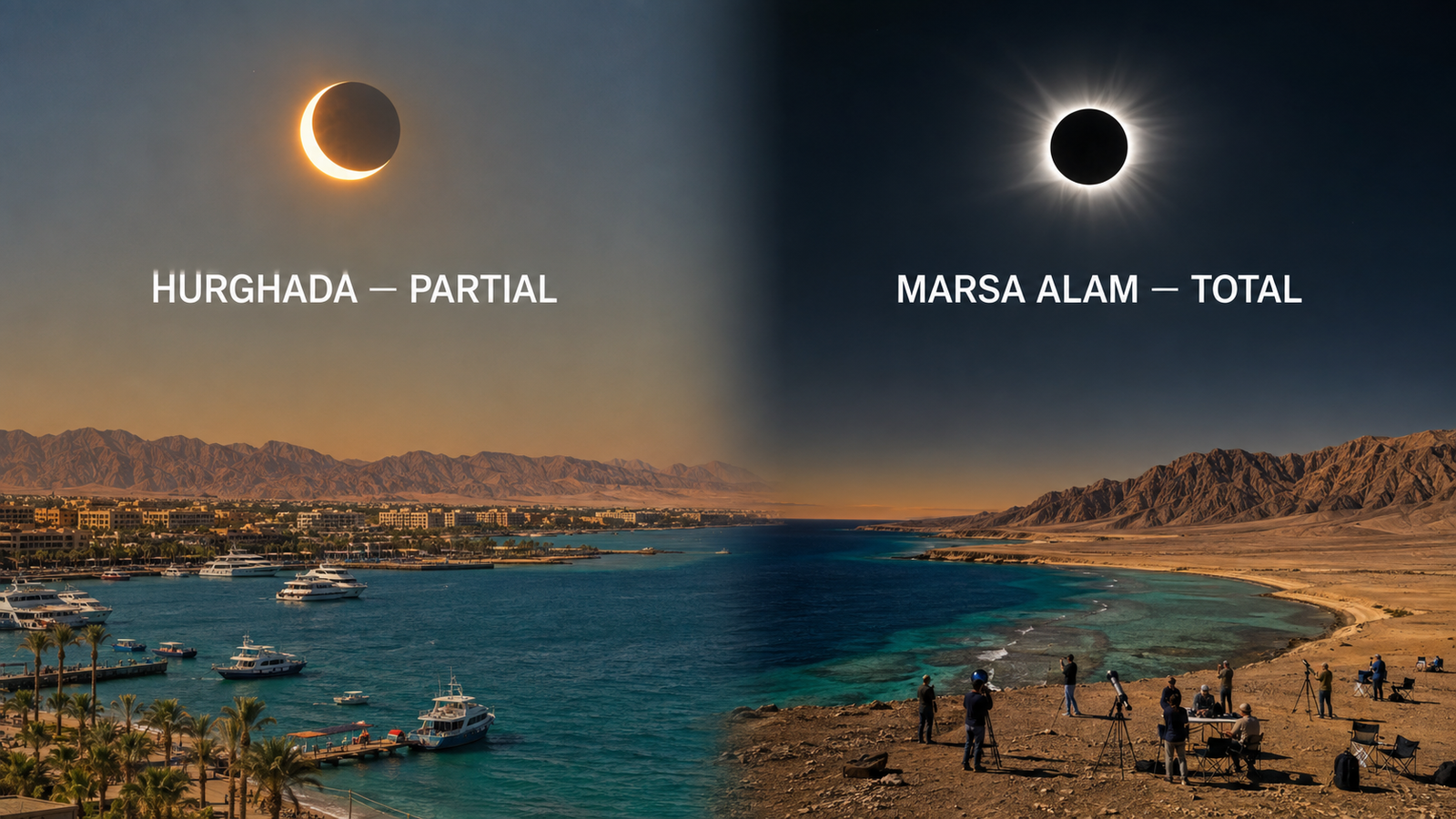
On Monday, August 2, 2027, Hurghada will experience a deep partial solar eclipse at representative city coordinates. The partial phase begins around 11:41 am, reaches maximum near 1:05 pm with a magnitude of approximately 0.980, and ends around 2:25 pm local summer time. The Sun will never be completely covered in Hurghada city, so eclipse glasses must remain in use whenever looking directly at it.
Marsa Alam, farther south, lies inside the path of totality at representative coordinates. The partial eclipse begins around 11:45–11:46 am, maximum occurs near 1:10 pm, and totality lasts approximately 5 minutes 28–30 seconds, depending on the exact coordinate and calculation update.
That difference is fundamental. Hurghada is not “almost total” in the experiential sense. Marsa Alam crosses the physical threshold into totality, when the bright photosphere disappears and the solar corona becomes visible.
The phrase “Red Sea eclipse” can therefore be misleading. El Gouna, Hurghada, Safaga, El Quseir, Port Ghalib and Marsa Alam are spread along a long coastline. They should never be assigned one eclipse type simply because they belong to the same governorate or tourism region.
This guide answers the questions travelers most often ask: whether Hurghada is total or partial, how long totality lasts in Marsa Alam, whether a hotel coordinate matters, whether guests can transfer from Hurghada, and how a Red Sea resort compares with a managed Western Desert eclipse-camp region between the White Desert and the Black Desert, inside the path of totality, with a final astronomically verified viewing point providing at least six minutes of totality.
For the national geography, read the 2027 eclipse path across Egypt. If you are comparing the Red Sea with our managed desert option, see the Eclipse 2027 Egypt Western Desert viewing experience.
Quick Answer: Hurghada Is Partial, Marsa Alam Is Total
| Question | Answer |
|---|---|
| Will Hurghada see totality? | No at the representative city coordinate. Hurghada sees a deep partial eclipse. |
| What is the eclipse magnitude in Hurghada? | Approximately 0.980. |
| When is maximum eclipse in Hurghada? | Approximately 1:05 pm local time. |
| Can viewers remove eclipse glasses in Hurghada? | No. Direct sunlight remains visible throughout. |
| Will Marsa Alam see totality? | Yes at the representative coordinate. |
| How long is totality in Marsa Alam? | Approximately 5 minutes 28–30 seconds. |
| When is maximum eclipse in Marsa Alam? | Approximately 1:10 pm local time. |
| Is every Red Sea resort total? | No. Every hotel or field must be checked separately. |
| Can guests stay in Hurghada and travel to totality? | Potentially, but it requires an early, verified transfer to a point inside the path. |
Why Red Sea Eclipse Results Can Be Confusing
Online eclipse information mixes local calculators, travel articles, package pages and destination lists, so each location still needs coordinate-level verification.
The main problems are:
- Some pages describe the global event as total and then imply that every Egyptian destination on the page will see totality.
- Some maps label a broad Red Sea region without identifying the city coordinate.
- Some travel pages group Hurghada and Marsa Alam together.
- Some hotel packages mention “eclipse viewing” without stating whether the resort itself is inside totality.
- Some competing destination lists currently place Hurghada inside the totality path, which conflicts with dedicated local calculations.
- Many pages use coverage percentage without explaining the physical difference between partial and total.
The correct research method is:
- Use NASA’s northern and southern path limits as the authoritative geographic framework.
- Check the exact latitude and longitude of the hotel, beach, road stop or viewing field.
- Use a local-circumstance calculator as a supplementary check.
- Record whether the location is total or partial.
- Record the local contact times and duration.
- Keep the viewing field comfortably inside the path rather than close to an edge.
- Recalculate using the exact operational GPS coordinate before the event.
A destination name is not a coordinate.
The Red Sea Coast Does Not Have One Eclipse Type
Egypt’s Red Sea tourism corridor stretches hundreds of kilometers.
The Moon’s umbral shadow crosses the southern and central part of the region, while northern resort areas remain outside totality.
| Red Sea location | Representative 2027 result | Planning message |
|---|---|---|
| El Gouna | Partial, magnitude around 0.978 | No safe naked-eye phase; transfer required for totality. |
| Hurghada | Partial, magnitude around 0.980 | Excellent partial eclipse but not totality. |
| Safaga | Partial, magnitude around 0.991 | Closer to the path but still partial at the representative port coordinate. |
| El Quseir | Coordinate-sensitive transition region | Do not publish total or partial without the exact hotel or field coordinate. |
| Port Ghalib | Total at representative local listings | Verify the exact resort and viewing field because the tourism area is broad. |
| Marsa Alam | Total, about 5m 28–30s | A valid Red Sea totality base at a confirmed coordinate. |
The table is a planning guide, not a substitute for site verification.
The exact boundary crosses between coastal locations. A resort marketed under “Marsa Alam” may be many kilometers from Marsa Alam town. Likewise, a package sold as “Hurghada” may place guests in Makadi Bay, Sahl Hasheesh, Soma Bay or farther south.
The hotel’s marketing name does not determine the eclipse.
Hurghada Solar Eclipse 2027: What Will Visitors See?
Hurghada’s local eclipse is partial.
The representative schedule is approximately:
| Phase | Hurghada local time | Safety rule |
|---|---|---|
| Partial eclipse begins | 11:41 am | Use approved eclipse glasses or indirect projection. |
| Maximum eclipse | 1:05 pm | Glasses remain on; the Sun is not fully covered. |
| Partial eclipse ends | 2:25 pm | Filtered viewing remains necessary until the Moon leaves the Sun. |
| Magnitude | Approximately 0.980 | High magnitude does not create totality. |
A magnitude of 0.980 means the Moon covers most of the Sun’s diameter, but a bright section of the photosphere remains exposed.
Visitors may notice:
- A thin solar crescent through approved viewers.
- Sharper or unusual shadows.
- Crescent projections through small openings.
- A reduction in daylight.
- A possible change in temperature or wind.
- An unusual quality of light.
- Strong interest from hotel guests and local residents.
They will not see the full totality experience:
- The corona will not appear with the contrast seen from inside the umbra.
- There is no safe period for naked-eye solar viewing.
- The dark lunar disk will not be surrounded by a fully revealed corona.
- The sky will not enter the same deep twilight.
- The complete second-contact and third-contact transitions do not occur.
Read total vs partial vs annular solar eclipse for the scientific difference.
Can You Stay in Hurghada and Transfer to Totality?
Yes, in principle.
Hurghada has substantial resort capacity, an airport, tourism transport and established services. It can operate as an accommodation base for guests who travel south or southwest to a verified totality field.
The challenge is that the eclipse is a fixed deadline.
A transfer plan must answer:
- Where exactly is the viewing field?
- Is it securely inside totality?
- How long is the normal drive?
- How much additional time is allowed for eclipse traffic?
- When will buses depart?
- Will guests travel before dawn or early morning?
- Are toilets available en route?
- Is water carried on every vehicle?
- Are backup vehicles available?
- Can photography equipment be loaded safely?
- Where will buses park?
- Is the land permitted?
- Is the site large enough?
- What happens after the eclipse when many vehicles leave together?
A late morning departure is unsafe operational planning.
Guests should arrive before the first partial contact, not during the final approach to totality.
A better structure may move the group to a southern hotel or camp on the previous day rather than treating the totality field as a same-day excursion.
Why “Almost Total” Is Not Enough
Hurghada’s 0.980 magnitude and Safaga’s approximately 0.991 magnitude sound extremely high.
The remaining photosphere is still powerful enough to dominate the view.
Totality is a threshold:
- Before the threshold, eye protection is required.
- At the threshold, the photosphere disappears.
- The corona becomes visible.
- The landscape darkens dramatically.
- The horizon may glow in all directions.
- Bright planets and stars may appear.
- Direct naked-eye viewing becomes possible only during the fully covered phase.
A traveler who remains in Hurghada will see an impressive partial eclipse. A traveler who enters totality will see a different astronomical phenomenon.
Marsa Alam Solar Eclipse 2027: Local Times and Duration
Marsa Alam lies inside totality at the representative town coordinate.
The planning schedule is approximately:
| Phase | Marsa Alam local time | What happens |
|---|---|---|
| Partial eclipse begins | 11:45–11:46 am | The Moon begins covering the Sun. |
| Totality begins | Shortly after 1:07 pm | The photosphere disappears at a confirmed total location. |
| Maximum eclipse | About 1:10 pm | The Moon is most centrally aligned over the Sun locally. |
| Totality ends | Shortly after 1:13 pm | Direct sunlight returns. |
| Partial eclipse ends | 2:31 pm | The Moon leaves the solar disk. |
| Totality duration | About 5m 28–30s | The exact duration depends on the selected coordinate and model. |
Marsa Alam’s totality is shorter than Luxor and representative Bahariya coordinates, but it remains exceptionally long by eclipse standards.
What Totality May Look Like in Marsa Alam
The Red Sea setting can create a memorable environmental experience.
During totality, observers may see:
- The black lunar disk.
- Bright inner corona.
- Extended coronal streamers.
- Pink or red prominences.
- A twilight glow around the horizon.
- Bright planets.
- Some stars.
- Darkening over the sea and desert.
A beach may sound ideal, but the site still requires operational review.
Questions include:
- Is the sand stable enough for tripods?
- Is the beach private or public?
- Will umbrellas block the high Sun?
- Can guests remain through the full partial phase?
- Is shade close to the viewing area?
- Are there toilets and water?
- Can the resort control music and lighting?
- Is the beach coordinate securely inside totality?
The Sun will be very high. The best viewing direction is not simply “toward the sea.”
Marsa Alam Resorts: Why Exact Hotel Coordinates Matter
“Marsa Alam” is used as a tourism label for a large coastal region.
Some properties marketed as Marsa Alam are closer to Port Ghalib or the airport. Others are much farther south or north. Their local totality duration can differ, and a hotel close to the path boundary deserves additional scrutiny.
Before booking, request:
- Hotel latitude and longitude.
- Viewing-field latitude and longitude.
- Local totality duration.
- Distance from the nearest path limit.
- Whether the hotel and viewing field are the same location.
- Whether a transfer is required.
- The last verification date.
- The source used for calculation.
A statement such as “Marsa Alam is total” is a good starting point, not a final operational plan.
Port Ghalib and El Quseir
Port Ghalib appears as a total location in current local eclipse listings. It may offer airport and resort advantages, but every individual property should still be checked.
El Quseir deserves special caution because it lies in the coastal transition between clearly partial Safaga and clearly total southern locations.
For each proposed property:
- Obtain the exact coordinate.
- Plot it against NASA’s path boundaries.
- Calculate local circumstances.
- Check the distance from the boundary.
- Avoid sites with an unnecessarily small margin.
- Publish the calculation date.
Red Sea Weather: Good Climatology Is Not a Guarantee
The Red Sea coast is attractive partly because of its generally dry summer conditions.
That does not guarantee a clear eclipse.
Visibility may be affected by:
- High thin cloud.
- Coastal haze.
- Humidity.
- Dust.
- Wind.
- Heat shimmer.
- Local smoke.
- Rare weather changes.
A resort should not promise guaranteed visibility.
Heat and Coastal Humidity
The eclipse occurs around midday in August.
A resort-based viewing plan needs:
- Air-conditioned rooms or lounges.
- Shade close to the field.
- Cold drinking water.
- Electrolytes where appropriate.
- Seating.
- Toilets.
- Medical support.
- Reduced unnecessary walking.
- Sun-protective clothing.
- Safe medication storage.
Guests should not stand on an exposed beach for the entire three-hour eclipse.
Solar Viewing Safety
The rules differ sharply between Hurghada and Marsa Alam.
Hurghada
There is no total phase at the representative city coordinate. Eclipse glasses remain necessary whenever looking directly at the Sun.
Marsa Alam
Glasses remain necessary through the partial phase. They may be removed only after the photosphere is completely covered and the site leader confirms totality. They must be replaced before direct sunlight returns.
Cameras and Telescopes
Cameras, binoculars and telescopes require suitable front-mounted solar filters during partial phases.
Read how to use eclipse glasses safely.
Photography on the Red Sea
The Red Sea offers strong travel photography, but the eclipse geometry is demanding.
The High Sun
The Sun will be close to overhead. This makes it difficult to include the sea, reef, mountains and eclipse in one natural frame.
Telephoto Photography
Photographers can record partial phases, Baily’s beads at total locations, diamond rings, prominences and the corona. A solar filter remains in place during partial phases.
Resort Photography Problems
- Beach umbrellas can block the Sun.
- Sand can destabilize tripods.
- Guests may walk through camera lines.
- Music and lighting may interfere with concentration.
- Salt and humidity can affect equipment.
- Open deck or roof access may be restricted.
A dedicated observation field is usually stronger than an ordinary beach area.
Families and Children
A Red Sea resort can be attractive for families because it provides rooms, pools, food and air conditioning.
The eclipse program still needs:
- Properly fitting safe viewers.
- Active adult supervision.
- Shade.
- Water.
- Toilets.
- Seating.
- A clear family assembly point.
- No unsupervised binoculars or telescopes.
- Simple explanations of when glasses may be removed.
- A plan for children who become tired before totality.
Families should review the child policy and confirm sleeping, pricing and supervision arrangements.
Divers and Snorkelers
Diving can add value before or after eclipse day.
The eclipse itself should not be treated as an underwater event.
On August 2:
- Avoid exhausting early-morning dives if guests need to set up equipment.
- Avoid boat schedules that risk late arrival.
- Consider hydration and fatigue.
- Keep guests on land well before first contact.
- Separate diving camera equipment from eclipse equipment.
- Do not assume a liveaboard or dive boat will be inside totality.
Any vessel-based viewing requires a confirmed route, coordinate, deck capacity and safety plan.
Hurghada vs Marsa Alam
| Factor | Hurghada | Marsa Alam |
|---|---|---|
| Local eclipse type | Partial | Total at representative coordinates |
| Maximum | About 1:05 pm | About 1:10 pm |
| Totality duration | None | About 5m 28–30s |
| Airport and resort capacity | Very strong | Strong but more dispersed |
| Transfer required for totality | Yes | Not necessarily, if the exact resort is total |
| Hotel-coordinate verification | Still useful | Essential |
| Best for | Partial-eclipse beach holiday or gateway transfer | Totality plus resort, diving and Red Sea extensions |
For a traveler who wants a Red Sea holiday and totality, Marsa Alam is the stronger choice.
For a traveler already booked in Hurghada, an organized transfer may work, but it should not be improvised.
Marsa Alam vs Luxor
Luxor receives approximately 6 minutes 22 seconds at representative coordinates, almost one minute longer than Marsa Alam.
Luxor offers:
- Longer totality.
- Major archaeological attractions.
- Extensive tourism infrastructure.
- Airport and Nile-cruise access.
Marsa Alam offers:
- A resort and diving experience.
- Red Sea scenery.
- Potential totality at the hotel or nearby field.
- A more relaxed coastal extension.
Luxor may face greater crowd pressure, traffic and archaeological-site restrictions.
Marsa Alam requires exact resort verification and may provide less control than a purpose-built private camp.
Read the Luxor eclipse guide.
Marsa Alam vs the Western Desert Eclipse Camp
This comparison helps travelers decide between a coastal holiday and a dedicated desert eclipse journey.
| Factor | Marsa Alam resort | Managed Western Desert camp near Bahariya |
|---|---|---|
| Representative totality | About 5m 28–30s | About 6m 17s near representative Bahariya coordinates; final camp varies |
| Main experience | Beach, resort and diving | Dedicated eclipse journey with White Desert experiences |
| Viewing field | May be a hotel beach, roof or transferred field | Can be designed as a private purpose-planned observation field |
| Capacity control | Depends on resort and public access | Can be controlled within the camp operation |
| Photography space | May compete with beach guests and umbrellas | Can include a dedicated tripod zone and open horizon |
| Cooling | Hotel rooms and lounges | Climate-controlled rest areas beside the open field |
| Access route | Flight or long transfer to southern Red Sea | Organized road transfer from Cairo to Bahariya |
| Local operating continuity | May involve hotel, transfer company and separate eclipse organizer | Can use one local desert team from oasis arrival through eclipse day |
| Best for | Travelers prioritizing the Red Sea | Travelers prioritizing a controlled totality experience |
Why the Western Desert Can Be the Stronger Totality-First Product
The Bahariya program can offer:
- Longer representative totality.
- A purpose-planned field rather than a normal resort beach.
- Controlled guest capacity.
- Open desert horizons.
- Dedicated photography space.
- Local 4x4 and desert operations.
- Climate-controlled recovery close to the field.
- A multi-day arrival and rehearsal schedule.
- Black Desert and White Desert experiences.
- Easier integration with Cairo arrivals.
The correct claim is not that every White Desert or Farafra coordinate lies inside totality.
The accurate product is a managed Western Desert eclipse-camp region between the White Desert and the Black Desert, inside the path of totality, with a final astronomically verified viewing point providing at least six minutes of totality.
Who Should Choose the Red Sea?
The Red Sea may be the better fit for:
- Divers and snorkelers.
- Travelers who prioritize a beach holiday.
- Guests who prefer conventional resort accommodation.
- Families wanting pools, restaurants and hotel facilities.
- Travelers already planning southern Red Sea tourism.
- Guests who select a verified Marsa Alam or Port Ghalib property inside totality.
Who Should Choose the Western Desert?
The Western Desert may be stronger for:
- Travelers whose main purpose is totality.
- Photographers needing controlled tripod space.
- Groups seeking a private field.
- Guests who want to stay close to the observation site.
- Travelers who want Bahariya and White Desert landscapes.
- People arriving through Cairo.
- Guests who prefer one local operating team.
- Travelers who want a purpose-built camp rather than a general resort event.
Recommended Red Sea Itinerary Structure
Day 1 — Arrival
Guests arrive at Hurghada or Marsa Alam and rest.
Day 2 — Resort and Orientation
The group receives an eclipse briefing and checks glasses, filters and equipment.
Day 3 — Field Verification
The operator confirms the exact viewing coordinate, transport timing and weather plan.
Day 4 — Eclipse Day
- Early breakfast.
- Hydration briefing.
- Transfer to the field if required.
- Setup before first contact.
- Partial-phase observation.
- Totality only at a confirmed total location.
- Lunch and rest.
- Staged return after traffic pressure reduces.
Day 5 — Red Sea Extension
Diving, snorkeling or a relaxed resort day follows the eclipse.
No important arrival or transfer should be scheduled for eclipse morning.
What to Ask Before Booking
Ask:
- Is the hotel inside totality?
- What are its coordinates?
- Is the viewing field at the hotel?
- What is the field coordinate?
- What local duration is calculated?
- How far is the field from a path boundary?
- Will guests transfer on eclipse morning?
- What departure time is planned?
- Is the field private or public?
- Are shade and air conditioning nearby?
- Are toilets available?
- Is water continuous?
- Is medical support present?
- Are eclipse glasses included?
- Is there a photography zone?
- Can beach guests enter the field?
- What happens if the field changes?
- Is a clear-sky guarantee being promised?
- What do cancellation terms cover?
- Are diving or boat activities separated safely from eclipse operations?
Common Mistakes
Assuming “Red Sea” Means Totality
It does not.
Assuming Hurghada Is Total
It is partial at representative city coordinates.
Assuming Every Marsa Alam Hotel Has the Same Duration
It does not.
Trusting a Destination List Without Coordinates
Broad lists can contain errors.
Removing Eclipse Glasses in Hurghada
This is unsafe.
Leaving Hurghada Too Late
Traffic or delays can cause guests to miss totality.
Using a Normal Beach Without Event Planning
A beautiful beach may lack shade, toilets, medical access and tripod control.
Comparing Packages Only by Hotel Quality
The viewing field is the central product.
Believing Clear Sky Is Guaranteed
No operator controls weather.
Frequently Asked Questions
Will Hurghada see a total solar eclipse in 2027?
No. Hurghada sees a partial eclipse at the representative city coordinate.
What time is maximum eclipse in Hurghada?
Approximately 1:05 pm local time.
How much of the Sun is covered in Hurghada?
The representative local magnitude is approximately 0.980.
Can I remove eclipse glasses in Hurghada?
No.
Will Safaga see totality?
Representative Safaga port coordinates are partial, with magnitude around 0.991.
Will Marsa Alam see totality?
Yes at the representative coordinate.
How long is totality in Marsa Alam?
Approximately 5 minutes 28–30 seconds.
What time is maximum eclipse in Marsa Alam?
Approximately 1:10 pm local time.
Is Port Ghalib inside totality?
Representative local listings identify Port Ghalib as total, but every resort and field should be verified by coordinate.
Is El Quseir inside totality?
It is in a coordinate-sensitive coastal transition region. Verify the exact property or field before publishing a claim.
Can I stay in Hurghada and travel south?
Potentially, but the operator needs a verified field, early departure and traffic contingency.
Is Marsa Alam better than Luxor?
Marsa Alam is better for a Red Sea resort experience. Luxor offers longer totality and major ancient sites.
Is Marsa Alam better than the Western Desert camp?
It depends on the trip goal. Marsa Alam suits beach and diving travelers. The Western Desert camp can be stronger for a private, purpose-planned totality experience.
Can I watch from a dive boat?
Only with a confirmed coordinate, route, deck capacity and safety plan. Land viewing is generally easier to control.
Can weather be guaranteed?
No.
Final Takeaway
The Red Sea does not offer one uniform eclipse experience.
Hurghada, El Gouna and representative Safaga coordinates remain partial. Marsa Alam and representative Port Ghalib locations are inside totality. The exact hotel and viewing field still determine the final local result.
Hurghada is a valid base for a partial-eclipse beach holiday or a carefully planned transfer. Marsa Alam is the stronger Red Sea destination for travelers who want totality without leaving the southern resort region.
For travelers whose main objective is a controlled eclipse experience rather than a beach holiday, another option to compare is the managed Western Desert eclipse-camp region between the White Desert and the Black Desert, inside the path of totality, with a final astronomically verified viewing point providing at least six minutes of totality. It can offer longer representative totality, a private purpose-planned viewing field, controlled capacity, open horizons, local desert operations and a complete multi-day journey from Cairo.
Explore the White Desert eclipse camp, compare the 2-, 3- and 4-day packages, or check availability.
Sources and the next planning step
Check NASA’s published 2 August 2027 path boundaries and the local eclipse circumstances for Hurghada. City-level timings are planning references, not confirmation for an individual resort or our final viewing field.