total vs partial solar eclipse: quick answer
total vs partial solar eclipse: The difference between a total vs partial solar eclipse is not simply how much of the Sun appears covered. During a total solar eclipse, the Moon completely hides the Sun’s bright photosphere for observers inside a narrow path, revealing the corona and
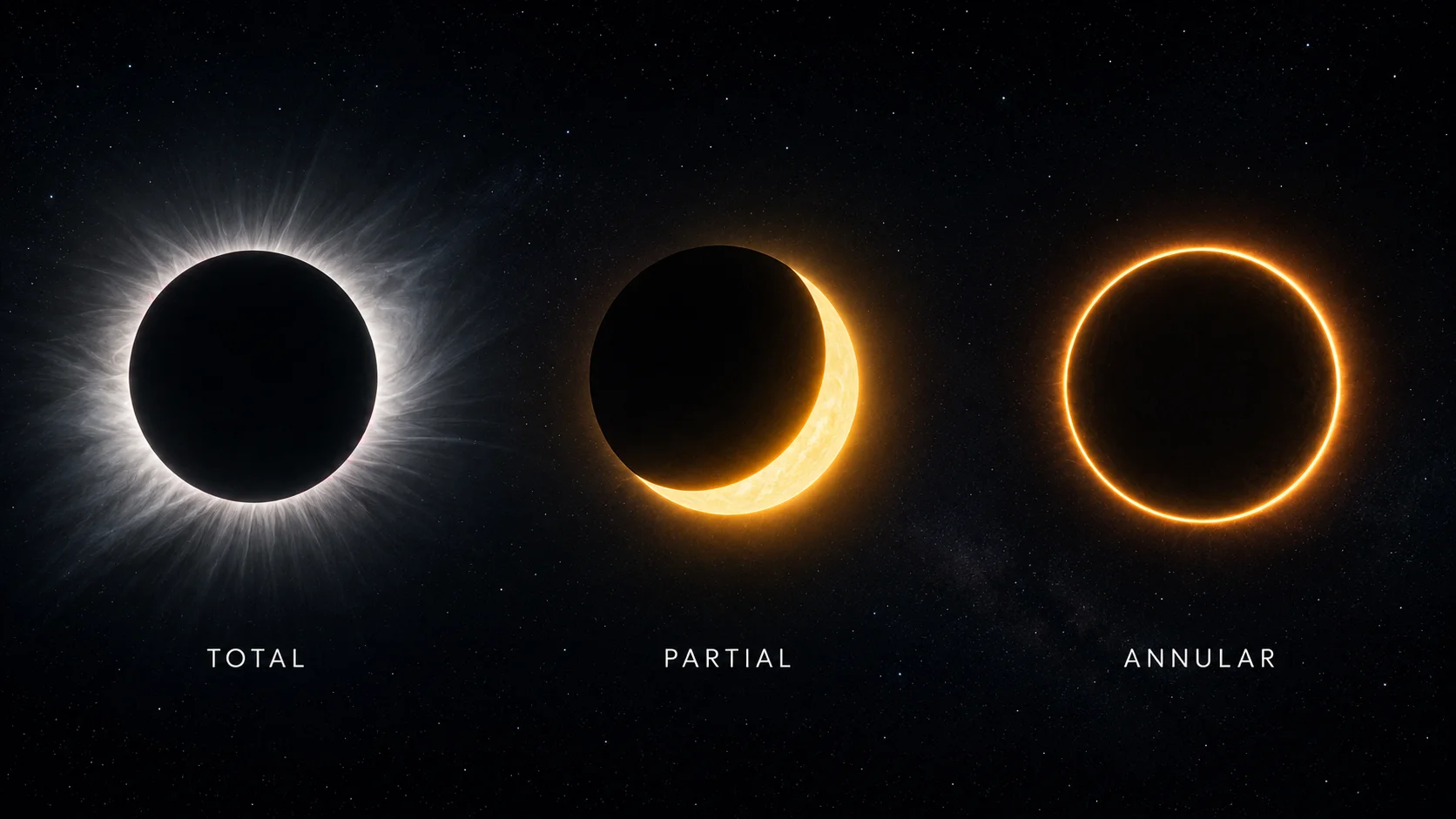
The difference between a total vs partial solar eclipse is not simply how much of the Sun appears covered. During a total solar eclipse, the Moon completely hides the Sun’s bright photosphere for observers inside a narrow path, revealing the corona and briefly transforming daylight into deep twilight. During a partial eclipse, some bright solar surface remains visible, even when coverage is extremely high. An annular eclipse occurs when the Moon passes centrally across the Sun but appears too small to cover it, leaving a bright ring around the lunar silhouette.
Those differences affect everything: what you see, where you must stand, how long the central phase lasts and which safety rules apply. A person inside the path of totality may experience the corona, stars or planets in a darkened sky and a rapid change in the landscape. Someone a short distance outside that path may see an impressive partial eclipse but never experience totality.
This guide explains the main types of solar eclipse in practical language, compares total, partial, annular and hybrid eclipses, and shows why exact location matters when planning for the 2027 total solar eclipse in Egypt.
Quick Answer: Total vs Partial vs Annular Solar Eclipse
A total solar eclipse happens when the Moon appears large enough and is aligned precisely enough to cover the Sun’s bright face completely. Observers must be inside the Moon’s central shadow, the umbra.
A partial solar eclipse happens when the Moon covers only part of the Sun from the observer’s location. The observer is normally inside the penumbra rather than the umbra.
An annular solar eclipse happens when the Moon is centered in front of the Sun but appears slightly smaller, so a ring of bright sunlight remains visible. Observers are inside the antumbra.
A hybrid solar eclipse changes between total and annular along different portions of its path because Earth’s curved surface and the eclipse geometry alter whether the Moon’s central shadow reaches the ground.
| Feature | Total eclipse | Partial eclipse | Annular eclipse | Hybrid eclipse |
|---|---|---|---|---|
| Sun completely covered? | Yes, during totality | No | No; a bright ring remains | Yes in some locations, ring visible in others |
| Main shadow region | Umbra | Penumbra | Antumbra | Umbra or antumbra depending on location |
| Corona visible? | Yes, weather permitting, during totality | No | No in the same way as totality | Only from the total portions of the path |
| Eye protection | Required before and after totality; may be removed only when the Sun is fully covered | Required at all times | Required at all times | Depends on local phase; totality rules apply only where and while total |
| Geographic area | Narrow path of totality | Much wider partial-eclipse region | Narrow path of annularity | Very narrow central path with changing eclipse type |
Why One Eclipse Can Look Different in Different Places
A solar eclipse is created when the Moon passes between the Sun and Earth and casts a shadow onto Earth. That shadow is not one uniform dark patch. It contains different regions, and each region produces a different view.
The darkest inner shadow is the umbra. When the umbra reaches Earth, people inside it see a total solar eclipse.
The broad outer shadow is the penumbra. People inside it see only part of the Sun covered, producing a partial eclipse.
When the Moon is too far away to appear large enough to cover the Sun completely, the umbra ends before reaching Earth. The shadow continuing beyond that point is the antumbra. People inside it see an annular eclipse.
This is why eclipse type is partly a property of the event and partly a property of the observer’s location. The same global event can be total in one narrow corridor and partial across a much wider region. During a hybrid eclipse, it can even be total in one part of the central path and annular in another.
For travelers, this distinction is decisive. Choosing the correct country is not enough. Choosing the correct region may not be enough. A reliable plan uses exact latitude and longitude, verified path boundaries and practical ground access.
What Is a Total Solar Eclipse?
A total solar eclipse occurs when the Moon’s apparent disk completely covers the Sun’s bright photosphere. This happens only for observers located inside the Moon’s umbra, which creates the path of totality across Earth.
The path is usually narrow compared with the large area that sees a partial eclipse. An observer just outside the path may see nearly all of the Sun covered but will not experience totality.
What Totality Looks Like
The transition into totality is rapid. As the final bright edge of the Sun disappears, the landscape darkens dramatically. The black disk of the Moon appears surrounded by the Sun’s corona, an extended atmosphere that is normally hidden by the brilliance of the photosphere.
Depending on atmospheric conditions, solar activity and the observer’s surroundings, several phenomena may be visible:
- The corona extending around the dark Moon.
- The diamond-ring effect close to the beginning or end of totality.
- Baily’s beads, created when sunlight passes through valleys along the Moon’s irregular edge.
- Pink or red prominences near the solar limb.
- Bright planets and some stars in the darkened sky.
- A 360-degree twilight glow near the horizon.
- Sharper temperature and light changes than during a partial eclipse.
Totality does not last for the entire eclipse. The partial phases before and after it may continue for much longer, while the fully covered phase lasts seconds or minutes.
Why Totality Is Qualitatively Different
It is common to describe a deep partial eclipse as “almost total.” Astronomically, that phrase can be misleading.
As long as any part of the photosphere remains visible, the Sun is still intensely bright. Human eyes adapt to changing light, so the landscape may remain surprisingly illuminated. The corona remains overwhelmed by direct sunlight, and the visual transformation associated with totality does not occur.
A 99 percent partial eclipse can be impressive, but it is not 99 percent of the total-eclipse experience. Totality is a threshold event: the last visible part of the photosphere must disappear.
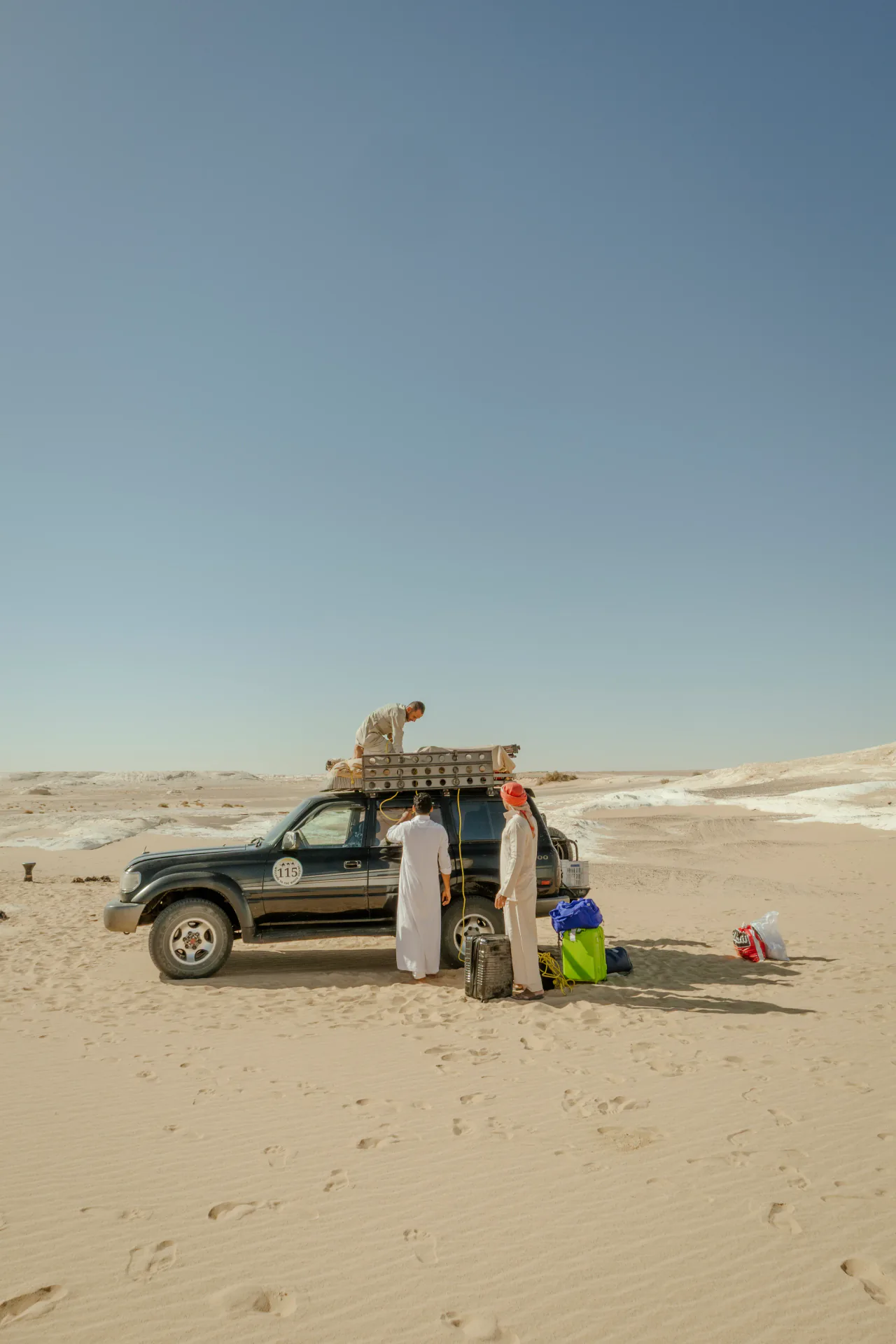
This is why eclipse travelers cross countries and continents to enter the path of totality rather than observing a deep partial eclipse from a convenient city outside the path. The practical example is explained in Cairo & Alexandria on Eclipse Day, including how travelers can use Cairo as the gateway to the confirmed Western Desert eclipse-camp region between the White Desert and the Black Desert, inside the path of totality, where the final astronomically verified viewing point will provide at least 6 minutes of totality.
Eye Safety During a Total Eclipse
A total solar eclipse is the only solar-eclipse type in which direct naked-eye viewing can be safe for a brief interval, and only when the Sun’s bright face is completely covered.
Before totality, approved solar-viewing glasses or another safe method are required. They must go back on immediately when the first bright point of sunlight returns.
Optical equipment requires a proper solar filter secured over the front of the lens, telescope or binoculars. Eclipse glasses worn by the observer do not make it safe to look through unfiltered optics because concentrated sunlight can damage the filter and the eyes.
A professionally managed viewing site should give guests clear phase announcements, explain when protection is required and supervise children carefully.
What Is a Partial Solar Eclipse?
A partial solar eclipse occurs when the Moon covers only part of the Sun from the observer’s viewpoint.
This can happen in two ways. A solar eclipse may be partial everywhere because the umbra misses Earth completely, or the global event may be total or annular along a central path while observers outside that path see a partial eclipse.
What a Partial Eclipse Looks Like
At first contact, the Moon seems to take a small bite from the edge of the Sun. The dark lunar silhouette moves across part of the solar disk, changing the Sun into a crescent at deeper phases.
The exact shape depends on the alignment and the observer’s location. Some places may see only a small portion covered. Others close to a totality boundary may see a very thin solar crescent.
The partial phase can produce beautiful indirect effects. Gaps between leaves act like pinhole projectors, covering the ground with crescent-shaped images. A colander or a card with small holes can create a similar projection.
Why a Deep Partial Eclipse Is Still Not Total
Suppose one observer is just inside the totality path and another is just outside it. Their maps may show only a small distance between them, yet their experiences are fundamentally different.
The person inside the path sees the photosphere disappear, the corona emerge and the sky darken dramatically. The person outside retains a narrow but powerful line of direct sunlight. Eye protection remains necessary, and the corona is not revealed as it is during totality.
This abrupt boundary is why accurate mapping matters. Eclipse paths are not general destination suggestions. They are geometric corridors with real northern and southern limits.
Eye Safety During a Partial Eclipse
There is no safe naked-eye phase during a partial solar eclipse. Proper solar viewers are required whenever looking directly at the Sun.
Regular sunglasses are not suitable, regardless of how dark they appear. Homemade filters, exposed film, smoked glass and unverified products should not be used.
Indirect viewing is a safe alternative. A pinhole projector allows the observer to watch an image of the Sun on another surface without facing the Sun directly.
Children should be supervised because they may remove glasses, look around the frames or confuse ordinary sunglasses with eclipse viewers.
What Is an Annular Solar Eclipse?
An annular eclipse occurs when the Moon passes centrally in front of the Sun but appears too small to cover it completely.
The Moon’s orbit is elliptical, so its distance from Earth changes. When it is farther away, its angular diameter can be slightly smaller than the Sun’s. Even with excellent central alignment, a ring of sunlight remains visible around the Moon.
This ring is called an annulus, which gives the eclipse its name. Popular coverage often calls it a “ring of fire,” although the ring is sunlight rather than fire.
What Annularity Looks Like
During the partial phase, the Moon gradually moves across the Sun. As the central phase approaches, the remaining sunlight may break into Baily’s beads near the lunar edge. At annularity, the Moon appears as a dark disk surrounded by a brilliant solar ring.
The sky may dim and the quality of the light may change, but the photosphere is never completely hidden. The corona is not revealed in the same way as during totality.
The ring can appear symmetrical near the centerline. Closer to the path boundary, it may look thinner on one side and thicker on the other.
Annular Does Not Mean Safer
An annular eclipse has no total phase. The bright solar ring remains exposed throughout the event.
Therefore, eclipse glasses or a safe handheld solar viewer are required at all times when looking directly at an annular eclipse. Cameras, binoculars and telescopes require front-mounted solar filters.
The visual drama of the ring can encourage people to remove protection, but doing so is unsafe. The central appearance does not reduce the intensity of the exposed photosphere to a safe level.
Annular vs Total Eclipse
The defining difference is apparent size.
During totality, the Moon appears large enough to cover the photosphere. During annularity, the Moon appears slightly smaller.
Both events require a central alignment, but only totality fully blocks the Sun’s bright surface. That is why an annular eclipse can last longer than some total eclipses while still never producing the dark-sky and corona experience of totality.
What Is a Hybrid Solar Eclipse?
A hybrid solar eclipse is a rare central eclipse that appears total in some locations and annular in others along its path.
The Moon’s central shadow is near the threshold of reaching Earth. Earth’s curved surface changes the distance between the observer and the Moon enough that the apparent geometry shifts.
At some portions of the path, the umbra reaches the ground and the eclipse is total. At other portions, the surface curves away, the umbra ends above Earth and the antumbra produces an annular eclipse.
Hybrid eclipses demonstrate why eclipse descriptions always require a location. Calling the entire event simply total or annular can hide what individual observers actually experience.
For travelers, a hybrid event would demand particularly careful coordinate selection. A viewing plan should never assume that every point along the central route receives the same eclipse type.
The Shadow Regions: Umbra, Penumbra and Antumbra
Understanding the three shadow regions makes the eclipse types easier to remember.
Umbra
The umbra is the dark central shadow where the Sun is completely blocked. Its footprint creates the path of totality.
Penumbra
The penumbra is the broader outer shadow where only part of the Sun is blocked. It creates the partial-eclipse region.
Antumbra
The antumbra is the continuation beyond the point where the umbra ends. From this region, the Moon appears entirely in front of the Sun but too small to cover it, producing annularity.
The boundaries between these regions are meaningful. Crossing from the penumbra into the umbra changes a partial eclipse into totality. Crossing into the antumbra changes a partial view into annularity.
Why the Moon’s Apparent Size Changes
The Moon does not orbit Earth at one fixed distance. Its orbit is an ellipse.
At perigee, it is closer and generally appears larger. At apogee, it is farther away and generally appears smaller. Actual eclipse geometry depends on the precise distance at the event, not simply whether the Moon is at the named closest or farthest point.
The Sun’s apparent size also changes slightly because Earth’s orbit is elliptical. Earth is closer to the Sun during one part of the year and farther during another.
A total or annular eclipse therefore depends on the comparison between two apparent disks at a specific time:
- If the Moon’s apparent diameter exceeds the Sun’s enough to cover it, the central eclipse can be total.
- If the Moon’s apparent diameter is smaller, the central eclipse is annular.
- If the geometry changes near the threshold along Earth’s curved surface, the event can be hybrid.
This apparent-size relationship is one reason eclipse predictions require precise astronomy rather than a simple calendar rule.
How Eclipse Magnitude and Obscuration Differ
Eclipse maps may show terms such as magnitude and obscuration. They are related but not identical.
Eclipse magnitude describes the fraction of the Sun’s diameter covered along a line through the centers at maximum eclipse. It is a linear measurement.
Obscuration describes the fraction of the Sun’s visible area covered. It is an area measurement.
A magnitude of 0.90 does not necessarily mean exactly 90 percent of the solar area is hidden. The relationship depends on the overlap of two circles.
For a total eclipse, magnitude is at least 1.0 at totality because the Moon’s apparent diameter covers the Sun along the relevant line. For an annular eclipse, the central alignment may be excellent, but magnitude remains below 1.0 because the Moon appears smaller.
Travelers should avoid using a single percentage as a substitute for eclipse type. A location with extremely high partial obscuration still lacks totality if it is outside the umbra.
Total vs Partial Solar Eclipse in the Landscape
The visual difference is not limited to the Sun itself.
Light
During a partial eclipse, daylight becomes reduced and may look unusual, but direct solar light remains. During totality, the last photospheric light disappears and illumination drops abruptly.
Shadows
Partial phases create sharp, unusual shadows. Small openings project crescent Suns. Near totality, shadows may appear highly defined because the remaining light comes from a thin solar edge.
Horizon
Inside totality, distant areas outside the umbra may remain illuminated, producing a twilight glow around much of the horizon.
Temperature
Temperatures can fall during any substantial eclipse, but the size of the change depends on weather, ground conditions, wind and local timing. Totality often produces a more noticeable rapid shift.
Animals
Birds, insects and other animals may react to the changing light and temperature. Responses vary and should not be presented as guaranteed behavior.
Human perception
A partial eclipse can be easy to underestimate without safe viewers because the eye adjusts to the reduced light. Totality creates a stronger sensory transition that is difficult to confuse with ordinary cloud cover.
Which Type Will Egypt See on August 2, 2027?
The August 2, 2027 event is a total solar eclipse globally, with a path of totality crossing parts of North Africa and the Middle East, including a corridor across Egypt.
That does not mean every place in Egypt will see totality. Locations inside the umbral path will see a total eclipse, weather permitting. Locations outside it will see a partial eclipse of varying depth.
This is why statements such as “Egypt will see a total eclipse” require clarification. Egypt contains both total-eclipse and partial-eclipse locations for this event.
Cairo and Alexandria are expected to be outside the path of totality, so observers there should plan for a partial eclipse unless updated authoritative path calculations indicate otherwise. Read the dedicated guide to the 2027 partial eclipse in Cairo and Alexandria.
Likewise, broad geographic names such as “the White Desert,” “Aswan” or “the Red Sea” can cover large areas. The eclipse type and duration must be calculated for exact coordinates rather than assumed from a destination label.
The planned viewing location for any tour should be checked against NASA GSFC path data, then confirmed for access, permits, horizon, roads and emergency logistics. The scientific map and the practical site plan must agree.
See the 2027 eclipse path of totality across Egypt for the location-focused guide.
Why Location Within the Path Matters
Entering the path of totality is the first requirement. Position within the path affects duration and geometry.
Near a path boundary, totality can be very short. Closer to the centerline, it is generally longer. However, maximum duration should not be the only factor.
A strong viewing site also needs:
- Reliable road access.
- A wide and unobstructed sky.
- Legal permission to occupy the area.
- Space for guests and equipment.
- Safe separation of vehicles and tripods.
- Shade, hydration and heat management.
- Toilets and sanitation.
- Communications and emergency procedures.
- A backup plan for local obstacles or changing conditions.
For an August desert event, comfort and safety are part of successful eclipse observation. A coordinate with excellent astronomical numbers can be unsuitable if guests cannot reach it safely or remain there in extreme conditions.
A specialized local team can combine astronomical verification with desert operations. This is particularly important for travelers who may be unfamiliar with remote roads, summer heat or the distance between services.
Which Eclipse Type Is Best to Experience?
There is no bad reason to be interested in astronomy. Each type offers something distinctive.
A partial eclipse is widely accessible and excellent for education, projection experiments and observing the Moon’s motion.
An annular eclipse creates the striking ring of sunlight and can be visually memorable through approved solar filters.
A hybrid eclipse is scientifically unusual because the central type changes along its path.
A total solar eclipse, however, is the only type that reveals the corona to the unaided eye during the fully covered phase and transforms the entire environment through totality.
For someone choosing whether to travel, the key question is not only “How much of the Sun will be covered?” It is “Will the observing site be inside the verified path of totality?”
Safe Viewing Rules by Eclipse Type
The safety rules can be summarized simply.
Total eclipse
Use proper eclipse glasses during every partial phase. Remove them only after the Sun is completely covered and totality has begun. Replace them immediately when direct sunlight returns.
Partial eclipse
Use proper eclipse glasses or an indirect viewing method throughout. There is no naked-eye phase.
Annular eclipse
Use proper eclipse glasses throughout. The ring remains part of the bright photosphere.
Hybrid eclipse
Follow the rule for the eclipse type at your precise location. If the local event is annular, protection remains on throughout. If it is total, glasses may come off only during confirmed totality.
Cameras and optical equipment
Any camera, binoculars or telescope pointed at the uneclipsed or partially eclipsed Sun needs a suitable solar filter over the front aperture. Do not place eclipse glasses behind an unfiltered optical device.
Common Misunderstandings About Eclipse Types
“A 99 percent partial eclipse is practically total”
No. It can be dark and impressive, but the remaining photosphere prevents the defining totality phenomena.
“Annular means the Sun is fully covered except for the atmosphere”
No. The visible ring is the Sun’s bright photosphere, not merely the corona.
“The eclipse type is the same everywhere”
No. The global event has a classification, but local observers can experience total, annular, partial or no eclipse depending on position.
“Clouds make eye protection unnecessary”
No. Thin clouds may reduce brightness without removing harmful solar radiation. Use proper protection whenever looking at the partially exposed Sun.
“A camera screen makes direct photography safe”
No. The camera sensor and optics can still be damaged, and looking through an optical viewfinder can injure the eye. Use proper equipment and filters.
“Being in the correct city guarantees totality”
Not always. Cities and regions cover area. Exact coordinates and path boundaries determine the local circumstances.
How to Read an Eclipse Map
A reliable path map normally shows:
- A northern limit of totality or annularity.
- A southern limit.
- A centerline.
- Times along the path.
- The direction of shadow movement.
- Duration or local circumstances.
- A wider region of partial visibility.
When using a map, zoom to the exact intended site. Do not treat a thick graphic line as infinitely precise. Different maps may use different Earth and lunar-limb models, and final operational plans should be checked closer to the event.
For the 2027 eclipse, NASA GSFC path tables provide geographic coordinates for the path limits and centerline at intervals. Those data are suitable for building detailed maps, but a local site still requires ground verification.
How the Eclipse Phases Differ
All three main solar-eclipse types begin and end with partial phases.
Total eclipse sequence
- First contact: partial eclipse begins.
- The Moon covers more of the Sun.
- Second contact: totality begins.
- Maximum eclipse.
- Third contact: totality ends.
- The partial phase continues.
- Fourth contact: eclipse ends.
Annular eclipse sequence
- First contact.
- Partial coverage increases.
- Second contact: annularity begins.
- Maximum annularity.
- Third contact: annularity ends.
- Partial coverage decreases.
- Fourth contact.
Partial-only sequence
- First contact.
- Coverage increases.
- Maximum partial eclipse.
- Coverage decreases.
- Last contact.
The same words “first contact” and “maximum eclipse” can therefore describe different local experiences. A timetable should always name the local eclipse type.
Planning a Total-Eclipse Trip Rather Than a Partial-Eclipse Stop
A serious total-eclipse plan begins with the umbral path, not the hotel.
First, identify a region securely inside totality. Second, evaluate likely weather and horizon conditions. Third, confirm legal access and logistics. Only then should accommodation and activities be built around the site.
For the 2027 event, August conditions in Egypt require particular attention to heat. Travelers may spend hours at a viewing area before and after the central phase. Shade, water, food, toilets, communications and a controlled rest environment are not luxury extras; they support safe participation.
A fully air-conditioned camp near the viewing field can provide recovery space while keeping the actual observation area open to the sky. It also allows families, older travelers and people less accustomed to desert heat to manage the long event day more comfortably.
The practical goal is not merely to reach a dot on a map. It is to arrive early, remain safe, observe without obstruction and leave in an organized way.
Total, Partial and Annular Eclipses for Photographers
Photographers must treat the eclipse type as an equipment and safety decision, not only a creative choice.
During a partial or annular eclipse, the photosphere remains visible throughout the event. A suitable solar filter must remain secured over the front of the camera lens whenever the camera is pointed at the Sun. The filter protects both the camera system and anyone using an optical viewfinder.
During a total eclipse, the solar filter stays on through the partial phase. It may be removed only after the photosphere is fully covered at the photographer’s exact location. The filter must be replaced before direct sunlight returns.
This transition happens quickly. A photographer who is still changing equipment may lose valuable totality time or accidentally expose an unfiltered system too early. A practical plan includes rehearsing the sequence before eclipse day, setting exposure brackets in advance and deciding which moments will be photographed and which will simply be watched.
Different eclipse types also require different exposure goals.
For a partial eclipse, the subject is the changing solar crescent. For an annular eclipse, the goal may be the full ring, Baily’s beads near contact or a wide composition including the landscape. For totality, exposure must change dramatically to record the corona, prominences and the surrounding sky.
A crowded viewing site can create additional problems. Tripod space, people walking in front of lenses, accidental white lights and unclear safety announcements can disrupt both observation and photography. A dedicated camp or managed viewing field should separate equipment zones, preserve clear sight lines and announce the eclipse phases consistently.
How Weather Affects Each Eclipse Type
Clouds do not change whether the predicted eclipse is total, partial or annular, but they can change what an observer is able to see.
Thin clouds may allow the solar shape to remain visible while reducing contrast. Thick clouds can hide the Sun entirely. During totality, even a cloudy site may become dark as the umbra passes, but the corona and contact phenomena may be invisible.
A partial eclipse can sometimes be followed through breaks in cloud because its visible phase lasts relatively long. The central phase of a total or annular eclipse may last only minutes, so a cloud arriving at the wrong time can obscure the most important part.
Weather planning should therefore look beyond a simple annual cloud percentage. Local terrain, seasonal wind, dust, humidity, access to alternate sites and the ability to move safely all matter.
For desert travel, a clear-sky reputation does not remove operational risks. Dust can affect the horizon and equipment, high temperatures can affect people and batteries, and a remote location can limit rapid movement. A specialized local team can evaluate both the sky and the ground conditions.
No responsible operator can guarantee clear skies. The useful promise is a carefully selected site, monitoring, realistic contingency planning and transparent communication.
How Families Can Explain the Eclipse Types to Children
The easiest way to explain the difference is to use three shadow ideas.
Tell children that the Moon casts a small dark shadow and a larger light shadow. If they stand in the darkest part, the whole Sun disappears and the eclipse is total. If they stand in the lighter shadow, only some of the Sun is hidden and it is partial. If the Moon looks too small and leaves a bright ring, it is annular.
A lamp and two balls can demonstrate the idea indoors, but no classroom activity should encourage children to imitate direct solar viewing outdoors.
For eclipse day, adults should establish one simple rule: glasses stay on whenever any bright part of the Sun is visible. Children should practice putting viewers on before looking up and looking down before removing them.
A managed site is helpful because phase announcements reinforce the parents’ instructions. Shade, hydration, toilets and a cool rest space also matter because children may struggle with a long wait in summer conditions even when they understand the astronomy.
Choosing Between a Nearby Partial Eclipse and Traveling for Totality
The decision depends on the traveler’s goals, budget, health and available time.
Staying home for a partial eclipse can be sensible. It avoids travel and still provides an educational astronomical experience. With safe viewers and projection activities, families and schools can follow the event meaningfully.
Traveling into totality is a different commitment. It requires transport, accommodation, path verification and the possibility that weather may interfere. The reward is access to phenomena that do not occur during a partial eclipse.
The decision should not be driven by exaggerated claims that a partial eclipse is worthless. It should be based on an honest explanation that the experiences are different.
A useful planning checklist asks:
- Is the proposed site securely inside the path?
- How long is totality at the exact coordinate?
- Is the horizon open in the Sun’s direction?
- Can the site be reached and exited safely?
- What heat, shade, water and medical arrangements exist?
- Are eye protection and phase briefings included?
- Is there enough space for the expected group?
- What is the policy if weather blocks the Sun?
- Are the operator’s claims consistent across the website and booking documents?
For the 2027 eclipse, travelers comparing Cairo, Luxor, Siwa, the Red Sea or the Western Desert should use the same standards. A famous destination does not automatically provide the best viewing operation, and a remote site is not automatically superior without access and safety systems.
The Most Important Difference to Remember
The simplest summary is this:
A partial eclipse changes the shape of the visible Sun. An annular eclipse creates a complete ring of visible sunlight. A total eclipse removes the bright photosphere entirely for a short time.
That final disappearance is what reveals the corona and creates totality. It is also what changes the eye-safety rule for a brief interval.
Everything else—maps, percentages, duration tables and travel plans—supports that central distinction.
Frequently Asked Questions
Is a total solar eclipse darker than a partial eclipse?
Yes. During totality, the Sun’s bright photosphere is completely covered and the environment darkens dramatically. A deep partial eclipse can reduce daylight, but the remaining exposed photosphere keeps the sky much brighter.
Can I see the corona during a partial eclipse?
Not as it is visible during totality. Direct photospheric light overwhelms the faint corona. Specialized coronagraph instruments can study it outside eclipses, but ordinary observers need totality to see the corona naturally around the Moon.
Is an annular eclipse a type of partial eclipse?
It is a central solar eclipse with a distinct path of annularity, but the Sun is never completely covered. In practical safety terms, it behaves like a partial eclipse because solar protection is required throughout.
Can I remove eclipse glasses during an annular eclipse?
No. The bright ring remains visible and unsafe to view directly without proper solar protection.
Can I remove eclipse glasses during a total eclipse?
Only during the brief interval when the Sun is completely covered at your exact location. Put them back on immediately when any bright sunlight returns.
Why is the path of totality so narrow?
The Moon’s umbral shadow tapers and creates a relatively small footprint by the time it reaches Earth. The footprint then moves rapidly across the rotating planet.
Does 100 percent coverage on an app always guarantee totality?
Do not rely on a rounded percentage alone. Check whether the coordinate is actually inside the authoritative path boundary and verify the local contact circumstances.
Will all of Egypt see totality in 2027?
No. Parts of Egypt lie inside the path of totality, while other areas will see a partial eclipse. Exact location determines the local type.
Is a partial eclipse worth watching?
Yes. It is an important astronomical event and can produce beautiful crescent projections and unusual light. It must be viewed safely, and it should not be confused with the totality experience.
Which is rarer, total or annular?
Both are uncommon for a specific location. Global frequency varies across eclipse cycles, but the more important practical fact is that the central path of either type is narrow and a particular city may wait a very long time for one.
Final CTA
A partial eclipse can be fascinating, but totality requires the correct location. Explore our 2027 Egypt eclipse tour packages or check availability for the Western Desert eclipse camp.
Related Location Guide
A location can change the event from total to partial. See the 2027 eclipse path of totality in Egypt map for city and region comparisons.
Authoritative planning reference
Use NASA 2027 eclipse path data as a primary reference, then verify local circumstances for the exact location.