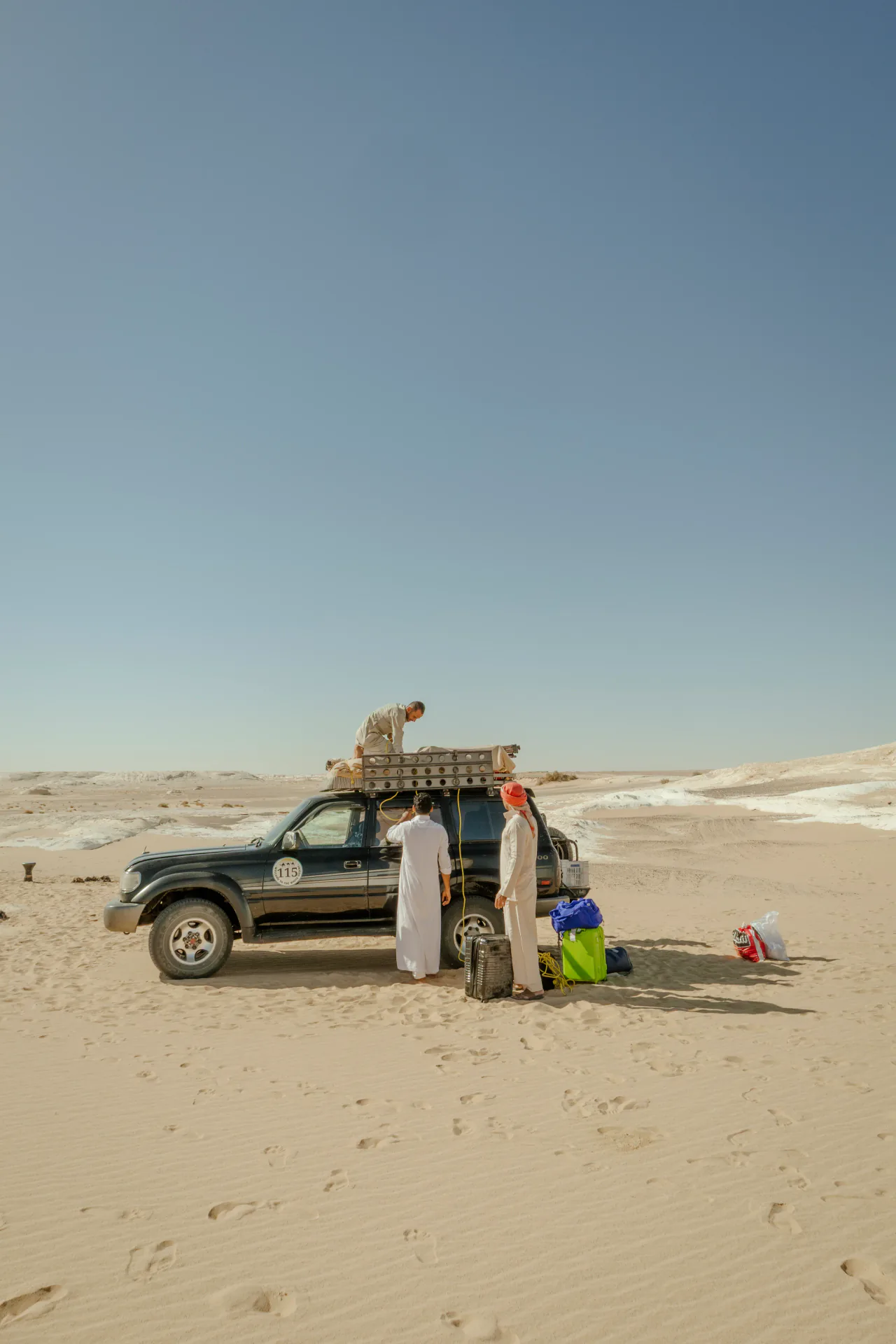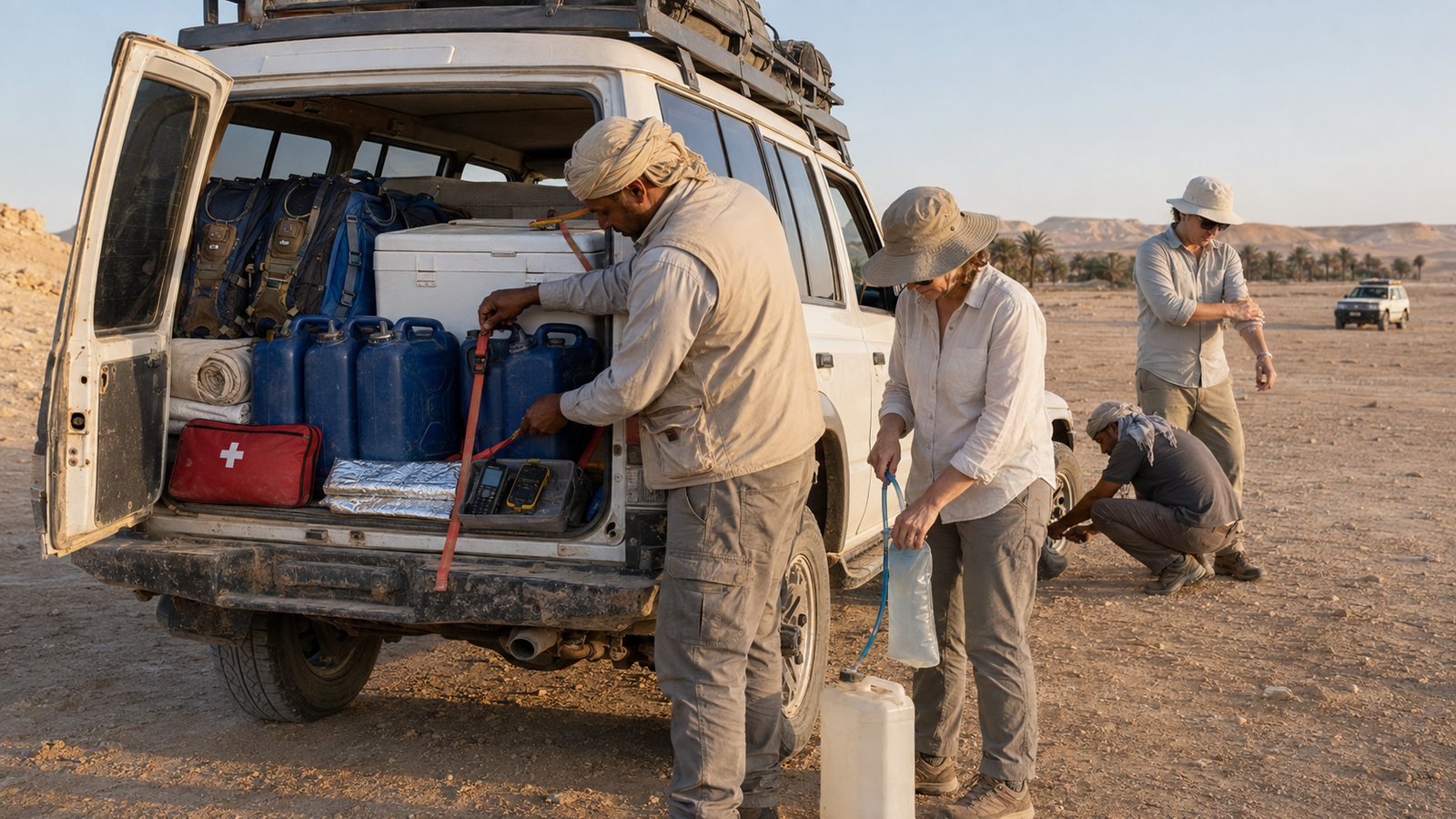
The Egypt August desert heat is not a side issue for travelers planning a Western Desert journey or the August 2, 2027 total solar eclipse. It is one of the main operational factors that should shape transport, accommodation, viewing schedules, hydration, medical preparation and the design of the eclipse camp itself.
A total solar eclipse may last only a few minutes, but a guest can spend hours outside before and after totality. Photographers often arrive early to set up tripods and test filters. Families may move between vehicles, shade areas and the observation field. Drivers, guides and camp staff work for much longer than visitors realize. In a desert environment, the risk comes from the total heat load over time, not only from the temperature shown in a weather app.
This guide explains how to prepare for Egypt's August desert heat in a practical, safety-first way. It is written for international travelers, families, photographers and eclipse visitors who may not be accustomed to prolonged exposure to hot, dry conditions.
It does not replace personal medical advice. Travelers with heart, kidney, respiratory or metabolic conditions, people taking medicines that affect hydration or heat tolerance, pregnant travelers, older adults and parents of young children should discuss their plans with a qualified clinician before a remote-desert trip.
Why August Desert Heat Needs a Different Travel Plan
Most classic White Desert trips are associated with the cooler months. Travelers can spend more time outside, camp comfortably at night and move through the landscape without the same level of heat management required in midsummer.
August is different.
The World Health Organization describes heat as a major environmental and occupational health hazard. Heat stress can contribute to heat exhaustion and heatstroke and can worsen existing cardiovascular, respiratory, kidney, metabolic and other health problems. Heatstroke is a medical emergency.
In the desert, several factors can combine:
- High air temperature.
- Strong solar radiation.
- Long periods in direct sunlight.
- Hot ground and reflected heat.
- Physical activity such as walking, carrying equipment or setting up camp.
- Dry air that can make sweat evaporate quickly and make dehydration less obvious.
- Dust and wind.
- Limited immediate access to urban medical facilities.
- Long road transfers.
- Heavy or inappropriate clothing.
- Alcohol, illness, poor sleep or medications that affect hydration.
- The temptation to stay outdoors because the eclipse schedule feels too important to miss.
For the 2027 eclipse, this matters because the strongest phase in Egypt occurs around midday. Guests may be focused on the sky and ignore early symptoms of overheating.
A safe plan treats heat management as part of the event design, not as a bottle of water handed out after someone feels unwell.
Heat Risk Starts Before You Feel “Too Hot”
One of the most dangerous assumptions is that a traveler will always recognize heat illness early.
People react differently. Fitness does not make someone immune. A person can be young and active and still become unwell. Someone who arrived from a cool climate may have less heat tolerance than a local driver who has spent years working in the desert.
The body tries to control temperature by increasing blood flow to the skin and producing sweat. In hot conditions, that cooling system can become less effective, especially when exposure is prolonged, activity is high or the person is dehydrated.
The result can progress from discomfort to headache, dizziness, unusual tiredness, weakness, nausea, muscle cramps, heavy sweating, shortness of breath, poor concentration, confusion or collapse.
The important operational lesson is simple: do not wait for severe symptoms before reducing heat exposure.
Shade breaks, cooled rest areas, water access, seating and shorter outdoor sessions should be built into the schedule for everyone.
Step 1: Choose a Program Designed for August
The first heat-safety decision is made before you pack.
Ask how the trip itself is designed.
A standard cool-season camping itinerary may not be suitable for August simply because the same road and attractions are technically accessible.
For an August desert program, ask the operator:
- Where will guests sleep?
- Is the sleeping area climate-controlled?
- Is there a genuinely cooled rest space during the day?
- How close is that space to the eclipse viewing field?
- Is there continuous drinking-water availability?
- Are there shaded seating areas?
- How many guests share each vehicle?
- Are vehicles air-conditioned and maintained for long desert transfers?
- Is backup transport available?
- Is there a medical plan?
- How will vulnerable guests be identified and supported?
- What happens if a guest develops heat illness?
- How far is the nearest suitable medical facility?
- What communications are available if mobile coverage fails?
- Is the schedule designed to avoid unnecessary walking during the hottest period?
- Are staff working in rotating shifts rather than remaining exposed continuously?
The White Desert summer safety guide explains why an August trip should be treated differently from a normal winter safari.
For eclipse travelers, the managed Western Desert eclipse camp should provide a practical balance: an open sky for observation and nearby cooled spaces for recovery.
Step 2: Do Not Schedule Long Outdoor Activities at Midday
The eclipse itself cannot be moved to a cooler hour. Other activities can.
WHO heat guidance recommends avoiding strenuous activity during the hottest part of the day when possible. That principle is especially relevant in Egypt's desert in August.
A responsible itinerary can move non-essential outdoor activity to early morning, late afternoon, evening or after sunset.
That means the eclipse morning should not be packed with long hikes, sandboarding sessions, repeated vehicle loading, extensive photography walks, unnecessary sightseeing stops, heavy equipment carrying or long queues in direct sun.
Guests should arrive at the viewing area with energy, not already dehydrated and exhausted.
The event field can be active without keeping everyone exposed. A good design allows guests to move between a cooled lounge or tent, a shaded outdoor area and the open observation field.
During the early partial phase, some guests may choose short viewing sessions rather than remaining outside continuously.
Step 3: Hydrate Before, During and After Exposure
Hydration is one of the core protections recommended by CDC, WHO and occupational heat-safety guidance.
The practical goal is regular access to fluids throughout the day.
Do not rely on a single large drink just before totality.
A better pattern is to begin the day normally hydrated, carry water personally rather than depending only on a central station, drink regularly during the day, refill before leaving the camp or vehicle and continue hydration after the observation period.
Watch for signs that you are falling behind, including dark urine, headache, dizziness or unusual fatigue.
There is no universal amount of water that is correct for every traveler. Needs vary with body size, activity, medical conditions, diet, medications and heat exposure.
People who have been told to limit fluids because of heart, kidney or other conditions should follow their clinician's advice rather than a generic travel target.
What About Electrolytes?
Sweating loses both water and salts.
Electrolyte drinks can be useful in some circumstances, especially during prolonged sweating, but they should not become an excuse to ignore cooling, shade or rest.
For many travelers, normal meals plus water may be sufficient for routine exposure. People with medical conditions should be cautious with products containing high levels of sodium, potassium or sugar.
Avoid assuming that “more electrolytes” automatically means safer.
Alcohol and Heavy Drinking the Night Before
An eclipse trip is a special event, but the night before is not the time to compromise sleep and hydration.
Heavy alcohol use can worsen dehydration, disturb sleep and reduce judgment the next day.
A traveler who begins eclipse morning tired, dehydrated and nauseated is starting with a disadvantage before the heat exposure even begins.
Step 4: Use Shade as a Primary Safety Tool
Shade is not a luxury feature.
WHO notes that conditions in direct sun can be substantially hotter than reported shade temperatures because weather-station measurements do not represent the radiant heat a person receives in full sunlight.
In the desert, the difference between sitting under a properly designed shade structure and standing in open sun can be operationally significant.
A viewing site should include shade that covers a meaningful number of guests, allows airflow, is securely anchored for wind, does not obstruct the eclipse field, includes seating, is close to water and can be reached without a long walk.
Photographers also need shade between setup and totality. Camera equipment can remain ready while the photographer rests nearby.
Step 5: Make Air-Conditioned Recovery Part of the Plan
A fan alone is not equivalent to cooling in extreme heat.
WHO and CDC guidance both emphasize access to cooler environments during hot weather. In very high temperatures, moving hot air across the body may not provide the protection people assume.
For an August eclipse camp, cooled recovery areas can be used for pre-event rest, breaks during the partial phase, children who become tired, older guests, people who develop early symptoms, staff rotation and recovery after the central phase.
This does not mean the eclipse should be watched through a window.
The actual observation field must remain open to the sky. The point is to reduce the time spent continuously exposed, not to move totality indoors.
Step 6: Wear Clothing for Heat, Sun and Desert Conditions
The best desert clothing balances sun protection, ventilation, comfort, dust protection, movement and cultural practicality.
Choose light, loose-fitting clothing.
Useful items can include lightweight long-sleeved shirts, breathable trousers, a wide-brimmed hat, normal sunglasses, comfortable closed footwear, a light scarf or buff, spare dry clothing and high-SPF sunscreen used according to product instructions.
Eclipse glasses are not sunglasses and should not be used as general-purpose eyewear while walking around.
Likewise, normal sunglasses are not safe for looking directly at the Sun.
Step 7: Protect Your Skin Before You Reach the Viewing Field
Sunburn is separate from heat illness, but both can affect the same traveler.
Apply sunscreen before long exposure rather than waiting until the skin feels hot. Reapplication may be needed depending on the product, sweating and time outdoors.
Do not forget commonly missed areas such as ears, the back of the neck, hands, exposed feet and scalp areas with thin hair.
Shade and clothing remain important even when sunscreen is used.
Step 8: Prepare for Heat Before You Travel
Heat acclimatization is real, but tourists should understand what it means.
CDC/NIOSH occupational guidance describes acclimatization as physiological adaptation that develops through repeated exposure to hot conditions over roughly 7 to 14 days.
That does not mean a traveler should deliberately sit in extreme heat for a week before the trip.
The practical lesson is that people arriving from cooler climates may be less adapted during the first days of exposure.
Therefore, do not plan the hardest activities immediately after arrival. Build rest into the first day, reduce unnecessary exertion, pay extra attention to symptoms and use cooling proactively.
Avoid assuming that athletic fitness equals heat acclimatization.
An eclipse itinerary that includes arrival in Egypt before the event provides more margin than landing from a cool country and immediately attempting a long desert transfer plus a full day outdoors.
Step 9: Sleep Matters More Than Many Travelers Expect
Poor sleep can affect judgment, mood and physical resilience.
Eclipse travel may involve overnight flights, jet lag, early departures, excitement, photography preparation, different meal schedules and long road transfers.
A program should protect the night before the eclipse from unnecessary activity.
The ideal goal is simple: guests reach eclipse morning rested.
That is one reason multi-day packages can be safer and more comfortable than a rushed same-day plan from Cairo.
Compare the current eclipse tour packages based not only on sightseeing but also on how much rest and logistical margin they provide.
Step 10: Understand Heat Cramps, Heat Exhaustion and Heatstroke
Travelers do not need to become medical experts, but they should know the warning signs.
Heat Cramps
Painful muscle cramps can occur with heavy sweating and prolonged activity.
The person should stop strenuous activity, move to a cooler place and recover. Persistent symptoms or medical concerns require professional assessment.
Heat Exhaustion
Possible symptoms can include heavy sweating, weakness, dizziness, headache, nausea, faintness, fatigue, a rapid pulse and reduced ability to continue activity.
The response should include moving the person out of the heat, cooling them and seeking medical advice when appropriate.
Do not pressure someone to “push through” because totality is approaching.
Heatstroke
Heatstroke is a medical emergency.
Warning signs can include confusion, altered behavior, loss of consciousness, seizure, very high body temperature or other severe neurological symptoms.
Emergency medical help is required.
While help is being arranged, the priority is rapid cooling according to trained medical guidance.
Do not leave the person alone.
The eclipse is never more important than the patient.
Step 11: Use a Buddy System
Heat symptoms can affect judgment.
A person who is becoming confused may not recognize that they need help.
A buddy system is useful for families, older travelers, solo travelers joining a group, photographers focused on equipment, staff working in exposed areas and anyone with a known vulnerability.
Partners can remind each other to drink, rest and move into shade.
During the eclipse, this is especially helpful because attention naturally shifts to the sky.
Step 12: Families Need a Different Heat Plan
Children are not simply smaller adults.
They may become distracted, remove protective clothing, forget to drink or refuse to leave the viewing area because they are excited.
Parents should know where the cooled area is, where the toilets are, where water is available, who is supervising each child, how the child will use eclipse glasses and what to do if the child becomes tired or irritable.
Do not force a child to remain outside for every phase.
A child can spend most of the partial phase in a cooled space and come out for selected viewing intervals.
For eye-safety planning, read Solar Eclipse Safety for Children and the site's Child Policy.
Step 13: Older Travelers and People With Medical Conditions Should Plan Early
Heat can worsen some existing conditions.
WHO specifically highlights increased vulnerability among older people and people with cardiovascular, respiratory, kidney, metabolic and other chronic conditions.
Travelers should speak with their clinician before a remote August trip if they have concerns.
Useful questions include whether prolonged heat exposure is appropriate, whether any medication affects sweating or hydration, whether fluids need to be limited, how medication should be stored, which symptoms should stop activity and whether remote desert travel is appropriate for the person's current health.
Do not change prescription medication on your own because of online heat advice.
Step 14: Medication Storage Needs a Real Plan
A closed vehicle, direct sunlight or hot luggage compartment may become much hotter than the surrounding air.
Some medicines have storage requirements.
Travelers who carry insulin, injectable medicines or temperature-sensitive products should ask their pharmacist or doctor how to transport and store them.
The operator should be told in advance if a guest needs refrigeration, secure storage, sharps disposal, easy access during transfer or emergency medication nearby.
Do not place critical medicine somewhere inaccessible under luggage.
Step 15: Vehicles Are Part of the Heat-Safety System
An air-conditioned vehicle is more than a comfort feature.
It can provide cooling during road transfers, recovery after outdoor stops, transport for someone feeling unwell and a backup shelter if another cooling system fails.
Ask about vehicle age and condition, air-conditioning, passenger capacity, luggage loading, spare tires, fuel planning, driver rotation, recovery arrangements and communication between vehicles.
No guest should be left waiting in a non-running vehicle in direct sun.
Never leave children or dependent adults alone in a parked vehicle.
Step 16: Photographers Face Extra Heat Exposure
Photography increases heat risk because it encourages people to arrive earlier, carry heavier equipment, stand in one location, focus on technical settings, ignore thirst and remain outdoors after others have moved into shade.
A photographer's heat plan should be as detailed as the camera plan.
Before eclipse day, rehearse the setup, know which lens and filter you will use, label equipment, reduce unnecessary gear, practice the filter-removal sequence, test the tripod at a high solar angle and decide which settings can be prepared in advance.
On eclipse day, set up early enough to avoid rushing, return to shade after setup, cover equipment when practical, keep batteries out of unnecessary direct heat, drink and rest before totality and avoid repeatedly walking back to the vehicle for forgotten items.
Read the 2027 Total Solar Eclipse Photography Guide for the technical side.
Step 17: Dust, Wind and Heat Can Combine
Clear sky does not always mean perfect comfort.
Desert wind can carry dust, reduce visibility and irritate eyes or airways.
Dust can also affect camera equipment, contact lenses, food preparation, water stations, cooling systems and vehicle filters.
Useful preparations include protective camera covers, lens-cleaning equipment, sealed drinking containers, eye protection when not viewing the Sun, dust-aware food service and a scarf or buff.
People with asthma or other respiratory illness should have their prescribed medication available and should seek personal medical advice before travel if dust is a concern.
Step 18: Do Not Confuse Low Humidity With Low Risk
Dry heat can feel more tolerable than humid heat because sweat evaporates more readily.
That can be helpful for cooling, but it can also make water loss less obvious.
A traveler may not feel soaked in sweat and may incorrectly assume they are not losing much fluid.
Hot, dry air plus wind can increase evaporation.
The correct conclusion is not “dry heat is safe.” It is that the heat profile is different.
Cooling, hydration and rest remain necessary.
Step 19: The Eclipse Itself Can Hide the Heat Problem
During deep partial phases, sunlight decreases.
The landscape may look dimmer and the temperature may fall temporarily.
That can create a psychological trap: guests feel the dramatic cooling and assume the heat risk is over.
After totality, direct sunlight returns quickly.
The day is not finished.
Guests still need eye protection during the remaining partial phase, water, shade, cooling, a controlled departure and time before strenuous packing.
Do not schedule a chaotic immediate exit where hundreds of people carry bags and equipment under returning midday sunlight.
Step 20: Plan the Departure Before the Eclipse Starts
Post-eclipse traffic can create delays.
A private desert field needs a staged departure plan.
That plan should consider which vehicles leave first, where guests wait, which areas remain cooled, water supply during departure, medical priority, toilet access, road congestion, equipment loading, communication between drivers and backup if a vehicle fails.
The safest event is not finished at third contact.
It is finished when guests have left the remote site safely.
What a Heat-Safe Eclipse Camp Should Include
A well-designed August camp should provide more than tents and a view.
Look for a system that includes:
- Climate-controlled sleeping or recovery areas.
- Large shaded areas.
- Continuous potable water.
- Seating.
- Toilets.
- Food storage and safe meal service.
- Backup electricity.
- Charging.
- Communications.
- Trained staff.
- First-aid capability.
- Medical escalation plan.
- Reliable transport.
- Guest counts.
- Controlled vehicle movement.
- Staff rotation.
- Waste management.
- Clear announcements.
- Eclipse glasses and eye-safety briefings.
- Separate photography zones where practical.
- Emergency access.
- Fire-safety planning.
- Lighting for nighttime movement without excessive glare.
The final specification should match what the operator can actually deliver. Marketing language should not promise facilities that are still provisional.
A Practical Heat-Safety Schedule for Eclipse Day
Every site will have different contact times, but the operational pattern can follow this logic.
Early Morning
- Eat breakfast.
- Begin the day hydrated.
- Check medication.
- Apply sunscreen.
- Dress for sun exposure.
- Confirm eclipse glasses.
- Prepare camera gear.
- Attend safety briefing.
Arrival at the Viewing Field
- Identify shade.
- Identify cooled rest space.
- Locate water.
- Locate toilets.
- Learn the medical contact procedure.
- Set up equipment without rushing.
Partial Phase
- Use eclipse glasses.
- Rotate between viewing and cooling.
- Drink regularly.
- Avoid unnecessary walking.
- Monitor children and vulnerable guests.
- Do not remain in direct sun simply because the eclipse has started.
Before Totality
- Return to the field early enough to be settled.
- Confirm eye-protection instructions.
- Stop unnecessary physical activity.
- Check on your group partner.
- Keep water nearby without cluttering camera areas.
Totality
- Follow the correct eye-safety timing.
- Experience the event.
- Avoid moving through crowded tripod zones.
After Totality
- Replace solar protection immediately when direct sunlight returns.
- Return to shade or cooling.
- Hydrate.
- Pack slowly.
- Follow the staged departure plan.
Common August Desert Heat Mistakes
Mistake 1: “I'm Fit, So I'll Be Fine”
Fitness is useful, but it does not eliminate heat illness.
Mistake 2: “It Is Dry Heat, So It Is Safe”
Dry conditions can still produce dangerous body heat and dehydration.
Mistake 3: “I'll Drink When I'm Thirsty”
Thirst alone is not a complete heat-management plan during prolonged exposure.
Mistake 4: “One Bottle Is Enough”
The viewing period, transfers and setup may last many hours.
Mistake 5: “I Don't Need Shade Because I'm Wearing Sunscreen”
Sunscreen helps with ultraviolet exposure. It does not replace shade and cooling.
Mistake 6: “A Fan Is the Same as Air Conditioning”
In very hot conditions, moving hot air may not provide the cooling people expect. A genuinely cooled environment is more reliable for recovery.
Mistake 7: “The Eclipse Will Cool Everything Down”
The cooling is temporary. The Sun returns after totality.
Mistake 8: “I Can Do a Full Desert Adventure the Same Morning”
Save strenuous or optional activity for cooler periods.
Mistake 9: “I Can Leave My Medicine in the Car”
Some medicines require controlled storage.
Mistake 10: “If Someone Feels Sick, We Can Wait Until After Totality”
No. Heat illness can progress quickly. Medical safety takes priority over the eclipse.
What to Pack for August Desert Heat
A practical personal list can include:
- Refillable water bottle.
- Lightweight breathable clothing.
- Long sleeves.
- Sun hat.
- Normal sunglasses.
- Sunscreen.
- Comfortable closed shoes.
- Spare socks.
- Light scarf or buff.
- Personal medications.
- Written medication list.
- Small personal first-aid items.
- Power bank.
- Phone cable.
- Tissues.
- Hand sanitizer.
- Electrolyte product if appropriate for you.
- Camera protection if carrying equipment.
- Approved eclipse glasses stored in a protective case.
The operator should provide the major infrastructure. Guests should not be expected to personally solve cooling, emergency transport or drinking-water supply.
Before You Book: Heat-Safety Questions to Ask
Use this checklist with any operator:
- What exactly is air-conditioned?
- How many guests can use the cooled space at once?
- How close is it to the observation field?
- Is drinking water continuously available?
- What shade structures are provided?
- Are seats available?
- What is the medical response plan?
- Who is trained in first aid?
- What communications are available?
- How are children supported?
- How are older guests supported?
- Can medication be stored safely?
- What vehicles are used?
- Is there backup transport?
- What happens if the main generator fails?
- What is the plan for dust or strong wind?
- How is the post-eclipse departure managed?
- How long will guests be expected to remain outdoors continuously?
- Are facilities already contracted or still planned?
- Who has final authority to stop an activity for safety?
Clear answers are a positive sign.
Vague answers such as “don't worry, we always do desert trips” are not enough for an August eclipse operation.
How This Changes the Egypt vs Spain vs Tunisia Decision
Heat is only one part of choosing where to watch the 2027 eclipse.
Spain, Tunisia and Egypt all offer totality from selected areas, but they do not offer the same combination of duration, weather climatology, travel infrastructure, heat profile and viewing geography.
Egypt has a major advantage in the strongest part of the path: exceptionally long totality and very low historical August cloudiness across parts of the Western Desert and Upper Egypt. That does not remove heat risk. In fact, the same dry desert climate that supports clear-sky prospects is exactly why cooling infrastructure matters so much.
Spain can offer easier European access for many travelers and generally favorable summer weather in the southern path, but its cloud climatology is not identical to the western Egyptian desert. Tunisia offers meaningful totality in its southern path and a strong North African travel alternative.
These comparisons deserve dedicated articles rather than one promotional sentence.
A useful comparison should consider historical cloud climatology, local totality duration at representative coordinates, Sun altitude and event time, transport and accommodation, heat and humidity, crowd pressure, forecast mobility and the cultural experience.
No country can guarantee a cloud-free eclipse.
Frequently Asked Questions
Is Egypt too hot for the August 2027 eclipse?
Egypt can be extremely hot in August, especially in desert and Upper Egyptian locations. That does not automatically make the trip unsuitable, but it means the program must be designed around cooling, shade, hydration, transport and medical readiness.
Should I avoid the desert completely in August?
A normal unsupported desert trip in peak summer is not comparable with a specialist eclipse operation. The key question is whether the program has real heat-management infrastructure and experienced local operations.
Can I stay outside for the whole partial phase?
Some healthy guests may tolerate significant outdoor time, but there is no reason to make continuous exposure a requirement. A better site allows people to move between open viewing, shade and cooling.
How much water should I drink?
There is no single amount that is correct for every person. Drink regularly and ensure continuous access to fluids. People with medical fluid restrictions should follow their clinician's advice.
Are electrolyte drinks necessary?
They can be useful during prolonged sweating for some people, but needs vary. They do not replace water, shade, cooling and rest.
Is dry heat safer than humid heat?
Not automatically. Dry air can improve sweat evaporation, but significant dehydration and overheating can still occur.
Can healthy young adults get heat illness?
Yes. Heat illness can affect anyone.
What are the most serious warning signs?
Confusion, altered behavior, seizure, collapse or loss of consciousness can indicate a medical emergency such as heatstroke. Seek emergency medical help immediately.
Should I change my medication before traveling?
No. Do not change prescription medication without medical advice.
Are children safe at an August eclipse camp?
They can participate when the camp is designed for families, with cooling, shade, supervision, water, toilets and correct eye protection. Parents should be prepared to move a child indoors if needed.
What about travelers over 65?
Age alone does not decide fitness for travel, but older people can be more vulnerable to heat. Discuss significant health concerns with a clinician and ask the operator about mobility, cooling and medical response.
Will totality make the temperature safe?
The environment may cool temporarily, but direct sunlight returns after totality. Heat precautions are still needed.
Is a fan enough inside a tent?
Not necessarily. In very hot conditions, air movement is not the same as effective cooling. Ask what “air-conditioned” or “cooled” means in the actual camp specification.
Is an air-conditioned vehicle enough?
It is an important part of the system but not the whole plan. Guests also need cooling and shade at the viewing site.
Should I arrive in Egypt several days early?
Arriving before the event can reduce travel stress and gives your body more time to adjust than a same-day arrival from a cool climate. It also reduces the risk of missing the eclipse because of transport disruption.
What if I feel dizzy during the partial phase?
Stop activity, move out of the heat, tell a companion or staff member and seek appropriate medical assessment. Do not ignore symptoms because you want to wait for totality.
Can I photograph the eclipse safely in the heat?
Yes, with planning. Rehearse the setup, minimize equipment carrying, use shade between adjustments and maintain hydration.
What is the biggest mistake eclipse travelers make about heat?
Treating heat as an individual endurance problem instead of an operational design problem.
Final Takeaway
Preparing for Egypt's August desert heat is not about fear and it is not about pretending the climate is mild.
It is about designing the trip around the real conditions.
A strong August eclipse program gives guests less unnecessary exposure, more shade, real cooling, reliable water, rest, safe transport, medical planning, clear staff responsibilities, a viewing field close to recovery areas and honest communication.
The 2027 total solar eclipse can be an extraordinary reason to visit Egypt's Western Desert, but the quality of the experience depends on what happens during the hours around those few minutes of totality.
For a managed route, review the Western Desert eclipse camp, compare the 2027 eclipse packages, read the Booking and Cancellation Policy and check availability.
Sources and Medical Guidance
For final pre-event review, use current guidance from:
- World Health Organization: Heat and health
- WHO: Heatwaves — how to stay cool
- CDC: About Heat and Your Health
- CDC/NIOSH: Heat Acclimatization
- OSHA: Heat Exposure Prevention
Medical guidance and operational details should be rechecked close to the event because recommendations, local conditions and camp facilities can change.