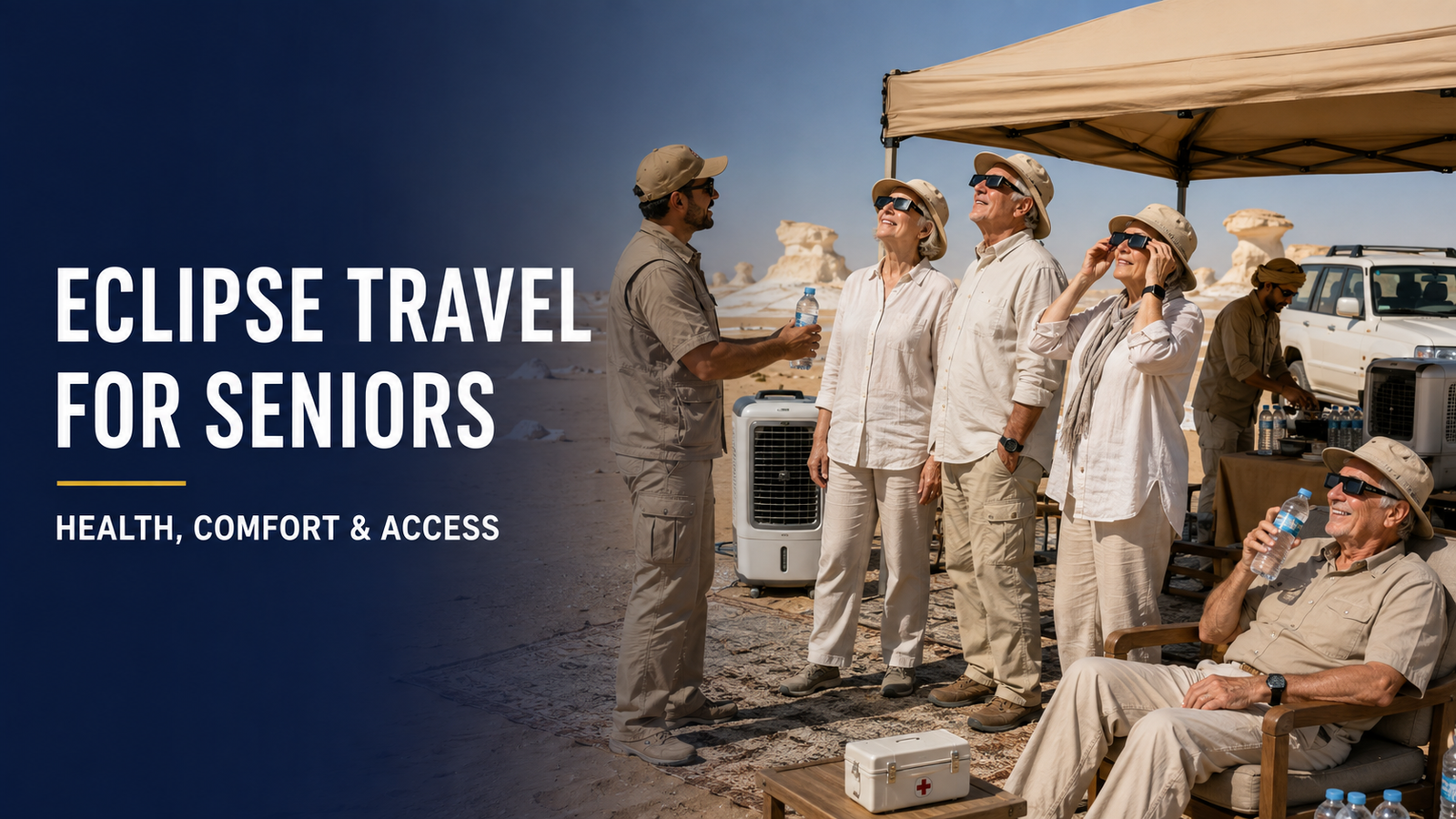
An eclipse trip for seniors can be an unforgettable way to experience the August 2, 2027 total solar eclipse in Egypt, but age, heat, mobility, medication needs and chronic health conditions deserve serious planning before a traveler commits to a remote desert program.
For many older travelers, the issue is not whether they are “too old” to see an eclipse. Healthy people in their 60s, 70s, 80s and beyond travel internationally every year. The more useful question is whether the specific itinerary, climate, transport, accommodation and medical backup match the individual traveler’s current health and functional needs.
That distinction matters in Egypt because the 2027 eclipse occurs in August, near midday, and some of the strongest viewing locations are in hot, remote environments. A traveler who manages heart disease, asthma, diabetes, kidney disease, reduced mobility or multiple medications may need more preparation than someone joining a mild-weather city break.
This guide is written for older adults, families traveling with an older parent, and travelers of any age who have chronic health conditions. It explains what to discuss with a clinician, what to ask an eclipse-tour operator, how to reduce heat exposure, how to plan medications and mobility, and why the right viewing-site design can make a major difference.
Can Seniors Travel to Egypt for the 2027 Total Solar Eclipse?
For many people, yes.
Chronological age alone does not determine whether someone can travel safely. A 75-year-old who walks regularly, manages medications reliably and tolerates heat may be a better candidate for a desert eclipse trip than a much younger traveler with unstable medical problems.
The decision should consider:
- Current medical stability.
- Heat tolerance.
- Walking ability.
- Balance.
- Ability to enter and exit vehicles.
- Need for mobility aids.
- Medication schedule.
- Refrigeration or storage requirements.
- Oxygen or respiratory equipment.
- Dietary needs.
- Sleep requirements.
- Ability to tolerate a several-hour road transfer.
- Access to toilets.
- Distance from medical care.
- Travel-insurance coverage.
- Whether the traveler is accompanied.
The right question is not, “Am I too old?”
It is, “Does this itinerary match my health and mobility needs?”
Why the 2027 Egypt Eclipse Requires More Planning Than a Normal Holiday
A conventional Egypt holiday can be designed around hotels, air-conditioned vehicles, early-morning sightseeing and long indoor rest periods.
The eclipse itself cannot be moved.
On August 2, 2027, the critical viewing period occurs around midday. That means some outdoor exposure is unavoidable if the traveler wants to experience totality.
A desert eclipse program can also involve:
- Remote roads.
- Limited nearby medical facilities.
- Uneven ground.
- Strong sunlight.
- High daytime temperatures.
- Long vehicle transfers.
- Crowded or busy event conditions.
- Standing or sitting outside for part of the eclipse.
- Changes in schedule because of weather, access or operational conditions.
For a healthy traveler, these may be manageable inconveniences.
For someone with reduced mobility, heart disease, respiratory disease, kidney disease, diabetes or medication sensitivity, each factor deserves a plan.
Older Adults and Heat: Why the Risk Is Different
WHO identifies older adults and people with chronic health conditions as groups that can be more vulnerable during extreme heat.
Heat places additional demand on the body’s cooling systems. The heart works harder to move blood toward the skin, sweating causes fluid and electrolyte loss, and prolonged exposure can contribute to dehydration and heat illness.
WHO notes that heat can worsen existing cardiovascular, respiratory, kidney, metabolic and other health problems.
This does not mean every older adult will become ill in hot weather.
It means that the margin for error can be smaller for some travelers.
A person who feels comfortable during the first 20 minutes outdoors may still accumulate heat stress after a longer period. That is why an eclipse program should be designed to reduce continuous exposure time, not simply offer water after someone feels unwell.
Step 1: Talk to a Healthcare Provider Before You Commit
CDC advises older adults and travelers with chronic illnesses to speak with a healthcare provider or travel-health specialist before travel, ideally several weeks in advance.
For the 2027 eclipse, the conversation should be specific.
Do not only say, “I am going to Egypt.”
Explain that the trip may include:
- August temperatures.
- A remote Western Desert viewing location.
- Several-hour road transfers.
- Time outdoors around midday.
- Uneven ground.
- Limited immediate medical facilities.
- International flights.
- A multi-day itinerary.
- Possible 4x4 transfers depending on the program.
Ask questions such as:
- Is my condition stable enough for this itinerary?
- Does heat increase my personal risk?
- Do any of my medicines affect sweating, blood pressure, hydration or heat tolerance?
- Do I have a fluid restriction?
- How should I store my medication during hot transfers?
- Do I need a written medical summary?
- Should I carry an updated medication list?
- Do I need additional prescriptions for the trip?
- What symptoms should make me stop outdoor activity?
- Is remote travel appropriate for me?
- Do I need compression stockings or other measures for long travel?
- What should I do if my normal medication schedule is disrupted by flights or time-zone changes?
- Do I need a plan for oxygen, insulin, injectable medicine or other equipment?
The clinician knows your health history. A travel article does not.
Step 2: Choose the Itinerary for Your Body, Not for the Longest Sightseeing List
A common travel mistake is buying the itinerary with the most activities because it appears to offer better value.
For an older traveler, a shorter and better-paced itinerary may deliver a better eclipse experience.
Look closely at:
- Daily departure times.
- Number of hotel changes.
- Long drives.
- Walking distances.
- Temple visits in midday heat.
- Number of desert activities.
- Check-in and check-out frequency.
- How much luggage handling is required.
- Whether there is recovery time before eclipse day.
- Whether the night before the eclipse is protected from late activities.
- Whether the post-eclipse schedule allows rest.
The eclipse is the non-repeatable part of the trip.
Do not arrive at eclipse morning exhausted because the previous two days were overloaded.
Step 3: Understand Exactly What “Accessible” Means
“Suitable for seniors” and “accessible” are not the same thing.
A trip may be comfortable for an active 70-year-old and unsuitable for a traveler who uses a wheelchair.
Ask specific questions.
Can a walker fit in the vehicle?
How high is the vehicle step?
Are there handholds?
Is assistance available when entering and exiting?
How far is the walk from the vehicle to the viewing area?
Is the surface sand, gravel, packed earth or pavement?
Are toilets level-access?
Are there steps into the camp?
Are chairs available?
Are chairs supportive, or are they low camping stools?
Can a traveler remain close to the vehicle?
Is there a cooled indoor or enclosed rest area?
Is there a private place to manage medication?
Can a mobility scooter be charged?
Is wheelchair access realistic on the actual surface?
Can a guest skip an activity without being separated from the group?
A useful operator answers in practical terms rather than saying, “No problem.”
Step 4: Treat Cooling as Medical Infrastructure, Not Luxury
For the 2027 eclipse, air conditioning and cooled rest space are not simply premium comforts.
For some guests they are risk-reduction tools.
WHO recommends reducing time in the heat and, when possible, spending time in a cool place during very hot conditions.
A well-designed eclipse operation should minimize the amount of time a vulnerable guest must remain continuously outdoors.
The ideal pattern is:
- Rest in a cooled environment.
- Move to shade near the observation field.
- Observe selected parts of the partial phase.
- Return to cooling when needed.
- Move outside in good time for totality.
- Return to cooling after the critical phase.
- Depart in a controlled sequence.
The confirmed Western Desert eclipse-camp region between the White Desert and the Black Desert, inside the path of totality should be evaluated on exactly these operational details.
Ask what is genuinely cooled.
A shaded tent, a fan and a climate-controlled room are not the same thing.
Step 5: Plan Hydration Around Your Medical Advice
Generic heat advice often says, “Drink more water.”
For many travelers that is appropriate.
For some people with heart failure, kidney disease or other medical conditions, fluid intake may need to be controlled.
That is why travelers with medical fluid restrictions should follow their clinician’s instructions rather than an internet target.
The practical travel plan should still include:
- Easy access to safe drinking water.
- A personal bottle.
- Frequent opportunities to drink if medically appropriate.
- Avoiding unnecessary alcohol.
- Meals that are compatible with medical and dietary needs.
- Awareness of symptoms such as dizziness, weakness or unusual fatigue.
Do not wait until you are thirsty and far from the camp to discover that your water is in another vehicle.
Read the full Egypt August desert heat safety guide for the general heat-management framework.
Step 6: Make a Medication Plan Before Leaving Home
Travelers who take regular medication should not rely on buying an identical product in Egypt after arrival.
CDC advises travelers with chronic illness to plan medications in advance.
A good system can include:
- Enough medication for the full trip plus a reasonable delay margin.
- Original labeled containers where practical.
- A written list of generic medication names.
- Dose and schedule information.
- Copies of relevant prescriptions.
- A medical summary for complex conditions.
- Emergency medications kept immediately accessible.
- Backup supplies separated from the main bag when appropriate.
- A plan for refrigeration or temperature-sensitive medication.
- Awareness of airline rules for liquids, syringes and medical devices.
Do not put every essential medication in checked luggage.
Do not leave medication in a hot parked vehicle.
Do not change your prescribed dose because you are worried about heat unless your clinician tells you to do so.
Step 7: Temperature-Sensitive Medicines Need Special Attention
Some medicines and medical products have defined storage ranges.
A desert vehicle, baggage compartment or uncooled tent can become much hotter than the air temperature shown in a weather forecast.
If you use insulin, injectable medicine or any product with temperature requirements, ask your pharmacist or clinician how it should be transported and stored.
Then ask the operator:
- Is refrigeration continuously available?
- Is it available during the Cairo-to-desert transfer?
- What happens if electricity fails?
- Is backup power available?
- Can medication remain with the traveler?
- Is there secure storage?
- Is there a clean area for injection or device management?
Never assume that the word “camp” includes medical refrigeration.
Get the answer before booking.
Step 8: Heart Conditions and August Heat
WHO and CDC both identify cardiovascular disease as a condition that can be aggravated by heat.
Heat can increase cardiovascular strain as the body tries to cool itself.
For a traveler with heart disease, the itinerary should reduce unnecessary exertion and prolonged direct sun exposure.
Useful planning questions include:
- Can I sit rather than stand during the partial phase?
- Can I rest in air conditioning close to the observation area?
- How far must I walk?
- Is there shade?
- Can the schedule be slowed down?
- Is emergency transport immediately available?
- How far is the nearest medical facility?
- Will staff know about my condition if I choose to disclose it?
- Can my companion remain with me?
A person with chest pain, severe shortness of breath, fainting or other alarming symptoms needs medical attention, not an argument about missing totality.
Step 9: Respiratory Conditions, Dust and Desert Air
Asthma and other respiratory conditions may be affected by heat, dry air, dust or exertion.
The desert can be clear and visually beautiful while still producing airborne dust.
Travelers with respiratory disease should have prescribed rescue medication accessible, not buried in luggage.
Before travel, ask your clinician about:
- Heat.
- Dry air.
- Dust exposure.
- Long transfers.
- Any need for a spacer, nebulizer or oxygen.
- What symptoms require urgent care.
Ask the operator whether the viewing area has:
- Dust shelter.
- Air-conditioned recovery space.
- Vehicle access.
- Electricity if medically required.
- A plan for strong wind or blowing dust.
If you rely on powered respiratory equipment, backup electricity becomes part of your medical planning.
Step 10: Diabetes Requires Heat, Meal and Medication Planning
Diabetes management may be affected by travel schedules, altered meals, activity and heat.
A traveler should discuss the trip with their healthcare provider and plan:
- Medication timing.
- Insulin storage if applicable.
- Glucose-monitor supplies.
- Backup batteries or charging.
- Snacks.
- Meal timing.
- Hydration.
- How to handle a delayed transfer.
- What to do if food intake changes.
- Where supplies will be stored during heat.
Do not assume the group’s meal timetable will perfectly match your normal routine.
Tell the operator about dietary or timing needs before travel when they materially affect participation.
Step 11: Kidney Disease and Fluid Restrictions Need Individual Advice
Heat increases fluid loss, but some people with kidney or heart conditions may have medical limits on fluid or electrolytes.
That creates a situation where generic “drink as much as possible” advice is inappropriate.
Discuss the climate and itinerary with your clinician.
Ask whether you need:
- A specific fluid plan.
- Electrolyte restrictions.
- Medication timing changes.
- Extra laboratory or medical review before travel.
- A lower-exertion itinerary.
The tour operator can provide water, shade and cooling.
Only your medical team should decide your personal fluid prescription.
Step 12: Mobility, Balance and Fall Risk
Eclipse travelers often focus on the sky and forget the ground.
That matters for people who have balance problems or reduced mobility.
Around totality, light levels fall rapidly. People may move suddenly. Tripods, bags and cables can create obstacles.
A safer field design should include:
- Clear walking lanes.
- Separated photography areas.
- Minimal loose cables.
- Stable seating.
- Lighting for pre-dawn or post-sunset movements when applicable.
- Staff awareness of guests who need assistance.
- No expectation that everyone must stand.
A traveler who uses a cane, walker or wheelchair should plan how mobility will work during the dark phase, not only during normal daylight.
Step 13: Hearing and Vision Needs Matter During a Timed Event
An eclipse is highly time-sensitive.
Safety instructions may be called out verbally:
“Glasses on.”
“Totality has begun.”
“Filters back on.”
A traveler with hearing loss should not rely on hearing a distant announcement in a crowd.
Ask for:
- A companion system.
- Visual timing cues.
- Written instructions.
- A seat near the briefing area.
- Staff awareness where appropriate.
Travelers with vision impairment may still enjoy the eclipse through environmental changes, temperature shifts, audio description and group reaction.
Accessibility should be discussed before the event so it can be planned rather than improvised.
Step 14: Eye Safety Rules Are the Same at Every Age
Being older does not change the fundamental solar-viewing rule.
During partial phases, direct viewing requires proper eclipse glasses or another safe solar-viewing method.
Ordinary sunglasses are not enough.
Binoculars, telescopes and camera lenses require appropriate front-mounted solar filters and should never be used simply through eclipse glasses.
During true totality, when the bright photosphere is completely covered, the unaided corona can be viewed directly. Protection must go back on as soon as the bright Sun returns.
If a traveler has had eye surgery or has an eye condition and has specific concerns, discuss them with an eye-care professional.
Read the safe eclipse glasses guide for detailed viewing instructions.
Step 15: Build a Companion Plan
For some travelers, the most important safety feature is not equipment.
It is another person.
A companion can help with:
- Medication reminders.
- Water.
- Walking.
- Vehicle entry.
- Communication.
- Hearing instructions.
- Recognizing confusion or unusual fatigue.
- Collecting belongings.
- Navigating the field as light changes.
- Communicating with staff in an emergency.
A couple traveling together should still decide who is responsible for what.
If both partners have mobility or health limitations, ask whether staff support is available.
Step 16: Know the Signs That Mean “Stop”
People often minimize symptoms because they do not want to miss a special event.
That is dangerous.
Possible heat-related warning signs can include:
- Dizziness.
- Headache.
- Weakness.
- Nausea.
- Unusual fatigue.
- Heavy sweating.
- Faintness.
- Muscle cramps.
- Confusion.
- Collapse.
Heatstroke is a medical emergency.
Confusion, altered behavior, seizure or loss of consciousness require urgent emergency response.
The correct rule is simple:
No phase of the eclipse is more important than the traveler’s health.
A person who becomes unwell should not be told to wait six more minutes for totality.
Step 17: Ask About the Medical Response Before Booking
“First aid available” is too vague.
Ask:
- Who has first-aid training?
- Is there a designated medical lead?
- What equipment is kept at the site?
- How will staff contact emergency services?
- Is mobile coverage expected?
- Is satellite communication available if needed?
- Which vehicle is available for evacuation?
- Can a vehicle leave without disrupting the whole group?
- How far is the nearest clinic or hospital?
- Is the route suitable for urgent transport?
- Are guest medical details available to authorized staff if voluntarily disclosed?
- What happens if a traveler cannot continue the desert portion?
The answers may change as final event operations develop.
The important thing is that the operator has a system rather than an assumption.
Step 18: Travel Insurance Matters More for a Remote Special-Event Trip
Comprehensive travel insurance is especially important for a high-value, fixed-date eclipse trip.
A suitable policy should be reviewed for:
- Emergency medical treatment.
- Medical evacuation.
- Trip cancellation.
- Trip interruption.
- Pre-existing-condition rules.
- Repatriation.
- Flight delay.
- Missed departure.
- Baggage and medical equipment.
- Special-event travel.
- Activities included in the itinerary.
Do not assume that a standard card benefit covers a remote desert trip or a pre-existing condition.
Read the policy wording.
If you have a chronic condition, disclose it when required by the insurer.
Step 19: Plan the International Flight, Not Only the Desert
The journey begins before Egypt.
Long airport walks, luggage, security queues, dehydration, disrupted sleep and long periods of sitting can create problems before the eclipse program starts.
Useful planning measures can include:
- Requesting airport assistance in advance.
- Choosing a seat based on mobility needs.
- Keeping medication in carry-on baggage.
- Carrying water after security where permitted.
- Allowing longer connection times.
- Avoiding an exhausting overnight arrival followed by immediate desert transfer.
- Booking at least one recovery night in Cairo when appropriate.
If you have personal risk factors related to long periods of sitting or blood clots, ask your clinician for individualized advice.
Do not self-prescribe medication for the flight.
Step 20: Arrive Early Enough to Recover
A traveler landing in Cairo shortly before the eclipse has multiple stressors at once:
- Jet lag.
- Heat.
- New food.
- Changed medication timing.
- Dehydration.
- Long transfers.
- Sleep disruption.
Arriving several days before the event can create useful margin.
It allows time to:
- Recover from the flight.
- Confirm medications and luggage arrived.
- Adjust gradually to the climate.
- Learn the group routine.
- Resolve accessibility problems before eclipse day.
- Rest.
For a fixed astronomical event, margin is valuable.
August 2 will not wait for a delayed flight.
Step 21: Protect the Night Before Totality
The evening before the eclipse should be calm.
Avoid building the itinerary around a late-night desert party, very long excursion or unnecessary transfer if the group includes older or medically vulnerable guests.
The priorities are:
- Dinner.
- Medication.
- Hydration according to medical advice.
- Equipment preparation.
- Eye-protection check.
- Good sleep.
- Clear briefing.
The goal is to arrive at eclipse morning with energy in reserve.
A Senior-Friendly Eclipse-Day Schedule
Exact timing will be calculated for the final astronomically verified point and shared with confirmed guests; the operational structure can be senior-friendly.
Morning
Eat breakfast.
Take medication as prescribed.
Confirm water, sun protection, eclipse glasses and mobility equipment.
Attend the briefing while seated.
Avoid unnecessary walking.
Before the Partial Phase
Move to the viewing field with plenty of time.
Choose a seat.
Identify toilets, shade, cooling, water and the medical contact point.
Do not wait until you need help to learn where these are.
During the Partial Phase
Use eclipse glasses for direct viewing.
Alternate short outdoor viewing periods with shade or cooling.
Remain seated if that is more comfortable.
Do not copy younger guests who choose to stand in direct sunlight for an hour.
Before Totality
Return to the field early enough to settle.
Use the toilet before the final minutes if needed.
Keep water, medication and mobility aid within reach.
Listen for safety instructions.
During Totality
Once totality is confirmed and the bright Sun is fully covered, enjoy the corona without eclipse glasses.
Remain seated if preferred.
There is no need to stand.
After Totality
Put eclipse glasses back on when bright sunlight returns.
Return to shade or cooling.
Hydrate according to your plan.
Do not rush to pack or board the vehicle.
A controlled departure is safer than a crowd moving at once.
How the Western Desert Camp Can Reduce Risk
A managed desert viewing field can be more appropriate than an improvised roadside stop because the environment can be organized around the event.
For older travelers, useful features include:
- Controlled guest capacity.
- Reserved seating.
- Shade.
- Nearby cooled recovery space where confirmed.
- Drinking water.
- Toilets.
- Vehicle access.
- Staff.
- First-aid planning.
- Power.
- Clear walking paths.
- A separated photography area.
- Time to set up before the event.
- A known departure plan.
The product should be described accurately as a confirmed Western Desert eclipse-camp region between the White Desert and the Black Desert, inside the path of totality.
The famous White Desert formations themselves should not automatically be presented as the totality field. The actual viewing coordinates need separate verification.
For the current program, review the Western Desert eclipse camp and eclipse tour packages.
Questions Seniors Should Ask Before Paying a Deposit
Use this checklist.
- How much walking is required each day?
- What is the longest drive?
- What type of vehicles are used?
- How high are the vehicle steps?
- Can a walker or wheelchair be carried?
- Are toilets available at the eclipse field?
- Are the toilets accessible?
- Is stable seating provided?
- Is there shade?
- What area is genuinely air-conditioned or cooled?
- How far is cooling from the viewing field?
- Is drinking water continuously available?
- Can medication be refrigerated if medically required?
- Is backup electricity available?
- What is the medical-response plan?
- Is emergency transport available?
- How far is the nearest medical facility?
- Can a guest skip an activity and remain in a comfortable place?
- Can dietary needs be accommodated?
- Is luggage assistance available?
- Can airport or hotel mobility assistance be arranged?
- What happens if a traveler cannot continue the desert program?
- Is there a single-room option if better sleep is important?
- Can a companion remain with the traveler throughout?
- Are final camp facilities already confirmed or still provisional?
Clear answers are more valuable than a generic “seniors welcome” label.
What to Pack for an Older or Medically Complex Traveler
The exact packing list depends on the person, but common items can include:
- Passport and visa documents.
- Travel-insurance documents.
- Medication list.
- Medical summary where useful.
- Prescriptions.
- Enough medication plus delay margin.
- Emergency medication.
- Medication storage equipment.
- Glucose monitor or other devices.
- Spare device batteries.
- Charging cables.
- Power bank where allowed.
- Mobility aid.
- Spare glasses or hearing-aid batteries.
- Wide-brimmed hat.
- Lightweight sun-protective clothing.
- Sunscreen.
- Normal sunglasses.
- Safe eclipse glasses.
- Refillable water bottle.
- Comfortable closed footwear.
- Small personal snack compatible with medical needs.
- Emergency contact information.
Keep critical items accessible.
Do not pack the only copy of essential medical information in a suitcase that could be delayed.
Common Mistakes Older Eclipse Travelers Should Avoid
Mistake 1: Assuming Age Is the Only Risk Factor
Health status, medication, mobility and heat tolerance matter more than the number on a passport.
Mistake 2: Booking Before Discussing the Itinerary With a Clinician
Show the clinician the real itinerary, not just the word “Egypt.”
Mistake 3: Assuming “Luxury Camp” Means Medical-Grade Comfort
Ask what cooling, toilets, power and accessibility actually mean.
Mistake 4: Carrying Too Little Medication
Fixed-date events are vulnerable to travel delays.
Mistake 5: Putting All Medication in Checked Baggage
Critical medication should remain accessible according to airline and medical guidance.
Mistake 6: Ignoring Heat Because the Air Is Dry
Dry heat can still cause dehydration and heat illness.
Mistake 7: Standing Outside Because Everyone Else Is Standing
Sit.
Shade and seating do not reduce the quality of totality.
Mistake 8: Hiding Important Medical Needs From the Operator
You do not need to share irrelevant private information, but the team cannot plan a necessary accommodation it does not know about.
Mistake 9: Assuming the Desert Has Instant Hospital Access
Remote travel requires an evacuation plan.
Mistake 10: Overloading the Days Before the Eclipse
Protect your energy for the non-repeatable event.
Traveling With a Parent: A Family Checklist
Adult children often organize eclipse trips for parents.
Do not assume that because your parent traveled independently five years ago, nothing has changed.
Before booking, discuss:
- Walking.
- Stairs.
- Vehicle entry.
- Heat.
- Hearing.
- Vision.
- Medication.
- Sleep.
- Toilets.
- Diet.
- Travel insurance.
- Emergency preferences.
- Who carries medical information.
- Who speaks with staff if help is needed.
Respect the older traveler’s independence.
The goal is not to take control unnecessarily. It is to remove preventable friction.
When a Remote Desert Eclipse May Not Be the Right Choice
A desert totality trip is not automatically suitable for every traveler.
A clinician may advise against it when a condition is unstable or when the traveler cannot safely tolerate the environment.
Operational limitations can also make the trip inappropriate if required support cannot be provided.
Examples of needs that require careful confirmation include:
- Continuous medical oxygen.
- Complex powered medical equipment.
- Frequent urgent medical treatment.
- Severe mobility limitations in an inaccessible field.
- Unstable heart or respiratory disease.
- High risk from heat exposure.
- Medication requiring storage conditions the operator cannot guarantee.
There may be other ways to experience the eclipse from more conventional infrastructure.
The correct choice is the one that fits the traveler.
Frequently Asked Questions
Is 70 too old for a 2027 eclipse trip to Egypt?
No fixed age automatically makes someone too old. Health, mobility, heat tolerance and the itinerary matter more. Discuss your personal situation with a clinician and ask the operator practical questions about the field and transport.
Can someone in their 80s see the eclipse in Egypt?
Potentially, yes. Older eclipse chasers travel internationally, but individual suitability varies. An 80-year-old with stable health and good mobility may travel comfortably, while another person may need a more supported program.
Is the Western Desert safe for seniors in August?
August heat is a serious operational issue. The trip should include shade, cooling, water, reliable transport, staff support and a medical-response plan. A normal winter safari should not simply be reused unchanged.
Is air conditioning necessary?
For some travelers it may be very important. A cooled recovery space close to the viewing field reduces prolonged heat exposure. Ask exactly which spaces are air-conditioned and how many guests they can accommodate.
What if I have heart disease?
Discuss the trip with your clinician before booking. Heat can increase cardiovascular stress. Plan for cooling, shade, reduced exertion, seating and rapid access to transport.
Can I travel with asthma?
Many people with asthma travel successfully, but heat, dust and dry air may affect symptoms. Carry prescribed medication and discuss the itinerary with your clinician.
Can I travel with diabetes?
Potentially, but medication, meals, heat and storage need planning. Discuss the trip with your medical team and confirm any refrigeration or meal-timing requirements with the operator.
What if I need to limit fluids?
Follow your clinician’s advice. Do not use a generic online hydration target if you have a medical fluid restriction.
Can medication be kept in the camp refrigerator?
Do not assume so. Ask the operator what refrigeration is available, whether backup power exists and whether temperature-sensitive medication can be stored safely.
Are wheelchairs suitable for a desert eclipse field?
It depends on the exact terrain and facilities. Sand, gravel and uneven ground can be difficult. Ask for specific surface, distance and toilet-access information.
Can I remain seated during totality?
Yes. Standing provides no astronomical advantage. A stable chair may be the best option.
Do seniors need special eclipse glasses?
The same eye-safety rules apply to adults of all ages. Use safe eclipse viewers during partial phases. If you have specific eye conditions, discuss concerns with an eye-care professional.
Is medical care available in the desert?
Medical facilities are more limited than in Cairo or other major cities. Ask the operator about first aid, communication, evacuation vehicles and the nearest appropriate facility.
Should I buy travel insurance?
Comprehensive insurance is strongly recommended. Review medical, evacuation, cancellation and pre-existing-condition provisions carefully.
Should I arrive before eclipse week?
Arriving several days early can reduce travel stress and give time to recover from flights and adjust to the climate.
What is the most important thing to ask the tour company?
Ask how the program handles heat, cooling, mobility and medical escalation for your specific needs.
Final Takeaway
An eclipse trip for seniors is not about proving endurance.
It is about designing the experience so that the traveler can safely enjoy the part that matters.
For the August 2, 2027 total solar eclipse in Egypt, that means planning around heat, mobility, medication, transport and remote-site logistics before booking.
Start with a clinician who understands your health.
Then choose an operator that can answer detailed questions.
The strongest program for an older or medically vulnerable traveler is one that minimizes unnecessary outdoor exposure, provides shade and cooling, keeps the viewing field close to vehicles and rest areas, offers seating and water, has clear staff responsibilities, plans for emergency transport and allows guests to skip non-essential activities without losing the eclipse experience.
For the broader climate plan, read How to Prepare for Egypt’s August Desert Heat. For the viewing setup, review the confirmed Western Desert eclipse-camp region between the White Desert and the Black Desert, inside the path of totality, compare the 2027 eclipse packages and check availability.
Sources
Recheck current medical and travel guidance shortly before travel, especially if health needs, entry rules or local conditions change.
- CDC: Older Adults and Healthy Travel
- CDC: Travelers with Chronic Illnesses
- CDC: Heat Illnesses for Travelers
- CDC: Egypt Traveler View
- WHO: Heat and Health
- WHO: Heatwaves — How to Stay Cool
This article provides general information only and does not replace advice from a physician, pharmacist, travel-health specialist, insurer or emergency professional.