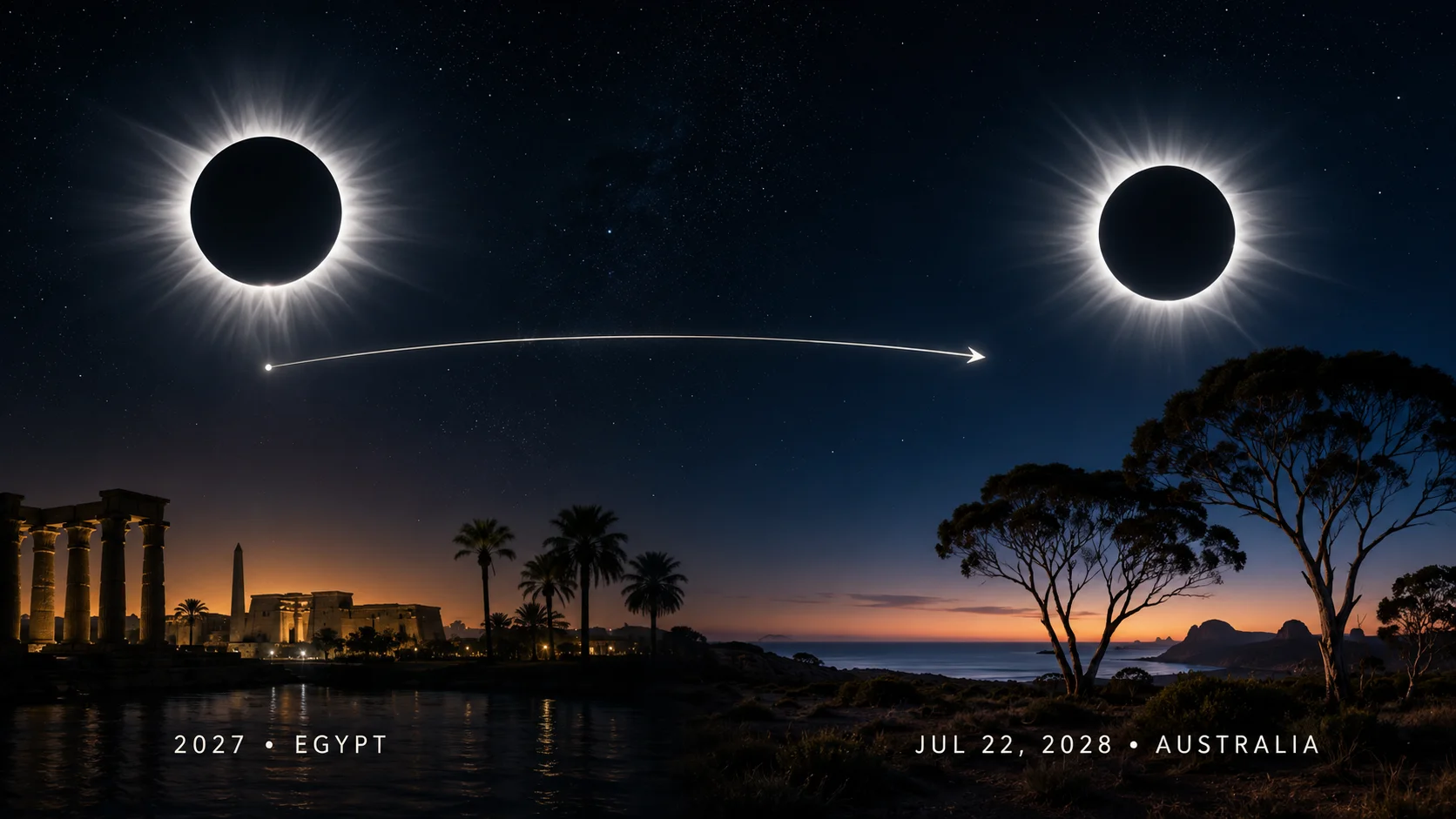
next total solar eclipse after 2027: quick answer
next total solar eclipse after 2027: The next total solar eclipse after 2027 occurs on July 22, 2028. Its path of totality crosses parts of the Indian Ocean, Southeast Asia, Australia and New Zealand, and the maximum total phase reaches approximately 5 minutes 10 seconds according to NASA’s
The next total solar eclipse after 2027 occurs on July 22, 2028. Its path of totality crosses parts of the Indian Ocean, Southeast Asia, Australia and New Zealand, and the maximum total phase reaches approximately 5 minutes 10 seconds according to NASA’s eclipse catalog.
That makes the 2028 eclipse the immediate global successor to the extraordinary August 2, 2027 event. However, it will not be visible from Egypt as a total eclipse. Travelers in Egypt who want to experience totality again without crossing the world will have another important opportunity on March 20, 2034, when a total solar eclipse crosses parts of Africa, the Middle East and Asia, including Egypt. Its maximum duration will be about 4 minutes 9 seconds.
The 2027 eclipse remains exceptional because its maximum totality reaches about 6 minutes 23 seconds, significantly longer than the total eclipses that follow it for many decades. It is not the final total solar eclipse of the century, nor the final one visible from Egypt. It is simply one of the longest and most favorable total eclipses of the modern era.
This guide explains the major total solar eclipses after 2027, where they will be visible, how their durations compare and why the phrase “next eclipse” must always be defined carefully.
Quick Answer
- Next total solar eclipse globally after August 2, 2027: July 22, 2028.
- Maximum totality in 2028: about 5 minutes 10 seconds.
- Next total solar eclipse after that: November 25, 2030.
- Next total solar eclipse visible from Egypt after 2027: March 20, 2034.
- Maximum totality in 2034: about 4 minutes 9 seconds.
- Next total eclipse longer than the 2027 event: June 3, 2114, based on NASA’s long-range catalog.
- Does every country in the visibility region see totality? No. Only locations inside the narrow path of totality do.
Timeline of Major Total Solar Eclipses After 2027
| Date | Eclipse type | Maximum central duration | Main totality regions | Egypt totality? |
|---|---|---|---|---|
| July 22, 2028 | Total | About 5m 10s | Southeast Asia, Australia, New Zealand, Indian and Pacific Ocean regions | No |
| November 25, 2030 | Total | About 3m 44s | Southern Africa, Indian Ocean, Australia and nearby regions | No |
| November 14, 2031 | Hybrid | About 1m 08s | Pacific and Panama region | No |
| March 30, 2033 | Total | About 2m 37s | Eastern Russia and Alaska | No |
| March 20, 2034 | Total | About 4m 09s | Africa, the Middle East and Asia, including Egypt | Yes, in the path |
| September 2, 2035 | Total | About 2m 54s | China, Korea, Japan and Pacific regions | No |
| July 13, 2037 | Total | About 3m 58s | Indonesia, Australia, New Zealand and the Pacific | No |
| December 26, 2038 | Total | About 2m 18s | Australia, New Zealand, Southeast Asia and Pacific regions | No |
| December 15, 2039 | Total | About 1m 51s | Southern South America and Antarctica | No |
| April 30, 2041 | Total | About 1m 51s | Atlantic, western Africa and central Africa | Check exact local visibility |
The table uses the maximum central duration listed in NASA GSFC catalogs. The duration at a real viewing site may be shorter.
What Does “The Next Total Solar Eclipse” Mean?
The question sounds simple, but it can mean several different things.
The Next Total Eclipse Anywhere on Earth
This is the first future date when the Moon’s umbra reaches Earth and creates a path of totality somewhere on the planet. After August 2, 2027, that date is July 22, 2028.
The Next Total Eclipse Visible from Your Country
A total solar eclipse can occur globally while your country sees only a partial eclipse or no eclipse at all. For Egypt, the next total event after 2027 is March 20, 2034, not July 2028.
The Next Total Eclipse Visible from Your City
Even if a path crosses a country, it may miss a particular city. Exact coordinates determine whether the Sun becomes fully covered.
The Next Central Solar Eclipse
A central eclipse can be total, annular or hybrid. The January 26, 2028 eclipse is annular, so it occurs before the July 2028 total eclipse but does not produce totality.
The Next Eclipse Longer Than 2027
This is a different question. Several total eclipses occur after 2027, but their maximum durations are shorter. NASA’s long-range catalog indicates that a total eclipse on June 3, 2114 will exceed the duration of the 2027 event.
These distinctions prevent misleading claims. Saying “there will not be another eclipse for decades” is incorrect. Saying “there will not be another total eclipse this long until 2114” is much closer to the scientifically meaningful comparison, provided the wording is checked against the latest NASA catalog.
July 22, 2028: The Immediate Next Total Solar Eclipse
The first total solar eclipse after 2027 occurs on July 22, 2028.
NASA lists a maximum central duration of approximately 5 minutes 10 seconds. This is shorter than the 2027 maximum, but it remains a very long total eclipse by modern standards.
The broad path reaches regions associated with Southeast Asia, Australia, New Zealand and surrounding ocean areas. The exact route should be studied on NASA’s path map before anyone chooses a destination.
Why 2028 Is Important
The 2028 eclipse offers several attractions:
- Totality longer than five minutes at the most favorable part of the path.
- A route through parts of Australia and New Zealand with established tourism infrastructure.
- Multiple landscape options.
- Potential opportunities for experienced eclipse travelers who attended Egypt in 2027.
- A different season and solar altitude from Egypt’s August event.
Why It Is Not a Replacement for Egypt 2027
The two events differ in timing, geography and atmosphere.
The 2027 eclipse crosses North Africa and the Middle East and reaches a maximum of about 6 minutes 23 seconds. The 2028 eclipse follows less than a year later but peaks around 5 minutes 10 seconds.
A traveler may prefer 2028 for personal, geographic or weather reasons. However, someone who postpones 2027 under the assumption that an equivalent event is available the next year should understand that the 2028 maximum is more than one minute shorter.
Travel Planning for 2028
A reliable plan should investigate:
- Exact totality path.
- Season and historical cloud patterns.
- Local road access.
- Accommodation capacity.
- Coastal or inland weather differences.
- Visa and entry rules.
- Medical and insurance arrangements.
- Solar altitude.
- Totality duration at the selected coordinate.
- Mobility between alternate sites.
The same principles used for Egypt apply globally. A famous city near the path is not necessarily the best observing location.
November 25, 2030: Southern Africa and Australia
The next total eclipse after July 2028 occurs on November 25, 2030.
NASA lists a maximum totality of approximately 3 minutes 44 seconds. The path crosses parts of southern Africa, the Indian Ocean and Australia.
The totality route includes Botswana, South Africa and Australia in NASA’s geographic summary.
What Makes 2030 Different?
The 2030 eclipse is shorter than both 2027 and 2028, but three minutes and forty-four seconds is still substantial.
Potential advantages may include:
- Southern African landscapes.
- Established safari and tourism destinations.
- Australian viewing options.
- A different seasonal and meteorological context.
- Opportunities to combine astronomy with wildlife or nature travel.
Potential challenges depend on the final site and may include long road transfers, remote accommodation, seasonal storms, crowd concentration or limited mobility.
Duration Comparison
- 2027 maximum: about 6m 23s.
- 2028 maximum: about 5m 10s.
- 2030 maximum: about 3m 44s.
A 2030 traveler receives about two minutes and thirty-nine seconds less maximum totality than the 2027 observer at greatest duration.
That does not make 2030 unimportant. Eclipse quality is not measured only in seconds. Weather, landscape, group organization and the emotional experience matter.
November 14, 2031: A Hybrid Eclipse
The November 14, 2031 event is classified as a hybrid solar eclipse, not a purely total eclipse across its entire central path.
A hybrid eclipse changes between annular and total along different parts of the route because the Moon’s central shadow is near the threshold of reaching Earth’s curved surface.
NASA lists a central duration of approximately 1 minute 8 seconds.
The central path is associated with the Pacific and Panama region.
Should It Be Included in a “Next Total Eclipses” List?
Yes, but it must be labeled correctly.
Observers in the total portion of a hybrid path can experience totality. Observers in the annular portion see a ring of sunlight and must keep solar protection on throughout.
A travel article that simply calls the entire 2031 event “total” would be inaccurate.
March 30, 2033: Alaska and Eastern Russia
The total solar eclipse of March 30, 2033 reaches a maximum duration of approximately 2 minutes 37 seconds.
NASA identifies totality in eastern Russia and Alaska.
This event may appeal to travelers seeking an Arctic or sub-Arctic eclipse environment. It differs sharply from Egypt in temperature, clothing, access, solar altitude and weather risks.
Planning Characteristics
Possible issues include:
- Cold-weather exposure.
- Snow or ice.
- Remote settlements.
- Limited road networks.
- Aircraft dependence.
- Low solar altitude at some locations.
- Cloud and wind.
- Specialized clothing and equipment.
An eclipse does not become operationally easier because the air is cool. Cold can affect batteries, vehicles and guests just as heat can.
March 20, 2034: The Next Total Solar Eclipse in Egypt
For Egypt, the most important post-2027 date is March 20, 2034.
NASA’s catalog lists a total solar eclipse with maximum duration of approximately 4 minutes 9 seconds. The path crosses parts of Africa, Europe and western Asia, with totality passing through countries including Nigeria, Cameroon, Chad, Sudan, Egypt, Saudi Arabia, Iran, Afghanistan, Pakistan, India and China.
This means Egypt receives another total eclipse less than seven years after the 2027 event.
Why 2034 Does Not Reduce the Importance of 2027
The 2034 event is significant, but it is not identical.
- Its maximum totality is about 2 minutes 14 seconds shorter than 2027.
- It occurs in March rather than August.
- Its path crosses a different part of Egypt.
- Solar altitude and local weather will differ.
- The best viewing regions and travel routes will be different.
- The tourism product will require a separate site analysis.
The existence of 2034 should be communicated honestly. Attempting to hide it would weaken trust. The stronger message is that 2027 offers an exceptionally long event, while 2034 gives Egypt another important but shorter total eclipse.
Where in Egypt Will 2034 Be Total?
The broad NASA summary confirms that the path crosses Egypt, but a responsible site should not publish city claims without reviewing the detailed path map.
Exact questions include:
- Which governorates are inside totality?
- What is the duration in each candidate location?
- What is the Sun’s altitude and azimuth?
- What are the historical March weather patterns?
- Which roads and hotels are practical?
- Is a desert or Nile location more favorable?
- How close is the site to the centerline?
The answer will not be the same as the 2027 site plan.
Potential Advantages of March 2034
Compared with August 2027, March may provide more comfortable temperatures in many Egyptian regions.
That can reduce:
- Heat stress.
- Cooling requirements.
- High-temperature equipment problems.
- The need for extensive midday air conditioning.
However, March can introduce other factors:
- Wind.
- Dust.
- Seasonal haze.
- Cloud variability.
- Different daylight and solar-altitude conditions.
A cooler month is not automatically a clearer month.
September 2, 2035: East Asia and the Pacific
The September 2, 2035 total eclipse has a maximum duration of approximately 2 minutes 54 seconds.
NASA’s summary identifies totality in China, Korea, Japan and Pacific regions.
This event is likely to attract substantial international interest because its path reaches major population centers and highly developed transport networks.
Possible benefits include:
- Rail and airport infrastructure.
- Large accommodation markets.
- Strong astronomy communities.
- Urban and rural viewing options.
Possible challenges include:
- Population density.
- Competition for rooms.
- Public-site crowding.
- Seasonal weather.
- Limited mobility in congested areas.
July 13, 2037: Australia and the Pacific
The July 13, 2037 total eclipse reaches a maximum of approximately 3 minutes 58 seconds.
NASA identifies totality in regions including Indonesia, Australia, New Zealand and the Pacific.
This is one of the longer total eclipses of the 2030s, though still well below the 2027 maximum.
For eclipse travelers, it may offer:
- Tropical and subtropical location options.
- Australian infrastructure.
- Island or coastal environments.
- Different corona and sky conditions.
The challenges may include monsoon patterns, tropical cloud, remote island logistics or expensive internal travel.
December 26, 2038: Australia and New Zealand
The December 26, 2038 total eclipse reaches a maximum duration of approximately 2 minutes 18 seconds.
Its path includes parts of Australia, New Zealand, Southeast Asia, the Pacific and nearby regions.
Because it occurs immediately after Christmas, travel demand and pricing may be major practical issues.
The date can affect:
- International flight availability.
- Holiday accommodation prices.
- Staff availability.
- Family travel schedules.
- Road congestion.
- Cancellation policies.
Astronomy is predictable; holiday travel markets are not.
December 15, 2039: Southern South America and Antarctica
The total eclipse of December 15, 2039 reaches a maximum duration of approximately 1 minute 51 seconds.
NASA’s summary places totality in southern South America and Antarctica.
This can become an expedition-style eclipse, particularly for Antarctic routes.
Potential requirements include:
- Specialized ships or aircraft.
- High travel cost.
- Strong weather uncertainty.
- Cold-weather equipment.
- Medical screening.
- Limited mobility.
- Strict environmental regulation.
A short totality can still justify an expedition for dedicated eclipse chasers, but travelers must understand the cost-to-duration tradeoff.
April 30, 2041: A Shorter African Total Eclipse
The April 30, 2041 eclipse is another total event in NASA’s central-eclipse catalog, with a maximum duration of approximately 1 minute 51 seconds.
Its route crosses Atlantic and African regions. Detailed path analysis is required before claiming visibility from a specific country or city.
This event illustrates an important point: Africa will host multiple total eclipses after 2027, but their paths, seasons and durations differ dramatically. “An eclipse in Africa” is not a substitute for the 2027 Egypt experience.
Why the 2027 Eclipse Remains Exceptional
A list of future eclipses can make them look interchangeable. They are not.
The 2027 eclipse combines several unusual features:
- Maximum totality of about 6 minutes 23 seconds.
- A wide path.
- A very high Sun near greatest eclipse.
- A route through accessible tourism countries.
- A path across Egypt.
- Desert and Nile landscape options.
- Strong cultural and historical appeal.
- Multiple possible viewing regions.
The next eclipse in 2028 is long, but shorter. The 2030 event is shorter again. Egypt’s 2034 event is important, but its maximum is around four minutes.
The real advantage of 2027 is not that no total eclipse follows it. The advantage is that few later events offer the same combination of duration, geography and travel appeal.
How Often Do Total Solar Eclipses Occur?
Globally, total solar eclipses are not extremely rare. A total eclipse occurs somewhere on Earth roughly every 18 months on average, though the intervals are irregular.
For a specific location, totality is rare because the path is narrow.
A city may wait centuries between total eclipses. A country with a large land area may receive them more often, but the path usually crosses only part of the country.
This explains why the phrase “once in a lifetime” can be both useful and misleading.
- Globally, another total eclipse comes relatively soon.
- For one city or a convenient travel region, the opportunity may be very rare.
- An eclipse with more than six minutes of totality is much rarer than an ordinary total eclipse.
The more precise phrase for 2027 is “an exceptionally long total solar eclipse and a rare opportunity to experience more than six minutes of totality in Egypt.”
Why Totality Duration Changes from Eclipse to Eclipse
Several factors determine duration.
Moon-Earth Distance
The Moon’s orbit is elliptical. A closer Moon appears larger and can cover the Sun for longer.
Earth-Sun Distance
Earth’s distance from the Sun changes. A slightly smaller apparent Sun is easier for the Moon to cover.
Shadow Speed
The Moon’s shadow moves at different speeds across Earth depending on the geometry.
Earth’s Curvature
A central path near favorable latitudes can produce longer durations.
Position Within the Path
Locations near the centerline generally receive longer totality than those near the limits.
Position Along the Global Route
The maximum duration normally occurs near one part of the path. Other countries may receive less.
This is why comparing only eclipse dates is incomplete. A four-minute eclipse at one location may offer two minutes elsewhere.
Does a Longer Eclipse Always Mean a Better Trip?
No.
Duration is important, but a successful eclipse journey also depends on:
- Weather prospects.
- Exact path position.
- Open horizon.
- Road access.
- Accommodation.
- Safety.
- Group size.
- Crowd management.
- Medical support.
- Local knowledge.
- Honest communication.
- Photography space.
- A backup strategy.
A five-minute eclipse behind cloud can be less rewarding than a two-minute eclipse under a clear sky. No operator can guarantee weather, but careful site selection can improve the odds.
Should You Wait for the 2028 Eclipse Instead of Traveling to Egypt in 2027?
That depends on personal circumstances.
Reasons to choose 2027 may include:
- Longer maximum totality.
- Interest in Egypt.
- Western Desert or Nile landscapes.
- A multi-day cultural journey.
- A desire to experience one of the century’s standout eclipses.
Reasons to prefer 2028 may include:
- Proximity to Australia or New Zealand.
- Personal travel restrictions.
- Better seasonal fit.
- Family or work timing.
- A preference for the destination.
The decision should not be based on the false idea that 2028 is identical. It is another excellent eclipse with a different path and a shorter maximum duration.
Should You Wait for Egypt 2034?
Travelers specifically interested in Egypt may ask whether they can skip 2027 and attend 2034.
The answer depends on what they value.
2034 offers:
- Another Egyptian total eclipse.
- A cooler month.
- A different route.
- Maximum totality of about 4 minutes 9 seconds.
2027 offers:
- More than six minutes at maximum.
- A very high Sun.
- A different path across Egypt.
- A larger duration advantage for photographers and first-time viewers.
- A Western Desert and White Desert travel concept.
The events should not compete through misleading marketing. They are two separate opportunities.
How to Choose a Future Eclipse Destination
A practical evaluation can score each candidate from one to five on:
| Factor | Question |
|---|---|
| Totality | How long is totality at the exact coordinate? |
| Weather | What do long-term cloud and transparency data suggest? |
| Mobility | Can the group move to an alternate site safely? |
| Access | Are roads, airports and transfers reliable? |
| Accommodation | Is there enough capacity and cooling or heating? |
| Health | Can the location manage heat, cold, altitude or remoteness? |
| Legal access | Are permits and land-use rights confirmed? |
| Photography | Is the Sun accessible from a stable and open field? |
| Operator quality | Are identity, terms and logistics transparent? |
| Destination value | Would the trip still be worthwhile if cloud blocks the Sun? |
The final question is especially important. Weather risk is unavoidable, so the surrounding journey should have genuine value.
Common Myths About Future Eclipses
“The 2027 Eclipse Is the Last Total Eclipse for Decades”
False. The next total eclipse occurs in July 2028.
“The Next Eclipse After 2027 Is Annular”
An annular eclipse occurs in January 2028, but the next total eclipse is July 2028.
“Egypt Will Not See Another Total Eclipse After 2027”
False. NASA’s catalog shows another total eclipse crossing Egypt on March 20, 2034.
“The 2034 Egypt Eclipse Will Be Just as Long”
False. Its maximum is about 4 minutes 9 seconds, compared with about 6 minutes 23 seconds in 2027.
“Every Future Total Eclipse Lasts Several Minutes”
False. Some total eclipses last less than two minutes at maximum.
“A Total Eclipse Occurs at Every Place Inside the Country Named by NASA”
False. NASA’s geographic summary means the path crosses part of the country. Exact coordinates still determine local totality.
“You Can Decide Later Because Eclipse Trips Are Easy to Organize”
Not always. Flights, hotels, camps, permits and specialist guides can become constrained well before the event.
Frequently Asked Questions
What Is the Next Total Solar Eclipse After August 2, 2027?
July 22, 2028.
Where Will the 2028 Total Eclipse Be Visible?
The totality path crosses parts of Southeast Asia, Australia, New Zealand and surrounding ocean regions. Exact destinations should be checked on NASA’s path map.
How Long Will Totality Last in 2028?
The maximum central duration is about 5 minutes 10 seconds.
What Is the Next Total Eclipse After 2028?
November 25, 2030, with maximum totality of about 3 minutes 44 seconds.
Is There a Total Eclipse in 2031?
The November 14, 2031 eclipse is hybrid. Some central-path locations see totality and others see annularity.
When Is the Next Total Eclipse in Egypt After 2027?
March 20, 2034.
How Long Will the 2034 Egypt Eclipse Last?
The maximum global duration is about 4 minutes 9 seconds. Local Egyptian duration depends on exact coordinates.
Is the 2034 Eclipse Longer Than 2027?
No. It is more than two minutes shorter at maximum.
When Will a Total Eclipse Longer Than 2027 Occur?
NASA’s long-range catalog indicates June 3, 2114 as the next total eclipse with a longer maximum duration.
Do Total Eclipses Happen Every Year?
Not necessarily. They occur somewhere on Earth roughly every 18 months on average, but the interval varies.
Can I See the 2028 Total Eclipse from Egypt?
Not as totality. Egypt is not inside the 2028 path of totality.
Will Future Eclipse Dates Change?
The dates are predictable. Detailed local contact times and path edges can be refined through improved models, lunar-limb data and Earth-rotation predictions.
Should I Book an Eclipse Trip Years in Advance?
High-demand destinations can fill early. Before paying, verify the operator, exact viewing plan, cancellation terms, payment protection and included services.
Can an Operator Guarantee Visibility?
No. An operator can select a verified path location and prepare logistics, but cannot guarantee clear weather.
Final Takeaway
The next total solar eclipse after the August 2, 2027 event occurs on July 22, 2028 and can reach about 5 minutes 10 seconds of totality.
The next total eclipse visible from Egypt occurs on March 20, 2034 and reaches a maximum of about 4 minutes 9 seconds.
These future events are important, but they do not duplicate 2027. The 2027 eclipse remains exceptional for its maximum duration of about 6 minutes 23 seconds, its path across Egypt and its combination of high Sun, broad path and powerful desert and cultural settings.
Explore the 2027 Egypt eclipse packages or check current availability.
Authoritative planning reference
Use NASA 2027 eclipse path data as a primary reference, then verify local circumstances for the exact location.